The EU will have to surrender to survive
The European Union is in danger of being crushed by the current economic and democratic crises unless Brussels starts to give power back to the member states, says Gisela Stuart.
I grew up in Bavaria, where the European Union and Nato were simply part of my political landscape. I had first-hand experience of the freedom of movement of labour when I came to Britain in the 1970s. In 1994 I was a candidate in the European elections. I couldn't fathom why there was such scepticism in this country about "Europe".
I have gradually changed my mind. The EU cannot continue with its current structure. Politicians can no longer rely on the electorate's implied consent or promote deeper political integration by stealth without making the institutions accountable. Trying to create political union, let alone any European identity, from above undermines any tendency for one to grow naturally; and to establish monetary union – now in so much difficulty – without political union was asking for trouble.
For almost two years I was Parliament's representative in Brussels on something called the Convention on the Future of Europe, which was set up by the governments of member states to devise a blueprint to modernise the institutions of the EU, and in particular to make them more accountable to voters. The institutional arrangement of the EU had been formed in very different circumstances: the model that was appropriate with six members in 1957 needed to be brought up to date.
The Convention failed. The old gang, led by the former French president Valéry Giscard d'Estaing, got their way. We ended up with a botched compromise which was first called a constitution and has now been rechristened the Treaty of Lisbon. The people of France and the Netherlands voted "no" to the constitution, but their parliaments voted it through anyway. The Irish also said "no", but will be told to vote again until they give the "right result". "No" means "yes" and the EU carries on regardless: the direction of travel is always to give more power to the union and less to the member states.
So what has gone wrong with a project that had aspired to so much? It started with clear aims, including a single market, free movement of workers and capital and an all-encompassing "solidarity" between member states. The current crisis has exposed the limits of this – President Sarkozy protects the French car industry even if it damages the Czech economy. Germany is offering credit exports and wage support for its workers. Britain demands British jobs for British workers.
Over the decades more countries joined, accompanied by further integration – powers handed to the union were never returned. Those who challenged this were dismissed as eurosceptics, isolationist little Englanders or worse.
More and more laws are made or originate in the EU. The introduction of direct elections to the European Parliament might have resulted in a direct relationship with voters, but it didn't work out like that. The decision making is so slow and opaque that no one knows who is responsible for what. In the European elections in June, voters will have a ballot paper which does not allow them to choose any candidates, but instead presents them with a list bearing the labels of national political parties. Just how difficult it is to work out what line they will take once elected is best illustrated by the fact that Conservative MEPs will sit and vote with the European People's Party – the most federalist and integrationist group in Brussels.
Of course there are problems we can only solve collectively at European level, but it is important to distinguish between more co-operation and more integration and "common" policies. These have a bad record: just look at the Common Agricultural Policy.
The single currency is not helping economies in the way its proponents said it would. It has led to economic divergence rather than convergence, reflected in the dire state of Spain, Ireland, Greece and Portugal today. One option for these countries is to leave the EMU. This can't be ruled out, but it would create problems for both the country leaving and, perhaps more importantly, those remaining, so some short term fix may be cobbled together.
The problem is that within EMU, the only way for these countries to regain competitiveness is to squeeze their economies so that the rate of inflation not only falls below the eurozone average, but also stays there for a long time, to make up lost ground. This would not be an easy task at the best of times, but when average inflation is already low, it implies actual deflation. I doubt that this would be politically sustainable.
The EMU is presented as a "zone of stability" because its participants have avoided the crises that might have affected separate national currencies. This may be true for some countries, but abandoning individual currencies simply transfers the problem elsewhere; if some of the patients are sick, throwing away the thermometer doesn't constitute a cure. Credit risk replaces currency risk: the markets now wonder whether some countries will default.
Unless there is a major devaluation of the euro (which at some stage would cause inflation to rise in Germany) the only way to rescue countries in the EMU that are in trouble would be a large and continuing transfer of resources from other countries in the system, in practice Germany. A one-off bail-out won't work. The German taxpayer was prepared to pay for reunification with East Germany; but I can't imagine the country's government stepping forward now, particularly with elections coming in September.
Europe is in crisis and many of the critical comments which used to be so typically British can now be heard elsewhere. The traditional response to crisis in the EU is "more Europe" – to force through integration that would not previously have been tolerated. This may happen again, but proponents of further integration and political union are playing with fire.
Europeans will never view the union as the citizens of California and Texas see the American union. Without this, political union in Europe is impossible. If the potential benefits of co-operation between Europe's nation states are to be realised, the EU needs to be closer to the vision of the former West German chancellor Ludwig Erhard, a fellow native of Bavaria: a commitment to free trade, but otherwise much less power to the union and much more for member states.
Gisela Stuart is Labour MP for Birmingham Edgbaston

A mixture of law, politics, autobiography and humour. Once described as "The Devilish Advocate" (Guardian), I do have the ability to provoke a response. Sometimes it comes from someone who uses a thought process, and sometimes from jerks usually associated with the knee.
Site Meter

Monday, March 09, 2009


Sunday, March 08, 2009
Escaped prisoner caught sneaking back into Georgia jail
Escaped prisoner caught sneaking back into Georgia jail
An escaped prisoner has been arrested in the US state of Georgia after guards caught him trying to sneak back into the jail.
Hours after guards raised the alarm when a jail door was found unlocked early on Saturday, Harry Jackson, 25, was spotted trying to slip back into the prison with 14 packs of cigarettes allegedly stolen from a nearby shop, authorities said.
Sheriff Tommy Gregory said Jackson had opened the door to the exercise yard and climbed an outer fence to escape. Officers have alleged that Jackson walked a few hundred yards to a convenience store, took the cigarettes, and returned to the prison.
Jackson was in jail in Camden County in southeast Georgia for charges including possession of a controlled substance and violating probation.
He now faces new charges of breaking out of jail and burglary.
An escaped prisoner has been arrested in the US state of Georgia after guards caught him trying to sneak back into the jail.
Hours after guards raised the alarm when a jail door was found unlocked early on Saturday, Harry Jackson, 25, was spotted trying to slip back into the prison with 14 packs of cigarettes allegedly stolen from a nearby shop, authorities said.
Sheriff Tommy Gregory said Jackson had opened the door to the exercise yard and climbed an outer fence to escape. Officers have alleged that Jackson walked a few hundred yards to a convenience store, took the cigarettes, and returned to the prison.
Jackson was in jail in Camden County in southeast Georgia for charges including possession of a controlled substance and violating probation.
He now faces new charges of breaking out of jail and burglary.
Telegraph scaremongering again
Telegraph scaremongering again
Prisoners paid £5m cost of living expenses when given early release
Why the Telegraph insists on calling it compensation is beyond me...
Criminals released early from prison under a scheme to end overcrowding have been paid more than £5 million in compensation, official figures show.
Compare and contrast...
"Offenders – including some convicted of violent crimes – are entitled to around £7 a day plus a one-off payment of £46, as they are not allowed to claim state benefits for the duration of their licence period".
Send in the clown...
"Dominic Grieve, the shadow justice secretary, condemned the payments, saying that the money would be better spent on prisoner rehabilitation.
"Hard-pressed taxpayers will be flabbergasted to learn they are compensation prisoners for being released early – it just adds insult to injury," he said. "Money that could have been spent holding and rehabilitating prisoners is being spend on releasing them to reoffend".
Prisoners paid £5m cost of living expenses when given early release
Why the Telegraph insists on calling it compensation is beyond me...
Criminals released early from prison under a scheme to end overcrowding have been paid more than £5 million in compensation, official figures show.
Compare and contrast...
"Offenders – including some convicted of violent crimes – are entitled to around £7 a day plus a one-off payment of £46, as they are not allowed to claim state benefits for the duration of their licence period".
Send in the clown...
"Dominic Grieve, the shadow justice secretary, condemned the payments, saying that the money would be better spent on prisoner rehabilitation.
"Hard-pressed taxpayers will be flabbergasted to learn they are compensation prisoners for being released early – it just adds insult to injury," he said. "Money that could have been spent holding and rehabilitating prisoners is being spend on releasing them to reoffend".

Lib Dems to oppose Titan prison
Lib Dems to oppose Titan prison

Politicians are being urged to oppose plans to build a 2,500 capacity Titan prison in Warrington.
The government identified Omega Business Park in Burtonwood, near the M62, as a possible location for the £400m prison last year.
Dr Jo Crotty, the Liberal Democrat prospective MP for Warrington south has tabled a motion against the prison at the party's spring conference.
Last month campaigners took a 10,000 strong petition to Downing Street.
The petition was complied by Warrington Residents Against Prison Proposal (WRAPP) with backing from the parliamentary candidate.
The Omega site, a former World War II air base, has been shortlisted for one of three "American style" prisons intended to be built by 2014.
The business park is to become the region's largest over the next 25 years with 25,000 jobs.
How many times do I have to tell the government? Smaller, more manageable units is the way forward. The only people Titan prisons benefit will be the builders and the private contractors who operate the prisons.

Politicians are being urged to oppose plans to build a 2,500 capacity Titan prison in Warrington.
The government identified Omega Business Park in Burtonwood, near the M62, as a possible location for the £400m prison last year.
Dr Jo Crotty, the Liberal Democrat prospective MP for Warrington south has tabled a motion against the prison at the party's spring conference.
Last month campaigners took a 10,000 strong petition to Downing Street.
The petition was complied by Warrington Residents Against Prison Proposal (WRAPP) with backing from the parliamentary candidate.
The Omega site, a former World War II air base, has been shortlisted for one of three "American style" prisons intended to be built by 2014.
The business park is to become the region's largest over the next 25 years with 25,000 jobs.
How many times do I have to tell the government? Smaller, more manageable units is the way forward. The only people Titan prisons benefit will be the builders and the private contractors who operate the prisons.
Lags plan to halt election
Lags plan to halt election
"JAILBIRDS are launching legal action to stop Gordon Brown holding a General Election next year - unless he gives THEM the vote.
Lags may apply for an injunction halting the poll.
The Association of Prisoners is also pressing for a judicial review over the Government's failure to implement a 2005 decision by the European Court of Human Rights.
It ruled Britain's 80,000 prisoners should get the vote as a basic human right - but ministers still say they are consulting".
(The People, 8 March 2009, p.21).
"JAILBIRDS are launching legal action to stop Gordon Brown holding a General Election next year - unless he gives THEM the vote.
Lags may apply for an injunction halting the poll.
The Association of Prisoners is also pressing for a judicial review over the Government's failure to implement a 2005 decision by the European Court of Human Rights.
It ruled Britain's 80,000 prisoners should get the vote as a basic human right - but ministers still say they are consulting".
(The People, 8 March 2009, p.21).

Saturday, March 07, 2009
Outrage in France over plight of boy locked away for seven years by his parents
Outrage in France over plight of boy locked away for seven years by his parents

"French authorities are seeking to contain public outrage over their failure to protect a young boy who was locked up in a cell-like bedroom for seven years by his abusive parents.
Detectives in Millau, central France, discovered Dylan, a skinny, naked, seven-year-old, huddled in the dark on a urine-soaked mattress on Tuesday. He had never been to school, never seen a doctor and never been allowed to play with other children.
The boy was shut in his bedroom every evening when his father came home from work. The door was locked from the outside and the claret-coloured shutters were padlocked.
The light switch was outside the bedroom and it was kept off. If Dylan wanted to go the toilet – which was kept locked – he was forbidden. The only furnishings in his room were a bed covered in a two blankets but no sheet, a desk without drawers and a Pikachu doll".
Horrific!

"French authorities are seeking to contain public outrage over their failure to protect a young boy who was locked up in a cell-like bedroom for seven years by his abusive parents.
Detectives in Millau, central France, discovered Dylan, a skinny, naked, seven-year-old, huddled in the dark on a urine-soaked mattress on Tuesday. He had never been to school, never seen a doctor and never been allowed to play with other children.
The boy was shut in his bedroom every evening when his father came home from work. The door was locked from the outside and the claret-coloured shutters were padlocked.
The light switch was outside the bedroom and it was kept off. If Dylan wanted to go the toilet – which was kept locked – he was forbidden. The only furnishings in his room were a bed covered in a two blankets but no sheet, a desk without drawers and a Pikachu doll".
Horrific!
Site policies
Site policies
Go Fourth operates as a Labour Party campaign to help reelect a Labour government for a fourth term.
I only wanted to leave a comment on John's Blog.
However, in order to leave a comment there is a requirement to register...
"Join the fight
If you're committed to fighting for a Labour fourth term then come and join Go Fourth.
This is YOUR campaign and we want to offer you as many different opportunities as possible to get involved and play your part.
You'll receive a weekly email on our campaign, details on what's happening in your region and things you can do to help Labour and beat the Tories.
It's completely free to join and you don't have to be a Labour Party member.
Just fill out the following details. We promise not to send them on to any other organisation".
Therefore, If you're [not] committed to fighting for a Labour fourth term then Go Fourth and multiply.
Apart from this pathetic either you're for us or against us primary school playground mentality, the blog does refer to Site policies (plural) and in fact only has a singular policy, namely "Go Fourth operates as a Labour Party campaign to help reelect a Labour government for a fourth term".
When the Labour Party starts pressing the issue of convicted prisoners and the franchise, I might consider supporting a Labour government fourth term.
Until then...
Gone Fishing.
UPDATE:
It appears that JP is not against universal suffrage, ie, one person one vote.
"Prescott held various posts in Labour's Shadow Cabinet, but his career was secured by an impassioned closing speech in the debate at the Labour Party Conference in 1993 on the introduction of "one member, one vote" elections for the party leadership that helped swing the vote in favour of this reform. Prescott became deputy leader with the first leadership vote under the new system following the death of John Smith in 1994".
And in relation to prisoners right to vote in the European Election for MEPs why is Prezza dodging this issue like he dodged the draft for National Service? Especially given his position here "Following his resignation, it was announced that he would take over from Tony Lloyd as the lead UK representative in the Parliamentary Assembly of the Council of Europe".
And, Richard Corbett MEP states he supports prisoners and the vote and adds "By the way, the European Court of Human Rights does not come within my locus standi as an MEP because, as I am sure you know, the ECHR has nothing to do with the European Union but is attached to the wider Council of Europe. The Council of Europe has its own Parliamentary Assembly composed of members appointed from the national parliaments of its member states. The leader of the British delegation to the Parliamentary Assembly is the Rt. Hon. John Prescott MP and you may wish to take the matter up with him".
Go Fourth operates as a Labour Party campaign to help reelect a Labour government for a fourth term.
I only wanted to leave a comment on John's Blog.
However, in order to leave a comment there is a requirement to register...
"Join the fight
If you're committed to fighting for a Labour fourth term then come and join Go Fourth.
This is YOUR campaign and we want to offer you as many different opportunities as possible to get involved and play your part.
You'll receive a weekly email on our campaign, details on what's happening in your region and things you can do to help Labour and beat the Tories.
It's completely free to join and you don't have to be a Labour Party member.
Just fill out the following details. We promise not to send them on to any other organisation".
Therefore, If you're [not] committed to fighting for a Labour fourth term then Go Fourth and multiply.
Apart from this pathetic either you're for us or against us primary school playground mentality, the blog does refer to Site policies (plural) and in fact only has a singular policy, namely "Go Fourth operates as a Labour Party campaign to help reelect a Labour government for a fourth term".
When the Labour Party starts pressing the issue of convicted prisoners and the franchise, I might consider supporting a Labour government fourth term.
Until then...
Gone Fishing.
UPDATE:
It appears that JP is not against universal suffrage, ie, one person one vote.
"Prescott held various posts in Labour's Shadow Cabinet, but his career was secured by an impassioned closing speech in the debate at the Labour Party Conference in 1993 on the introduction of "one member, one vote" elections for the party leadership that helped swing the vote in favour of this reform. Prescott became deputy leader with the first leadership vote under the new system following the death of John Smith in 1994".
And in relation to prisoners right to vote in the European Election for MEPs why is Prezza dodging this issue like he dodged the draft for National Service? Especially given his position here "Following his resignation, it was announced that he would take over from Tony Lloyd as the lead UK representative in the Parliamentary Assembly of the Council of Europe".
And, Richard Corbett MEP states he supports prisoners and the vote and adds "By the way, the European Court of Human Rights does not come within my locus standi as an MEP because, as I am sure you know, the ECHR has nothing to do with the European Union but is attached to the wider Council of Europe. The Council of Europe has its own Parliamentary Assembly composed of members appointed from the national parliaments of its member states. The leader of the British delegation to the Parliamentary Assembly is the Rt. Hon. John Prescott MP and you may wish to take the matter up with him".
Friday, March 06, 2009
Mayor arrested in corruption probe
Mayor arrested in corruption probe
The elected mayor of Stoke-on-Trent was arrested on suspicion of misconduct in public office following an inquiry into alleged council corruption.
 Mark Meredith, elected mayor of Stoke-on-Trent, was questioned by Staffordshire Police yesterday. Photo: PA
Mark Meredith, who was elected in May 2005, was questioned by Staffordshire Police yesterday.
His arrest comes exactly a week after councillor Roger Ibbs was arrested on suspicion of corruption in public office.
Mr Meredith is due to stand down from office in June after a public referendum in October voted to scrap the elected mayor system. Stoke-on-Trent South Labour MP Rob Flello said the authority's acting chief executive, Chris Harman, would ensure services continued to operate.
"What's important now is that there is continuity," the MP said.
"At the end of the day, the city council is here to provide services to the people of Stoke-on-Trent and they need to get on with that.
"It would be wrong of me at this time to comment on an ongoing police inquiry."
A Staffordshire Police spokeswoman said: "A 43-year-old man has been arrested on suspicion of misconduct in a public office and complicity in corruption in public office.
"We are pursuing a number of lines of inquiry and, as with any criminal investigation, we cannot give any details or discuss the nature of the ongoing investigation."
The council declined to comment.
Comment: I was rather hoping when I read the headline that it would be Boris...
The elected mayor of Stoke-on-Trent was arrested on suspicion of misconduct in public office following an inquiry into alleged council corruption.
 Mark Meredith, elected mayor of Stoke-on-Trent, was questioned by Staffordshire Police yesterday. Photo: PA
Mark Meredith, who was elected in May 2005, was questioned by Staffordshire Police yesterday.
His arrest comes exactly a week after councillor Roger Ibbs was arrested on suspicion of corruption in public office.
Mr Meredith is due to stand down from office in June after a public referendum in October voted to scrap the elected mayor system. Stoke-on-Trent South Labour MP Rob Flello said the authority's acting chief executive, Chris Harman, would ensure services continued to operate.
"What's important now is that there is continuity," the MP said.
"At the end of the day, the city council is here to provide services to the people of Stoke-on-Trent and they need to get on with that.
"It would be wrong of me at this time to comment on an ongoing police inquiry."
A Staffordshire Police spokeswoman said: "A 43-year-old man has been arrested on suspicion of misconduct in a public office and complicity in corruption in public office.
"We are pursuing a number of lines of inquiry and, as with any criminal investigation, we cannot give any details or discuss the nature of the ongoing investigation."
The council declined to comment.
Comment: I was rather hoping when I read the headline that it would be Boris...
Fatty Two Jags says protester should face assault charge
Fatty Two Jags says protester should face assault charge
John Prescott said it was "unacceptable" that the climate change protester who threw a cup of green "slime" over Lord Mandelson was allowed to walk away with impunity.
The former deputy prime minister - who was the victim of a number of similar incidents - said Miss Deen should have been arrested for her "assault".


John Prescott said it was "unacceptable" that the climate change protester who threw a cup of green "slime" over Lord Mandelson was allowed to walk away with impunity.
The former deputy prime minister - who was the victim of a number of similar incidents - said Miss Deen should have been arrested for her "assault".


Second cold night for clamped man
Second cold night for clamped man

A motorist in Hull has spent a second freezing night in his car as a protest against clampers who immobilised the vehicle while he nipped into a shop.
Earlier news report...
Driver in city clamping stand-off

A motorist in Hull has spent a second freezing night in his car as a protest against clampers who immobilised the vehicle while he nipped into a shop.
Earlier news report...
Driver in city clamping stand-off
Tory candidate apologises over Sun plagiarism row
Tory candidate apologises over Sun plagiarism row

A prospective Conservative MP has been forced to apologise after being accused of plagiarising a newspaper article criticising the Prime Minister over the economy.
"Mr Rees-Mogg, a former financier who spent 10 years in the City, said the newsletter was written by a member of his staff".
Marvelous how it is always someone else to blame never themselves!

A prospective Conservative MP has been forced to apologise after being accused of plagiarising a newspaper article criticising the Prime Minister over the economy.
"Mr Rees-Mogg, a former financier who spent 10 years in the City, said the newsletter was written by a member of his staff".
Marvelous how it is always someone else to blame never themselves!
Walk of the month
Walk of the month

Christopher Somerville is inspired by the Queen of Northumbrian small-pipes while walking in Rothbury and among the stately Simonside Hills.

"Rothbury is a real country town where you can buy bootlaces from the pork pie shop"

Christopher Somerville is inspired by the Queen of Northumbrian small-pipes while walking in Rothbury and among the stately Simonside Hills.

"Rothbury is a real country town where you can buy bootlaces from the pork pie shop"
Asylum system hampered by lack of detention spaces
Asylum system hampered by lack of detention spaces
An "urgent" shortage of detention centre places is holding up the removal of failed asylum seekers, a senior government official warned yesterday.
Is this more alarmist nonsense from the Telegraph? Or lobbying for the private sector which profits from building and running asylum centres which are just prisons by another name?
An "urgent" shortage of detention centre places is holding up the removal of failed asylum seekers, a senior government official warned yesterday.
Is this more alarmist nonsense from the Telegraph? Or lobbying for the private sector which profits from building and running asylum centres which are just prisons by another name?
Thursday, March 05, 2009
MP blog attack on teenage mothers
MP blog attack on teenage mothers
 Tom Harris
A Labour MP has launched a fierce attack on teenage mothers, accusing them of raising a new "underclass".
Tom Harris states: "it was time to stop worrying about hurt feelings".
I won't worry about his hurt feelings Tom Harris you are a TWUNT! I'm surprised your wife stands by you!
 Tom Harris
 A Labour MP has launched a fierce attack on teenage mothers, accusing them of raising a new "underclass".
Tom Harris states: "it was time to stop worrying about hurt feelings".
I won't worry about his hurt feelings Tom Harris you are a TWUNT! I'm surprised your wife stands by you!

Jail for home alone death mother
Jail for home alone death mother

A mother whose 22-month-old daughter died in a house fire after being left alone has been jailed for seven-and-a-half years.
This case should be a stark warning for Gerry and Kate McCann, but still they have managed to escape justice for the death of 3 year old Madeleine McCann.

A mother whose 22-month-old daughter died in a house fire after being left alone has been jailed for seven-and-a-half years.
This case should be a stark warning for Gerry and Kate McCann, but still they have managed to escape justice for the death of 3 year old Madeleine McCann.
Lord Ahmed of Moorland open prison
Lord Ahmed of Moorland open prison
 Lord Ahmed's private penal estate
At approximately 10.45am, I received an email from Old Holborn seeking assistance in tracking down the whereabouts in the penal system "The Stig" is located. OH did supply his last known address, which was helpful as a starting point. Two phone calls later, the first did not elicit the required information, and prisoner number XP5810 Nazir Ahmed was tracked down to HM Prison Moorland (part of the open penal estate) near Doncaster. He was transferred from HM Prison "Doncatraz" on 26 February 2009.
At 11.15am I emailed the results of my inquiry back to OH. He posted an update on his blog.
At 12.26pm, I am informed that the Prison Service is conducting a security inquiry, into Serco (formerly Securicor) the private contractor which operates "Doncatraz", to determine who and why security details about a serving prisoner were leaked to Jailhouselawyer a former prisoner and blogger.
I recall when Phil Wheatley (Director General of the National Offender Management Service (NOMS)) was the No1 Governor at Hull Prison and a prison officer was complaining about my breach of security, Phil Wheatley replied: "He's driven a horse and cart through it!".

 Photos: The Sun
Related content...
What is it about prison that Lords find so attractive?

'Lord' jailed for £229m bank plot
Lord Ahmed's private penal estateAt approximately 10.45am, I received an email from Old Holborn seeking assistance in tracking down the whereabouts in the penal system "The Stig" is located. OH did supply his last known address, which was helpful as a starting point. Two phone calls later, the first did not elicit the required information, and prisoner number XP5810 Nazir Ahmed was tracked down to HM Prison Moorland (part of the open penal estate) near Doncaster. He was transferred from HM Prison "Doncatraz" on 26 February 2009.
At 11.15am I emailed the results of my inquiry back to OH. He posted an update on his blog.
At 12.26pm, I am informed that the Prison Service is conducting a security inquiry, into Serco (formerly Securicor) the private contractor which operates "Doncatraz", to determine who and why security details about a serving prisoner were leaked to Jailhouselawyer a former prisoner and blogger.
I recall when Phil Wheatley (Director General of the National Offender Management Service (NOMS)) was the No1 Governor at Hull Prison and a prison officer was complaining about my breach of security, Phil Wheatley replied: "He's driven a horse and cart through it!".

 Photos: The Sun
 Related content...
What is it about prison that Lords find so attractive?

'Lord' jailed for £229m bank plot
Rights versus liberty
Rights versus liberty
Hidden by the spirit of the Convention On Modern Liberty was a row about the Human Rights Act, which I want to bring out into the open
By Henry Porter
Hidden by the extraordinary spirit of the Convention On Modern Liberty was a row about the Human Rights Act (HRA), which I want to bring out into the open because I think the differences need to be sorted out. It was caused principally by remarks David Cameron made at my invitation in the run-up to the convention. This is what he said in full.
When academics look back on Labour's time in power, the erosion of our historic liberties will surely be one of its most defining, and damning, aspects. Things we have long thought were part of the fabric of liberty in this country – such as trial by jury, habeas corpus with strict limits on the time that people can be held without charge, the protection of parliament against intrusion by the executive – have been whittled away.
Already this month we've had Dame Stella Rimington's comments about Labour doing the terrorists' work for them, by frightening people into accepting a police state. And we've also had the House of Lords' Constitutional Committee warning that Labour's obsession with surveillance is threatening our freedoms.
This report from the Convention on Modern Liberty adds even more weight to the evidence of these erosions. It shows very clearly that the HRA has not protected us from these erosions, and may even have given them a veneer of respectability.
That's why a Conservative government would replace the act with a British Bill of Rights – to better tailor, but also strengthen, the protection of our core rights in keeping with the great tradition of freedom under law that has been nurtured in this country for centuries.
This has annoyed and worried many of the defenders of the HRA. If the former senior law lord, Lord Bingham, had been aware of the remarks he too might have one or two reservations about Conservative policy. This is what he said last week:
It seems clear that the last half century has seen an erosion of values once held dear. This is not the work of one party or one government, certainly not of the present government which in enacting the Human Rights Act coming into office took the single most powerful step in another direction, but overall, an erosion nonetheless.
Lord Bingham's speech was one of the best of the convention and although he gave credit to Labour for the HRA he was unremitting in his condemnation of the way they have governed:
Responsibility for protecting the liberty of the citizen must also rest on parliament and the House of Commons, traditionally regarded as the watchdog that will arrest any extension of ministerial power. But the watchdog has lacked ferocity of late, if, that is, a government with a reasonable majority can impose its will on its own members, regardless of its private reservations and thus on the House of Commons as a whole and so legislate without effective restraint, then that is a defect in our constitution. Compounded by an increased willingness to bypass the House of Lords, which calls for attention, the Commons should be a bastion and defender of our freedoms, not an accomplice on their unjustified erosion.
We cannot escape the fact that while the HRA has added greatly to justice it has failed as a constitutional device to protect the public from the government or help parliament act as watchdog.
It is a misunderstanding about these two roles that makes discussion of the HRA fraught: much of the time people seem to be talking at cross purposes, taking up defensive positions when they don't need to. Those who desire proper constitutional guarantees – like me – in no way want to harm the recourse that the HRA provides for those whose rights have been breached. I believe the opposite should be also true – that those who value what the HRA does very well at the present should also see that we need laws to protect us from the attack on liberty.
The trouble at the moment is the "rights" side attacks the "constitutional" side – or vice versa – and Jack Straw sails between us claiming that Labour has done more than any other to extend liberty and constrain government.
This being Britain, an entirely unnecessary dispute is laden with tribal symbolism. The rights side is characterised as representing the left while the constitutional side is deemed be full of Tory individualists. If we could only stop being so damned stupid and unite around a common cause we would be able to confront those in the Conservative party who desire to seriously harm the redress available under the HRA, at the same time as those in the Labour party who have done so much to attack liberty.
Liberty and rights, or rights and liberty: it doesn't matter which come first as long as we use them in the same sentence. That way we can move forward to claim the constitutional settlement that this country clearly needs. That way Straw and Jacqui Smith can be properly identified as people who care neither for rights nor liberty, but only for their own power.
If there is one thing that can come out of the Convention on Modern Liberty, after the various coded speeches and pointed asides, it is this union – which is why I do not favour one side or the other. I propose a third way that accepts merits in both arguments and focuses on the prize of a settlement.
Politicians do not want agreement to break out between us. They fear this unity because it would represent a powerful intellectual force that would bring its case to bear with considerable moral authority. We need to stop pitting rights against liberty and get on with the job of protecting our society against power-crazy and incompetent politicians who claim they do the business of the state.
n.b. I intend to comment upon this when I find the time.
Hidden by the spirit of the Convention On Modern Liberty was a row about the Human Rights Act, which I want to bring out into the open
By Henry Porter
Hidden by the extraordinary spirit of the Convention On Modern Liberty was a row about the Human Rights Act (HRA), which I want to bring out into the open because I think the differences need to be sorted out. It was caused principally by remarks David Cameron made at my invitation in the run-up to the convention. This is what he said in full.
When academics look back on Labour's time in power, the erosion of our historic liberties will surely be one of its most defining, and damning, aspects. Things we have long thought were part of the fabric of liberty in this country – such as trial by jury, habeas corpus with strict limits on the time that people can be held without charge, the protection of parliament against intrusion by the executive – have been whittled away.
Already this month we've had Dame Stella Rimington's comments about Labour doing the terrorists' work for them, by frightening people into accepting a police state. And we've also had the House of Lords' Constitutional Committee warning that Labour's obsession with surveillance is threatening our freedoms.
This report from the Convention on Modern Liberty adds even more weight to the evidence of these erosions. It shows very clearly that the HRA has not protected us from these erosions, and may even have given them a veneer of respectability.
That's why a Conservative government would replace the act with a British Bill of Rights – to better tailor, but also strengthen, the protection of our core rights in keeping with the great tradition of freedom under law that has been nurtured in this country for centuries.
This has annoyed and worried many of the defenders of the HRA. If the former senior law lord, Lord Bingham, had been aware of the remarks he too might have one or two reservations about Conservative policy. This is what he said last week:
It seems clear that the last half century has seen an erosion of values once held dear. This is not the work of one party or one government, certainly not of the present government which in enacting the Human Rights Act coming into office took the single most powerful step in another direction, but overall, an erosion nonetheless.
Lord Bingham's speech was one of the best of the convention and although he gave credit to Labour for the HRA he was unremitting in his condemnation of the way they have governed:
Responsibility for protecting the liberty of the citizen must also rest on parliament and the House of Commons, traditionally regarded as the watchdog that will arrest any extension of ministerial power. But the watchdog has lacked ferocity of late, if, that is, a government with a reasonable majority can impose its will on its own members, regardless of its private reservations and thus on the House of Commons as a whole and so legislate without effective restraint, then that is a defect in our constitution. Compounded by an increased willingness to bypass the House of Lords, which calls for attention, the Commons should be a bastion and defender of our freedoms, not an accomplice on their unjustified erosion.
We cannot escape the fact that while the HRA has added greatly to justice it has failed as a constitutional device to protect the public from the government or help parliament act as watchdog.
It is a misunderstanding about these two roles that makes discussion of the HRA fraught: much of the time people seem to be talking at cross purposes, taking up defensive positions when they don't need to. Those who desire proper constitutional guarantees – like me – in no way want to harm the recourse that the HRA provides for those whose rights have been breached. I believe the opposite should be also true – that those who value what the HRA does very well at the present should also see that we need laws to protect us from the attack on liberty.
The trouble at the moment is the "rights" side attacks the "constitutional" side – or vice versa – and Jack Straw sails between us claiming that Labour has done more than any other to extend liberty and constrain government.
This being Britain, an entirely unnecessary dispute is laden with tribal symbolism. The rights side is characterised as representing the left while the constitutional side is deemed be full of Tory individualists. If we could only stop being so damned stupid and unite around a common cause we would be able to confront those in the Conservative party who desire to seriously harm the redress available under the HRA, at the same time as those in the Labour party who have done so much to attack liberty.
Liberty and rights, or rights and liberty: it doesn't matter which come first as long as we use them in the same sentence. That way we can move forward to claim the constitutional settlement that this country clearly needs. That way Straw and Jacqui Smith can be properly identified as people who care neither for rights nor liberty, but only for their own power.
If there is one thing that can come out of the Convention on Modern Liberty, after the various coded speeches and pointed asides, it is this union – which is why I do not favour one side or the other. I propose a third way that accepts merits in both arguments and focuses on the prize of a settlement.
Politicians do not want agreement to break out between us. They fear this unity because it would represent a powerful intellectual force that would bring its case to bear with considerable moral authority. We need to stop pitting rights against liberty and get on with the job of protecting our society against power-crazy and incompetent politicians who claim they do the business of the state.
n.b. I intend to comment upon this when I find the time.
Prisons: Safety /House of Lords/ 3 Mar 2009 : Column 611
Prisons: Safety /House of Lords/ 3 Mar 2009 : Column 611
Baroness Stern: To ask Her Majesty's Government how they plan to respond to the concerns about prison safety set out in the annual report of HM Chief Inspector of Prisons published on 28 January.
The Parliamentary Under-Secretary of State, Ministry of Justice (Lord Bach): My Lords, we welcome this report and, in particular, the recognition of Her Majesty's chief inspector of the progress made over the past year against a difficult background. The detailed individual inspections carried out by HMCIP provide valuable insight into a range of key operational issues. The issues set out in the report have all previously been raised as a result of individual prison inspections. Each inspection report results in a detailed action plan with progress monitored by NOMS senior managers.
Baroness Stern: My Lords, I thank the Minister for that helpful reply. Is he aware of one of the chief inspector's conclusions based on an analysis of 52 inspections; namely, that small prisons perform better than large ones and, in particular, that they are safer? The report says that,
"large prisons are more likely to be unsafe, and to need to rely more on force".
What influence will this evidence have on the Government's plans to build three Titan prisons, each holding 2,500 prisoners?
Lord Bach: My Lords, we are grateful to the inspectorate for bringing this research to our attention. We are currently in discussion with it about this report, but we are not yet in a position to comment on the methodology and the results. With regard to Titans, clusters or large prisons, we will publish the Government's response to the consultation shortly. The response will set out at high level our thinking on large prisons and we will be looking to continue to talk with those interested about how these prisons can be developed to support improved outcomes.
With the caution that the inspector inspected only 52 of the 139 prisons, the noble Baroness will remember that in her opening comments the chief inspector said that the number of self-inflicted deaths has decreased this year from the extremely high level of last year. Among other points, she said:
"This year, more than 70% of our assessments, against our four tests of safety, respect, purposeful activity and resettlement, were positive".
In other words, the prison was performing at least reasonably well in that area. We take some comfort from that part of the report.
Lord Henley: My Lords, the Minister was a little complacent in his Answer. Does he remember the words used by Her Majesty's Chief Inspector of Prisons in her report when she said that there is "little room for complacency"? Will the Minister comment on the fact that some 80 of the 139 prisons in England and Wales are seriously overcrowded? What will the Government do about that?
Lord Bach: My Lords, I hope that I was not complacent. Of course overcrowding is wrong. Too many prisons are currently overcrowded and that is why there is a prison-building programme and why we are consulting on ideas about large prisons. I think it is fair to ask the noble Lord sitting opposite exactly what his party-!
Lord Bach: My Lords, I think that I have answered the noble Lord and I now ask him in his turn, although not today, to consider what his party's policies are. If members of his party are so concerned about overcrowding, what precisely do they intend to do about it?
Baroness Falkner of Margravine: My Lords, did the noble Lord notice that the section on race and religion in the chief inspector's report stated that the perception of black and minority prisoners about their prison experience is far poorer than that of their white counterparts, particularly in relation to safety? The chief inspector puts this down to a lack of cultural awareness in prisons which are a considerable distance from prisoners' homes. To buttress what the noble Baroness, Lady Stern, said, the chief inspector finds that in local prisons which are nearer to where prisoners live, the trend is reversed, with the percentage of prisoners expressing concern dropping from 59 to 21. Therefore, does the Minister agree that more local, smaller prisons are the only answer when looking across the range of prisoners, irrespective of their sentences?
Lord Bach: My Lords, local prisons are very important, and the inspector makes important points about, and criticisms of, the present system. However, in her introduction to the report, she says:
"Though there is still much to be done ... our prisons are, in general, undoubtedly better-run, more effective and more humane places than they used to be".
I do not think that that is bad.
Lord Elystan-Morgan: My Lords, is the noble Lord aware that on page 20 of the report the chief inspector makes the point that, although more than 50 per cent of all self-injury cases in prisons relate to women, women represent only 5 per cent of the total prison population? Will he give this matter his urgent attention, particularly in the context of assistance in relation to mental health and detoxification, and especially in relation to women under 21?
Lord Bach: My Lords, as always, the noble Lord makes a good point. I take this opportunity to say that, if any noble Lords are interested, immediately after Questions in Committee Room 2 I shall be showing a DVD on working with women prisoners. I strongly invite all noble Lords who are interested in this to come and see it. I have watched it and it is very moving. It makes a point about the particular problems relating to women prisoners. Of course, we have the huge advantage of the report of my noble friend Lady Corston, which we are in the process of implementing.
The Lord Bishop of Liverpool: My Lords, does the Minister understand the frustration felt by IPP prisoners who have served their sentences but still find themselves in prison because no courses are available for them? Does he see that that frustration adds to the tension in already overcrowded prisons and makes them less safe places to be?
Lord Bach: My Lords, I know that prisoners serving indeterminate sentences have lots of frustrations. Indeed, to be fair, the inspector refers to them in her report and the initial legislation in particular. Additional funding was provided for the implementation of offender management in prisons in 2007-08, particularly in relation to indeterminate sentence prisoners, and a further £3 million was made available last year and the year before. However, I am conscious that there are difficulties concerning these prisoners, and that is one reason why we changed the law in relation to them last year.
Lord Elton: My Lords, does the first part of the noble Lord's Answer mean that the Government are now having second thoughts about Titan prisons? If not, and in regard to the growing volume of evidence that they are the wrong answer, why not?
Lord Bach: My Lords, the noble Lord and the House will have to wait. Proper and full consultation has taken place and, as I said, announcements will be made shortly, and perhaps even very shortly.
Source for this message:
http://www.publications.parliament.uk/pa/ld200809/ldhansrd/text/90303-0001.htm#09030336000490
Comment: It would seem to me that from Lord Bachside's response that the government intends to go ahead with this madness to build Titan prisons regardless of the outcome of the consultation exercise!
Baroness Stern: To ask Her Majesty's Government how they plan to respond to the concerns about prison safety set out in the annual report of HM Chief Inspector of Prisons published on 28 January.
The Parliamentary Under-Secretary of State, Ministry of Justice (Lord Bach): My Lords, we welcome this report and, in particular, the recognition of Her Majesty's chief inspector of the progress made over the past year against a difficult background. The detailed individual inspections carried out by HMCIP provide valuable insight into a range of key operational issues. The issues set out in the report have all previously been raised as a result of individual prison inspections. Each inspection report results in a detailed action plan with progress monitored by NOMS senior managers.
Baroness Stern: My Lords, I thank the Minister for that helpful reply. Is he aware of one of the chief inspector's conclusions based on an analysis of 52 inspections; namely, that small prisons perform better than large ones and, in particular, that they are safer? The report says that,
"large prisons are more likely to be unsafe, and to need to rely more on force".
What influence will this evidence have on the Government's plans to build three Titan prisons, each holding 2,500 prisoners?
Lord Bach: My Lords, we are grateful to the inspectorate for bringing this research to our attention. We are currently in discussion with it about this report, but we are not yet in a position to comment on the methodology and the results. With regard to Titans, clusters or large prisons, we will publish the Government's response to the consultation shortly. The response will set out at high level our thinking on large prisons and we will be looking to continue to talk with those interested about how these prisons can be developed to support improved outcomes.
With the caution that the inspector inspected only 52 of the 139 prisons, the noble Baroness will remember that in her opening comments the chief inspector said that the number of self-inflicted deaths has decreased this year from the extremely high level of last year. Among other points, she said:
"This year, more than 70% of our assessments, against our four tests of safety, respect, purposeful activity and resettlement, were positive".
In other words, the prison was performing at least reasonably well in that area. We take some comfort from that part of the report.
Lord Henley: My Lords, the Minister was a little complacent in his Answer. Does he remember the words used by Her Majesty's Chief Inspector of Prisons in her report when she said that there is "little room for complacency"? Will the Minister comment on the fact that some 80 of the 139 prisons in England and Wales are seriously overcrowded? What will the Government do about that?
Lord Bach: My Lords, I hope that I was not complacent. Of course overcrowding is wrong. Too many prisons are currently overcrowded and that is why there is a prison-building programme and why we are consulting on ideas about large prisons. I think it is fair to ask the noble Lord sitting opposite exactly what his party-!
Lord Bach: My Lords, I think that I have answered the noble Lord and I now ask him in his turn, although not today, to consider what his party's policies are. If members of his party are so concerned about overcrowding, what precisely do they intend to do about it?
Baroness Falkner of Margravine: My Lords, did the noble Lord notice that the section on race and religion in the chief inspector's report stated that the perception of black and minority prisoners about their prison experience is far poorer than that of their white counterparts, particularly in relation to safety? The chief inspector puts this down to a lack of cultural awareness in prisons which are a considerable distance from prisoners' homes. To buttress what the noble Baroness, Lady Stern, said, the chief inspector finds that in local prisons which are nearer to where prisoners live, the trend is reversed, with the percentage of prisoners expressing concern dropping from 59 to 21. Therefore, does the Minister agree that more local, smaller prisons are the only answer when looking across the range of prisoners, irrespective of their sentences?
Lord Bach: My Lords, local prisons are very important, and the inspector makes important points about, and criticisms of, the present system. However, in her introduction to the report, she says:
"Though there is still much to be done ... our prisons are, in general, undoubtedly better-run, more effective and more humane places than they used to be".
I do not think that that is bad.
Lord Elystan-Morgan: My Lords, is the noble Lord aware that on page 20 of the report the chief inspector makes the point that, although more than 50 per cent of all self-injury cases in prisons relate to women, women represent only 5 per cent of the total prison population? Will he give this matter his urgent attention, particularly in the context of assistance in relation to mental health and detoxification, and especially in relation to women under 21?
Lord Bach: My Lords, as always, the noble Lord makes a good point. I take this opportunity to say that, if any noble Lords are interested, immediately after Questions in Committee Room 2 I shall be showing a DVD on working with women prisoners. I strongly invite all noble Lords who are interested in this to come and see it. I have watched it and it is very moving. It makes a point about the particular problems relating to women prisoners. Of course, we have the huge advantage of the report of my noble friend Lady Corston, which we are in the process of implementing.
The Lord Bishop of Liverpool: My Lords, does the Minister understand the frustration felt by IPP prisoners who have served their sentences but still find themselves in prison because no courses are available for them? Does he see that that frustration adds to the tension in already overcrowded prisons and makes them less safe places to be?
Lord Bach: My Lords, I know that prisoners serving indeterminate sentences have lots of frustrations. Indeed, to be fair, the inspector refers to them in her report and the initial legislation in particular. Additional funding was provided for the implementation of offender management in prisons in 2007-08, particularly in relation to indeterminate sentence prisoners, and a further £3 million was made available last year and the year before. However, I am conscious that there are difficulties concerning these prisoners, and that is one reason why we changed the law in relation to them last year.
Lord Elton: My Lords, does the first part of the noble Lord's Answer mean that the Government are now having second thoughts about Titan prisons? If not, and in regard to the growing volume of evidence that they are the wrong answer, why not?
Lord Bach: My Lords, the noble Lord and the House will have to wait. Proper and full consultation has taken place and, as I said, announcements will be made shortly, and perhaps even very shortly.
Source for this message:
http://www.publications.parliament.uk/pa/ld200809/ldhansrd/text/90303-0001.htm#09030336000490
Comment: It would seem to me that from Lord Bachside's response that the government intends to go ahead with this madness to build Titan prisons regardless of the outcome of the consultation exercise!
At least 20 dead in Mexican prison riot
At least 20 dead in Mexican prison riot

Massacre in border city the latest of a series of bloodbaths in jails that have killed 83 prisoners in six months
At least 20 inmates died inside the high security area of a prison in the border city of Ciudad Juarez yesterday in what looks to have been a massacre carried out by members of one gang against rivals.
This is the latest of a series of bloodbaths in Mexican jails that have killed 83 prisoners in six months. They are associated with the drug wars outside which killed over 6,000 in 2008 and well over 1,000 so far this year.
The different cartels are fighting each other for supremacy in strategic cities and states around the country, as well as fighting an unprecedented military-led crackdown launched by president Felipe Calderón two years ago. Juarez, just over the border from El Paso, Texas, is currently the most violent front in the wider war.
"The external conflict is being transferred to inside the prisons," said Enrique Torres, spokesman of the federal government's security operation in Juarez. "Organised crime looks for any space it can fill."
Torres said that the massacre started shortly after 6am when 14 members of a gang calling itself the Aztecas were escorted back to their cells after conjugal visits. Arriving at their module in a relatively low-security part of the building, they produced knives and forced the guards to unlock about 150 fellow gang members.
Taking the wardens hostage, the Aztecas went directly to the high-security block and forced guards to open cells containing members of rival gangs called the Mexicles and the Artistas Asesinos. They then set about killing them.
Some of the victims were murdered with the knives, others beaten to death and others killed with a home-made gun, Torres said.
Local media reported several corpses where thrown from the roof of the three story prison, while the terrified family members crowded outside the prison gates looked on.
The situation was eventually brought under control three hours after it started. Around 200 special forces agents from the militarised federal police, 50 soldiers, two helicopters, a plane, and unspecified numbers of state and municipal police were involved in the operation.
They found 17 Mexicles and Artistas Asesinos already dead. Three more perished on their way to hospital. A fourth survivor remains in critical condition and five others were seriously injured.
The massacre came while Juarez was waking up to a rare experience of 24 hours without a drug war related death. The calm had come after a large military build-up at the weekend.
With 383 people killed in January and February despite 2,500 troops and federal police on the streets, the government decided to send 5,000 more last week. Most have already arrived.
Prior to the Juarez massacre, the bloodiest recent incidents in Mexican jails included 19 killed in September 2008 in a jail in Tijuana, near San Diego, California. A further 21 died the following month at a jail in Reynosa on the other extreme of the Mexican border across from McAllen, Texas.
Typically fights in Mexican prisons involve inmates struggling to control the jail who are directly identified with the main cartels fighting the turf war outside. Groups such as the Sinaloa Cartel, headed by the infamous Joaquin El Chapo Guzman, and the military-deserters-turned-drug lords known as The Zetas.
Torres insisted that while the Aztecas, the Mexicles and the Artistas Asesinos are associated with organised crime they are not cartel members themselves. This raises speculation that the drug bosses paid the Aztecas to prove that the authorities cannot fully control the situation in Juarez, even behind bars.
Comment: The last thing on my mind after a conjugal visit would be killing rivals and a prison riot. I would simply light a cigarette, as you do, after sex.

Massacre in border city the latest of a series of bloodbaths in jails that have killed 83 prisoners in six months
At least 20 inmates died inside the high security area of a prison in the border city of Ciudad Juarez yesterday in what looks to have been a massacre carried out by members of one gang against rivals.
This is the latest of a series of bloodbaths in Mexican jails that have killed 83 prisoners in six months. They are associated with the drug wars outside which killed over 6,000 in 2008 and well over 1,000 so far this year.
The different cartels are fighting each other for supremacy in strategic cities and states around the country, as well as fighting an unprecedented military-led crackdown launched by president Felipe Calderón two years ago. Juarez, just over the border from El Paso, Texas, is currently the most violent front in the wider war.
"The external conflict is being transferred to inside the prisons," said Enrique Torres, spokesman of the federal government's security operation in Juarez. "Organised crime looks for any space it can fill."
Torres said that the massacre started shortly after 6am when 14 members of a gang calling itself the Aztecas were escorted back to their cells after conjugal visits. Arriving at their module in a relatively low-security part of the building, they produced knives and forced the guards to unlock about 150 fellow gang members.
Taking the wardens hostage, the Aztecas went directly to the high-security block and forced guards to open cells containing members of rival gangs called the Mexicles and the Artistas Asesinos. They then set about killing them.
Some of the victims were murdered with the knives, others beaten to death and others killed with a home-made gun, Torres said.
Local media reported several corpses where thrown from the roof of the three story prison, while the terrified family members crowded outside the prison gates looked on.
The situation was eventually brought under control three hours after it started. Around 200 special forces agents from the militarised federal police, 50 soldiers, two helicopters, a plane, and unspecified numbers of state and municipal police were involved in the operation.
They found 17 Mexicles and Artistas Asesinos already dead. Three more perished on their way to hospital. A fourth survivor remains in critical condition and five others were seriously injured.
The massacre came while Juarez was waking up to a rare experience of 24 hours without a drug war related death. The calm had come after a large military build-up at the weekend.
With 383 people killed in January and February despite 2,500 troops and federal police on the streets, the government decided to send 5,000 more last week. Most have already arrived.
Prior to the Juarez massacre, the bloodiest recent incidents in Mexican jails included 19 killed in September 2008 in a jail in Tijuana, near San Diego, California. A further 21 died the following month at a jail in Reynosa on the other extreme of the Mexican border across from McAllen, Texas.
Typically fights in Mexican prisons involve inmates struggling to control the jail who are directly identified with the main cartels fighting the turf war outside. Groups such as the Sinaloa Cartel, headed by the infamous Joaquin El Chapo Guzman, and the military-deserters-turned-drug lords known as The Zetas.
Torres insisted that while the Aztecas, the Mexicles and the Artistas Asesinos are associated with organised crime they are not cartel members themselves. This raises speculation that the drug bosses paid the Aztecas to prove that the authorities cannot fully control the situation in Juarez, even behind bars.
Comment: The last thing on my mind after a conjugal visit would be killing rivals and a prison riot. I would simply light a cigarette, as you do, after sex.
Motorist stopped by police for laughing
Motorist stopped by police for laughing

A motorist was stopped by a police officer and questioned because he was laughing at the wheel.
Gary Saunders, a company director, was using a hands-free phone when he burst out laughing at a joke told by his brother-in-law, who he was talking to.
A few moments later he noticed a traffic officer flashing his lights at him and gesticulating at him to stop his Renault.
When Mr Saunders got out of his car, the policeman told him: "Laughing while driving a car can be an offence."
The officer spent half an hour questioning his suspect before reluctantly allowing him to carry on his way.
I can well believe this. Many years ago I was questioned by a police officer for laughing at some roadsweepers who kept sweeping rubbish onto a shovel which was then pushed too far and fell back onto the road again. Give these coppers a little bit of power and they lose their sense of humour!

A motorist was stopped by a police officer and questioned because he was laughing at the wheel.
Gary Saunders, a company director, was using a hands-free phone when he burst out laughing at a joke told by his brother-in-law, who he was talking to.
A few moments later he noticed a traffic officer flashing his lights at him and gesticulating at him to stop his Renault.
When Mr Saunders got out of his car, the policeman told him: "Laughing while driving a car can be an offence."
The officer spent half an hour questioning his suspect before reluctantly allowing him to carry on his way.
I can well believe this. Many years ago I was questioned by a police officer for laughing at some roadsweepers who kept sweeping rubbish onto a shovel which was then pushed too far and fell back onto the road again. Give these coppers a little bit of power and they lose their sense of humour!
Telegraph publishes alarmist nonsense to smear Labour
Telegraph publishes alarmist nonsense to smear Labour
It would seem that common sense and decency and honest journalism has gone out of the window at the offices of the Telegraph. In the run up to the next General Election the Tories have decided to adopt scare mongering tactics in an attempt to frighten the general public. And the Telegraph has taken on the role of unthinking megaphone, to shout out the garbled Tory message.
Specifically, I refer to this headline Scores of killers who were given life terms released from prison to commit serious crimes
The reality which the Telegraph will not let get in the way of what it sees as a good story, is that less then 3% of lifers go on to commit further serious offences compared with 60-80% of re-offending for lesser crimes committed by ex-prisoners.
Whilst it is tragic when a lifer does go on to seriously re-offend, no system is perfect and the odd one or two will slip through the net of public protection. However, the subject needs to be treated with proportionality and not overreaction by the knee-jerkism effected by the likes of Edward Garnier, shadow justice minister.
It would seem that common sense and decency and honest journalism has gone out of the window at the offices of the Telegraph. In the run up to the next General Election the Tories have decided to adopt scare mongering tactics in an attempt to frighten the general public. And the Telegraph has taken on the role of unthinking megaphone, to shout out the garbled Tory message.
Specifically, I refer to this headline Scores of killers who were given life terms released from prison to commit serious crimes
The reality which the Telegraph will not let get in the way of what it sees as a good story, is that less then 3% of lifers go on to commit further serious offences compared with 60-80% of re-offending for lesser crimes committed by ex-prisoners.
Whilst it is tragic when a lifer does go on to seriously re-offend, no system is perfect and the odd one or two will slip through the net of public protection. However, the subject needs to be treated with proportionality and not overreaction by the knee-jerkism effected by the likes of Edward Garnier, shadow justice minister.
Wednesday, March 04, 2009
This revolting trade in human lives is an incentive to lock people up
This revolting trade in human lives is an incentive to lock people up
The inmate population has soared since Britain started running prisons for profit. Little wonder lobbyists want Titan jails
By George Monibot

It's a staggering case; more staggering still that it has scarcely been mentioned on this side of the ocean. Last week two judges in Pennsylvania were convicted of jailing some 2,000 children in exchange for bribes from private prison companies.
Mark Ciavarella and Michael Conahan sent children to jail for offences so trivial that some of them weren't even crimes. A 15-year-old called Hillary Transue got three months for creating a spoof web page ridiculing her school's assistant principal. Ciavarella sent Shane Bly, then 13, to boot camp for trespassing in a vacant building. He gave a 14-year-old, Jamie Quinn, 11 months in prison for slapping a friend during an argument, after the friend slapped her. The judges were paid $2.6m by companies belonging to the Mid-Atlantic Youth Services Corp for helping to fill its jails. This is what happens when public services are run for profit.
It's an extreme example, but it hints at the wider consequences of the trade in human lives created by private prisons. In the US and the UK they have a powerful incentive to ensure that the number of prisoners keeps rising.
The US is more corrupt than the UK, but it is also more transparent. There the lobbyists demanding and receiving changes to judicial policy might be exposed, and corrupt officials identified and prosecuted. The UK, with a strong tradition of official secrecy and a weak tradition of scrutiny and investigative journalism, has no such safeguards.
The corrupt judges were paid by the private prisons not only to increase the number of child convicts but also to shut down a competing prison run by the public sector. Taking bribes to bang up kids might be novel; shutting public facilities to help private companies happens - on both sides of the water - all the time.
The Wall Street Journal has shown how, as a result of lobbying by the operators, private jails in Mississippi and California are being paid for non- existent prisoners. The prison corporations have been guaranteed a certain number of inmates. If the courts fail to produce enough convicts, they get their money anyway. This outrages taxpayers in both states, which have cut essential public services to raise these funds. But there is a simple means of resolving this problem: you replace ghost inmates with real ones. As the Journal, seldom associated with raging anti-capitalism, observes: "Prison expansion [has] spawned a new set of vested interests with stakes in keeping prisons full and in building more ... The result has been a financial and political bazaar, with convicts in stripes as the prize."
Even as crime declines, lawmakers are pressed by their sponsors to increase the rate of imprisonment. The US has, by a very long way, the world's highest proportion of people behind bars: 756 prisoners per 100,000 people, just over 1% of the adult population. Similarly wealthy countries have around one-tenth of this rate of imprisonment.
Like most of its really bad ideas, the last Conservative government imported private jails from the US. As Stephen Nathan, author of a forthcoming book about prison privatisation in the UK, has shown, the notion was promoted by the home affairs select committee, which in 1986 visited prisons run by the Corrections Corporation of America (CCA). When the corporation told them that private provision in the US improved prison standards and delivered good value for money, the committee members failed to check its claims. They recommended that the government should put the construction and management of prisons out to tender "as an experiment".
Encouraged by the committee's report, the CCA set up a consortium in Britain with two Conservative party donors, Sir Robert McAlpine Ltd and John Mowlem & Co, to promote privately financed prisons over here. The first privately run prison in the UK, Wolds, was opened by the Danish security company Group 4 in 1992. In 1993, before it had had a chance to evaluate this experiment, the government announced that all new prisons would be built and run by private companies.
The Labour party, then in opposition, was outraged. John Prescott promised that "Labour will take back private prisons into public ownership - it is the only safe way forward." Jack Straw stated that "it is not appropriate for people to profit out of incarceration. This is surely one area where a free market certainly does not exist." He too promised to "bring these prisons into proper public control and run them directly as public services".
But during his first seven weeks in office, Straw renewed one private prison contract and launched two new ones. A year later he announced that all new prisons in England and Wales would be built and run by private companies, under the private finance initiative (PFI). Today the UK has a higher proportion of prisoners in private institutions than the US. This is the only country in Europe whose jails are run on this model.
So has prison privatisation here influenced judicial policy? As we discovered during the recent lobbying scandal in the House of Lords, there's no way of knowing. Unlike civilised nations, the UK has no register of lobbyists; we are not even entitled to know which lobbyists ministers have met. But there are some clues.
The former home secretary, John Reid, previously in charge of prison provision, has become a consultant to the private prison operator G4S. The government is intending to commission a series of massive Titan jails under PFI. Most experts on prisons expect them to be disastrous, taking inmates further away from their families (which reduces the chances of rehabilitation) and creating vast warrens in which all the social diseases of imprisonment will fester. Only two groups want them built: ministers and the prison companies - they offer excellent opportunities to rack up profits. And the very nature of PFI, which commits the government to paying for services for 25 or 30 years - whether or not they are still required - creates a major incentive to ensure that prison numbers don't fall. The beast must be fed.
And there's another line of possible evidence. In the two countries whose economies most resemble the UK's - Germany and France - the prison population has risen quite slowly. France has 96 inmates per 100,000 people, an increase of 14% since 1992. Germany has 89 prisoners per 100,000 - 25% more than in 1992 but 9% less than in 2001. But the UK now locks up 151 out of every 100,000 inhabitants: 73% more than in 1992 and 20% more than in 2001. Yes, our politicians have barely come down from the trees, yes we are still governed out of the offices of the Daily Mail, but it would be foolish to dismiss the likely influence of the private prison industry.
This revolting trade in human lives creates a permanent incentive to lock people up: not because prison works, not because it makes us safer, but because it makes money. Privatisation appears to have locked this country into mass imprisonment.
monbiot.com
The inmate population has soared since Britain started running prisons for profit. Little wonder lobbyists want Titan jails
By George Monibot

It's a staggering case; more staggering still that it has scarcely been mentioned on this side of the ocean. Last week two judges in Pennsylvania were convicted of jailing some 2,000 children in exchange for bribes from private prison companies.
Mark Ciavarella and Michael Conahan sent children to jail for offences so trivial that some of them weren't even crimes. A 15-year-old called Hillary Transue got three months for creating a spoof web page ridiculing her school's assistant principal. Ciavarella sent Shane Bly, then 13, to boot camp for trespassing in a vacant building. He gave a 14-year-old, Jamie Quinn, 11 months in prison for slapping a friend during an argument, after the friend slapped her. The judges were paid $2.6m by companies belonging to the Mid-Atlantic Youth Services Corp for helping to fill its jails. This is what happens when public services are run for profit.
It's an extreme example, but it hints at the wider consequences of the trade in human lives created by private prisons. In the US and the UK they have a powerful incentive to ensure that the number of prisoners keeps rising.
The US is more corrupt than the UK, but it is also more transparent. There the lobbyists demanding and receiving changes to judicial policy might be exposed, and corrupt officials identified and prosecuted. The UK, with a strong tradition of official secrecy and a weak tradition of scrutiny and investigative journalism, has no such safeguards.
The corrupt judges were paid by the private prisons not only to increase the number of child convicts but also to shut down a competing prison run by the public sector. Taking bribes to bang up kids might be novel; shutting public facilities to help private companies happens - on both sides of the water - all the time.
The Wall Street Journal has shown how, as a result of lobbying by the operators, private jails in Mississippi and California are being paid for non- existent prisoners. The prison corporations have been guaranteed a certain number of inmates. If the courts fail to produce enough convicts, they get their money anyway. This outrages taxpayers in both states, which have cut essential public services to raise these funds. But there is a simple means of resolving this problem: you replace ghost inmates with real ones. As the Journal, seldom associated with raging anti-capitalism, observes: "Prison expansion [has] spawned a new set of vested interests with stakes in keeping prisons full and in building more ... The result has been a financial and political bazaar, with convicts in stripes as the prize."
Even as crime declines, lawmakers are pressed by their sponsors to increase the rate of imprisonment. The US has, by a very long way, the world's highest proportion of people behind bars: 756 prisoners per 100,000 people, just over 1% of the adult population. Similarly wealthy countries have around one-tenth of this rate of imprisonment.
Like most of its really bad ideas, the last Conservative government imported private jails from the US. As Stephen Nathan, author of a forthcoming book about prison privatisation in the UK, has shown, the notion was promoted by the home affairs select committee, which in 1986 visited prisons run by the Corrections Corporation of America (CCA). When the corporation told them that private provision in the US improved prison standards and delivered good value for money, the committee members failed to check its claims. They recommended that the government should put the construction and management of prisons out to tender "as an experiment".
Encouraged by the committee's report, the CCA set up a consortium in Britain with two Conservative party donors, Sir Robert McAlpine Ltd and John Mowlem & Co, to promote privately financed prisons over here. The first privately run prison in the UK, Wolds, was opened by the Danish security company Group 4 in 1992. In 1993, before it had had a chance to evaluate this experiment, the government announced that all new prisons would be built and run by private companies.
The Labour party, then in opposition, was outraged. John Prescott promised that "Labour will take back private prisons into public ownership - it is the only safe way forward." Jack Straw stated that "it is not appropriate for people to profit out of incarceration. This is surely one area where a free market certainly does not exist." He too promised to "bring these prisons into proper public control and run them directly as public services".
But during his first seven weeks in office, Straw renewed one private prison contract and launched two new ones. A year later he announced that all new prisons in England and Wales would be built and run by private companies, under the private finance initiative (PFI). Today the UK has a higher proportion of prisoners in private institutions than the US. This is the only country in Europe whose jails are run on this model.
So has prison privatisation here influenced judicial policy? As we discovered during the recent lobbying scandal in the House of Lords, there's no way of knowing. Unlike civilised nations, the UK has no register of lobbyists; we are not even entitled to know which lobbyists ministers have met. But there are some clues.
The former home secretary, John Reid, previously in charge of prison provision, has become a consultant to the private prison operator G4S. The government is intending to commission a series of massive Titan jails under PFI. Most experts on prisons expect them to be disastrous, taking inmates further away from their families (which reduces the chances of rehabilitation) and creating vast warrens in which all the social diseases of imprisonment will fester. Only two groups want them built: ministers and the prison companies - they offer excellent opportunities to rack up profits. And the very nature of PFI, which commits the government to paying for services for 25 or 30 years - whether or not they are still required - creates a major incentive to ensure that prison numbers don't fall. The beast must be fed.
And there's another line of possible evidence. In the two countries whose economies most resemble the UK's - Germany and France - the prison population has risen quite slowly. France has 96 inmates per 100,000 people, an increase of 14% since 1992. Germany has 89 prisoners per 100,000 - 25% more than in 1992 but 9% less than in 2001. But the UK now locks up 151 out of every 100,000 inhabitants: 73% more than in 1992 and 20% more than in 2001. Yes, our politicians have barely come down from the trees, yes we are still governed out of the offices of the Daily Mail, but it would be foolish to dismiss the likely influence of the private prison industry.
This revolting trade in human lives creates a permanent incentive to lock people up: not because prison works, not because it makes us safer, but because it makes money. Privatisation appears to have locked this country into mass imprisonment.
monbiot.com
Police officers charged over 'Cardiff Three' miscarriage of justice
Police officers charged over 'Cardiff Three' miscarriage of justice

'Fabricated' evidence used to convict men of killing prostitute
Thirteen police officers are to be charged with perverting the course of justice, 21 years after they allegedly "moulded, manipulated and fabricated" evidence to secure convictions against three men wrongly accused of killing a prostitute.
Stephen Miller, Yusef Abdullahi and Anthony Paris were jailed in 1990 for the murder of Lynette White, a 20-year-old sex worker who was stabbed more than 50 times in a flat in Cardiff in 1988.
The men – dubbed The Cardiff Three – protested their innocence and were freed on appeal in 1992. More than 10 years later, in 2003, Jeffrey Gafoor, a security guard from Llanharan, near Bridgend, admitted to the murder and was sentenced to life imprisonment.

'Fabricated' evidence used to convict men of killing prostitute
Thirteen police officers are to be charged with perverting the course of justice, 21 years after they allegedly "moulded, manipulated and fabricated" evidence to secure convictions against three men wrongly accused of killing a prostitute.
Stephen Miller, Yusef Abdullahi and Anthony Paris were jailed in 1990 for the murder of Lynette White, a 20-year-old sex worker who was stabbed more than 50 times in a flat in Cardiff in 1988.
The men – dubbed The Cardiff Three – protested their innocence and were freed on appeal in 1992. More than 10 years later, in 2003, Jeffrey Gafoor, a security guard from Llanharan, near Bridgend, admitted to the murder and was sentenced to life imprisonment.
Tuesday, March 03, 2009
Dizzy Thinks awarded blog post of the day
Dizzy Thinks awarded blog post of the day
Blog post of the day goes to Dizzy Thinks for the courage to tread where angels fear to tread.
Blog post of the day goes to Dizzy Thinks for the courage to tread where angels fear to tread.
'Phantom' killer sent to hospital
'Phantom' killer sent to hospital

"I could not have her and I was afraid she would have someone else. I wanted her at any cost.
"I came with the intention to kill her and to kill me."
Comment: None. It leaves me speechless.

"I could not have her and I was afraid she would have someone else. I wanted her at any cost.
"I came with the intention to kill her and to kill me."
Comment: None. It leaves me speechless.
Jack Tweed guilty of assault again
Jack Tweed guilty of assault again

The husband of terminally ill reality television star Jade Goody has been convicted of assaulting a taxi driver.
What the hell the following has got to do with anything is beyond me...
He cried in court as his lawyer Tania Panagiotopoulou gave details of Ms Goody's condition to the court and said: "She has been given less than four weeks to live."
Tweed needs anger management courses and violence awareness courses. These are available in custody, whether he can go on them in the community I don't know but I would be surprised if none are available like those for Alcoholics Anonymous.

The husband of terminally ill reality television star Jade Goody has been convicted of assaulting a taxi driver.
What the hell the following has got to do with anything is beyond me...
He cried in court as his lawyer Tania Panagiotopoulou gave details of Ms Goody's condition to the court and said: "She has been given less than four weeks to live."
Tweed needs anger management courses and violence awareness courses. These are available in custody, whether he can go on them in the community I don't know but I would be surprised if none are available like those for Alcoholics Anonymous.
Conrad Black on his prison life
Conrad Black on his prison life

Former media tycoon Conrad Black has told how he has been expanding his social circle and learning to play the piano during his first year in prison.
Black, a member of the House of Lords, was jailed for six and a half years for fraud and obstruction of justice.
In an e-mail interview with Canadian newspaper the National Post he said his day starts with granola and ends with coffee made by Colombian prisoners.
He also revealed he is giving history and politics lectures.
Comment: I hope our prison system takes note of how Mr Black has frequent access to emails and that such a service should be developed on this side of the Atlantic!

Former media tycoon Conrad Black has told how he has been expanding his social circle and learning to play the piano during his first year in prison.
Black, a member of the House of Lords, was jailed for six and a half years for fraud and obstruction of justice.
In an e-mail interview with Canadian newspaper the National Post he said his day starts with granola and ends with coffee made by Colombian prisoners.
He also revealed he is giving history and politics lectures.
Comment: I hope our prison system takes note of how Mr Black has frequent access to emails and that such a service should be developed on this side of the Atlantic!
Man convicted of Brandon killing
Man convicted of Brandon killing

A man has been found guilty of killing his girlfriend's 23-month-old son.
Robert Cunningham, 23, had denied murdering Brandon Muir, who died in Dundee in March 2008 after suffering more than 40 injuries.
He was convicted of the lesser charge of culpable homicide by a majority verdict at the High Court in Glasgow. He will be sentenced later this month.
It has been announced that a review of child protection services in Dundee will be carried out following the case.
Brandon's mother Heather Boyd, 23, was cleared last week of charges including her son's culpable homicide.
Brandon died at Ninewells Hospital in Dundee on 16 March 2008 after suffering what the jury was told would have been a painful death.
This is another tragic case. It is disappointing to read "It has been announced that a review of child protection services in Dundee will be carried out following the case". Inquiry after inquiry after inquiry! It is also disappointing to read "Brandon's mother Heather Boyd, 23, was cleared last week of charges including her son's culpable homicide". The child suffered injuries over a 3 week period. The mother is a heroin addict. Nevertheless, the mother is not blind. She must have known at least some of the injuries were down to her boyfriend. She sacrificed her young son for whatever reasons. In my view, she is culpable in his death at least to the extent of not reporting her boyfriend to the authorities.

A man has been found guilty of killing his girlfriend's 23-month-old son.
Robert Cunningham, 23, had denied murdering Brandon Muir, who died in Dundee in March 2008 after suffering more than 40 injuries.
He was convicted of the lesser charge of culpable homicide by a majority verdict at the High Court in Glasgow. He will be sentenced later this month.
It has been announced that a review of child protection services in Dundee will be carried out following the case.
Brandon's mother Heather Boyd, 23, was cleared last week of charges including her son's culpable homicide.
Brandon died at Ninewells Hospital in Dundee on 16 March 2008 after suffering what the jury was told would have been a painful death.
This is another tragic case. It is disappointing to read "It has been announced that a review of child protection services in Dundee will be carried out following the case". Inquiry after inquiry after inquiry! It is also disappointing to read "Brandon's mother Heather Boyd, 23, was cleared last week of charges including her son's culpable homicide". The child suffered injuries over a 3 week period. The mother is a heroin addict. Nevertheless, the mother is not blind. She must have known at least some of the injuries were down to her boyfriend. She sacrificed her young son for whatever reasons. In my view, she is culpable in his death at least to the extent of not reporting her boyfriend to the authorities.
Foster parents not warned of teen sex offender who raped their son
Foster parents not warned of teen sex offender who raped their son
Social workers failed to warn foster parents about sexual offences committed by a teenager placed in their care who went on to rape their two-year-old son and abuse their nine-year-old daughter.
The youth, 18, attacked the children within months of being welcomed into the family, a court was told yesterday.
An inquiry was ordered as the director of social services for Vale of Glamorgan Council apologised for what he admitted was a serious error of judgment in placing the youth in a home with young children.
The youth was ordered to be detained indefinitely, after admitting rape and sexual assault.
Once I reached the age of 16, I left care but still remained in aftercare for another 2 years. I was also immature. He's at an age of sexual experimentation. In my view, the Social Services should have taken him into a massage parlour and let the girls there give him the pleasure and education he so obviously needs.
Social workers failed to warn foster parents about sexual offences committed by a teenager placed in their care who went on to rape their two-year-old son and abuse their nine-year-old daughter.
The youth, 18, attacked the children within months of being welcomed into the family, a court was told yesterday.
An inquiry was ordered as the director of social services for Vale of Glamorgan Council apologised for what he admitted was a serious error of judgment in placing the youth in a home with young children.
The youth was ordered to be detained indefinitely, after admitting rape and sexual assault.
Once I reached the age of 16, I left care but still remained in aftercare for another 2 years. I was also immature. He's at an age of sexual experimentation. In my view, the Social Services should have taken him into a massage parlour and let the girls there give him the pleasure and education he so obviously needs.
CIAgate
CIAgate
CIA destroyed terror interrogation tapes
The CIA has admitted to destroying 92 videotapes of interrogation sessions with terrorist suspects.
The revelation that far more tapes had been destroyed than previously acknowledged came in a letter filed by US government lawyers in New York.
The American Civil Liberties Union has filed a lawsuit seeking more details of the Bush administration's terror interrogation programmes following the September 11 attacks.
"The CIA can now identify the number of videotapes that were destroyed. Ninety two videotapes were destroyed," said the letter written by Lev Dassin, the acting US attorney.
Amrit Singh, an ACLU lawyer, said the CIA should be held in contempt of court for holding back the information for so long.
"The large number of videotapes destroyed confirms that the agency engaged in a systematic attempt to hide evidence of its illegal interrogations and to evade the court's order," she said in a statement.
CIA destroyed terror interrogation tapes
The CIA has admitted to destroying 92 videotapes of interrogation sessions with terrorist suspects.
The revelation that far more tapes had been destroyed than previously acknowledged came in a letter filed by US government lawyers in New York.
The American Civil Liberties Union has filed a lawsuit seeking more details of the Bush administration's terror interrogation programmes following the September 11 attacks.
"The CIA can now identify the number of videotapes that were destroyed. Ninety two videotapes were destroyed," said the letter written by Lev Dassin, the acting US attorney.
Amrit Singh, an ACLU lawyer, said the CIA should be held in contempt of court for holding back the information for so long.
"The large number of videotapes destroyed confirms that the agency engaged in a systematic attempt to hide evidence of its illegal interrogations and to evade the court's order," she said in a statement.
Harman out on a limb
Harman out on a limb

Gordon Brown refuses to back Harriet Harman over Sir Fred Goodwin pension
Gordon Brown, the Prime Minister, has refused to back Harriet Harman after the deputy Labour leader indicated the Government would change the law to seize Sir Fred Goodwin’s pension.
I would say that is Harriet Harman's leadership challenge doomed already.

Gordon Brown refuses to back Harriet Harman over Sir Fred Goodwin pension
Gordon Brown, the Prime Minister, has refused to back Harriet Harman after the deputy Labour leader indicated the Government would change the law to seize Sir Fred Goodwin’s pension.
I would say that is Harriet Harman's leadership challenge doomed already.
Prison Law war breaks out
Prison Law war breaks out
Yesterday evening I went along to hear my friend's Inaugural Lecture entitled: "Re-enchanting the world:the role of imagination in perception". I understood what she was saying, but cannot get over why academics waste so much time and energy making cowpats when the only good ingredients are the pieces of straw which have to be pulled out of the surrounding mess.
It didn't help that the Vice-Chancellor moved the mike up to his level, when it had been set for Kathleen's level, and then failed to return it to the desired level again for Kathleen. Kathleen probably did not notice that her voice did not initially reach the back seats. But then she spoke up or whoever was controlling the mike level increased the volume.
The PowerPoint Kathleen admitted she had not mastered, and it showed. The written text did not always sync with the spoken word. There were a couple of slips pressing the next section before finishing the present one. And, jumping from section 7 to section 9, both verbally and on screen had me asking where was section 8? The missing link. Otherwise, it was a good lecture.
Kathleen is fragile. Humphrey felt he had to bodyguard her. For a feminist this must rankle. Lucy was moist-eyed at the wine buffet, and Daniel and I talked old times. The drinks were ok. The food was crap. I feel sorry for the old bloke who had only turned up for the free food and drinks. Earlier we had discussed our local chippy compared to McCraps and the former won hands down. I told him where he could get better chips.
Cold soggy pizza, tiny bits of salmon squares, and some veggy-things for the Vegetables who don't eat meat. The University of Hull needs a lesson in how to put on a buffet. You should see the ones put on for the Parole Board. Alternatively, those put on by the Open University.
I returned home at 8.30pm.
Fist things first, I greet Rocky. Apologise for being late for his 7pm walk. I give him a bone out of the freezer as a consolation. Whilst he is busy with that in the kitchen I roll a joint in the lounge. At 8.50 I rush out to Nissa to get Rocky a tin of dog food. Give him some with some mixer biscuits. Another joint takes us up to 9.30pm, and I take Rocky for a walk in the park. But, as some have asked "Who is taking who for a walk?".
Rocky does tend to pull you in the direction and at the speed that suits him. The problem is, Beverley Road tends to be busy and Rocky is not aware of the dangers of traffic. His nose is to the ground, scanning the scents like I scan the onlinenewspapers and blog headlines. I have to be his eyes and ears. I can let him off the lead in the park.
He has got a lot better and more confident over the years. He did bark at a group of yooves. They laughed, and said I had a good dog. I told them I love him. They know the importance of having a good dog who looks out for the leader of the pack. The park is not as rough as it used to be. The park wardens might clean up the dog shit, Rocky cleaned up the human mess that used to hide in the bushes to mug the unsuspecting passerby.
At 10pm I check my emails. There is one from the Students for a Free Tibet, and another email telling me that Mark Leech is dissing the Association of Prisoners and and myself on his Google group. I go and take a look. What do I find? Only that the prisonguru has taken a fight to Mark Leech in the bear pit of prison politics. So, I jumped in and gave Leech a mauling. Take a look for yourselves...
Link.
If Mark Leech deletes the comments, I have copied and pasted them to those within the loop and can repost them on here if necessary...
Yesterday evening I went along to hear my friend's Inaugural Lecture entitled: "Re-enchanting the world:the role of imagination in perception". I understood what she was saying, but cannot get over why academics waste so much time and energy making cowpats when the only good ingredients are the pieces of straw which have to be pulled out of the surrounding mess.
It didn't help that the Vice-Chancellor moved the mike up to his level, when it had been set for Kathleen's level, and then failed to return it to the desired level again for Kathleen. Kathleen probably did not notice that her voice did not initially reach the back seats. But then she spoke up or whoever was controlling the mike level increased the volume.
The PowerPoint Kathleen admitted she had not mastered, and it showed. The written text did not always sync with the spoken word. There were a couple of slips pressing the next section before finishing the present one. And, jumping from section 7 to section 9, both verbally and on screen had me asking where was section 8? The missing link. Otherwise, it was a good lecture.
Kathleen is fragile. Humphrey felt he had to bodyguard her. For a feminist this must rankle. Lucy was moist-eyed at the wine buffet, and Daniel and I talked old times. The drinks were ok. The food was crap. I feel sorry for the old bloke who had only turned up for the free food and drinks. Earlier we had discussed our local chippy compared to McCraps and the former won hands down. I told him where he could get better chips.
Cold soggy pizza, tiny bits of salmon squares, and some veggy-things for the Vegetables who don't eat meat. The University of Hull needs a lesson in how to put on a buffet. You should see the ones put on for the Parole Board. Alternatively, those put on by the Open University.
I returned home at 8.30pm.
Fist things first, I greet Rocky. Apologise for being late for his 7pm walk. I give him a bone out of the freezer as a consolation. Whilst he is busy with that in the kitchen I roll a joint in the lounge. At 8.50 I rush out to Nissa to get Rocky a tin of dog food. Give him some with some mixer biscuits. Another joint takes us up to 9.30pm, and I take Rocky for a walk in the park. But, as some have asked "Who is taking who for a walk?".
Rocky does tend to pull you in the direction and at the speed that suits him. The problem is, Beverley Road tends to be busy and Rocky is not aware of the dangers of traffic. His nose is to the ground, scanning the scents like I scan the onlinenewspapers and blog headlines. I have to be his eyes and ears. I can let him off the lead in the park.
He has got a lot better and more confident over the years. He did bark at a group of yooves. They laughed, and said I had a good dog. I told them I love him. They know the importance of having a good dog who looks out for the leader of the pack. The park is not as rough as it used to be. The park wardens might clean up the dog shit, Rocky cleaned up the human mess that used to hide in the bushes to mug the unsuspecting passerby.
At 10pm I check my emails. There is one from the Students for a Free Tibet, and another email telling me that Mark Leech is dissing the Association of Prisoners and and myself on his Google group. I go and take a look. What do I find? Only that the prisonguru has taken a fight to Mark Leech in the bear pit of prison politics. So, I jumped in and gave Leech a mauling. Take a look for yourselves...
Link.
If Mark Leech deletes the comments, I have copied and pasted them to those within the loop and can repost them on here if necessary...
Monday, March 02, 2009
Petition demands votes for prisoners in EU Elections in June
Petition demands votes for prisoners in EU Elections in June
John Hirst writes…for Inside Time (March 2009 issue)
The Association of Prisoners (AoP), have filed
a petition with the European Parliament.
The AoP have petitioned the EU to be
allowed to vote in the UK, at the Elections
to the European Parliament, to be held on
4 June 2009. They wish to vote for
Members of the European Parliament
(MEPs), under Article 194 of the EC Treaty
and the AoP have submitted a petition to
the European Parliament to be allowed to
exercise their rights as EU citizens.
The surprise legal move has caught the UK
government off guard, because of its
mistaken legal view that: "At present,
prisoners serving a custodial sentence do
not have the right to vote. This ban was
enshrined in section 3 of the
Representation of the People Act 1983 as
amended by the Representation of the
People Act 1985: A convicted person during
the time that he is detained in a penal
institution in pursuance of his sentence [or
unlawfully at large when he would otherwise
be so detained] is legally incapable of
voting at any parliamentary or local government
election".
The AoP, in its petition, contends that the "any
parliamentary election” only applies to any UK
parliamentary election, because under EU
law the UK cannot bind the EU Parliament,
but the EU Parliament can bind the UK. For
example, a Swedish prisoner in a UK prison
is entitled to vote in the EU parliamentary
election. It follows that because UK prisoners
are also EU citizens, they too can exercise
their right to vote in the forthcoming election.
The prisoners are relying upon the
principle of universal suffrage. To deny
them this right would mean that they are
being victimised, and would lead to claims
for compensation costing the government
many millions of pounds at a time when
there is an economic downturn.
Following the landmark judgment in Hirst
v UK(No2), Cyprus, Iraq, and the Republic
of Ireland have granted prisoners the vote,
and now Hong Kong is to follow suit.
The petition has been filed with the
Committee on Petitions, the specific point
raised about the EU parliamentary election
did not emerge during the above case,
which is itself to be the subject of the
Committee of Ministers meeting on 17-19
March 2009, when the execution of the
judgment is expected. It would appear that
the government is facing a double whammy,
and have seriously underestimated the legal
ability of the jailhouselawyers and AoP
members politicisation over recent years.
n.b. This article is available in the paper edition but has not yet been linked to on the InsideTime online edition. It can be read by downloading the pdf version.
John Hirst writes…for Inside Time (March 2009 issue)
The Association of Prisoners (AoP), have filed
a petition with the European Parliament.
The AoP have petitioned the EU to be
allowed to vote in the UK, at the Elections
to the European Parliament, to be held on
4 June 2009. They wish to vote for
Members of the European Parliament
(MEPs), under Article 194 of the EC Treaty
and the AoP have submitted a petition to
the European Parliament to be allowed to
exercise their rights as EU citizens.
The surprise legal move has caught the UK
government off guard, because of its
mistaken legal view that: "At present,
prisoners serving a custodial sentence do
not have the right to vote. This ban was
enshrined in section 3 of the
Representation of the People Act 1983 as
amended by the Representation of the
People Act 1985: A convicted person during
the time that he is detained in a penal
institution in pursuance of his sentence [or
unlawfully at large when he would otherwise
be so detained] is legally incapable of
voting at any parliamentary or local government
election".
The AoP, in its petition, contends that the "any
parliamentary election” only applies to any UK
parliamentary election, because under EU
law the UK cannot bind the EU Parliament,
but the EU Parliament can bind the UK. For
example, a Swedish prisoner in a UK prison
is entitled to vote in the EU parliamentary
election. It follows that because UK prisoners
are also EU citizens, they too can exercise
their right to vote in the forthcoming election.
The prisoners are relying upon the
principle of universal suffrage. To deny
them this right would mean that they are
being victimised, and would lead to claims
for compensation costing the government
many millions of pounds at a time when
there is an economic downturn.
Following the landmark judgment in Hirst
v UK(No2), Cyprus, Iraq, and the Republic
of Ireland have granted prisoners the vote,
and now Hong Kong is to follow suit.
The petition has been filed with the
Committee on Petitions, the specific point
raised about the EU parliamentary election
did not emerge during the above case,
which is itself to be the subject of the
Committee of Ministers meeting on 17-19
March 2009, when the execution of the
judgment is expected. It would appear that
the government is facing a double whammy,
and have seriously underestimated the legal
ability of the jailhouselawyers and AoP
members politicisation over recent years.
n.b. This article is available in the paper edition but has not yet been linked to on the InsideTime online edition. It can be read by downloading the pdf version.
Judicial Review to challenge Government over prisoners right to vote
Judicial Review to challenge Government over prisoners right to vote
By: Eric McGraw
A legal challenge to the Government’s refusal to give prisoners the vote is being planned, Inside Time has learnt.
The European Court of Human Rights published its judgement in HIRST v UK five years ago in March 2004. The Court decided that the UK Government’s blanket ban on convicted prisoners having the vote in General and local Elections breached their human rights. The Government lodged an appeal with the Grand Chamber and lost.
They then spent 2 years on a ‘consultation’ exercise but have refused to publish the results. It has now decided to run a second consultation but declines to give a date as to when the consultation will begin or end.
To add to the Government’s troubles, Parliament’s Joint Committee on Human Rights has gone so far as saying:
“The Government must give prisoners the right to vote or the next General Election will be illegal under European Law, ministers have been warned”.
Inside Time understands that a Judicial Review is planned in an effort to shove them along’.
The initial focus of the legal challenge will be to get the High Court to rule that the current voting law is out of step with the Human Rights Act, and to force the Government to enact legislation before the next General Election which has to be held on or before 3rd June 2010.
If the Government fails to act, an injunction will be issued to prevent the General Election taking place and that alone will create a major constitutional crisis.
Gerard McGrath, in this issue of Inside Time, acknowledges that giving prisoners the vote is not a vote winner for any major political party, but argues that disaffection and alienation can themselves be a cause of crime. His proposal is for the Ministry of Justice to roll-out a citizenship course, which imparts an understanding of the relationship of the rights, duties and responsibilities of all citizens. He adds that accepting personal responsibility and duty is a core offending behaviour issue for many prisoners.
By: Eric McGraw
A legal challenge to the Government’s refusal to give prisoners the vote is being planned, Inside Time has learnt.
The European Court of Human Rights published its judgement in HIRST v UK five years ago in March 2004. The Court decided that the UK Government’s blanket ban on convicted prisoners having the vote in General and local Elections breached their human rights. The Government lodged an appeal with the Grand Chamber and lost.
They then spent 2 years on a ‘consultation’ exercise but have refused to publish the results. It has now decided to run a second consultation but declines to give a date as to when the consultation will begin or end.
To add to the Government’s troubles, Parliament’s Joint Committee on Human Rights has gone so far as saying:
“The Government must give prisoners the right to vote or the next General Election will be illegal under European Law, ministers have been warned”.
Inside Time understands that a Judicial Review is planned in an effort to shove them along’.
The initial focus of the legal challenge will be to get the High Court to rule that the current voting law is out of step with the Human Rights Act, and to force the Government to enact legislation before the next General Election which has to be held on or before 3rd June 2010.
If the Government fails to act, an injunction will be issued to prevent the General Election taking place and that alone will create a major constitutional crisis.
Gerard McGrath, in this issue of Inside Time, acknowledges that giving prisoners the vote is not a vote winner for any major political party, but argues that disaffection and alienation can themselves be a cause of crime. His proposal is for the Ministry of Justice to roll-out a citizenship course, which imparts an understanding of the relationship of the rights, duties and responsibilities of all citizens. He adds that accepting personal responsibility and duty is a core offending behaviour issue for many prisoners.
Ballot box bandits
Ballot box bandits

By: Gerard McGrath - HMP Haverigg
Gerard McGrath says the enfranchisement of prisoners could go a long way towards removing the sense of exclusion that many feel
A contribution in the January issue of Inside Time informing readers that Minister of Justice Jack Straw had initiated a 'consultation process' regarding the matter of prisoners and their legal right to vote was the catalyst which prompted the following that Jack et al might care to consider.
It seems reasonable for those opposed to allowing prisoners to vote to hold the opinion that, having offended against society, the offender is not only ostracised but disenfranchised. However, there is an alternative opinion which appears to be far more reasonable and desirable; and readers are invited to consider whether or not they agree the alternative better serves the public interest in terms of the rehabilitation of offenders.
With the enfranchisement of prisoners, it seems to me that the Prison and Probation Services are gifted the opportunity of drastically reducing the rate of re-offending and prison overcrowding of. To this end, the rolling-out of purpose designed citizenship courses which dovetail with existing offending behaviour courses holds great potential. The content of a citizenship course could incorporate a number of elements, including unbiased political education in terms of imparting an understanding of the philosophies and manifestos of political parties and explaining the methods of voting in this country. Of greatest importance, such courses must impart an understanding of the symbiotic relationships of the rights, duties and responsibilities of all citizens in a democratic society. Accepting personal responsibility and duty is a core offending behaviour issue for many prisoners.
Writing as a prisoner who now has the right to vote pending the government enacting overdue legislation, I feel less alienated. Though I share the view that the only people ever to enter Parliament with honourable intent were Guy Fawkes and his crew, how I decide to cast my vote is of consequence to those seeking office and thus elevates my self-esteem. I value the autonomy of my right to vote and I appreciate the privilege. Exercising a right to vote is a pro-social act. Voting is an act of belonging. The enfranchisement of prisoners has the potential to go a long way towards eradicating the sense of exclusion that many feel and in breaking the pernicious cycle of re-offending.
Not surprisingly, many prisoners experience a sense of alienation from society the moment prison gates close behind them. This sense of alienation is reinforced and compounded by the day-to-day experiences of a prisoner and the longer the sentence, the greater the sense becomes. Release does not see the sense of feeling different dissipate. A con merely becomes an ‘ex-con’ with a sense of alienation. Self-evidently, there is risk to the well-being of society where people with such negative feelings are concerned. Alienated people are often antisocial, angry, bitter and cynical. The sense of ‘not belonging’ all too often leads to re-offending and further imprisonment. Sadly, the cycle is self-perpetuating.
Prisoners’ issues have never been regarded as a vote winner by any political party. At best there is middle-ground ambivalence amongst the general public where anything to do with prisoners is concerned. The extreme opposed opinions of the rabid right-wing 'whip ‘em and hang 'em’ brigade and of the ultra-liberal lefties are well known. Former Home Secretary Michael Howard, he of …’something of the night’ about him, was right in one regard when he famously said that ‘prison works’. Self-evidently, when offenders are in prison they are not offending, ergo prison works. However, given that all but a few prisoners will be released at some point in time, what most concerns the public is how effective has prison been in facilitating the rehabilitation of prisoners to reintegrate back into society? Given the current rate of re-offending, it can be safely argued that prison does not work in that regard.
Whatever the conclusions of Jack Straw’s consultation exercise are, the fact will remain that a prisoner's right to vote is a fait accompli – therefore my grateful thanks to the European Court. Straw and his colleagues need to enact the legislation expeditiously otherwise, whether or not his party is returned to power, the election result will be rendered illegal and invalid. My opinion is shared by Prisons & Probation Ombudsman Stephen Shaw, who is happy to be quoted in the following terms: ‘I must emphasise that my office has no formal position on prisoners' voting rights and is awaiting the Government's decision following its consultation exercise after the European Court judgment. However, my personal view is that taking part in elections is an important way of encouraging prisoners to think of themselves as citizens attached to society, not criminals at war with society.
Disaffection and alienation can be causes of crime and the goal should be to repair and restore prisoners’ links to the community against which they have offended. The right to vote can be a small but important part of that objective, as has been acknowledged in many other countries around the world’.

By: Gerard McGrath - HMP Haverigg
Gerard McGrath says the enfranchisement of prisoners could go a long way towards removing the sense of exclusion that many feel
A contribution in the January issue of Inside Time informing readers that Minister of Justice Jack Straw had initiated a 'consultation process' regarding the matter of prisoners and their legal right to vote was the catalyst which prompted the following that Jack et al might care to consider.
It seems reasonable for those opposed to allowing prisoners to vote to hold the opinion that, having offended against society, the offender is not only ostracised but disenfranchised. However, there is an alternative opinion which appears to be far more reasonable and desirable; and readers are invited to consider whether or not they agree the alternative better serves the public interest in terms of the rehabilitation of offenders.
With the enfranchisement of prisoners, it seems to me that the Prison and Probation Services are gifted the opportunity of drastically reducing the rate of re-offending and prison overcrowding of. To this end, the rolling-out of purpose designed citizenship courses which dovetail with existing offending behaviour courses holds great potential. The content of a citizenship course could incorporate a number of elements, including unbiased political education in terms of imparting an understanding of the philosophies and manifestos of political parties and explaining the methods of voting in this country. Of greatest importance, such courses must impart an understanding of the symbiotic relationships of the rights, duties and responsibilities of all citizens in a democratic society. Accepting personal responsibility and duty is a core offending behaviour issue for many prisoners.
Writing as a prisoner who now has the right to vote pending the government enacting overdue legislation, I feel less alienated. Though I share the view that the only people ever to enter Parliament with honourable intent were Guy Fawkes and his crew, how I decide to cast my vote is of consequence to those seeking office and thus elevates my self-esteem. I value the autonomy of my right to vote and I appreciate the privilege. Exercising a right to vote is a pro-social act. Voting is an act of belonging. The enfranchisement of prisoners has the potential to go a long way towards eradicating the sense of exclusion that many feel and in breaking the pernicious cycle of re-offending.
Not surprisingly, many prisoners experience a sense of alienation from society the moment prison gates close behind them. This sense of alienation is reinforced and compounded by the day-to-day experiences of a prisoner and the longer the sentence, the greater the sense becomes. Release does not see the sense of feeling different dissipate. A con merely becomes an ‘ex-con’ with a sense of alienation. Self-evidently, there is risk to the well-being of society where people with such negative feelings are concerned. Alienated people are often antisocial, angry, bitter and cynical. The sense of ‘not belonging’ all too often leads to re-offending and further imprisonment. Sadly, the cycle is self-perpetuating.
Prisoners’ issues have never been regarded as a vote winner by any political party. At best there is middle-ground ambivalence amongst the general public where anything to do with prisoners is concerned. The extreme opposed opinions of the rabid right-wing 'whip ‘em and hang 'em’ brigade and of the ultra-liberal lefties are well known. Former Home Secretary Michael Howard, he of …’something of the night’ about him, was right in one regard when he famously said that ‘prison works’. Self-evidently, when offenders are in prison they are not offending, ergo prison works. However, given that all but a few prisoners will be released at some point in time, what most concerns the public is how effective has prison been in facilitating the rehabilitation of prisoners to reintegrate back into society? Given the current rate of re-offending, it can be safely argued that prison does not work in that regard.
Whatever the conclusions of Jack Straw’s consultation exercise are, the fact will remain that a prisoner's right to vote is a fait accompli – therefore my grateful thanks to the European Court. Straw and his colleagues need to enact the legislation expeditiously otherwise, whether or not his party is returned to power, the election result will be rendered illegal and invalid. My opinion is shared by Prisons & Probation Ombudsman Stephen Shaw, who is happy to be quoted in the following terms: ‘I must emphasise that my office has no formal position on prisoners' voting rights and is awaiting the Government's decision following its consultation exercise after the European Court judgment. However, my personal view is that taking part in elections is an important way of encouraging prisoners to think of themselves as citizens attached to society, not criminals at war with society.
Disaffection and alienation can be causes of crime and the goal should be to repair and restore prisoners’ links to the community against which they have offended. The right to vote can be a small but important part of that objective, as has been acknowledged in many other countries around the world’.
Malevolent voices that despise our freedoms
Malevolent voices that despise our freedoms
By Philip Pullman
[article originally published on Timesonline but subsequently deleted with no explanation given]
Are such things done on Albion’s shore?
The image of this nation that haunts me most powerfully is that of the sleeping giant Albion in William Blake’s prophetic books. Sleep, profound and inveterate slumber: that is the condition of Britain today.
We do not know what is happening to us. In the world outside, great events take place, great figures move and act, great matters unfold, and this nation of Albion murmurs and stirs while malevolent voices whisper in the darkness - the voices of the new laws that are silently strangling the old freedoms the nation still dreams it enjoys.
We are so fast asleep that we don’t know who we are any more. Are we English? Scottish? Welsh? British? More than one of them? One but not another? Are we a Christian nation - after all we have an Established Church - or are we something post-Christian? Are we a secular state? Are we a multifaith state? Are we anything we can all agree on and feel proud of?
The new laws whisper:
You don’t know who you are
You’re mistaken about yourself
We know better than you do what you consist of, what labels apply to you, which facts about you are important and which are worthless
We do not believe you can be trusted to know these things, so we shall know them for you
And if we take against you, we shall remove from your possession the only proof we shall allow to be recognised
The sleeping nation dreams it has the freedom to speak its mind. It fantasises about making tyrants cringe with the bluff bold vigour of its ancient right to express its opinions in the street. This is what the new laws say about that:
Expressing an opinion is a dangerous activity
Whatever your opinions are, we don’t want to hear them
So if you threaten us or our friends with your opinions we shall treat you like the rabble you are
And we do not want to hear you arguing about it
So hold your tongue and forget about protesting
What we want from you is acquiescence
The nation dreams it is a democratic state where the laws were made by freely elected representatives who were answerable to the people. It used to be such a nation once, it dreams, so it must be that nation still. It is a sweet dream.
You are not to be trusted with laws
So we shall put ourselves out of your reach
We shall put ourselves beyond your amendment or abolition
You do not need to argue about any changes we make, or to debate them, or to send your representatives to vote against them
You do not need to hold us to account
You think you will get what you want from an inquiry?
Who do you think you are?
What sort of fools do you think we are?
The nation’s dreams are troubled, sometimes; dim rumours reach our sleeping ears, rumours that all is not well in the administration of justice; but an ancient spell murmurs through our somnolence, and we remember that the courts are bound to seek the truth, the whole truth, and nothing but the truth, and we turn over and sleep soundly again.
And the new laws whisper:
We do not want to hear you talking about truth
Truth is a friend of yours, not a friend of ours
We have a better friend called hearsay, who is a witness we can always rely on
We do not want to hear you talking about innocence
Innocent means guilty of things not yet done
We do not want to hear you talking about the right to silence
You need to be told what silence means: it means guilt
We do not want to hear you talking about justice
Justice is whatever we want to do to you
And nothing else
Are we conscious of being watched, as we sleep? Are we aware of an ever-open eye at the corner of every street, of a watching presence in the very keyboards we type our messages on? The new laws don’t mind if we are. They don’t think we care about it.
We want to watch you day and night
We think you are abject enough to feel safe when we watch you
We can see you have lost all sense of what is proper to a free people
We can see you have abandoned modesty
Some of our friends have seen to that
They have arranged for you to find modesty contemptible
In a thousand ways they have led you to think that whoever does not want to be watched must have something shameful to hide
We want you to feel that solitude is frightening and unnatural
We want you to feel that being watched is the natural state of things
One of the pleasant fantasies that consoles us in our sleep is that we are a sovereign nation, and safe within our borders. This is what the new laws say about that:
We know who our friends are
And when our friends want to have words with one of you
We shall make it easy for them to take you away to a country where you will learn that you have more fingernails than you need
It will be no use bleating that you know of no offence you have committed under British law
It is for us to know what your offence is
Angering our friends is an offence
It is inconceivable to me that a waking nation in the full consciousness of its freedom would have allowed its government to pass such laws as the Protection from Harassment Act (1997), the Crime and Disorder Act (1998), the Regulation of Investigatory Powers Act (2000), the Terrorism Act (2000), the Criminal Justice and Police Act (2001), the Anti-Terrorism, Crime and Security Act (2001), the Regulation of Investigatory Powers Extension Act (2002), the Criminal Justice Act (2003), the Extradition Act (2003), the Anti-Social Behaviour Act (2003), the Domestic Violence, Crime and Victims Act (2004), the Civil Contingencies Act (2004), the Prevention of Terrorism Act (2005), the Inquiries Act (2005), the Serious Organised Crime and Police Act (2005), not to mention a host of pending legislation such as the Identity Cards Bill, the Coroners and Justice Bill, and the Legislative and Regulatory Reform Bill.
Inconceivable.
And those laws say:
Sleep, you stinking cowards
Sweating as you dream of rights and freedoms
Freedom is too hard for you
We shall decide what freedom is
Sleep, you vermin
Sleep, you scum.
Philip Pullman will deliver a keynote speech at the Convention on Modern Liberty at the Institute of Education in London tomorrow
[article recovered via Sequential Inconsequential]
Ask yourself: is our media now self-censoring criticism of the state’s apparatus?
Spread the word; spread this article.
Hat-Tip to Liberal Conspiracy
Timesonline has reinstated the article here.
By Philip Pullman
[article originally published on Timesonline but subsequently deleted with no explanation given]
Are such things done on Albion’s shore?
The image of this nation that haunts me most powerfully is that of the sleeping giant Albion in William Blake’s prophetic books. Sleep, profound and inveterate slumber: that is the condition of Britain today.
We do not know what is happening to us. In the world outside, great events take place, great figures move and act, great matters unfold, and this nation of Albion murmurs and stirs while malevolent voices whisper in the darkness - the voices of the new laws that are silently strangling the old freedoms the nation still dreams it enjoys.
We are so fast asleep that we don’t know who we are any more. Are we English? Scottish? Welsh? British? More than one of them? One but not another? Are we a Christian nation - after all we have an Established Church - or are we something post-Christian? Are we a secular state? Are we a multifaith state? Are we anything we can all agree on and feel proud of?
The new laws whisper:
You don’t know who you are
You’re mistaken about yourself
We know better than you do what you consist of, what labels apply to you, which facts about you are important and which are worthless
We do not believe you can be trusted to know these things, so we shall know them for you
And if we take against you, we shall remove from your possession the only proof we shall allow to be recognised
The sleeping nation dreams it has the freedom to speak its mind. It fantasises about making tyrants cringe with the bluff bold vigour of its ancient right to express its opinions in the street. This is what the new laws say about that:
Expressing an opinion is a dangerous activity
Whatever your opinions are, we don’t want to hear them
So if you threaten us or our friends with your opinions we shall treat you like the rabble you are
And we do not want to hear you arguing about it
So hold your tongue and forget about protesting
What we want from you is acquiescence
The nation dreams it is a democratic state where the laws were made by freely elected representatives who were answerable to the people. It used to be such a nation once, it dreams, so it must be that nation still. It is a sweet dream.
You are not to be trusted with laws
So we shall put ourselves out of your reach
We shall put ourselves beyond your amendment or abolition
You do not need to argue about any changes we make, or to debate them, or to send your representatives to vote against them
You do not need to hold us to account
You think you will get what you want from an inquiry?
Who do you think you are?
What sort of fools do you think we are?
The nation’s dreams are troubled, sometimes; dim rumours reach our sleeping ears, rumours that all is not well in the administration of justice; but an ancient spell murmurs through our somnolence, and we remember that the courts are bound to seek the truth, the whole truth, and nothing but the truth, and we turn over and sleep soundly again.
And the new laws whisper:
We do not want to hear you talking about truth
Truth is a friend of yours, not a friend of ours
We have a better friend called hearsay, who is a witness we can always rely on
We do not want to hear you talking about innocence
Innocent means guilty of things not yet done
We do not want to hear you talking about the right to silence
You need to be told what silence means: it means guilt
We do not want to hear you talking about justice
Justice is whatever we want to do to you
And nothing else
Are we conscious of being watched, as we sleep? Are we aware of an ever-open eye at the corner of every street, of a watching presence in the very keyboards we type our messages on? The new laws don’t mind if we are. They don’t think we care about it.
We want to watch you day and night
We think you are abject enough to feel safe when we watch you
We can see you have lost all sense of what is proper to a free people
We can see you have abandoned modesty
Some of our friends have seen to that
They have arranged for you to find modesty contemptible
In a thousand ways they have led you to think that whoever does not want to be watched must have something shameful to hide
We want you to feel that solitude is frightening and unnatural
We want you to feel that being watched is the natural state of things
One of the pleasant fantasies that consoles us in our sleep is that we are a sovereign nation, and safe within our borders. This is what the new laws say about that:
We know who our friends are
And when our friends want to have words with one of you
We shall make it easy for them to take you away to a country where you will learn that you have more fingernails than you need
It will be no use bleating that you know of no offence you have committed under British law
It is for us to know what your offence is
Angering our friends is an offence
It is inconceivable to me that a waking nation in the full consciousness of its freedom would have allowed its government to pass such laws as the Protection from Harassment Act (1997), the Crime and Disorder Act (1998), the Regulation of Investigatory Powers Act (2000), the Terrorism Act (2000), the Criminal Justice and Police Act (2001), the Anti-Terrorism, Crime and Security Act (2001), the Regulation of Investigatory Powers Extension Act (2002), the Criminal Justice Act (2003), the Extradition Act (2003), the Anti-Social Behaviour Act (2003), the Domestic Violence, Crime and Victims Act (2004), the Civil Contingencies Act (2004), the Prevention of Terrorism Act (2005), the Inquiries Act (2005), the Serious Organised Crime and Police Act (2005), not to mention a host of pending legislation such as the Identity Cards Bill, the Coroners and Justice Bill, and the Legislative and Regulatory Reform Bill.
Inconceivable.
And those laws say:
Sleep, you stinking cowards
Sweating as you dream of rights and freedoms
Freedom is too hard for you
We shall decide what freedom is
Sleep, you vermin
Sleep, you scum.
Philip Pullman will deliver a keynote speech at the Convention on Modern Liberty at the Institute of Education in London tomorrow
[article recovered via Sequential Inconsequential]
Ask yourself: is our media now self-censoring criticism of the state’s apparatus?
Spread the word; spread this article.
Hat-Tip to Liberal Conspiracy
Timesonline has reinstated the article here.
Labour pulling in the same direction...
Labour pulling in the same direction...
 click on cartoon to enlarge image
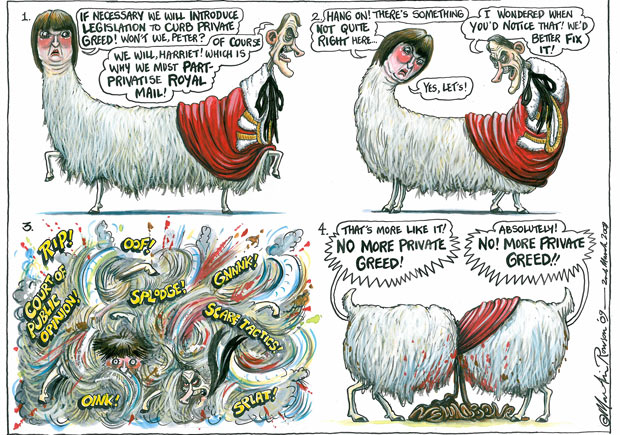 click on cartoon to enlarge image
Our liberties need more than a bill of rights
Our liberties need more than a bill of rights
By Marcel Berlins
One theme lurked throughout all the dozens of sessions of Saturday's spirited Convention on Modern Liberty: does Britain need some new constitution or bill of rights to curb government excesses?
The easy part of the convention produced, not surprisingly, a unanimous, angry consensus that our civil liberties were being devoured and eroded by the government. But what can be done about it? On this there was little agreement. To be fair, it was not the purpose of the convention to lay down policy for the struggle to come. Nevertheless, it was what everyone should have been thinking about.
Broadly, there are two schools of thought. One puts its faith in creating a new document that sets out our rights and freedoms and makes it impossible for the government to trample over them. Some talk about a solemn written constitution, others of a custom-made British bill of rights. Jack Straw is trying to flog a strange hybrid animal called a British bill of rights and responsibilities. Some - David Cameron for one - want our current Human Rights Act to be abolished. Others are happy to keep it, while juggling with some new instrument to attach. The other side argues that there is no need for any of those things; other ways can be found.
New written constitutions usually arise on the birth of a new country or as the aftermath of a brutal event, a war or revolution, or, as in the case of South Africa, the dismantling of a mode of government. Canada got a new constitution and a charter of rights and freedoms in 1982, following its constitutional divorce from Britain. None of these special watershed circumstances apply here.
The main practical objections to creating a written constitution or tailor-made bill of rights is twofold. Agreement will not be quickly reached (if reached at all). It would take years for the new constitution or whatever to become effective. What is to be done in the meantime? The feeling I got from the weekend convention was that the government had to be stopped from continuing its anti-libertarian excesses soon, not in a few years.
I do not believe that Britain needs a new formal instrument. The US constitution, so admired, rubber-stamped unlimited detention without trial, and torture. There is no such thing as watertight bill of rights. A government intent on breaching civil liberties, with sufficient sheep voting in parliament, and a hesitant judiciary, will get its way, in any country. We have enough legislative tools: the European convention on human rights and various international treaties and conventions. More words on a piece of paper won't make much difference. The aftermath to the weekend's excellent convention should concentrate on getting rid of the supine politicians and the power-mad ministers.
By Marcel Berlins
One theme lurked throughout all the dozens of sessions of Saturday's spirited Convention on Modern Liberty: does Britain need some new constitution or bill of rights to curb government excesses?
The easy part of the convention produced, not surprisingly, a unanimous, angry consensus that our civil liberties were being devoured and eroded by the government. But what can be done about it? On this there was little agreement. To be fair, it was not the purpose of the convention to lay down policy for the struggle to come. Nevertheless, it was what everyone should have been thinking about.
Broadly, there are two schools of thought. One puts its faith in creating a new document that sets out our rights and freedoms and makes it impossible for the government to trample over them. Some talk about a solemn written constitution, others of a custom-made British bill of rights. Jack Straw is trying to flog a strange hybrid animal called a British bill of rights and responsibilities. Some - David Cameron for one - want our current Human Rights Act to be abolished. Others are happy to keep it, while juggling with some new instrument to attach. The other side argues that there is no need for any of those things; other ways can be found.
New written constitutions usually arise on the birth of a new country or as the aftermath of a brutal event, a war or revolution, or, as in the case of South Africa, the dismantling of a mode of government. Canada got a new constitution and a charter of rights and freedoms in 1982, following its constitutional divorce from Britain. None of these special watershed circumstances apply here.
The main practical objections to creating a written constitution or tailor-made bill of rights is twofold. Agreement will not be quickly reached (if reached at all). It would take years for the new constitution or whatever to become effective. What is to be done in the meantime? The feeling I got from the weekend convention was that the government had to be stopped from continuing its anti-libertarian excesses soon, not in a few years.
I do not believe that Britain needs a new formal instrument. The US constitution, so admired, rubber-stamped unlimited detention without trial, and torture. There is no such thing as watertight bill of rights. A government intent on breaching civil liberties, with sufficient sheep voting in parliament, and a hesitant judiciary, will get its way, in any country. We have enough legislative tools: the European convention on human rights and various international treaties and conventions. More words on a piece of paper won't make much difference. The aftermath to the weekend's excellent convention should concentrate on getting rid of the supine politicians and the power-mad ministers.
What's wrong with a bit of drama in C Wing?
What's wrong with a bit of drama in C Wing?
By Libby Purves
No amount of tabloid indignation can change this truth: entertainment and arts projects in jails are good for all of us
A month ago in this space, I recorded the dismay spreading through the UK Prison Service as a result of Jack Straw's banning of a well-established comedy course at Whitemoor Prison. Some nasty little toerag outed it to indignant tabloids looking for something to get cross about.
The result, you may recall, was the Justice Secretary's ruling that comedy in prison is “totally unacceptable”, “not a constructive pursuit”, and that all inmate activities - even if not funded by taxpayers - “must be justified to the community”. Comedy sounded too much like fun, even though heaven knows the science of laughter is devoted to laying bare just the kind of stupid failures of judgment that tend to get you into prison in the first place.
A PSI - Prison Service instruction - followed this, laying down formally that all activities must now be judged not only by whether they do any good but by how they “might be perceived by the public”. Sir David Ramsbotham, the former Chief Inspector of Prisons and patron of several prison arts projects, robustly described the PSI as “lunacy”. Organisations that take arts into prison were more cautious, not wanting a fight; but they were scared, disheartened and in some cases had projects abruptly cancelled by understandably nervous governors. Nobody, after all, has defined the parameters of a “public acceptability test”, and where convicts (or even remand prisoners) are concerned some media can work themselves up into a rage over anything better than bread-and-skilly and the lash.
By Libby Purves
No amount of tabloid indignation can change this truth: entertainment and arts projects in jails are good for all of us
A month ago in this space, I recorded the dismay spreading through the UK Prison Service as a result of Jack Straw's banning of a well-established comedy course at Whitemoor Prison. Some nasty little toerag outed it to indignant tabloids looking for something to get cross about.
The result, you may recall, was the Justice Secretary's ruling that comedy in prison is “totally unacceptable”, “not a constructive pursuit”, and that all inmate activities - even if not funded by taxpayers - “must be justified to the community”. Comedy sounded too much like fun, even though heaven knows the science of laughter is devoted to laying bare just the kind of stupid failures of judgment that tend to get you into prison in the first place.
A PSI - Prison Service instruction - followed this, laying down formally that all activities must now be judged not only by whether they do any good but by how they “might be perceived by the public”. Sir David Ramsbotham, the former Chief Inspector of Prisons and patron of several prison arts projects, robustly described the PSI as “lunacy”. Organisations that take arts into prison were more cautious, not wanting a fight; but they were scared, disheartened and in some cases had projects abruptly cancelled by understandably nervous governors. Nobody, after all, has defined the parameters of a “public acceptability test”, and where convicts (or even remand prisoners) are concerned some media can work themselves up into a rage over anything better than bread-and-skilly and the lash.
Weather to turn cold again after sunny end to February
Weather to turn cold again after sunny end to February

After a two-week mild spell across the country, the weather will turn more wintry with a possibility of showers across the country.
Andrew Kimber, a forecaster from the Met Office, said the cold weather would return this week and last through to the weekend.

After a two-week mild spell across the country, the weather will turn more wintry with a possibility of showers across the country.
Andrew Kimber, a forecaster from the Met Office, said the cold weather would return this week and last through to the weekend.
Sunday, March 01, 2009
Jack Straw: Is he having a laugh?
Jack Straw: Is he having a laugh?
"Since 1997, we have done more to extend freedoms than any government before".
In my view, Jack Straw and David Miliband share the Ian Brady and Myra Hindley Award for Torture.

But yesterday, I hope, a movement was born and the standard raised against Straw and those who would destroy rights and liberties that have taken 800 years to accumulate.
And this...
Today's Convention on Modern Liberty showed that the British public are more than ready to defend their freedoms
And this...
Safeguarding Britain's security does not justify the totalising ambition of the government's data schemes
"Since 1997, we have done more to extend freedoms than any government before".
In my view, Jack Straw and David Miliband share the Ian Brady and Myra Hindley Award for Torture.

But yesterday, I hope, a movement was born and the standard raised against Straw and those who would destroy rights and liberties that have taken 800 years to accumulate.
And this...
Today's Convention on Modern Liberty showed that the British public are more than ready to defend their freedoms
And this...
Safeguarding Britain's security does not justify the totalising ambition of the government's data schemes
Police killer Harry Roberts could be free within months
Police killer Harry Roberts could be free within months

The notorious police killer Harry Roberts could be freed from prison within months after serving 42 years in jail.
Roberts, who was jailed for life for the murder of three unarmed policemen in a west London street, has already completed the first stage of a Parole Board hearing, which he believes will pave the way for his release, it has been reported.
The killer hopes a final hearing will find that he is no longer a risk to the public and will order his immediate release.
He has already served 12 years more than the minimum sentence recommended by his trial judge.
Roberts himself insists he is no longer a risk to the public and he has been punished sufficiently for the crimes he committed as a 30-year-old man.
"I'm not Harry Roberts, police killer. I'm Harry Roberts, old-age pensioner," he said last year at Littlehey Prison, Cambridgeshire. "I want to get out of prison and make something of the last years of my life. I can understand why the families of the three policemen could never forgive me and wouldn't want me released. But I feel I've served my time".
Good old Harry. Best of luck this time around mate.
UPDATE: Poor old Harry stitched up again!

The notorious police killer Harry Roberts could be freed from prison within months after serving 42 years in jail.
Roberts, who was jailed for life for the murder of three unarmed policemen in a west London street, has already completed the first stage of a Parole Board hearing, which he believes will pave the way for his release, it has been reported.
The killer hopes a final hearing will find that he is no longer a risk to the public and will order his immediate release.
He has already served 12 years more than the minimum sentence recommended by his trial judge.
Roberts himself insists he is no longer a risk to the public and he has been punished sufficiently for the crimes he committed as a 30-year-old man.
"I'm not Harry Roberts, police killer. I'm Harry Roberts, old-age pensioner," he said last year at Littlehey Prison, Cambridgeshire. "I want to get out of prison and make something of the last years of my life. I can understand why the families of the three policemen could never forgive me and wouldn't want me released. But I feel I've served my time".
Good old Harry. Best of luck this time around mate.
UPDATE: Poor old Harry stitched up again!
Benefits pilot scheme scrapped for costing too much
Benefits pilot scheme scrapped for costing too much
Embarrassed ministers have been forced to scrap a pilot scheme that suspended benefits for offenders who breached community orders because it costs more than £150 for every £1 it saves.
The scheme, run in four areas since 2001, was designed to get tough on those ignoring community service but only saw a 1.8 per cent improvement in compliance rates.
At the same time, it costs more than £650,000 a year to organise and saves less than £4,000, in average, in benefit handouts.
What a waste!
Embarrassed ministers have been forced to scrap a pilot scheme that suspended benefits for offenders who breached community orders because it costs more than £150 for every £1 it saves.
The scheme, run in four areas since 2001, was designed to get tough on those ignoring community service but only saw a 1.8 per cent improvement in compliance rates.
At the same time, it costs more than £650,000 a year to organise and saves less than £4,000, in average, in benefit handouts.
What a waste!
Subscribe to:
Posts (Atom)