Site Meter

Monday, July 13, 2009

Baha Mousa inquiry: British soldiers 'made prisoners scream and dance'

Baha Mousa inquiry: British soldiers 'made prisoners scream and dance'

British soldiers made Iraqi prisoners scream in an "orchestrated choir" and forced one to dance like Michael Jackson, an inquiry into the death of Iraqi receptionist Baha Mousa has heard.


Mr Mousa, 26, died while in the custody of the former Queen's Lancashire Regiment in Basra, southern Iraq, in September 2003.

A wide-ranging public inquiry into his death and the British Army's use of so-called conditioning techniques to "soften up" prisoners for interrogation got under way on Monday.

The inquiry heard that Mr Mousa's injuries may have been inflicted "with a greater degree of deliberation" than was previously thought.


If this death was the result of softening up techniques, what must the interrogation be like?

Kate and Gerry McCann v Gonçalo Amaral

Kate and Gerry McCann v Gonçalo Amaral

The money grabbing McCanns are at it again. According to the Daily Mirror, the McCanns claim that they are, in relation to Gonçalo Amaral, so TORN APART BY HIS LIES that they have issued a writ for defamation and breach of their human rights and claim £1M in damages and the case is to be heard in Lisbon next Summer.

Apparently, the McCanns claim that Gonçalo Amaral's accusations that they are responsible for Madeleine's death and then covering it up has left them distraught. The writ claims that both the McCanns suffer from "permanent anxiety, insomnia, lack of appetite, irritability and an indefinable fear". It also claims that Kate McCann is "steeped in a deep and serious depression".

According to the biased Daily Mirror report, it is said that Gonçalo Amaral's theory is absurd that Madeleine died in Apartment 5A and that the McCanns covered it up. However, I find his theory far from absurd. What I find absurd are the McCanns explanations and their belief that everybody should believe their lies.

The writ accuses Amaral of being a self-obsessed, manipulative money-grabber with no morals. Isn't this just a case of the McCanns pot calling kettle black?

Strangely, "Madeleine is named with Kate and Gerry and the twins as a complainant in the lawsuit". I don't know about Portuguese law, but under English law a dead person is unable to be defamed therefore cannot bring a claim. As for the McCanns claiming that the twins have been defamed and that their human rights are being breached is absurd!

According to the McCanns writ, "Madeleine has been deprived of the possibility of a fair and adequate investigation into her disappearance, putting her moral and physical integrity at serious risk". Given that the McCanns from the outset interfered with the official investigation, this claim is a bit rich coming from them. Can somebody please tell me how it is possible to put the moral and physical integrity of a 3 year old dead child at serious risk?

The writ goes on to claim that the McCanns have been "totally destroyed from a moral, social, ethical, emotional and family point of view, beyond the pain that the absence of their eldest daughter causes them". What is moral and ethical about leaving 3 children under 4 unsupervised and then lying about a fake break-in?

The McCanns claim Amaral's "sole objectives" in writing the book were "to earn a lot of money", using "lies". Again this is a bit rich coming from the McCanns who's sole purpose of setting up the Find Madeleine Fund was to earn a lot of money by telling lies.

UPDATE: Link

Related content:
Mother who left children playing in park is branded a criminal
A Sunday school teacher was given a police record after she briefly left her own children playing together in a park while she popped to a nearby shop.
Why is it only the McCanns who have escaped being brought to justice?


Hat-Tip mccannfiles

Saturday, July 11, 2009

Madeleine McCann: What happened to her, and where is she now?

Madeleine McCann: What happened to her, and where is she now?

Approximately 10 O’ Clock on the evening of 3rd of May 2007, the calm in Praia da Luz was about to be disturbed by Kate McCann announcing that daughter Madeleine was missing. Kate McCann and husband Gerry McCann were quick to assert that an abductor must be responsible for the disappearance of Madeleine. It is illegal for a private investigation to be conducted whilst there is an ongoing police investigation. The police were not convinced that the abduction theory put forward by the McCanns was credible. It was thought that the answer to 3 year old Madeleine’s disappearance lay in Apartment 5A. Madeleine was last seen alive by someone other than the McCanns or someone in their group at 5.30pm when Kate McCann took her out of the Mark Warner crèche. From then until about 10, only the McCanns themselves and David Payne claim to have seen Madeleine alive. The police view is that Madeleine died in the apartment. And that the McCanns version of events is cover up and alibi seeking. Some of the McCanns friends on holiday with them appear to be part of the cover up. If the abduction theory is removed from the equation, then the McCanns have some explaining to do. David Payne also needs to clarify some points. Based upon the presumption that Madeleine is dead, what time did it occur and how?

Approximately half an hour earlier, 9.30pm, Matthew Oldfied left the Tapas Bar to go to Apartment 5A to check on Madeleine and the 2 year old twins Sean and Amelie. Only the twins were present, Madeleine had already disappeared by this time. It is not being very responsible if an adult is entrusted with the task of checking to see if 3 young children are safe, and upon discovering one is missing and not attempting to ascertain Madeleine's whereabouts. This calls into question why Kate McCann 30 minutes later made an announcement informing the group that Madeleine had disappeared?

Matthew Oldfield may well have been prepared to go along with a cover up to a point, but drew a line at committing himself to perjury and perverting the course of justice by lying that Madeleine was present when he checked Apartment 5A.

Approximately half an hour earlier, 9pm, Gerry McCann left the Tapas Bar to go to check on the 3 children. He claims that all 3 were present and asleep in their beds.

If Gerry McCann's statement is truthful, then Madeleine disappeared between 9 and 9.30pm. This provides a half hour window of opportunity for an abductor to enter Apartment 5A and snatch Madeleine. The same length of time between Matthew Oldfield checking at 9.30 and Kate McCann checking at 10pm, when there was no sign of Madeleine and yet no big song and dance or hue and cry into her disappearance.

At approximately 8.30pm Gerry and Kate McCann leave Apartment 5A and arrive at the Tapas Bar. They claim that all the children were asleep in their beds. An hour later we know that Madeleine is not asleep in her bed, according to Matthew Oldfield's account. There is only Gerry McCann's word that everything was ok at 9pm. It would have strengthened the McCanns version of events had Matthew Oldfield corroborated their account. Instead, his evidence exposes Kate McCann's 10pm alarm to be a falsehood.

There is a glaring inconsistency. At approximately 9.15pm Jane Tanner claims that she saw someone walking away with a child who she believed could have been Madeleine. This might appear to fill the gap between 9pm and Gerry McCann stating that all was well, and 9.30pm when Matthew Oldfield states he did not see Madeleine. However, it does not explain the inaction of the group between 9.30 and 10pm.

As already stated, it is illegal in Portugal for a private investigation to be conducted into a case whilst there is an ongoing police investigation. The McCanns from the outset claimed that an abductor was responsible for Madeleine's disappearance. The obvious problem with the McCanns private investigation is that it leaves themselves out of the equation of being responsible for the disappearance of 3 year old Madeleine. Ultimately, responsibility for the safety of the children rests with the McCanns. The McCanns claim that they believed it was safe to leave 3 children unsupervised is not a belief that stands up to scrutiny. It was not a safe thing to do. Accidents can and do happen.

If Madeleine suffered a fatal accident between the hours of 5.30 and 9.30pm, it follows that her body would have been discovered, and one supposes that the emergency services are called. If there was a fatal accident and the emergency services were not called, it raises the question why not? Cause of death would have to be determined by an autopsy. Surely, a simple accident would not lead to the McCanns being responsible? Therefore, the McCanns did not want an autopsy being conducted. At the very least it raises the question of contributory negligence in the death of Madeleine.

The most likely explanation is that Madeleine died sometime between 5.30 and 8.30pm. The only other person other than the McCanns themselves during that time to visit Apartment 5A was David Payne. Interestingly, the statements of the Tapas Bar group are confusing in relation to what time David Payne visited Apartment 5A. According to Gerry McCann it was approximately 6.30pm, and the purpose of David Payne's visit was to assist Kate McCann in getting the children ready to go to the play area near the Tapas Bar. Kate McCann is then supposed to have informed David Payne about the change of plan, and the reason she gave was that the children were too tired. David Payne claims that he saw all 3 children playing in their pyjamas. It was the last time he claims to have seen Madeleine alive. If his statement is to be believed, then Madeleine died sometime between 6.35 and 7pm when Kate McCann was alone in Apartment 5A with the children or between 7 and 8.30pm when both Gerry and Kate McCann were in Apartment 5A.

The problem with the McCanns accounts that all 3 children were asleep in their beds when they left Apartment 5A to go to the Tapas Bar at 8.30, is the differences in describing the same scene. Witness accounts can differ according to different interpretations from different perspectives. However, the McCanns are describing a static scene which would be the same for both of them as they walked out of the door. Therefore, the variation in their versions is not accounted for. Perhaps, the most telling was the BBC interview with Kate McCann when she had difficulty answering the simple question about were the children asleep when they left to go to the Tapas Bar. It threw Kate McCann. Her story was supposed to have started from 10pm, the 90 minute earlier starting time by the interviewer left Kate McCann wrongfooted. She did recover her composure and finally answered the question, but it raises the question that perhaps only the twins were both asleep in their beds because something had already happened to Madeleine by 8.30pm.

It could be that Kate McCann's announcement about the change of plan was genuine and all 3 children were deemed to be too tired to go to the play area. There again, it could be a hastily made up excuse to cover up the fact that Madeleine was already dead and as such could not be paraded in public. It calls into question David Payne's claim to have seen all 3 children alive and in their pyjamas. In any event, David Payne returns to the tennis court and speaks to Gerry McCann who then changes his plan to play on and returns to Apartment 5A. A tennis instructor takes Gerry McCann's place on the tennis court. That's two changes of plans by two people in a very short space of time, half an hour. Something unexpected comes up usually for people to change their plans. Was this an unexpected death in the family?

Madeleine had to disappear not because her death could not be explained by an autoposy, but because the cause of death would be discovered. This is why accidental death does not appear to be the probable cause. If Madeleine had simply drowned in the bath, for example, her death could be easily explained away. If Madeleine met a violent end this would have shown up on an autopsy. The same if she had died by a drug overdose. The crime here is robbing the coroner of a body. The McCanns did not want the authorities becoming aware of how Madeleine died. That is why Madeleine had to disappear. The McCanns could not simply telephone the authorities and report Madeleine's disappearance when either Kate or Gerry or both were present at the time it occured. They needed to distance themselves from the scene of the crime. In their absence the Bogey Man becomes responsible. The cause of death no longer needs to be explained because there is no body to examine.

Instead of worried parents calling the police and asking them to help in finding their missing daughter and what may have happened to her, the police are confronted by parents telling them that they know an abductor is responsible for her disappearance. So sure are the parents that they phone family and friends in the UK and informed them that an abductor had broken into the apartment and taken Madeleine away. The police found no evidence to support the break-in claim. Much later, Clarence Mitchell, the McCanns press spokesman, admits that there was no break-in. The McCanns cover story is blown apart. If there was no break-in, in all probability there was no abductor. Would innocent parents invent a story of a fake break-in to explain the disappearance of their 3 year old daughter? No. They would have no need for invention. On the other hand, guilty parents seeking to push away responsibility most certainly needed a cover story.

Matthew Oldfield's not seeing Madeleine at 9.30pm, leaves Gerry McCann claiming to be the last person to see Madeleine alive at 9pm. Gerry McCann is setting the scene for a fake break-in story. He is outside by the shutters when he is disturbed by Jeremy Wilkins out walking with his child. Gerry McCann has to go and distract Jeremy Wilkins by making small talk. It was impossible for Jane Tanner to pass by both Gerry McCann and Jeremy Wilkins without either seeing her and for her to have seen Abduction Man walking off with a child who could have been Madeleine.

Weaknesses in the McCanns version of events;

1. Fake break-in;
2. Matthew Oldfield not seeing Madeleine;
3. Jane Tanner's fake sighting.

A fake break-in, a fake sighting, in all probability the abductor was also a fake. It all puts responsibility back on the McCanns to explain what happened to Madeleine. Why were the police family liasion officers replaced on the police inquiry when they asked the McCanns to explain what had happened to their 3 year old daughter? The question is legitimate. Can the same be said for the officers removal from the case? Was their removal political?

Why did the British Secret Service monitor the McCanns mobile phones?

Clarence Mitchell tipped off the McCanns that they were subject to electronic surveillance. This revelation led to Mitchell having to resign from the Media Monitoring Unit and his temporary appointment to the Foreign Office. The McCanns then offered Mitchell the job as their official spokesman.

The McCanns from the outset attempted to control the police investigation and the media coverage of the case.

Madeleine was not in Apartment 5A at 10pm, because she was not there when Matthew Oldfield checked at 9.30. Madeleine was not there at 9pm because Gerry McCann is setting the scene for the break-in story. Madeleine was not asleep in her bed at 8.30pm, because she was already dead. The McCanns went out to the Tapas Bar with the full knowledge of what had happened to Madeleine. It is an inescapable fact that Madeleine is dead.

Cause of death and the time is between 5.30 and 8.30pm. Most probably earlier than 8.30pm. Outside of Gerry and Kate McCann knowing the facts of what happened, there is the question how much does David Payne know?

If the reason for Kate McCann announcing a change of plan because the children were tired is valid, why did Gerry McCann also change his plan and leave the tennis court early? The children were supposedly being taken cared of, it leaves him free to play on without worries. Instead the two people who have had to change their plans get together.

Madeleine was dead before 7pm.

To be continued (A work in progress)

Mr President Obama and Sarkozy does my bum look big in this?

Mr President Obama and Sarkozy does my bum look big in this?


US President Barack Obama and France's President Nicolas Sarkozy look on as Brazil's Mayora Tavares walks by for a family photo at the G8 summit in L'Aquila, Italy
Picture: REUTERS

Two jailed for inciting racial hatred online

Two jailed for inciting racial hatred online

Two men have been jailed after becoming the first in the UK to be convicted of inciting racial hatred online. Simon Sheppard, 52, was sentenced to four years and 10 months while Stephen Whittle, 42, was given a term of two years and four months.

The men printed leaflets and controlled websites featuring racist material, then fled to the US after being convicted of race-hate offences at a trial last year. On arrival their asylum application was rejected and they were deported back to the UK. Leeds Crown Court heard that Whittle wrote offensive articles which were then published on the internet by Sheppard. The published material included grotesque images of murdered Jews alongside cartoons and articles ridiculing a number of ethnic groups. Their right-wing output was based on the writings of other extremists such as the founder of the American Nazi Party, George Lincoln Rockwell. Judge Rodney Grant told the pair their material was "abusive and insulting" and had the potential to cause "grave social harm".

Madeleine McCann: The Forbidden Investigation

Madeleine McCann: The Forbidden Investigation

Madeleine McCann: The Forbidden Investigation

Friday, July 10, 2009

Prisoner victim in votes challenge against MoJ

Prisoner victim in votes challenge against MoJ


Here is the news. Peter Chester, a post-tariff life sentence prisoner, is challenging the Minister of Justice for denying him the vote. Mr Chester is entitled to legal aid because he satisfies the government set means test, and the Legal Services Commissions merits test. This means that he does not have the money to obtain access to justice without public funding, and that the LSC believes he has a good chance at success in the action against the MoJ.

In Hirst v UK(No2) the European Court of Human Rights decided that a blanket ban violated Protocol 1 of Article 3 of the Convention. The issue of a lifer being post-tariff is important because of the twin aims of retribution and deterrence (punishment elements) are satisfied at the expiry of tariff. The tariff is that element of a life sentence which the trial judge believes meets justice in punishment terms, and continued detention can only be justified on grounds of public protection. This treatment stage must be separated from the punitive stage for legitimacy. The government has always argued that loss of the vote is part of the punishment. Peter Chester is no longer being legally punished he is being legally treated. Whatever one's thoughts about his offence, he is, in this case, a victim.

The government erred in law by excluding post-tariff lifers from the consultation exercise. The UK is already in deep water at the EU for not abiding by the ECtHR decision. This case adds to the pressure on the goverment to toe the line.

I find the MSM reporting below very irresponsible, and the commenters in the Daily Mail fail to address the issues. No wonder our politicians knee-jerk when the redtops are knee-jerking and the readers knee-jerk.

Child killer used public money to demand right to vote

A child killer serving a life sentence is using public money and human rights legislation to challenge the Government's refusal to allow him and other lifers the vote.


------------

'Don't give vote to man who killed my Donna'

-------------
Child killer using public money in legal bid to win right to vote

---------------------
Monster who raped and killed a child uses public funds to sue the government because they won't let him vote

News from the House of Corrections

News from the House of Corrections

Quis custodiet ipsos custodes?

Prisoners’ Discharge Grants
Mr. Garnier: To ask the Secretary of State for Justice how many prisoners who had been in custody for less than 14 days received discharge grants upon release in each of the last 10 years for which figures are available; and how many days the offender had spent in custody in each case.
[281956]

Mr. Straw: The amount of expenditure recorded as discharge grant in each year for the last five years is given as follows.
£000
2007-08 4,407
2006-07 3,509
2005-06 3,737
2004-05 4,154
2003-04 4,270

In 2007-08 End of Custody Licence was introduced and some expenditure on subsistence payments made to prisoners on discharge has been included in the recorded expenditure for discharge grants. It would incur disproportionate costs to separate this amount as we would need to survey all prison establishments.
The purpose of the Discharge Grant is to enable the prisoner to meet their immediate subsistence needs in the first week after release. Whether they are going straight into employment or applying for benefits, they will receive payment in arrears. Without a discharge grant, therefore, there would be an increased risk that prisoners would re-offend in order to meet their immediate financial needs.
Sentenced prisoners are eligible on release for a Discharge Grant of £46 unless certain exclusions apply. These exclusions include, for example: those serving a sentence of 14 days or less; those awaiting deportation or removal from the United Kingdom; those who are known to
21 Apr 2009 : Column 623W
have in excess of £8,000 in savings (and would therefore be ineligible for income support under the relevant regulations).


Commentary:The amount of expenditure recorded for 2007-08 was £4,407,000. If £46 is divided by that amount it would imply that more than 96,000 people were discharged from prison in 2007-08 – more than the entire prison population. And given that a good percentage of prisoners don’t qualify for the discharge grant the figure might leave the reader wondering where is all the money going? (Source: Inside Time – National Newspaper for Prisoners, July 2009, only available in print edition. On line version here).

In answer to Who Guards the Guards? It would appear from Inside Time that prisoners do.

Paperwork with a difference

Paperwork with a difference

Origami city: model crafted entirely from paper


Check out the other great photos here.

Alan and Ann husband and wife MPs are keen to fiddle expenses

Alan and Ann husband and wife MPs are keen to fiddle expenses


MPs' expenses: Alan and Ann Keen face formal sleaze investigation

Alan and Ann Keen, the Labour MPs, are to have their expenses investigated by the parliamentary sleaze watchdog.

The Keens claimed £140,000 over four years for their "second home" - a Thameside apartment ten miles away in Westminster - while listing the run-down, semi-detached house in Brentford, west London, as their "main home".

Under Commons rules, an MP's main home must be the one in which they spend the most nights. However, the Keens were sent a warning from Hounslow Council that the property would be seized as an "abandoned dwelling" - and council tenants would be moved in - if it remained unoccupied for much longer.

Kids go to school to learn not get battered

Kids go to school to learn not get battered


I have long known that anybody can lash out when suffering from stress. I remember being told that even teachers and social workers are not immune from this. It would appear that the teacher was provoked by the pupil. However, this does not justify the savagery of the attack. It is merely an explanation of what can happen when somebody is on the brink and gets pushed over the edge. The final straw which breaks the camel's back. I suspect that a charge of attempted murder will not hold for the simple reason the charge requires the necessary mental intent. The teacher does not appear to have had the mental intent at the time the offence was committed because of the mental abnormality of his mind. Perhaps, a hospital order would be a more fitting disposal of this case?

Photo the Guardian

Holy Moses second Tory leader linked to the great man

Holy Moses second Tory leader linked to the great man

David Cameron ‘could be a direct descendant of Moses’

David Cameron could be a direct descendant of Moses, a Jewish scholar has suggested.

Political commentators have long known that the Conservative Party leader’s paternal great-great-grandfather was a Jewish immigrant who became a successful businessman.

But Yaakov Wise, a research fellow at the University of Manchester Centre for Jewish Studies, has traced the politician’s ancestry back to Elijah Levita, an eminent 16th-century Jewish scholar. Dr Wise’s study of archival material also suggests that Mr Cameron, who has described himself as an “enthusiastic friend of the Jewish people”, could be a direct descendant of Moses.


Thursday, July 09, 2009

Multimillion pound deal could send Nigerian prisoners home

Multimillion pound deal could send Nigerian prisoners home

• Government hopes to transfer up to 400 inmates
• UK would pay to upgrade jails in west African state


clicken photo to enlargen

Hundreds of Nigerians in British jails could be sent home to finish their sentences under a multimillion pound deal now being negotiated by the government. Talks are starting on a British investment to improve prison conditions in the west African country so as to allow the transfer of as many as possible of the 400 Nigerian prisoners here.

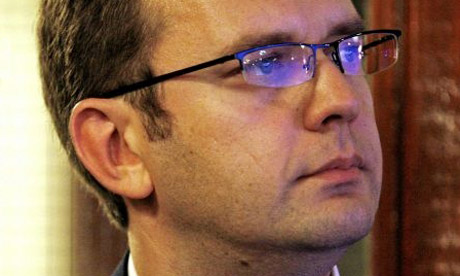
Andy Coulson claims his mobilephone is hacked

Andy Coulson claims his mobilephone is hacked


Original photo the Guardian

Idea for change Jailhouselawyer

Executive Director of the Bureau of Change RonKnee

Cash for prisoners – The Prison Sell - A National Scandal

Cash for prisoners – The Prison Sell - A National Scandal

According to Policy transfer and criminal justice by Jones and Newburn, “The policy of contracting out of prisons and remand centres to commercial providers was first mooted in 1984 by the free-market think tank, the Adam Smith Institute”. Largely falling on deaf ears, the ASI published a second report in 1987 Privatizing Prisons: The Moral Case by Logan. Between the two reports in 1986, the Home Affairs Select Committee, chaired by the Conservative MP, the late Sir Edward Gardner, started an inquiry into the state of prisons in England and Wales. In spite of privatising prisons not being part of the remit of the inquiry, nevertheless members of HAC decided to visit American prisons, concentrating on those private prisons operated by Corrections Corporation of America (CCA). Because of the division between Labour and the Tories on the issue, the topic was not covered in the main report but was instead the subject of a separate report, which recommended privatising prisons.

In support of Sir Edward Gardner was the senior Tory member Sir John Wheeler. Another Tory, the junior Home Office minister Lord Windlesham, began to lobby the Prime Minister. The Home Office minister, Lord Caithness, also visited America and upon his return advocated privatisation of prisons. John Mowlem Ltd, a large donor to the Tory party, and Sir Robert McAlpine Ltd, a large donor to the Tory party, formed a consortium with the US based CCA. Following this the government published its Green Paper, Private Sector Involvement in the Remand System, in July 1988. Commercial lobbying reached fever pitch. No surprises then that Contract Prisons Ltd was formed with the former HAC chairman Sir Edward Gardner as chief executive! It is difficult to see any legitimate justification for private involvement given that by the late 1980s the remand population had fallen quite significantly.

The Home Office was against the idea of privatisation of prisons and was against a provision allowing for privatisation of remand prisons in the Criminal Justice Bill, however, those with vested interests continued to lobby for it and when Margaret Thatcher threw her weight behind it the Home Office caved in. A clause was added which permitted contracting out for newly constructed remand facilities. But still those with a vested interest were not satisfied. At the committee stage, Tory backbenchers and Lord Windlesham lobbied for and succeeded with an amendment which granted the power to contract out for convicted prisoners and existing prisons and remand centres. Money talks!

According to a 1989 article in The Guardian, the "private prison network" came together on September 15, 1988, at a dinner for more than 150 people, given by the conservative Carlton Club's political committee. "All the various players were there," the article by D. Rose read: "representatives of the ASI and other right wing policy units, civil servants, John Wheeler and his colleagues, architects and people from the consortia ... a mood of satisfied expectation was beginning to emerge"”.

And, George Monibot writes “Last week two judges in Pennsylvania were convicted of jailing some 2,000 children in exchange for bribes from private prison companies…The judges were paid $2.6m by companies belonging to the Mid-Atlantic Youth Services Corp for helping to fill its jails. This is what happens when public services are run for profit”.
It is not being claimed here that British judges are accepting bribes to jail people they would otherwise give non custodial sentences to, however, it has to be said that bribes have been paid and accepted by those involved in the privatisation of British prisons. In Sweden, for example, prisons are built to accommodate 250 inmates. The private sector lobbied for 3 Titan Prisons to be built each to accommodate 2,500 prisoners. Even though the Titan Prisons plan has been scrapped in favour of 5 x 1,500 place prisons, that’s still 7,500 places at £40,000 per year per inmate, that’s £60 million per year per prison of taxpayers money which will go into the privateers pockets. It is one thing to jail people if it is necessary, and quite another to jail people for profit. Whatever the legal position, there is no moral case for prison privatisation.

Faulty Tories

Faulty Tories

"I know nothing!"


Andy Coulson is a bugger.

Remand prisoner dies in hospital

Remand prisoner dies in hospital

A remand prisoner at HMP Exeter has died in hospital after a "self-harm" incident, prison authorities revealed.

A spokesman said 37-year-old Marcus Penrose died in hospital after the incident on Sunday.

Mr Penrose was on trial accused of burglary and was not on suicide watch at the jail.

"Our thoughts are with the family and friends of Mr Penrose," the spokesman said. An investigation into the death has started.

Drug dealer posts updates on Facebook from jail

Drug dealer posts updates on Facebook from jail

Jailed drug dealer Shane Smith has been updating his Facebook website page from inside his prison cell.


Smith was jailed for two and a half years in April for peddling cocaine and handling stolen goods, but is still communicating with family and friends on the outside, over the social networking site.

Life behind bars does not seem too hard for the 25-year-old who has been playing online games on the site, updating his status and even accepting friend requests.

On Wednesday, the Ministry of Justice had contacted the bosses of Facebook about the inappropriate postings.

Smith has been in custody since his home was raided on February 3 and officers found £2,000 in cash and cocaine with a street value of £1,550.

Wednesday, July 08, 2009

NOMS reduction move on MoJ prison expansion policy

NOMS reduction move on MoJ prison expansion policy

Exclusive:

It can be exclusively revealed that this morning the National Offender Management Service (NOMS) stated that it had no plans for prison expansion. Previously, the Ministry of Justice (MoJ) announced that it intended to build 3 Titan Prisons, catering for 2,500 in each, following the recommendations of the Carter report. However, this proved too controversial and the plans were scrapped in favour of plans to build 5 smaller prisons with spaces for 1,500 in each prison, a total of 7,500 new places. Now even this plan has been scrapped because of the economic downturn. When the MoJ press office was contacted for confirmation, I was referred to a 2 month old statement. As Harold Wilson famously said “A week in politics is a long time”. Apparently, there is a breakdown in communication between the MoJ and its press office. No statement has yet been issued by the MoJ on this welcome U Turn. Whereas such a move would normally bring criticisms from the Tory party that Labour are going soft on crime, the reality is that there is little money in the pot and other priorities are more pressing.

Phil Wheatley, Director General of NOMS, said that “the Government's policy is to close old and inefficient establishments (5,000 places) and to build 5 new establishments (7,500) - net increase 2,500”. In other words, it is a reduction of 5,000 prison places. Whilst this is a welcome first step, it does not go far enough. Having been critical of the Tory plans to expand by a privatisation prison building programme advocated by the discredited Jonathan Aitken and Stuart Mitson, this is still too close to Tory policy for comfort. That NOMS is still in the process of tendering, means that nothing has yet been finalised. There’s room for yet another step back. Firstly on the ground that even hardliners in the US are advocating closing more jails and letting more prisoners out, because of the lack of finances. Secondly because law and order is not gauged by more prisons and more prisoners but by less. Crime prevention rather than trying to deal with offenders after the event. The only plus side is that the 5 new prisons, if built, will not be on the basis of a rigged Prison Reform Working Group operated by the Tories. What’s the point of a think tank if they don’t think to examine what their own members are getting up to?

Related tidbits

NOMS is happy that the expected sharp increase in the crime statistics, as a result of times getting harder, has not materialised. Because of the no rise in crime, it would be difficult to justify public expenditure on a prison building programme.

NOMS is also seriously considering adopting methods which produces crime prevention, on the cheap, at local level. When specifically asked whether this means extending the pilot projects in relation to the policy of Justice Reinvestment, this was met with a positive response. Examples were given whereby local initiatives are already underway. Drinkers who leave pubs and clubs late at night or in the early hours of the morning, and who would normally just hang about the city centres because of the lack of buses and taxis, and might lead to rowdiness, is being resolved by taxis and buses being provided to disperse the crowds.

Police give ASBO warning to two-year-old

Police give ASBO warning to two-year-old

A two-year-old became the youngest child in Britain to receive an ASBO warning after police mistakenly accused the toddler of terrorising neighbours.


Next week police to serve ASBO on unborn baby...

Monday, July 06, 2009

Would you buy a used car from Jonathan Aitken?

Would you buy a used car from Jonathan Aitken?


Arthur Daley

If it was shown that he has not really reformed, is he best placed to recommend prison reform?

Legitimate target...


Is there any comment Jonathan Aitken would like to make before he is exposed?

Update: Aitken: "I never lost sight of the fact that one day my nightmare would end and the sun would shine again. And it has".

Your worst nightmare is just about to begin. Your head will be so far up your arse where the sun don't shine. If you believe in God start praying. If he exists he must know you are a fraud?

Jailhouselawyer rocks the Tory party...

Lord Carter of Coles: This is your life

Lord Carter of Coles: This is your life


I find it rather disturbing when a public figure such as Baron Carter of Coles is able to hide his character from public view.

It appears that the government simply wheel him out to conduct so-called independent inquiries. I would like to know what qualifies him to be so appointed to make the recommendations that he does. It would appear that he is nothing more than a government yes man.

The fact that he was best man at Jack Straw's two weddings hardly qualifies him for such an important role. Nor that Tony Blair put him forward to become a baron. What did he do to earn such an award?

All I know is that his recommendations for private prisons, Titan Prisons, and the creation of the National Offender Management Service, have produced disasterous results.

Boris says he will form a government as soon as possible after victory for his party in general election

Boris says he will form a government as soon as possible after victory for his party in general election

Boiko Borisov

Bulgarian ex-bodyguard wins general election

Mr Borisov, the mayor of Sofia, had been expected to punish the ruling Socialist party for its handling of the economic crisis, which has hit the European Union's poorest country hard, and its failure to stamp out organised crime.

According to exit polls on Sunday night, he was expected to win about 40 per cent of the vote, with the incumbent government failing to reach even half of that figure.

Sunday, July 05, 2009

Great British literary walks

Great British literary walks


WILLIAM GILPIN - Wye Valley (6 miles)
William Gilpin’s Observations on the River Wye, published in 1782 (and now reprinted by Pallas Athene), extolled the river’s picturesque charms and they are at their best on the Goodrich-Symonds Yat circular walk, one of the routes in “Walk this Wye”, a free booklet available at local tourist offices, which you can also order online: go to www.wyevalleyaonb.org.uk and look for “Publications” under “News & Activities”.
Picture: GETTY


JANE AUSTEN - Chawton, Hampshire (4.5 miles)
Starting from the house Jane lived in for the last eight years of her life, from 1809 to 1817, this walk takes in the church where her mother and sister, Cassandra, are buried and includes a stretch along a disused railway line. Details: website for Edward Thomas walk. www.easthants.gov.uk/edo/tourism.nsf/webpages/walking
Picture: CHRISTOPHER COX


WILLIAM WORDSWORTH - Rydal and Grasmere, Cumbria

Reading The Grasmere Journals by Dorothy Wordsworth
Distance 5 miles; Map OS Explorer OL7: The English Lakes South-eastern Area

The route Details in “Wordsworth Walk Two” under “Walks – Kendal and the Southern Lakes” at www.lakedistrictoutdoors.co.uk

Is this the most popular literary walk in the country? No matter, it merits having its praises repeatedly resung for this stroll around the navel of the Lakes should be regarded as a compulsory initiation into England’s most beautiful region. Wordsworth put the Lake District on the map for tourists and his spirit still haunts its fells and waters.

This circular walk takes in tiny Dove Cottage, where he produced his best work and wrote that epic manifesto of poetic Romanticism, The Prelude, and Rydal Mount, where he lived the last 37 years of his life, as well as the Wordsworth Trust Museum, the graveyard where he and his sister Dorothy are buried, and two of Cumbria’s loveliest small lakes, Grasmere and Rydal Water. As you follow the southern shore of the latter lake, look across to the opposite shore and there is Nab Cottage, the home of that “English opium-eater”, Thomas

De Quincey. Note, too, the island in the middle of Grasmere, where Wordsworth, Dorothy and Coleridge went for picnics.
Picture: DAVID BURGES


SIR WALTER SCOTT - Loch Katrine

Reading Rob Roy by Sir Walter Scott
Distance 13 miles; Map OS Explorers 364, 365: Loch Lomond North/The Trossachs

When Scott’s epic poem, The Lady of the Lake, was published in 1810 it was an immediate literary sensation. Set in and around Loch Katrine in the scenic Trossachs, where the Highlands and Lowlands meet, it relates the story of Ellen Douglas, exiled on an island in the loch. In a forerunner of the “Captain Corelli effect” readers flocked to the area in their thousands to see for themselves the real-life locations of the poem. Scott repeated the trick with his novel Rob Roy, about the Highland outlaw and folk hero Rob Roy MacGregor, who was reputedly born on the shores of the loch.

This walk includes locations relevant to both works (for example, Ellen’s Isle and the burial ground of the MacGregors) and involves a pleasurable cruise on the loch’s resident steamship – inevitably called the Sir Walter Scott. Take the 10.30am sailing, get off at Stronachlachar Pier at 11.15 and simply walk back along the shore road through a glorious landscape fit for the top of a chocolate box. Details of sailings at www.lochkatrine.com .
Picture: Tim Hurst

Saturday, July 04, 2009

Brazil: Big cat country in the Pantanal

Brazil: Big cat country in the Pantanal

Counterblast: Why penal reform should not be a Conservative issue

Counterblast: Why penal reform should not be a Conservative issue

Ian Loader, Professor of Criminology at the University of Oxford and a Fellow of All Souls College, argues in 988 words, on the blog ConservativeHome.com, “Why penal reform should be a Conservative issue” http://conservativehome.blogs.com/platform/2009/07/ian-loader-why-penal-reform-should-be-a-conservative-issue.html. Unfortunately for an academic he has failed to properly research his subject. According to Wikipedia “Prison reform is the attempt to improve conditions inside prisons, aiming at a more effective penal system…A precise definition refers to attempts to change the penal system, typically from one model of penology to another. Reverting to an earlier model is frequently also characterized as reform. Criminal justice models are based on the goals of the penal system” http://en.wikipedia.org/wiki/Prison_reform.

Ian Loader advertises the fact that he sat on the Howard League’s Commission on English Prisons Today, and that they have just published their report which advocates a change of direction. Another member of the Commission is Professor Andrew Rutherford, author of Prisons and the Process of Justice. In his book he writes: “Prison populations are determined, intentionally or otherwise, by policy choices. There are three general policy options: expansion, standstill and reduction”.

Beneath Ian Loader’s article, in the comments section, “Andrew” drew readers attention to the “Conservative policy document Prisons with a Purpose” http://www.conservatives.com/~/media/Files/Green%20Papers/Prisons_Policy_Paper.ashx?dl=true which I had read already. In the Foreword by David Cameron, he states “For too long, Labour have refused to build the prison places that are needed”. Clearly Tory prison policy intends to go down the road of expansionism. With their minds already made up not to address the prison crisis and their minds made up to make matters even worse than they are at the present, I cannot help but wonder why Ian Loader chose to go against the wind? Any fisherman would have told him that he would only get wet in the process.

It was only in March that the Centre for Social Studies published the findings from their Prison Reform Working Group, the report, “Locked Up Potential: A Strategy for Reforming Prisons and Rehabilitating Prisoners”, http://www.centreforsocialjustice.org.uk/client/downloads/CSJLockedUpPotentialFULLrEPORT.pdf in my view, is the Tory version of Labour’s dodgy dossier on WMD. The task force was chaired by disgraced former Tory MP Jonathan Aitken. According to the Tories, Aitken’s 7 months in custody made him uniquely qualified to chair the task force. (Prisoners, on the other hand, would say that amount of imprisonment only qualifies him to take a dump and a shave). Another member of the task force was the severely discredited former prison governor Stuart Mitson. Aitken’s report recommended that future prison design should follow the “unique design” of the Mitson Academy Model. Whilst the task force was sitting but before the report was published, Stuart Mitson Consultancy Ltd was set up. There is nothing unique about the design at all. It may be that GSL (formerly Group 4) (who Stuart Mitson worked for until the Her Majesty’s Chief Inspector of Prison’s damning report ended his prison career) could prove to a court’s satisfaction that the design is based on the “Carling Unit” at H.M. Prison Rye Hill.

Whilst the Tories talk about rehabilitation and the need to prevent offenders from re-offending, their prison building programme is aimed at the private sector. The private sector requires a higher body count for higher profits. It is not in the private sector’s interests to prevent re-offending. Genuine prison reform uses the reductionism model. One look at the Tory spending plans in Aitken’s report shows that the Tory policy is motivated by ever increasing profits year on year. Neither the public nor prisoners will benefit from this deception. The only ones to benefit will be the building contractors, and any others who gain, like parasites, by feeding off prisoners suffering. Less prisons not more serves law and order. The larger the penal estate the bigger the failure by government to tackle crime. What the Tory party is offering in public protection is akin to Fagin helping himself to someone’s purse.

Millionaire Tory MP steals £63k from taxpayers

Millionaire Tory MP steals £63k from taxpayers

Alan Duncan, a senior Conservative MP, has claimed tens of thousands of pounds in mortgage interest on his designated second home – even though he had owned the property outright for more than a decade, The Daily Telegraph can disclose.


It is not homophobic to say that Alan Duncan is a flipping crook.

In the last few days that is George Osborne and Alan Duncan both caught with their dirty little snouts firmly in the trough. In spite of David Cameron stating that he will not tolerate such corruption in the Tory party, he has taken no firm action to discipline Osborne and Duncan.

Jack Straw's two-tier justice

Jack Straw's two-tier justice

While General Pinochet was let out, Ronnie Biggs and Liverpool football supporter Michael Shields remain unfairly imprisoned

Eric Allison

It becomes clearer by the day that justice minister Jack Straw, who allowed mass murderer Pinochet to escape the consequences of his actions, is not prepared to show the same degree of mercy to working-class people. So if any of his constituents in working-class Blackburn fall foul of the law, they should not look to their MP for compassion, or justice for that matter.

Related content...

Lawyers challenge Biggs decision

Lawyers for Great Train robber Ronnie Biggs have claimed Justice Secretary Jack Straw acted outside his powers in denying the 79-year-old parole.

Friday, July 03, 2009

Expenses fiddling Tory MP disgusted that Prisoners on run cannot be named 'due to privacy rights'

Expenses fiddling Tory MP disgusted that Prisoners on run cannot be named 'due to privacy rights'

Prisoners on the run from Holleseley Bay prison cannot be identified because it would breach their rights to privacy, the Ministry of Justice has said.

Civil servants have refused to name inmates who have fled prison even though individual police forces will often identify them if they pose a risk to the public.

They say releasing their names would breach obligations under the Data Protection Act.

Does anyone still rob trains?

Does anyone still rob trains?

Crunch time for expanding prisons

Crunch time for expanding prisons

In a bid to please the red-top press, prisons have become dumping grounds for people with problems. It is time to take stock

In case you haven't noticed, our prisons are in crisis. The jail population soared to an all-time high of almost 84,000 in 2008 – more than doubling since 1992 – and overcrowding continues to reach record levels. We lock up a greater proportion of our population than the French, the Germans, the Italians, the Turks, Greeks, Poles, Hungarians and just about every other European nation – even though British society is no more criminogenic than the continent.

Why should we worry? Because penal expansionism is corrosive to society. Prisons are not tools to be deployed lightly. In England and Wales they have become a surrogate for a health and welfare system that fails the most vulnerable. Prisons are becoming little more than warehouses for dumping people with problems society has failed to deal with – those with mental health needs, with histories of neglect and abuse, with drug and alcohol addictions.

Sympathy for the devil

Sympathy for the devil

Jack Straw's harsh ruling on Biggs is all the more alarming in light of his past compassion for Pinochet

A frail old man, barely able to communicate, guilty of a crime committed many decades earlier, but unrepentant about his past, wants only to be released so that he can spend his final days with his family. Some people object, saying that the nature of the crime is such that the old man deserves to die in custody. Enter Jack Straw, the member of the government who must make the onerous decision on the old man's future. He realises that the old man is barely able to walk and is in a confused state of mind. He allows him to return home.

The old man was General Pinochet. In 2000, the then home secretary Jack Straw declined requests from Spain for Pinochet to stand trial for gross human rights violations and sent him back to Chile. Pinochet was responsible for the deaths of 3,000 people, the torture of many thousands more, the removal of a democratically elected president and the looting of the national coffers. Straw still felt that mercy was appropriate.

We move to the present day. A frail old man, guilty of a crime committed many decades earlier, but supposedly unrepentant about his past, wants only to be released so that he can spend his final days with his family. His crime – being part of the gang that robbed the Glasgow to Euston mail train of more that £2m in 1964 – presumably seems more serious to Jack Straw than the deaths of a few thousand Chilean leftists. He pompously announces that Biggs must remain in jail. "Whilst the medical evidence indicates that your ability to commit further acts of violence has reduced to a very low level, I am concerned that you might incite and be involved in such acts of violence." Oh, come on. Does Straw really believe that tosh or did he just sign his name to something rustled up for him by some unfortunate civil servant?

Life with a control order: a wife's story

Life with a control order: a wife's story

Mahmoud Abu Rideh has spent four years behind bars and another four years on a control order. A father of six, he is in a wheelchair and has never seen the evidence against him. Today he goes to the High Court, backed by Amnesty International, in a plea to leave Britain. Here Dina Al Jnidi, his wife, describes the family's descent into a nightmare


It is still fresh in my mind the day the police came to arrest my husband – it was the 19 December 2001. They broke down the door and forced their way into our home while I was still in my night dress. They were pointing their guns in my face and in the children's faces. There were about 30 armed officers. They forced my husband to the floor and handcuffed him, pressing down on his back and neck with their knees as he screamed in pain. They yelled: "Shut up you f***ing terrorist!" I implored the police to stop because my husband suffers from back pain. All this was in view of my children who were terrified; they were crying, shaking, many had wet themselves .

The police took my husband away – to where, I do not know. They took me and my children to a hostel; they wanted to search our home.


Comment: This does appear to be a case of state terrorism against citizens.

Leading article: Our prisons are not doing what we expect of them

Leading article: Our prisons are not doing what we expect of them

The penal system is prohibitively expensive and dangerously ineffective

The recommendations of the two-year study by the Commission on English Prisons Today are what you would expect from a report sponsored by those veteran campaigners for penal reform, the Howard League. But that does not make its prescriptions any less sensible, or pertinent to our present situation...

...It is time to change direction.

This sick old man should be freed

This sick old man should be freed

It is daft and inhumane to keep Ronnie Biggs in jail, says Robert Chesshyre

Biggs pictured in the 1960s

Out of the corner of my eye I saw Ronnie Biggs shuffle into the prison waiting room. This was more than two years ago, and he was clearly a sick man; he sat opposite his son Michael, scarcely speaking. He shuffled out again before visiting time was over. It was, I thought, only a matter of time before this old man, who had returned himself to British custody, was released. There were few people in that room who would have been alive when Biggs took part in the robbery of a mail train in 1963. His fellow robbers were either dead or had long ago been set free.

Thursday, July 02, 2009

Biggs' health is 'deteriorating'

Biggs' health is 'deteriorating'

The son of 79-year-old Great Train Robber Ronnie Biggs has said his father's condition is "deteriorating".


Comment: The Minister of Justice has the power to grant release on medical or compassionate reasons...

Shadowy Chancellor Gideon Osborne's flipping conduct to be examined

Shadowy Chancellor Gideon Osborne's flipping conduct to be examined

Guilty looking

Fiddler on the hoof

George Osborne to be investigated over expenses

George Osborne, the shadow Chancellor, is being investigated by the Parliamentary Commissioner for Standards over his second home expenses.

Biggs and the Parole Board and the Minister of Justice

Biggs and the Parole Board and the Minister of Justice

The Parole Board was set up in 1967 to consider cases whereby prisoners could be released from prison early under certain conditions. The government decided that those who should benefit from the scheme would not exceed 20% of eligible prisoners. Given that each case in law is meant to be judged on individual merit, this arbitrary capping meant that 80% of eligible prisoners did not stand a chance of obtaining parole no matter how justified their cases may be. Rightly, the so-called independent and impartial judicial body known as the Parole Board was legally challenged in both the national courts and European Court of Human Rights. The Parole Board was found to be lacking in independence.

The problem is easy to see from the Parole Board Rules below. Parties to the proceedings are the prisoner and the Secretary of State for Justice. Ronnie Biggs won his argument before the Parole Board, and the Minister of Justice lost. The decision of the Parole Board should be final. It is a breach of natural justice for the Minister of Justice, who was the losing party to the proceedings, to be judge in his own cause and overturn the Parole Board decision. This power must be taken from the Minister of Justice. In the same way that the prisoner can challenge the Ministry of Justice by way of judicial review, the Ministry of Justice should be able to challenge the Parole Board decision by way of judicial review. Presently, we are left with the Executive overruling the Judiciary. The doctrine of the Separation of Powers has been stood on its head and justice is denied.

Criminal Justice Act 1991
Part III Early Release of Prisoners
Preliminary
32 The Parole Board

(1) There shall continue to be a body to be known as the Parole Board (“the Board”) which shall discharge the functions conferred on it by this Part.

(2) It shall be the duty of the Board to advise the Secretary of State with respect to any matter referred to it by him which is connected with the early release or recall of prisoners.

(3) The Board shall deal with cases as respects which it makes recommendations under this Part on consideration of—

(a) any documents given to it by the Secretary of State; and

(b) any other oral or written information obtained by it,

and if in any particular case the Board thinks it necessary to interview the person to whom the case relates before reaching a decision, the Board may authorise one of its members to interview him and shall consider the report of the interview made by that member.

(4) The Board shall deal with cases as respects which it gives directions under this Part on consideration of all such evidence as may be adduced before it.

(5) Without prejudice to subsections (3) and (4) above, the Secretary of State may make rules with respect to the proceedings of the Board, including provision authorising cases to be dealt with by a prescribed number of its members or requiring cases to be dealt with at prescribed times.

(6) The Secretary of State may also give to the Board directions as to the matters to be taken into account by it in discharging any functions under this Part; and in giving any such directions the Secretary of State shall in particular have regard to—

(a) the need to protect the public from serious harm from offenders; and

(b) the desirability of preventing the commission by them of further offences and of securing their rehabilitation.

(7) Schedule 5 to this Act shall have effect with respect to the Board.
New arrangements for early release
33 Duty to release short-term and long-term prisoners

(1) As soon as a short-term prisoner has served one-half of his sentence, it shall be the duty of the Secretary of State—

(a) to release him unconditionally if that sentence is for a term of less than twelve months; and

(b) to release him on licence if that sentence is for a term of twelve months or more.

(2) As soon as a long-term prisoner has served two-thirds of his sentence, it shall be the duty of the Secretary of State to release him on licence.

(3) As soon as a short-term or long-term prisoner who—

(a) has been released on licence under subsection (1)(b) or (2) above or section 35 or 36(1) below; and

(b) has been recalled to prison under section 38(2) or 39(1) below,

would (but for his release) have served three-quarters of his sentence, it shall be the duty of the Secretary of State to release him unconditionally.

(4) Where a prisoner whose sentence is for a term of less than twelve months has been released on licence under section 36(1) below and recalled to prison under section 38(2) below, subsection (3) above shall have effect as if for the reference to three-quarters of his sentence there were substituted a reference to one-half of that sentence.

(5) In this Part—

*

“long-term prisoner” means a person serving a sentence of imprisonment for a term of four years or more;
*

“short-term prisoner” means a person serving a sentence of imprisonment for a term of less than four years.

Parole Board Rules Part 1
INTRODUCTION

Title, commencement and revocation

1. (1) These Rules may be cited as the Parole Board Rules 2004 and shall come into force on 1st August 2004.

(2) The Parole Board Rules 1997 are hereby revoked.

Application and interpretation

2. (1) Subject to rule 24, these Rules apply where a prisoner's case is referred to the Board by the Secretary of State under section 28(6)(a), 28(7) or 32(4) of the 1997 Act, or under section 39(4) or 44A(2) of the 1991 Act, at any time after the coming into force of these Rules.

(2) In these Rules, unless a contrary intention appears:

'Board' means the Parole Board, continued by section 32(1) of the 1991 Act;

'Chairman' means the chairman of the Board appointed under paragraph 2 of Schedule 5 to the 1991 Act;

'Chair' means the chairman of a panel appointed under rule 3(5);

'Governor' includes a director of a contracted out prison;

'Panel' means those members of the Board constituted in accordance with rule 3 and having conduct of the case;

'Parties' means the prisoner and the Secretary of State;

'Prison' includes a young offender institution or any other institution where the prisoner is or has been detained;

'Single member panel' means that member of the Board constituted in accordance with rule 3(1);

'Three member paper panel' means those members of the Board constituted in accordance with rule 3(2);

'Three member oral panel' means those members of the Board constituted in accordance with rule 3(3);

'The 1991 Act' means the Criminal Justice Act 1991; and

'The 1997 Act' means the Crime (Sentences) Act 1997.


Directions to the Parole Board under Section 32(6) of the Criminal Justice Act 1991 Issued May 2004

Directions relating to the Release of Determinate Sentence Prisoners

In deciding whether or not to recommend release on license, the Parole Board shall consider primarily the risk to the public of a further offence being committed at a time when the prisoner would otherwise be in prison and whether any such risk is acceptable. This must be balanced against the benefit, both to the public and the offender, of early release back into the community under a degree of supervision which might help rehabilitation and so lessen the risk of re-offending in the future. The Board shall take into account that safeguarding the public may often outweigh the benefits to the offender of early release.

2. Before recommending release on parole licence, the Parole Board shall consider:

a) whether the safety of the public would be placed unacceptably at risk. In assessing such risk, the Board shall take into account;

(i) the nature and circumstances of the index offence including any information provided in relation to its impact on the victim of the victim's family;

(ii) the offender's background, including the nature, circumstances and pattern of any previous offending;

(iii) whether the prisoner has shown by his attitude and behaviour in custody that he is willing to address his offending behaviour by participating in programmes or activities designed to address his risk, and has made positive effort and progress in doing so;

(iv) behaviour during any temporary release or other outside activities;

(v) any risk to other persons, including the victim, their family and friends;

(vi) any medical, psychiatric or psychological considerations relevant to risk (particularly where there is a history of mental instability);

(vii) if available, the indication of predicted risk as determined by a validated actuarial risk predictor:

(viii) that a risk of violent or sexual offending is more serious than a risk of other types of offending;

(b) the content of the resettlement plan;

(c) whether the longer period of supervision that parole would provide is likely to reduce the risk of further offences being committed;

(d) whether the prisoner is likely to comply with the conditions of his licence and the requirements of supervision, taking into account occasions where he has breached trust in the past;

(e) the suitability of home circumstances;

(f) the relationship with the supervising probation officer:

(g) the attitude of the local community in cases where it may have a detrimental affect upon compliance; and

(h) representations on behalf of the victim in respect of licence conditions.

3. Each individual case shall be considered on its merits, without discrimination on any grounds.

Related content...

Parole Board is independent despite Ministry of Justice power to give directions

Court of Appeal
Published January 19, 2007
Regina (Girling) v Secretary of State for the Home Department
Before Sir Anthony Clarke, Master of the Rolls, Sir Igor Judge, President and Lord Justice Carnmwath
Judgment December 21, 2006


And Independence and Impartiality of Parole Board Insufficient for Fair Hearing see this judgment.

Biggs to challenge parole refusal

Biggs to challenge parole refusal

Great Train Robber Ronnie Biggs is set to appeal against the government's decision to refuse him parole.


Some years ago I legally challenged that the Parole Board was not an independent judicial body if it followed directions from the Home Office. At the time the judge rejected my claim. Since then the legal position changed and the courts accepted the lack of independence.

Do we let the courts decide legal issues or do we allow politicians to decide? In my view, the Parole Board has reached the right decision in this case. Jack Straw has acted irrationally. The sooner a judical review of Jack Straw's decision the better it will be for justice in this case.

Report calls for jail number cut

Report calls for jail number cut

Changes to the justice system should include reducing the numbers in jail and closing some prisons to deal with a "mounting crisis", says a report.


Money must be spent locally to prevent crime, said a commission set up by the Howard League for Penal Reform.

The report, on England and Wales, said years of "hyperactivity" by politicians had created more laws and prisoners but had not made people feel safer.

Meanwhile, MPs have said longer jail sentence policies are "misguided".


If Jack Straw cannot even reached a balanced and sensible decision in the Biggs case below, what chance is there that he will listen to this report?

Wednesday, July 01, 2009

Jack Straw's political decision in Biggs case interferes with judicial jurisdiction

Jack Straw's political decision in Biggs case interferes with judicial jurisdiction

The Daily Telegraph reports...

Great Train Robber Ronnie Biggs refused parole

Great Train Robber Ronnie Biggs has been refused parole by Jack Straw, the Justice Secretary.


Mr Straw said the Great Train Robber was "wholly unrepentant" about his actions and had "outrageously courted the media" while on the run from prison.

He added that Biggs would have been a free man "many years ago" if he had complied with the sentence given to him.


In my view, if the Parole Board is to maintain its independence and impartiality then its decisions must be binding on the Minister of Justice, Jack Straw. The only issue is whether Biggs is deemed to pose an unacceptable risk to the public of committing a serious offence? The answer to that must be no. A judicial decision and not a political decision based on what the redtops might say is what is required to satisfy justice in this case.

For example this court decision.

Is this judge the Missing Link?

Is this judge the Missing Link?

Should linking be illegal?

In a misguided attempt to aid newspapers, one of America's most influential judges is suggesting a new copyright law

Those who wish to keep the internet free and open had best dust off their legal arguments. One of America's most influential conservative judges, Richard Posner, has proposed a ban on linking to online content without permission. The idea, he said in a blog post last week, is to prevent aggregators and bloggers from linking to newspaper websites without paying:

Expanding copyright law to bar online access to copyrighted materials without the copyright holder's consent, or to bar linking to or paraphrasing copyrighted materials without the copyright holder's consent, might be necessary to keep free riding on content financed by online newspapers from so impairing the incentive to create costly news-gathering operations that news services like Reuters and the Associated Press would become the only professional, nongovernmental sources of news and opinion.


It has been said that 'the law is an ass'. Perhaps, what was meant is that a judge in deciding a case can be an ass?

Bathing sleeping nailclippers and ouch

Bathing sleeping nailclippers and ouch

Last night I got into the bath at 10pm. I fell asleep and woke up a few times to let out some cold water and top up again with hot. I got out of the bath at 2am, and after drying off I cut my toenails with a pair of nail clippers.

OUCH!

Water is cool for big cats

Water is cool for big cats

Tiger takes a playful lunge at lion as big cats cool off in China

This tiger may look like it is lunching on a lion but the big cats are only cooling down as they cool off at a Nanjing Hongshan Forest Zoo in Jiangsu, China.


"Lions and tigers are not ususally kept in cages together.

However both big cats will use water to cool down and were seen playfulling nuzzling in a lake at the zoo in Jiangsu, China.

Tigers love water and are often seen in lakes and pools in the wild. Lions from Africa tend to cool down in the shade rather than find a pool but will take advantage of the water when it is available. Both big cats are capable swimmers. Lions will only swim when they have to but tigers are strong swimmers and often found in water".

Moral Compasses to be issued to Muslim prisoners

Moral Compasses to be issued to Muslim prisoners


Police force to issue compasses to point Muslims to Mecca

Muslim prisoners are to be given compasses so they can face towards the holy city of Mecca when praying in their cells under plans announced by a police force.

Norfolk Police Authority put forward the plan in its Custody Visitors Committee report, following a trial at Bethel Street Police Station in Norwich where compass points correctly aligned were painted on the ceilings of cells.

The report states: "The painted compasses on the ceilings at Bethel Street will be replicated across the rest of the county.


Is this more politically correct nonesense?

What is it about Muslims and praying to bingo halls?

Related content...

Allah strikes cricketer dead without use of compass for not praying to Mecca

Do we really need a law change to protect postmen from dog attacks?

Do we really need a law change to protect postmen from dog attacks?


Recently, I was quite surprised to face a prosecution under the Dogs Act 1871...

A 10-minute rule bill will be introduced in the Commons on Wednesday by Labour MP Angela Smith after complaints that the Dangerous Dogs Act needed updating.

The bill aims to extend the law to offer protection to workers such as postmen and women from being attacked by dogs on private property.


Given that Defra has since March been publicising the benefits of the 1871 Act it begs the question do we really yet another law?

A particular advantage of the 1871 Act is the fact that it applies everywhere, even in and around a private house which is why it is particularly appropriate for action on behalf of people such as postmen and women who are regularly at risk from dogs in front gardens.