Founder of electric shock autism treatment school forced to quit
Institute uses punishment machine to discipline severely autistic and emotionally disturbed children by giving them electric shocks
The founder of a controversial school that treats severely autistic and emotionally disturbed children by shocking them into submission with the use of electrodes has been forced to quit the institution and serve five years' probation.
Matthew Israel, a Harvard-trained psychologist, has created a treatment that is unique to the US and possibly the world. The Judge Rotenberg Center, just outside Boston, disciplines its students using a punishment machine that Israel invented called the GED, which gives a two-second electric shock to the skin of up to 90 milliamps.
At the centre, which was profiled by the Guardian earlier this year, students wear backpacks around the clock with the GED electric generators inside them, and are zapped using remote control devices controlled by their carers. In some cases, they are shocked as often as 30 times a day as a means of dissuading them from behaviour deemed dangerous to themselves or others.
The criminal charges brought against Israel relate to an incident in August 2007 at one of the school's residential homes where students sleep at night. A call came in from someone posing as an authorised supervisor, who informed the carers on duty that two teenagers had misbehaved and should be given shock treatment.
At 2am, the boys were strapped on boards and given multiple shocks. One of the boys, aged 18, was shocked 77 times over a three-hour period and the other boy, aged 16, was shocked 29 times. It was later discovered that the initial call had been a hoax.
The Massachusetts attorney general, Martha Coakley, indicted Israel over allegations that he ordered his staff to destroy video evidence that revealed exactly what happened that night. Prosecutors had previously ordered that the video recordings from the home were preserved.
"Dr Israel then attempted to destroy evidence of the events and mislead investigators, and that conduct led to his indictments today. Today's action removes Dr Israel from the school and should ensure better protection for students in the future," Coakley said.
The conviction is a substantial blow to Israel, who has weathered a storm of protest about his controversial methods for 40 years. He announced his retirement from the school on 2 May, without referring to the pending criminal case. He said he was moving to California, where his wife Judy lives.
"I am now almost 78 years old, and it is time for me to move over and let others take the reins," he said in a resignation letter.
But his departure will not materially change the way the school operates, crucially its technique of disciplining children by meting out electric shocks as a form of supposedly therapeutic punishment. Of the school's 225 students, 97 are currently on the electric shock regime.
The terms of the plea deal struck between Israel and the prosecutors require the school to introduce additional monitoring to prevent a similar lapse of security happening again. But the shocks themselves can continue.
"The case was only about Israel's conduct, it did not address the way the school is run," a spokesman for the attorney general's office said.
Laurie Ahern of Disability Rights International, which has been a persistent critic of the school, said that without an end to the shocks, Israel's departure would be irrelevant. "I don't see any radical change at the moment."
Hillary Cook, who spent three years at the school until 2009, and who was regularly shocked, said that whatever happened to Israel, she wanted to see the regime of shocks abolished. "I'm just worried about the kids who live there, because I know what it's like. They say the shocks are like a bee sting, and believe me they are not. It should be illegal to physically harm children and disabled people in this country."
The school has been a subject of huge controversy over past decades, with regular attempts to shut it down. Last year its use of electric shocks was attacked as a form of torture by the UN rapporteur on torture.
In February, the justice department opened an investigation into the school after it received a complaint alleging the centre had violated disability laws.
Despite the negative publicity directed at him, Israel managed to keep operating for so long partly because he had the vociferous support of parents of severely autistic children at the school.
The centre rarely uses drugs on its students, in contrast to many other homes for autistic people where heavy doses of psychotropic drugs are prescribed. At the time of Israel's resignation, Louisa Goldberg, whose son has been on the shock regime for the past 11 years, said that "Dr Israel's pioneering efforts have given our child back his life and we are extremely grateful for all that he has done for our family."

A mixture of law, politics, autobiography and humour. Once described as "The Devilish Advocate" (Guardian), I do have the ability to provoke a response. Sometimes it comes from someone who uses a thought process, and sometimes from jerks usually associated with the knee.
Site Meter

Thursday, May 26, 2011


Many youth detainees from care home
Many youth detainees from care home
Press Association, Thursday May 26 2011
One in four children held in young offenders' institutions have been in care, inspectors have revealed.
Nick Hardwick, chief inspector of prisons, said the fact that around 400 children who have been in care are in custody at any one time was "a cause for real concern".
He also said little progress has been made to close the "substantive gaps in the planning and care of looked-after children in custody" over the past five years.
Many young people are being released with inadequate support, some without even an address to go to, and three of the 10 young people released and interviewed by inspectors were back in custody within a month, the report found.
Within three months, seven of the 10 children had been convicted of further offences, with four returning to prison.
While the involvement of local authorities often depended on the commitment of individual social workers, a third of custody safeguarding teams "felt that some social workers tried to end their involvement while the young person was in custody".
The report, which polled young people and staff at seven institutions between May and October last year, found adequate and early planning for release was a key concern.
"Accommodation was often not confirmed until close to the young person's release or, occasionally, even the day of release," Mr Hardwick said.
Penelope Gibbs, director of the Prison Reform Trust's Out of Trouble programme, said the report showed the system "simply is not working".
A Ministry of Justice spokesman said: "The Government recognises that young people in custody are some of the most vulnerable young people in society and that effective resettlement and support is essential to breaking the cycle of offending."
Copyright (c) Press Association Ltd. 2011, All Rights Reserved.
Press Association, Thursday May 26 2011
One in four children held in young offenders' institutions have been in care, inspectors have revealed.
Nick Hardwick, chief inspector of prisons, said the fact that around 400 children who have been in care are in custody at any one time was "a cause for real concern".
He also said little progress has been made to close the "substantive gaps in the planning and care of looked-after children in custody" over the past five years.
Many young people are being released with inadequate support, some without even an address to go to, and three of the 10 young people released and interviewed by inspectors were back in custody within a month, the report found.
Within three months, seven of the 10 children had been convicted of further offences, with four returning to prison.
While the involvement of local authorities often depended on the commitment of individual social workers, a third of custody safeguarding teams "felt that some social workers tried to end their involvement while the young person was in custody".
The report, which polled young people and staff at seven institutions between May and October last year, found adequate and early planning for release was a key concern.
"Accommodation was often not confirmed until close to the young person's release or, occasionally, even the day of release," Mr Hardwick said.
Penelope Gibbs, director of the Prison Reform Trust's Out of Trouble programme, said the report showed the system "simply is not working".
A Ministry of Justice spokesman said: "The Government recognises that young people in custody are some of the most vulnerable young people in society and that effective resettlement and support is essential to breaking the cycle of offending."
Copyright (c) Press Association Ltd. 2011, All Rights Reserved.
Wednesday, May 25, 2011
Judge defends role in financier's secret libel suit
Judge defends role in financier's secret libel suit
Justice Tugendhat says he was right to make all the parties anonymous in case pitting 'Zam' against his sister-in-law

The judge who has allowed a financier to bring a secret libel suit against his own sister-in-law defended his decision to make all the parties anonymous on Wednesday, in the wake of the uproar over superinjunctions and the outing of footballer Ryan Giggs in defiance of court orders.
Mr Justice Tugendhat, at a high court hearing in London where the financier was only allowed to be referred to as Zam, said that although his grant of anonymity in a case of libel was "unusual", it was not the first time such a thing had occurred. He said there had been another occasion when it had happened – in a 1997 case known as "P versus T".
He stressed that the sister-in-law and her husband were not only accused of circulating libellously untrue stories but also of harassment of the wealthy financier. In a previous judgment, the judge referred to suggestions of blackmail, but police have not apparently been involved in the civil case. The family are engaged in a dispute over shares in a £100m offshore trust fund.
The hearing took place following an application by Zam's lawyers to have his sister-in-law, who lives in England, jailed for contempt of court, because full details of the case and Zam's name have been posted on the internet, and she was allegedly linked to the postings.
The prospect of her imprisonment receded on Wednesday when Richard Spearman QC, counsel for the financier, told the court that an agreeement had now been reached with the woman.
Her husband, who also cannot be named under the judge's order, lives in Rome, along with business associates, where he is outside the court's jurisidiction and apparently cannot be stopped from making internet postings. The court was told legal moves against him had now also been postponed.
Last week, a committee of lawyers, headed by Lord Neuberger, master of the rolls, said that people who went to court to gain injunctions should only be granted anonymity where it was "strictly necessary".
Previously, however, lawyers for Zam had successfully claimed anonymity for their client on the more limited grounds that it would be unfair for him and his family to suffer speculation about the circumstances that had led them to make use of the powers of the high court.
Comment: Original story and secret order here.
Justice Tugendhat says he was right to make all the parties anonymous in case pitting 'Zam' against his sister-in-law

The judge who has allowed a financier to bring a secret libel suit against his own sister-in-law defended his decision to make all the parties anonymous on Wednesday, in the wake of the uproar over superinjunctions and the outing of footballer Ryan Giggs in defiance of court orders.
Mr Justice Tugendhat, at a high court hearing in London where the financier was only allowed to be referred to as Zam, said that although his grant of anonymity in a case of libel was "unusual", it was not the first time such a thing had occurred. He said there had been another occasion when it had happened – in a 1997 case known as "P versus T".
He stressed that the sister-in-law and her husband were not only accused of circulating libellously untrue stories but also of harassment of the wealthy financier. In a previous judgment, the judge referred to suggestions of blackmail, but police have not apparently been involved in the civil case. The family are engaged in a dispute over shares in a £100m offshore trust fund.
The hearing took place following an application by Zam's lawyers to have his sister-in-law, who lives in England, jailed for contempt of court, because full details of the case and Zam's name have been posted on the internet, and she was allegedly linked to the postings.
The prospect of her imprisonment receded on Wednesday when Richard Spearman QC, counsel for the financier, told the court that an agreeement had now been reached with the woman.
Her husband, who also cannot be named under the judge's order, lives in Rome, along with business associates, where he is outside the court's jurisidiction and apparently cannot be stopped from making internet postings. The court was told legal moves against him had now also been postponed.
Last week, a committee of lawyers, headed by Lord Neuberger, master of the rolls, said that people who went to court to gain injunctions should only be granted anonymity where it was "strictly necessary".
Previously, however, lawyers for Zam had successfully claimed anonymity for their client on the more limited grounds that it would be unfair for him and his family to suffer speculation about the circumstances that had led them to make use of the powers of the high court.
Comment: Original story and secret order here.
Fred Goodwin gagging order
Fred Goodwin gagging order
Fred Goodwin gagging order
The Order prevents us from knowing that Sir Fred Goodwin was bonking his RBS colleague Susan Bor.
Original judgment MNB and News Group Newspapers Ltd
Latest judgment Sir Frederick Goodwin and News Group Newspapers Ltd
Fred Goodwin gagging order
The Order prevents us from knowing that Sir Fred Goodwin was bonking his RBS colleague Susan Bor.
Original judgment MNB and News Group Newspapers Ltd
Latest judgment Sir Frederick Goodwin and News Group Newspapers Ltd
Home Office falsely imprisoned sex offender
Home Office falsely imprisoned sex offender
Shepard Kambadzi was detained under immigration law powers day before he was due to be released
Hundreds of foreign national prisoners like Mohamoud are being detained indefinitely when they can't be deported. The supreme court ruling gives hope to long-term detainees
Video.
The Home Office falsely imprisoned a convicted sex offender in immigration detention for two years because of a failure to carry out regular reviews, a court has ruled.
The supreme court verdict is the end of a three-year legal battle for Shepard Kambadzi, a failed asylum seeker from Zimbabwe who was detained while the Home Office tried to remove him from the UK.
Kambadzi arrived in the UK in 2002 on a visitor's visa that ran out in 2004. In December 2005 he was convicted of assault and sexual assault and sentenced to 12 months in prison.
The day before he was due to be released he was detained under immigration act powers.
Two years later in April 2008, with Kambadzi still in detention, his lawyers took the case to the high court, arguing that holding him was unlawful because it was not reviewed on the required monthly basis. No review was carried out at all in the first 10 months of his detention.
He was released in June 2008 but has still not been removed to Zimbabwe because of conditions there.
At an earlier stage of the case, high court judge Justice Munby described as "casual mendacity" a Home Office practice in which the writing of monthly progress reports "seemed to have predated the actual decision".
Foreign national prisoners first became a pressing issue for the Home Office in 2006. Charles Clarke was forced to resign as home secretary when it was discovered that around 1,000 foreign national prisoners had been released without being considered for removal.
Clarke's successor, John Reid, introduced a tougher policy that all foreign nationals would be detained at the end of a criminal sentence.
Lawyers say the policy has led to hundreds of people being held despite there being no way to remove them quickly from the country.
Shepard Kambadzi was detained under immigration law powers day before he was due to be released
Hundreds of foreign national prisoners like Mohamoud are being detained indefinitely when they can't be deported. The supreme court ruling gives hope to long-term detainees
Video.
The Home Office falsely imprisoned a convicted sex offender in immigration detention for two years because of a failure to carry out regular reviews, a court has ruled.
The supreme court verdict is the end of a three-year legal battle for Shepard Kambadzi, a failed asylum seeker from Zimbabwe who was detained while the Home Office tried to remove him from the UK.
Kambadzi arrived in the UK in 2002 on a visitor's visa that ran out in 2004. In December 2005 he was convicted of assault and sexual assault and sentenced to 12 months in prison.
The day before he was due to be released he was detained under immigration act powers.
Two years later in April 2008, with Kambadzi still in detention, his lawyers took the case to the high court, arguing that holding him was unlawful because it was not reviewed on the required monthly basis. No review was carried out at all in the first 10 months of his detention.
He was released in June 2008 but has still not been removed to Zimbabwe because of conditions there.
At an earlier stage of the case, high court judge Justice Munby described as "casual mendacity" a Home Office practice in which the writing of monthly progress reports "seemed to have predated the actual decision".
Foreign national prisoners first became a pressing issue for the Home Office in 2006. Charles Clarke was forced to resign as home secretary when it was discovered that around 1,000 foreign national prisoners had been released without being considered for removal.
Clarke's successor, John Reid, introduced a tougher policy that all foreign nationals would be detained at the end of a criminal sentence.
Lawyers say the policy has led to hundreds of people being held despite there being no way to remove them quickly from the country.
Gordon Ramsay's father-in-law fails to retain superinjunction
Gordon Ramsay's father-in-law fails to retain superinjunction
Chris Hutcheson can be named in a case involving his family after court of appeal partially lifts privacy order
 Celebrity chef Gordon Ramsay had fallen out with father-in-law Chris Hutcheson last year. Photograph: Mike Segar/Reuters
A superinjunction obtained by the father-in-law of the television chef Gordon Ramsay has been partially lifted by an order of the court of appeal.
Chris Hutcheson failed in an attempt to retain an injunction gagging the press in a case involving his family.
The decision is a further setback to the power of privacy orders to restrict reporting and comes on the day after an MP named Ryan Giggs as the footballer identified on Twitter as having brought an injunction to prevent publication of allegations he had an affair.
Hutcheson can be named after the court partially lifted anonymity over the legal action.
He had appealed against a refusal in December by high court judge Mr Justice Eady to grant him an interim injunction restraining newspapers from publishing "private information".
Hugh Tomlinson QC, for Hutcheson, said the case related to "family issues – conduct which might well be said to be morally blameworthy" but not criminal or regulatory misconduct.
Upholding Justice Eady's decision, the Master of the Rolls, Lord Neuberger, said: "We consider he was right to dismiss KGM's [ Hutcheson's] application for restraint on publication of certain information."
Tomlinson said Hutcheson's case was that the information he was seeking to keep out of the newspapers was "purely a private matter of concern only to him and a small number of other individuals".
He was "not a public figure, not a premiership footballer" and he did not hold any public office or official position.
Hutcheson and his celebrity chef son-in-law parted company last October in a public falling out.
The Master of the Rolls, sitting with Lord Justice Etherton and Lord Justice Gross, will consider on Wednesday what material from the high court judgment can now be disclosed to the public.
He warned that, until then, details of the judgment must not be published.
But he added that newspapers and the media could use information about the case before then if it came "from an independent source".
The appeal court decision was a victory for the publishers of The Sun, Daily Mirror and Daily Mail, which had opposed Hutcheson's application for a gagging order.
Chris Hutcheson can be named in a case involving his family after court of appeal partially lifts privacy order
 Celebrity chef Gordon Ramsay had fallen out with father-in-law Chris Hutcheson last year. Photograph: Mike Segar/Reuters
A superinjunction obtained by the father-in-law of the television chef Gordon Ramsay has been partially lifted by an order of the court of appeal.
Chris Hutcheson failed in an attempt to retain an injunction gagging the press in a case involving his family.
The decision is a further setback to the power of privacy orders to restrict reporting and comes on the day after an MP named Ryan Giggs as the footballer identified on Twitter as having brought an injunction to prevent publication of allegations he had an affair.
Hutcheson can be named after the court partially lifted anonymity over the legal action.
He had appealed against a refusal in December by high court judge Mr Justice Eady to grant him an interim injunction restraining newspapers from publishing "private information".
Hugh Tomlinson QC, for Hutcheson, said the case related to "family issues – conduct which might well be said to be morally blameworthy" but not criminal or regulatory misconduct.
Upholding Justice Eady's decision, the Master of the Rolls, Lord Neuberger, said: "We consider he was right to dismiss KGM's [ Hutcheson's] application for restraint on publication of certain information."
Tomlinson said Hutcheson's case was that the information he was seeking to keep out of the newspapers was "purely a private matter of concern only to him and a small number of other individuals".
He was "not a public figure, not a premiership footballer" and he did not hold any public office or official position.
Hutcheson and his celebrity chef son-in-law parted company last October in a public falling out.
The Master of the Rolls, sitting with Lord Justice Etherton and Lord Justice Gross, will consider on Wednesday what material from the high court judgment can now be disclosed to the public.
He warned that, until then, details of the judgment must not be published.
But he added that newspapers and the media could use information about the case before then if it came "from an independent source".
The appeal court decision was a victory for the publishers of The Sun, Daily Mirror and Daily Mail, which had opposed Hutcheson's application for a gagging order.


The untold story of gagging orders
The untold story of gagging orders
Hundreds of other reporting restrictions remain in force, and the public knows next to nothing about them
By Cahal Milmo, Oliver Wright and Nigel Morris
Wednesday, 25 May 2011
 GETTY IMAGES Ryan Giggs has been named in Parliament as having taken an injunction out
The extent of court privacy injunctions in British public life and the media can be revealed today after an analysis by The Independent found that more than 333 gagging orders protecting the identities of celebrities, children and private individuals have been granted in the past five years.
As the ramifications of the naming in Parliament of footballer Ryan Giggs continued to fuel the debate over injunctions, MPs renewed calls for the Ministry of Justice to begin collating figures for the number of privacy orders being granted in Britain's courts after a senior judge warned that the absence of reliable data was undermining public confidence in the administration of justice.
The secret nature of super-injunctions and other restrictive orders means that no definitive figures exist for the number of rulings currently in force in England and Wales – despite a rash of revelations which has seen a number of high-profile individuals, from the broadcaster Andrew Marr to the former Royal Bank of Scotland chief executive Sir Fred Goodwin, unmasked as recipients.
An audit by The Independent has found that at least 264 orders exist which grant anonymity to children or vulnerable adults. But the figures reveal a further 69 cases where injunctions have been granted barring the publication of the names of high-profile individuals, including 28 men accused of extra-marital affairs and nine cases where convicted criminals have been granted anonymity. Courts are ready to issue gagging orders in a wide-ranging and occasionally surprising number of circumstances, including the case of a lawyer accused of possessing a quantity of hardcore pornography and an order preventing disclosure of the identity of a sex change candidate.
The data highlights the importance of anonymity orders, which concern at least six allegations of blackmail, where the victims include a Premier League footballer and a prominent aristocrat.
Orders have also been granted to at least seven major companies, including the publicly owned bank Northern Rock. The orders, some of which are permanent and some temporary, prevent publication of allegations about their commercial affairs.
The true number of anonymised injunctions is likely to be higher but the analysis highlights an alarming gap in public knowledge about the extent to which the courts are granting gagging orders. Lord Neuberger, the Master of the Rolls, has said it is "impossible to verify" the number of rulings being handed down which make it a criminal offence to publish certain information about individuals. His report into injunctions on Friday stated: "The absence of evidence has encouraged a view that an entirely secret process has developed in the civil courts, and that this is improper in principle, risks neutering press freedom to report matters of public interest and undermines the public's right to be informed of court proceedings."
A senior MP last night called on the Government to swiftly enforce the report's finding that the Ministry of Justice should start recording how many injunctions containing publicity restrictions are applied for and granted.
John Whittingdale, the Conservative chairman of the Culture, Media and Sport Select Committee, said: "This is something which we called for a year ago and we have yet to see this information. As a result it is very difficult to know the extent of 'privacy creep' within the courts."
The controversy is set to be raised by David Cameron and other world leaders at a summit in France tomorrow. British government sources confirmed they expected the storm surrounding the naming of Ryan Giggs to be discussed at a meeting of G8 leaders in Deauville, where Nicolas Sarkozy is pressing for tougher regulation of the internet to protect copyright and privacy, though Mr Cameron may be sceptical about how this could be applied. But a UK source said: "The mechanisms of regulation and the hurdles before you intervene are quite high."
Meanwhile, John Hemming, the Liberal Democrat MP who named Mr Giggs, said he was aware of 10 recipients of super-injunctions amid criticism of his decision to use parliamentary privilege to reveal the footballer's identity. He said: "I think in some ways naming Ryan Giggs lances the boil. It has brought the whole issue out in the open, which is where it should be."
The untold story
The 333 gagging orders analysed by The Independent include:
* A footballer alleging blackmail after a group-sex session in a hotel was captured on mobile phone video
* A male celebrity with a disabled son
* At least four child abusers protecting their new identities
* A company accused of pollution
* A member of the public who didn't want the press to report his sex change
* A television personality who received death threats
* A woman who had a laptop containing her sex videos stolen
* A paedophile who gained an injunction prohibiting reporting of his rehabilitation trips
* A football manager who strayed
* A gambling spouse
* A betting company that obtained an injunction against disclosing information about its clients' betting
* A murderer's ex-girlfriend given a new identity – and the psychiatrist who assessed her
* A blackmailed aristocrat
* A "leading actor" who slept with Helen Wood (only she can be named)
* Tens of Premier League footballers who are family men in public but who are in reality promiscuous cheats
* A media personality who denied alcohol addiction
* A sportsman's child who is subject to court proceedings
* An actress whose laptop containing intimate photographs was stolen
* At least half a dozen since unmasked, among them the commodities trader Trafigura, Andrew Marr (who broke his own injunction), Sir Fred Goodwin, John Terry, Ryan Giggs (named in Parliament), and the News of the World's "Fake Sheikh" Mazher Mahmood (the paper tried to stop photos of him from being distributed).
* And hundreds of anonymity orders preventing the media from doing anything that would lead to the identification of children whose parents or carers are accused of murder, child abuse or other crimes.
Hundreds of other reporting restrictions remain in force, and the public knows next to nothing about them
By Cahal Milmo, Oliver Wright and Nigel Morris
Wednesday, 25 May 2011
 GETTY IMAGES Ryan Giggs has been named in Parliament as having taken an injunction out
The extent of court privacy injunctions in British public life and the media can be revealed today after an analysis by The Independent found that more than 333 gagging orders protecting the identities of celebrities, children and private individuals have been granted in the past five years.
As the ramifications of the naming in Parliament of footballer Ryan Giggs continued to fuel the debate over injunctions, MPs renewed calls for the Ministry of Justice to begin collating figures for the number of privacy orders being granted in Britain's courts after a senior judge warned that the absence of reliable data was undermining public confidence in the administration of justice.
The secret nature of super-injunctions and other restrictive orders means that no definitive figures exist for the number of rulings currently in force in England and Wales – despite a rash of revelations which has seen a number of high-profile individuals, from the broadcaster Andrew Marr to the former Royal Bank of Scotland chief executive Sir Fred Goodwin, unmasked as recipients.
An audit by The Independent has found that at least 264 orders exist which grant anonymity to children or vulnerable adults. But the figures reveal a further 69 cases where injunctions have been granted barring the publication of the names of high-profile individuals, including 28 men accused of extra-marital affairs and nine cases where convicted criminals have been granted anonymity. Courts are ready to issue gagging orders in a wide-ranging and occasionally surprising number of circumstances, including the case of a lawyer accused of possessing a quantity of hardcore pornography and an order preventing disclosure of the identity of a sex change candidate.
The data highlights the importance of anonymity orders, which concern at least six allegations of blackmail, where the victims include a Premier League footballer and a prominent aristocrat.
Orders have also been granted to at least seven major companies, including the publicly owned bank Northern Rock. The orders, some of which are permanent and some temporary, prevent publication of allegations about their commercial affairs.
The true number of anonymised injunctions is likely to be higher but the analysis highlights an alarming gap in public knowledge about the extent to which the courts are granting gagging orders. Lord Neuberger, the Master of the Rolls, has said it is "impossible to verify" the number of rulings being handed down which make it a criminal offence to publish certain information about individuals. His report into injunctions on Friday stated: "The absence of evidence has encouraged a view that an entirely secret process has developed in the civil courts, and that this is improper in principle, risks neutering press freedom to report matters of public interest and undermines the public's right to be informed of court proceedings."
A senior MP last night called on the Government to swiftly enforce the report's finding that the Ministry of Justice should start recording how many injunctions containing publicity restrictions are applied for and granted.
John Whittingdale, the Conservative chairman of the Culture, Media and Sport Select Committee, said: "This is something which we called for a year ago and we have yet to see this information. As a result it is very difficult to know the extent of 'privacy creep' within the courts."
The controversy is set to be raised by David Cameron and other world leaders at a summit in France tomorrow. British government sources confirmed they expected the storm surrounding the naming of Ryan Giggs to be discussed at a meeting of G8 leaders in Deauville, where Nicolas Sarkozy is pressing for tougher regulation of the internet to protect copyright and privacy, though Mr Cameron may be sceptical about how this could be applied. But a UK source said: "The mechanisms of regulation and the hurdles before you intervene are quite high."
Meanwhile, John Hemming, the Liberal Democrat MP who named Mr Giggs, said he was aware of 10 recipients of super-injunctions amid criticism of his decision to use parliamentary privilege to reveal the footballer's identity. He said: "I think in some ways naming Ryan Giggs lances the boil. It has brought the whole issue out in the open, which is where it should be."
The untold story
The 333 gagging orders analysed by The Independent include:
* A footballer alleging blackmail after a group-sex session in a hotel was captured on mobile phone video
* A male celebrity with a disabled son
* At least four child abusers protecting their new identities
* A company accused of pollution
* A member of the public who didn't want the press to report his sex change
* A television personality who received death threats
* A woman who had a laptop containing her sex videos stolen
* A paedophile who gained an injunction prohibiting reporting of his rehabilitation trips
* A football manager who strayed
* A gambling spouse
* A betting company that obtained an injunction against disclosing information about its clients' betting
* A murderer's ex-girlfriend given a new identity – and the psychiatrist who assessed her
* A blackmailed aristocrat
* A "leading actor" who slept with Helen Wood (only she can be named)
* Tens of Premier League footballers who are family men in public but who are in reality promiscuous cheats
* A media personality who denied alcohol addiction
* A sportsman's child who is subject to court proceedings
* An actress whose laptop containing intimate photographs was stolen
* At least half a dozen since unmasked, among them the commodities trader Trafigura, Andrew Marr (who broke his own injunction), Sir Fred Goodwin, John Terry, Ryan Giggs (named in Parliament), and the News of the World's "Fake Sheikh" Mazher Mahmood (the paper tried to stop photos of him from being distributed).
* And hundreds of anonymity orders preventing the media from doing anything that would lead to the identification of children whose parents or carers are accused of murder, child abuse or other crimes.
These restless reformers have left the constitution in disarray
These restless reformers have left the constitution in disarray
A wise politician should show restraint when tinkering with our system of government , writes Anthony King.
 Super-injunctions are showing up the flaws in Britain's system of government Photo: Getty
By Anthony King 10:16PM BST 24 May 2011
The past few weeks have seen an increasingly bitter battle waged over the right to privacy, drawing in the courts, the media, the Houses of Parliament, and thousands of internet users. But it is not just super-injunctions that are highlighting the strains in our system of government. The truth is that the British constitution is in a greater state of disarray than at any time since the beginning of the last century, with almost every element – except the monarchy – subject to intense criticism and debate.
The reasons are not hard to identify. One of the most significant, especially in terms of the judiciary’s role, is that Britain’s decision to enter the Common Market in 1973 had ramifications far beyond joining a mere free-trade area. Yes, power has migrated from Westminster to Brussels, but within the UK it has also migrated from Whitehall and Parliament to the courts.
During the negotiations for entry, a Tory knight of the shires, Sir Derek Walker-Smith, was one of the few to draw attention to the significance of Article 3, Paragraph H of the Treaty of Rome, which obligated members of the EU to adjust their national law “to the extent necessary for the functioning of the Common Market”. That is still an obligation on the UK, and one that Britain’s courts decided a generation ago should take precedence over domestic law in doubtful cases. It was not their fault: given the terms of the Treaty, and the Heath government’s European Communities Act, they could not have decided any other way. As Lord Denning, a famous Master of the Rolls, said at the time: “The Treaty is like an incoming tide. It flows into the estuaries and up the rivers. It cannot be held back.” Unlike most tides, the tide of European law never ebbs.
So joining Europe tilted the balance of political power towards the judges – but the judges themselves have tilted it further in their direction. This process began in the 1960s, when they started to extend their ancient right of “judicial review”. A generation ago, that phrase was scarcely known; now, it is on everyone’s lips.
The courts had always insisted that ministers of the Crown must act in accordance with the law. But now they required ministers to act “reasonably” and – more than that – not to violate what the judges called citizens’ “constitutional rights”. The hunger for power of successive governments, both Conservative and Labour, undoubtedly persuaded judges they had a bounden duty to curb abuses of executive power. Then the Blair government augmented their role still further by passing the 1998 Human Rights Act. Many individual judges advocated such an Act. Many did not. But once it was on the statute book, they had no choice but to enforce it. Judges could not ignore an Act of Parliament, and the Human Rights Act enjoined them to have due regard to both freedom of expression and individuals’ and families’ right to privacy. It gives them no useful guidance about where the balance should be struck.
This, in large part, explains the courts’ current dilemmas. Judges have no option but to judge. If they strike the balance in favour of privacy, they are lambasted by the press and held up to ridicule by hitherto unknown MPs. If they favour freedom of expression, they can be accused of failing in their duty to preserve privacy. If they follow European rulings and attempt to extend prisoners’ voting rights, they are slapped down by both the Prime Minister and a majority of MPs.
Most of these dilemmas cannot be resolved: they are the inevitable consequence of constitutional democracy. Ministers and MPs cannot complain if they pass laws which the courts then have to interpret, since the need for interpretation is inevitable. Even a new, wholly British, non-European Human Rights Act would almost certainly provide for both freedom of expression and the right to privacy – so the courts would be no better off than now. This is also why the Prime Minister is quite right to shy away from any new privacy law: it would be bound to be as vague – and therefore, from the courts’ point of view, as useless – as the existing system.
In other words, the current system has to be lived with. That involves MPs and judges recognising that each has a different job to do, and showing some sympathy for the other side’s difficulties and dilemmas. The spectacle of judges slagging off ministers and MPs, and ministers and MPs slagging off judges, demeans the system. No one wants the UK to look and smell like Italy. There is also a danger that the appointment of judges could become politicised, as with the nomination and confirmation of Supreme Court justices in the US.
Another problem, strange as it may seem to say it, is the current fashion for “democracy”, in the form of pure people power. This is what ministers and MPs claim to be promoting when they criticise judges – or when they propose to give people a direct say in local policing, or to create a wholly or largely elected Upper House.
But pure people power may well on occasion be the enemy of liberty, or good government, or both. Reform of the House of Lords is a good example. An elected Upper House would undoubtedly be more democratic, but it is less clear that a chamber consisting largely of career politicians and nominees of the political parties would produce better government. So advancing the cause of Lords reform would almost certainly be a waste of everyone’s time: the UK would most probably not be better governed, and the people would not be grateful to be offered yet more chances to vote – and to vote for yet more full-time politicians.
The future of the United Kingdom is an altogether more serious matter. It is ironic that, at just the time when most republicans in Northern Ireland are reluctantly accepting the UK’s permanence, the Scots have elected an administration bent on breaking it up. The Scots are unlikely to vote for independence in anything like the near future, but the greatest challenge facing English statesmanship at the moment is to decide whether the UK is worth preserving and, if so, how it can be.
Alex Salmond is playing a long game, and clearly enjoying it. His aim is to provoke governments south of the border – of whichever party – into actions that will make independence appear more attractive than it does now. When the Scottish Parliament was created, the UK as a whole was prosperous and Labour was in power, or at least shared power, both at Westminster and in Scotland. Those two conditions no longer apply – so if David Cameron wants to preserve the Union, he is going to have to spend the next several years treading a delicate path between responding sympathetically to the SNP government’s initiatives and resisting its more outrageous demands.
The great 19th-century journalist Walter Bagehot once observed: “In well-framed polities, great innovation can only be occasional. If you are always altering your house, it is a sign either that you have a bad house or that you have an excessively restless disposition. There is something wrong somewhere.” The house called the United Kingdom is not in such bad shape at the moment, though it needs to be kept in good repair. But our political leaders show signs of having restless dispositions. In both word and deed, they might consider exercising greater restraint.
Anthony King is professor of government at Essex University and author of 'The British Constitution” (Oxford University Press)
A wise politician should show restraint when tinkering with our system of government , writes Anthony King.
 Super-injunctions are showing up the flaws in Britain's system of government Photo: Getty
By Anthony King 10:16PM BST 24 May 2011
The past few weeks have seen an increasingly bitter battle waged over the right to privacy, drawing in the courts, the media, the Houses of Parliament, and thousands of internet users. But it is not just super-injunctions that are highlighting the strains in our system of government. The truth is that the British constitution is in a greater state of disarray than at any time since the beginning of the last century, with almost every element – except the monarchy – subject to intense criticism and debate.
The reasons are not hard to identify. One of the most significant, especially in terms of the judiciary’s role, is that Britain’s decision to enter the Common Market in 1973 had ramifications far beyond joining a mere free-trade area. Yes, power has migrated from Westminster to Brussels, but within the UK it has also migrated from Whitehall and Parliament to the courts.
During the negotiations for entry, a Tory knight of the shires, Sir Derek Walker-Smith, was one of the few to draw attention to the significance of Article 3, Paragraph H of the Treaty of Rome, which obligated members of the EU to adjust their national law “to the extent necessary for the functioning of the Common Market”. That is still an obligation on the UK, and one that Britain’s courts decided a generation ago should take precedence over domestic law in doubtful cases. It was not their fault: given the terms of the Treaty, and the Heath government’s European Communities Act, they could not have decided any other way. As Lord Denning, a famous Master of the Rolls, said at the time: “The Treaty is like an incoming tide. It flows into the estuaries and up the rivers. It cannot be held back.” Unlike most tides, the tide of European law never ebbs.
So joining Europe tilted the balance of political power towards the judges – but the judges themselves have tilted it further in their direction. This process began in the 1960s, when they started to extend their ancient right of “judicial review”. A generation ago, that phrase was scarcely known; now, it is on everyone’s lips.
The courts had always insisted that ministers of the Crown must act in accordance with the law. But now they required ministers to act “reasonably” and – more than that – not to violate what the judges called citizens’ “constitutional rights”. The hunger for power of successive governments, both Conservative and Labour, undoubtedly persuaded judges they had a bounden duty to curb abuses of executive power. Then the Blair government augmented their role still further by passing the 1998 Human Rights Act. Many individual judges advocated such an Act. Many did not. But once it was on the statute book, they had no choice but to enforce it. Judges could not ignore an Act of Parliament, and the Human Rights Act enjoined them to have due regard to both freedom of expression and individuals’ and families’ right to privacy. It gives them no useful guidance about where the balance should be struck.
This, in large part, explains the courts’ current dilemmas. Judges have no option but to judge. If they strike the balance in favour of privacy, they are lambasted by the press and held up to ridicule by hitherto unknown MPs. If they favour freedom of expression, they can be accused of failing in their duty to preserve privacy. If they follow European rulings and attempt to extend prisoners’ voting rights, they are slapped down by both the Prime Minister and a majority of MPs.
Most of these dilemmas cannot be resolved: they are the inevitable consequence of constitutional democracy. Ministers and MPs cannot complain if they pass laws which the courts then have to interpret, since the need for interpretation is inevitable. Even a new, wholly British, non-European Human Rights Act would almost certainly provide for both freedom of expression and the right to privacy – so the courts would be no better off than now. This is also why the Prime Minister is quite right to shy away from any new privacy law: it would be bound to be as vague – and therefore, from the courts’ point of view, as useless – as the existing system.
In other words, the current system has to be lived with. That involves MPs and judges recognising that each has a different job to do, and showing some sympathy for the other side’s difficulties and dilemmas. The spectacle of judges slagging off ministers and MPs, and ministers and MPs slagging off judges, demeans the system. No one wants the UK to look and smell like Italy. There is also a danger that the appointment of judges could become politicised, as with the nomination and confirmation of Supreme Court justices in the US.
Another problem, strange as it may seem to say it, is the current fashion for “democracy”, in the form of pure people power. This is what ministers and MPs claim to be promoting when they criticise judges – or when they propose to give people a direct say in local policing, or to create a wholly or largely elected Upper House.
But pure people power may well on occasion be the enemy of liberty, or good government, or both. Reform of the House of Lords is a good example. An elected Upper House would undoubtedly be more democratic, but it is less clear that a chamber consisting largely of career politicians and nominees of the political parties would produce better government. So advancing the cause of Lords reform would almost certainly be a waste of everyone’s time: the UK would most probably not be better governed, and the people would not be grateful to be offered yet more chances to vote – and to vote for yet more full-time politicians.
The future of the United Kingdom is an altogether more serious matter. It is ironic that, at just the time when most republicans in Northern Ireland are reluctantly accepting the UK’s permanence, the Scots have elected an administration bent on breaking it up. The Scots are unlikely to vote for independence in anything like the near future, but the greatest challenge facing English statesmanship at the moment is to decide whether the UK is worth preserving and, if so, how it can be.
Alex Salmond is playing a long game, and clearly enjoying it. His aim is to provoke governments south of the border – of whichever party – into actions that will make independence appear more attractive than it does now. When the Scottish Parliament was created, the UK as a whole was prosperous and Labour was in power, or at least shared power, both at Westminster and in Scotland. Those two conditions no longer apply – so if David Cameron wants to preserve the Union, he is going to have to spend the next several years treading a delicate path between responding sympathetically to the SNP government’s initiatives and resisting its more outrageous demands.
The great 19th-century journalist Walter Bagehot once observed: “In well-framed polities, great innovation can only be occasional. If you are always altering your house, it is a sign either that you have a bad house or that you have an excessively restless disposition. There is something wrong somewhere.” The house called the United Kingdom is not in such bad shape at the moment, though it needs to be kept in good repair. But our political leaders show signs of having restless dispositions. In both word and deed, they might consider exercising greater restraint.
Anthony King is professor of government at Essex University and author of 'The British Constitution” (Oxford University Press)
Tuesday, May 24, 2011

EC cited for contempt of court for disenfranchising prisoners
EC cited for contempt of court for disenfranchising prisoners
 Dr. Afari Gyan
A civil rights group is citing the Electoral Commission for contempt of court.
The centre for constitutional order wants EC boss, Kwadwo Afari Gyan and his key staff punished for disobeying a Supreme Court order in March last year which gave the Commission twelve months to make regulations to enable the process that would allow prisoners to exercise their right to vote.
The order followed a declaration by the court granting prisoners the right to vote in national elections.
President of the centre, Dennis Ofosu-Apea, told Joy News his checks show a deliberate refusal to obey the orders of the court.
According to him, the Chairman of the Electoral Commission, Dr Afari Gyan is not prepared, in fact disagrees with the Supreme Court ruling and will continue to disenfranchise the prisoners.
He has petitioned President Atta Mills over the matter and has asked the court to cause the immediate arrest and imprisonment of key officers of the EC.
Attempts by Joy News to get a reaction from the EC proved futile.
Source: Joy
News/Ghana
UPDATED:
Afari-Gyan explains delay in enfranchising prisoners
 Dr. Kwadwo Afari-Gyan, Chairman of the Electoral Commission
Chairman of the Electoral Commission of Ghana, Dr. Kwadwo Afari-Gyan has stated that his outfit has encountered a number of bottlenecks in implementing the Supreme Court’s decision to allow prisoners to vote.
Reacting on Joy FM’s Super Morning Show on Tuesday, to reports that the EC has been cited for contempt by a group for the Commission’s failure to execute the decision of the Supreme Court to allow prisoners to vote, Dr Afari-Gyan said the EC has been working steadily to ensure that the decision is put into action as soon as possible.
The Supreme Court, in a landmark decision on 24th March, 2010, gave the nod to all on remand and convicted prisoners in the country to exercise their franchise.
To cement its decision, the Court directed the EC to come out with a Legislative Instrument (LI) to create the legal framework that would facilitate the inclusion of prisoners in the voters register for the 2012 general elections.
The court, chaired by the Chief Justice, Mrs. Justice Georgina Theodora Wood, in a unanimous decision, upheld an application filed on behalf of remand and convicted prisoners by two legal practitioners, Ahumah Ocansey and Kojo Graham of the Centre for Human Rights and Civil Liberties (CHURCIL).
A civil rights group, Centre for Constitutional Order however believes the EC boss has disobeyed the order and therefore want him punished accordingly.
President of the Centre, Dennis Ofosu-Apea explained that their decision to cite the EC for contempt was borne out of the conviction that everyone’s rights must be respected and that the EC is not prepared to execute the court decision.
But Dr. Afari-Gyan says “the Commission has nothing against prisoners voting if the law so says. We have been working at it. We’ve held meetings with Prisons officials. We’ve collected the inmate population of all the various prisons and so on.”
Explaining the problems facing the EC, he said as the country is moving towards the implementation of a biometric voting system, another LI will have to be promulgated to encapsulate the changes that will come with the registration processes, suggesting it will be a waste of time to create a new LI now and change it in a few months after the biometric voting system parameters have been agreed upon.
Furthermore Dr. Afari-Gyan asked: “Are we setting the polling stations within the prisons? Will all prisons have adequate space for setting up polling stations and so on? If we set them outside the prisons, how do we ensure the safety and so on of anybody concerned?”
He stated that these consequential issues must be addressed in order to make any new legislation meaningful.
Dr. Afari-Gyan said it is probably a good idea to ask for an extension from the court as the processes have delayed but they will explain the difficulties to the court and “we believe that the court will understand and the court will know that we have not gone to sleep over the order; that we’ve been working steadily.”
Story by Derick Romeo Adogla/Myjoyonine.com/Ghana
 Dr. Afari Gyan
A civil rights group is citing the Electoral Commission for contempt of court.
The centre for constitutional order wants EC boss, Kwadwo Afari Gyan and his key staff punished for disobeying a Supreme Court order in March last year which gave the Commission twelve months to make regulations to enable the process that would allow prisoners to exercise their right to vote.
The order followed a declaration by the court granting prisoners the right to vote in national elections.
President of the centre, Dennis Ofosu-Apea, told Joy News his checks show a deliberate refusal to obey the orders of the court.
According to him, the Chairman of the Electoral Commission, Dr Afari Gyan is not prepared, in fact disagrees with the Supreme Court ruling and will continue to disenfranchise the prisoners.
He has petitioned President Atta Mills over the matter and has asked the court to cause the immediate arrest and imprisonment of key officers of the EC.
Attempts by Joy News to get a reaction from the EC proved futile.
Source: Joy
News/Ghana
UPDATED:
Afari-Gyan explains delay in enfranchising prisoners
 Dr. Kwadwo Afari-Gyan, Chairman of the Electoral Commission
Chairman of the Electoral Commission of Ghana, Dr. Kwadwo Afari-Gyan has stated that his outfit has encountered a number of bottlenecks in implementing the Supreme Court’s decision to allow prisoners to vote.
Reacting on Joy FM’s Super Morning Show on Tuesday, to reports that the EC has been cited for contempt by a group for the Commission’s failure to execute the decision of the Supreme Court to allow prisoners to vote, Dr Afari-Gyan said the EC has been working steadily to ensure that the decision is put into action as soon as possible.
The Supreme Court, in a landmark decision on 24th March, 2010, gave the nod to all on remand and convicted prisoners in the country to exercise their franchise.
To cement its decision, the Court directed the EC to come out with a Legislative Instrument (LI) to create the legal framework that would facilitate the inclusion of prisoners in the voters register for the 2012 general elections.
The court, chaired by the Chief Justice, Mrs. Justice Georgina Theodora Wood, in a unanimous decision, upheld an application filed on behalf of remand and convicted prisoners by two legal practitioners, Ahumah Ocansey and Kojo Graham of the Centre for Human Rights and Civil Liberties (CHURCIL).
A civil rights group, Centre for Constitutional Order however believes the EC boss has disobeyed the order and therefore want him punished accordingly.
President of the Centre, Dennis Ofosu-Apea explained that their decision to cite the EC for contempt was borne out of the conviction that everyone’s rights must be respected and that the EC is not prepared to execute the court decision.
But Dr. Afari-Gyan says “the Commission has nothing against prisoners voting if the law so says. We have been working at it. We’ve held meetings with Prisons officials. We’ve collected the inmate population of all the various prisons and so on.”
Explaining the problems facing the EC, he said as the country is moving towards the implementation of a biometric voting system, another LI will have to be promulgated to encapsulate the changes that will come with the registration processes, suggesting it will be a waste of time to create a new LI now and change it in a few months after the biometric voting system parameters have been agreed upon.
Furthermore Dr. Afari-Gyan asked: “Are we setting the polling stations within the prisons? Will all prisons have adequate space for setting up polling stations and so on? If we set them outside the prisons, how do we ensure the safety and so on of anybody concerned?”
He stated that these consequential issues must be addressed in order to make any new legislation meaningful.
Dr. Afari-Gyan said it is probably a good idea to ask for an extension from the court as the processes have delayed but they will explain the difficulties to the court and “we believe that the court will understand and the court will know that we have not gone to sleep over the order; that we’ve been working steadily.”
Story by Derick Romeo Adogla/Myjoyonine.com/Ghana
Monday, May 23, 2011
Ryan Giggs named by MP as Twitter row footballer
Ryan Giggs named by MP as Twitter row footballer
Manchester United's Ryan Giggs has been named in Parliament as the footballer at the centre of the Twitter row.
Liberal Democrat MP John Hemming's outburst - which was heavily criticised by Speaker John Bercow - was broadcast live on the BBC's Parliament channel.
The member for Birmingham Yardley had earlier described the gagging order as "a joke".
Hemming's intervention came minutes after the High Court refused to lift the ban on naming the player. Mr Justice Eady rejected an application by News Corporation, owners of The Sun, to dicharge the privacy injunction on the grounds that it was "futile" in the light of recent publicity about the player's identity.
That has included hundreds of thousands of Twitter messages, articles in American magazines and a front-page photograph of the instantly-recognisable player in Scotland's Sunday Herald.
Hemming said: "With about 75,000 people having named Ryan Giggs on Twitter it seems impracticable."
He also named Times journalist Giles Coren, who has been threatened with legal action for naming a player with an injunction via the social network site.
Manchester United's Ryan Giggs has been named in Parliament as the footballer at the centre of the Twitter row.
Liberal Democrat MP John Hemming's outburst - which was heavily criticised by Speaker John Bercow - was broadcast live on the BBC's Parliament channel.
The member for Birmingham Yardley had earlier described the gagging order as "a joke".
Hemming's intervention came minutes after the High Court refused to lift the ban on naming the player. Mr Justice Eady rejected an application by News Corporation, owners of The Sun, to dicharge the privacy injunction on the grounds that it was "futile" in the light of recent publicity about the player's identity.
That has included hundreds of thousands of Twitter messages, articles in American magazines and a front-page photograph of the instantly-recognisable player in Scotland's Sunday Herald.
Hemming said: "With about 75,000 people having named Ryan Giggs on Twitter it seems impracticable."
He also named Times journalist Giles Coren, who has been threatened with legal action for naming a player with an injunction via the social network site.
Ryan Giggs v The Sun and Imogen Thomas
Ryan Giggs v The Sun and Imogen Thomas
Court judgment.
UPDATE: John Hemmings used Parliamentary privilege to name Ryan Giggs and Giles Coren in the House of Commons.
Court judgment.
UPDATE: John Hemmings used Parliamentary privilege to name Ryan Giggs and Giles Coren in the House of Commons.


Sunday, May 22, 2011
Votes for prisoners are essential for human rights
Votes for prisoners are essential for human rights
The UK must not usurp the authority of the European Court of Human Rights
Author: John Hirst, New Europe 22 May 2011 - Issue : 936
One of the arguments advanced by the UK in Hirst UK (No2) was that convicted prisoners by committing their crimes and receiving custodial sentences had lost the moral authority to vote. When the expenses scandal broke in the UK the former Archbishop of Canterbury Lord Carey opined that Parliament had lost the moral authority to govern.
Recently the 1922 Committee summoned David Cameron to a meeting and gave him instructions to curb the power of the Independent Parliamentary Standards Authority (IPSA), and curb the jurisdiction of the European Court of Human Rights (ECHR).
Then last Tuesday were Prime Minister’s Questions in the House of Commons: “The session started with a poser. Tory Philip Hollobone raised the inquiry of votes for prisoners, against which the house has already voted by a margin of 10 to one. “Will the administration bend the knee to the European Court, or will they stand up and insist that on this issue Britain will not budge?” Hmm. The Prime Minister said that Ken Clarke was “leading the charge” to constitute the court pay more attention to national parliaments. And he would “consider our response to this issue” in the hopes of bringing it “as close as imaginable to the will of the House of Commons””.
The ECHR has been undergoing reform for 10 years now, and the Interlaken Conference highlighted the growing number of cases back logged in the Court process and many of these from Member States which have failed to implement the Court’s judgments. Because the UK has so far ignored fully complying with Hirst v UK (No2) the UK has added 3,500 more cases from convicted prisoners denied their human right to vote! At the Interlaken Conference the UK reaffirmed its commitment to abide by the European Convention on Human Rights, and abide by the Court’s judgments. The UK cannot be allowed to get away with saying one thing and doing another.
According to Strasbourg compliance with the ECHR and implementing the ECHR decisions rests primarily with Member States. However, the UK is adopting the stance that Strasbourg cannot enforce its decisions and that it is unlikely that the UK will face any sanctions. This is clear evidence of a lack of responsibility on the part of the Executive, Parliament and the Judiciary. It discloses a structural failure relating to the separation of powers. The fusion of powers removes the necessary checks and balances against abuse of power. Supremacy of Parliament is contrary to the subsidiarity principle and sovereignty of the people. Within a country claiming to be a developed democracy and the mother of Parliaments, there is a systemic failure in ensuring human rights and providing an effective remedy for their breach by a national authority.
Strasbourg and Brussels along with the UN must step in and steer the UK away from becoming a rogue or pariah state.
The media needs to be informed that the UK is a failing state in relation to its obligations and responsibilities. This strong message must be reinforced with threats of referring Hirst v UK (No2) back to the Court for a ruling upon infringement, and the sanctions of suspension or expulsion from the Council of Europe and EU. The UK must not be allowed to use its chairmanship of the Committee of Ministers to usurp the authority of the Court. It is not as the UK tries to make out the Court challenging the UK’s sovereignty, rather it is the UK challenging the Court’s and Council of Europe’s authority. They must rise up to meet the challenge or human rights, democracy and the rule of law are lost.
John Hirst is a former prisoner who campaigns on prison and legal matters. He recently took the UK government to the European Court of Human Rights and won a key ruling on voting rights for offenders. He has a widely read weblog at jailhouselawyersblog.blogspot.com.
The UK must not usurp the authority of the European Court of Human Rights
Author: John Hirst, New Europe 22 May 2011 - Issue : 936
One of the arguments advanced by the UK in Hirst UK (No2) was that convicted prisoners by committing their crimes and receiving custodial sentences had lost the moral authority to vote. When the expenses scandal broke in the UK the former Archbishop of Canterbury Lord Carey opined that Parliament had lost the moral authority to govern.
Recently the 1922 Committee summoned David Cameron to a meeting and gave him instructions to curb the power of the Independent Parliamentary Standards Authority (IPSA), and curb the jurisdiction of the European Court of Human Rights (ECHR).
Then last Tuesday were Prime Minister’s Questions in the House of Commons: “The session started with a poser. Tory Philip Hollobone raised the inquiry of votes for prisoners, against which the house has already voted by a margin of 10 to one. “Will the administration bend the knee to the European Court, or will they stand up and insist that on this issue Britain will not budge?” Hmm. The Prime Minister said that Ken Clarke was “leading the charge” to constitute the court pay more attention to national parliaments. And he would “consider our response to this issue” in the hopes of bringing it “as close as imaginable to the will of the House of Commons””.
The ECHR has been undergoing reform for 10 years now, and the Interlaken Conference highlighted the growing number of cases back logged in the Court process and many of these from Member States which have failed to implement the Court’s judgments. Because the UK has so far ignored fully complying with Hirst v UK (No2) the UK has added 3,500 more cases from convicted prisoners denied their human right to vote! At the Interlaken Conference the UK reaffirmed its commitment to abide by the European Convention on Human Rights, and abide by the Court’s judgments. The UK cannot be allowed to get away with saying one thing and doing another.
According to Strasbourg compliance with the ECHR and implementing the ECHR decisions rests primarily with Member States. However, the UK is adopting the stance that Strasbourg cannot enforce its decisions and that it is unlikely that the UK will face any sanctions. This is clear evidence of a lack of responsibility on the part of the Executive, Parliament and the Judiciary. It discloses a structural failure relating to the separation of powers. The fusion of powers removes the necessary checks and balances against abuse of power. Supremacy of Parliament is contrary to the subsidiarity principle and sovereignty of the people. Within a country claiming to be a developed democracy and the mother of Parliaments, there is a systemic failure in ensuring human rights and providing an effective remedy for their breach by a national authority.
Strasbourg and Brussels along with the UN must step in and steer the UK away from becoming a rogue or pariah state.
The media needs to be informed that the UK is a failing state in relation to its obligations and responsibilities. This strong message must be reinforced with threats of referring Hirst v UK (No2) back to the Court for a ruling upon infringement, and the sanctions of suspension or expulsion from the Council of Europe and EU. The UK must not be allowed to use its chairmanship of the Committee of Ministers to usurp the authority of the Court. It is not as the UK tries to make out the Court challenging the UK’s sovereignty, rather it is the UK challenging the Court’s and Council of Europe’s authority. They must rise up to meet the challenge or human rights, democracy and the rule of law are lost.
John Hirst is a former prisoner who campaigns on prison and legal matters. He recently took the UK government to the European Court of Human Rights and won a key ruling on voting rights for offenders. He has a widely read weblog at jailhouselawyersblog.blogspot.com.
Ryan Giggs named in the Herald
Ryan Giggs named in the Herald
Scottish newspaper identifies injunction footballer
Paper publishes 'censored' picture on front page, and attorney general reportedly looking into separate journalist's tweets
See the story here...
Latest news for 22 May Ryan Giggs named in Scottish press.
Scottish newspaper identifies injunction footballer
Paper publishes 'censored' picture on front page, and attorney general reportedly looking into separate journalist's tweets
See the story here...
Latest news for 22 May Ryan Giggs named in Scottish press.
Saturday, May 21, 2011
Secret state, low tricks and South Africa sleeps
Secret state, low tricks and South Africa sleeps
by Bryan Rostron, Saturday, May 21st, 2011
South Africa has been embroiled in nationwide municipal elections for the past month. Although most results should have been published, for the moment we can do without the statistics. More importantly, at the same time, there has been a secret election campaign.
The really significant power struggle that has been waged over the past month has been the covert one within the ruling African National Congress. President Jacob Zuma appears to be losing his grip fast. Some of his closest allies, who forced out former President Thabo Mbeki so brutally, have realised the mistake of latching onto an individual who is now revealed as standing for very little, except perhaps the rapid enrichment of his own family. The result is that powerful factions within the party are hedging their bets, encouraging rampant speculation as to who they may prefer to take over after Zuma has served only one term.
They do so almost openly. The liberation traditions of the ANC dictate that no one is allowed to show any leadership ambitions or put themselves forward for positions of power. They must be “called” and then they will “humbly serve”. The result is that power struggles within the party remain nearly as opaque as the election of popes by cardinals locked up in the Sistine Chapel. This secrecy and faux modesty is a guarantee of back-room deals and squalid horse-trading. It is also an absurd charade for a governing alliance whose members range from ravenous capitalists to the SA Communist Party, and encompassing everything in between, including ultra-conservative traditional chiefs. It is especially hypocritical as there are well-documented cases of cash and other inducements offered in leadership contests; even, more recently, factional party assassinations.
This is one of the most glaring proofs that the ANC is yet to emerge from being a secretive liberation movement to a modern political party.
The most recent example is the leaking of an extremely dubious intelligence report naming several prominent ANC leaders as “plotting” against Zuma. The President had been sitting on this report for months and took it seriously. Yet the report only came to light when the policeman who compiled it, the head of crime intelligence, was charged with involvement in a murder committed back in 1999. Was the “plot” report a desperate attempt to save a guilty man? Or was the crime intelligence boss arrested as part of a wider political conspiracy?
It is still sufficient for a few ANC politicians to meet privately, to discuss a presidential succession plan, for them to be accused of “plotting” – as though they were planning a coup d’état. Chief victim once again is the charismatic Tokyo Sexwale, former Robben Island prisoner, then flamboyant tycoon and now housing minister. Sexwale has committed the ANC “sin” of showing presidential ambitions.
In 2001, President Mbeki tried to scupper the presidential aspirations of his then deputy, Jacob Zuma. Back then, Tokyo Sexwale was also publicly smeared as a conspirator in a baseless “plot” based on ludicrous intelligence reports. The manoeuvre finally backfired on Mbeki. The current plot allegations may similarly hoist the floundering Zuma.
It is clear that South African intelligence agencies are increasingly bound up in factional ANC battles. Referring to this dangerous and abusive spy partisanship, the former ANC minister of intelligence Ronnie Kasrils warned: “The country is asleep.” No one paid any attention.
In other words, just as there was under apartheid, there is a secret state where leadership battles are decided out of the public eye and by dirty tricks. So while the municipal elections will be analysed minutely, that other, more sinister campaign will dictate our immediate future. Or will the country wake up?
by Bryan Rostron, Saturday, May 21st, 2011
South Africa has been embroiled in nationwide municipal elections for the past month. Although most results should have been published, for the moment we can do without the statistics. More importantly, at the same time, there has been a secret election campaign.
The really significant power struggle that has been waged over the past month has been the covert one within the ruling African National Congress. President Jacob Zuma appears to be losing his grip fast. Some of his closest allies, who forced out former President Thabo Mbeki so brutally, have realised the mistake of latching onto an individual who is now revealed as standing for very little, except perhaps the rapid enrichment of his own family. The result is that powerful factions within the party are hedging their bets, encouraging rampant speculation as to who they may prefer to take over after Zuma has served only one term.
They do so almost openly. The liberation traditions of the ANC dictate that no one is allowed to show any leadership ambitions or put themselves forward for positions of power. They must be “called” and then they will “humbly serve”. The result is that power struggles within the party remain nearly as opaque as the election of popes by cardinals locked up in the Sistine Chapel. This secrecy and faux modesty is a guarantee of back-room deals and squalid horse-trading. It is also an absurd charade for a governing alliance whose members range from ravenous capitalists to the SA Communist Party, and encompassing everything in between, including ultra-conservative traditional chiefs. It is especially hypocritical as there are well-documented cases of cash and other inducements offered in leadership contests; even, more recently, factional party assassinations.
This is one of the most glaring proofs that the ANC is yet to emerge from being a secretive liberation movement to a modern political party.
The most recent example is the leaking of an extremely dubious intelligence report naming several prominent ANC leaders as “plotting” against Zuma. The President had been sitting on this report for months and took it seriously. Yet the report only came to light when the policeman who compiled it, the head of crime intelligence, was charged with involvement in a murder committed back in 1999. Was the “plot” report a desperate attempt to save a guilty man? Or was the crime intelligence boss arrested as part of a wider political conspiracy?
It is still sufficient for a few ANC politicians to meet privately, to discuss a presidential succession plan, for them to be accused of “plotting” – as though they were planning a coup d’état. Chief victim once again is the charismatic Tokyo Sexwale, former Robben Island prisoner, then flamboyant tycoon and now housing minister. Sexwale has committed the ANC “sin” of showing presidential ambitions.
In 2001, President Mbeki tried to scupper the presidential aspirations of his then deputy, Jacob Zuma. Back then, Tokyo Sexwale was also publicly smeared as a conspirator in a baseless “plot” based on ludicrous intelligence reports. The manoeuvre finally backfired on Mbeki. The current plot allegations may similarly hoist the floundering Zuma.
It is clear that South African intelligence agencies are increasingly bound up in factional ANC battles. Referring to this dangerous and abusive spy partisanship, the former ANC minister of intelligence Ronnie Kasrils warned: “The country is asleep.” No one paid any attention.
In other words, just as there was under apartheid, there is a secret state where leadership battles are decided out of the public eye and by dirty tricks. So while the municipal elections will be analysed minutely, that other, more sinister campaign will dictate our immediate future. Or will the country wake up?
Following on from Mr Bean is Chris Huhne Mr Has Been?
Following on from Mr Bean is Chris Huhne Mr Has Been?
 Mr Bean
 Chris Huhne Mr Has Been?
 Mr Bean
 Chris Huhne Mr Has Been?
Ryan Giggs aka "CTB" takes proceedings against Twitter!
Ryan Giggs aka "CTB" takes proceedings against Twitter!

Ryan Giggs aka "CTB" has extended his High Court action against The Sun and Imogen Thomas, to include Twitter. Apparently, Ryan Giggs aka "CTB" is attempting to get Twitter to release details of the Twitter accounts which have named him in defiance of a court order.
It would appear that Ryan Giggs has now become something of a Twitter joke!
Latest news for 22 May Ryan Giggs named in Scottish press.
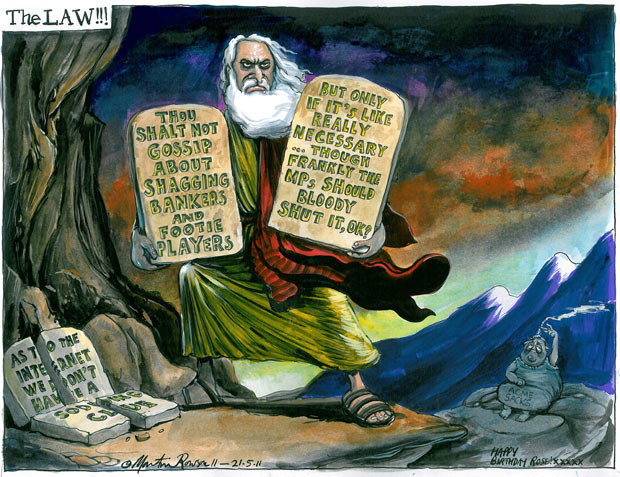
Ryan Giggs aka "CTB" has extended his High Court action against The Sun and Imogen Thomas, to include Twitter. Apparently, Ryan Giggs aka "CTB" is attempting to get Twitter to release details of the Twitter accounts which have named him in defiance of a court order.
It would appear that Ryan Giggs has now become something of a Twitter joke!
Latest news for 22 May Ryan Giggs named in Scottish press.
Friday, May 20, 2011
Ex-MP Elliot Morley jailed for expenses fraud
Ex-MP Elliot Morley jailed for expenses fraud
Former Labour minister Elliot Morley has been sentenced to 16 months in jail for dishonestly claiming more than £30,000 in parliamentary expenses.
 Elliot Morley was a government minister under Tony Blair's government
He pleaded guilty last month to making excessive claims for mortgage costs from 2004 to 2007 and claiming for a mortgage that had been paid off.
Morley, MP for Scunthorpe since 1987, stepped down at the general election.
As a former environment minister, he is the most senior politician to plead guilty to expenses fraud.
When the allegations against him first surfaced, he claimed it had been a genuine mistake and said he would prove that he was not guilty of deception.
But the Crown Prosecution Service said Morley's behaviour had been "blatantly dishonest".
The 58-year-old pleaded guilty to two charges of false accounting under the Theft Act.
He admitted to receiving £15,200 more than he was entitled to in inflated mortgage claims and of submitting £16,800 of claims towards a mortgage on a property near Scunthorpe - after it had been paid off.
He wrongly filled out a total of 40 forms relating to mortgage payments.
Sentencing him, Mr Justice Saunders said Morley had been "a positive force for good" during his time as a minister and had done "a great deal to promote the green agenda".
The judge described it as "a tragic case" for the defendant and said Morley had "thrown away his good name and good character".
Former Labour minister Elliot Morley has been sentenced to 16 months in jail for dishonestly claiming more than £30,000 in parliamentary expenses.
 Elliot Morley was a government minister under Tony Blair's government
He pleaded guilty last month to making excessive claims for mortgage costs from 2004 to 2007 and claiming for a mortgage that had been paid off.
Morley, MP for Scunthorpe since 1987, stepped down at the general election.
As a former environment minister, he is the most senior politician to plead guilty to expenses fraud.
When the allegations against him first surfaced, he claimed it had been a genuine mistake and said he would prove that he was not guilty of deception.
But the Crown Prosecution Service said Morley's behaviour had been "blatantly dishonest".
The 58-year-old pleaded guilty to two charges of false accounting under the Theft Act.
He admitted to receiving £15,200 more than he was entitled to in inflated mortgage claims and of submitting £16,800 of claims towards a mortgage on a property near Scunthorpe - after it had been paid off.
He wrongly filled out a total of 40 forms relating to mortgage payments.
Sentencing him, Mr Justice Saunders said Morley had been "a positive force for good" during his time as a minister and had done "a great deal to promote the green agenda".
The judge described it as "a tragic case" for the defendant and said Morley had "thrown away his good name and good character".
United Kingdom: Legal Challenges Against The "Blanket Ban" On Prisoners' Vote
United Kingdom: Legal Challenges Against The "Blanket Ban" On Prisoners' Vote
20 May 2011
Article by Jennifer Spence and Carron Rand
As voters across the UK went to the polls on Thursday 5 May 2011, in a series of national and local elections, as well as a referendum on the way in which MPs are elected, prisoners remained disenfranchised.
Over one month into the 6 month timescale fixed by the European Court of Human Rights (ECtHR), the UK Government has taken no steps to address the blanket ban on prisoners exercising their right to vote. We recently reported that the ECtHR had, for the time being at least, drawn a line under the issue, noting that it would not hear any further applications pending compliance by the UK Government. This decision, however, has not prevented prisoners from continuing to challenge the blanket ban. Indeed, some of those who have continued to do so have adopted distinctly different arguments, with a view to taking their cases to a different European Court altogether; not to the ECtHR in Strasbourg, but to the European Court of Justice (ECJ) in Luxembourg.
One such prisoner, who sought to challenge the decision of the Electoral Registration Officer to refuse to register him as a voter, by way of judicial review, has been unsuccessful in obtaining a reference to the ECJ. Lord Tyre dismissed the Petition for Judicial Review on the basis that a statutory remedy existed that provided an effective means of seeking redress and, in respect of the substantial arguments, Lord Tyre was not persuaded by the interpretation of the European Union law as presented on behalf of the prisoner. In finding against the prisoner, Lord Tyre was of the view that the rights referred to (which, it was argued, provided the individual prisoner with the opportunity to vote in certain elections) were only conferred on persons resident in a member state of which they are not a national. Accordingly, they were not applicable here. Furthermore, there was uncertainty as to which elections fell into the specific category that these rights related to, but this matter did not require to be considered in full as the judicial review was dismissed on other grounds.
An appeal has now been marked against this decision and, following a successful motion for early disposal, the appeal will be heard by three Senior Judges in the Inner House of the Court of Session in early July 2011. It seems unlikely that the UK Government will have taken steps to introduce legislation to address the blanket ban on prisoners voting by the time the Court hears this appeal, particularly with MPs currently focused on coming to terms with the fall out from the recent elections. It remains to be seen, however, whether such steps will be taken before the Court’s decision is issued, or, (if the Court determines it appropriate) before the matter reaches the ECJ, or even before the 6 month timescale expires.
20 May 2011
Article by Jennifer Spence and Carron Rand
As voters across the UK went to the polls on Thursday 5 May 2011, in a series of national and local elections, as well as a referendum on the way in which MPs are elected, prisoners remained disenfranchised.
Over one month into the 6 month timescale fixed by the European Court of Human Rights (ECtHR), the UK Government has taken no steps to address the blanket ban on prisoners exercising their right to vote. We recently reported that the ECtHR had, for the time being at least, drawn a line under the issue, noting that it would not hear any further applications pending compliance by the UK Government. This decision, however, has not prevented prisoners from continuing to challenge the blanket ban. Indeed, some of those who have continued to do so have adopted distinctly different arguments, with a view to taking their cases to a different European Court altogether; not to the ECtHR in Strasbourg, but to the European Court of Justice (ECJ) in Luxembourg.
One such prisoner, who sought to challenge the decision of the Electoral Registration Officer to refuse to register him as a voter, by way of judicial review, has been unsuccessful in obtaining a reference to the ECJ. Lord Tyre dismissed the Petition for Judicial Review on the basis that a statutory remedy existed that provided an effective means of seeking redress and, in respect of the substantial arguments, Lord Tyre was not persuaded by the interpretation of the European Union law as presented on behalf of the prisoner. In finding against the prisoner, Lord Tyre was of the view that the rights referred to (which, it was argued, provided the individual prisoner with the opportunity to vote in certain elections) were only conferred on persons resident in a member state of which they are not a national. Accordingly, they were not applicable here. Furthermore, there was uncertainty as to which elections fell into the specific category that these rights related to, but this matter did not require to be considered in full as the judicial review was dismissed on other grounds.
An appeal has now been marked against this decision and, following a successful motion for early disposal, the appeal will be heard by three Senior Judges in the Inner House of the Court of Session in early July 2011. It seems unlikely that the UK Government will have taken steps to introduce legislation to address the blanket ban on prisoners voting by the time the Court hears this appeal, particularly with MPs currently focused on coming to terms with the fall out from the recent elections. It remains to be seen, however, whether such steps will be taken before the Court’s decision is issued, or, (if the Court determines it appropriate) before the matter reaches the ECJ, or even before the 6 month timescale expires.
Ken Clarke's night of trial on Question Time in jail
Ken Clarke's night of trial on Question Time in jail
If the justice secretary had hoped to play his get-out-of-jail card on the show, he failed
Mark Lawson, The Guardian, Friday 20 May 2011
 Ken Clark on Question Time. Photograph: BBC
One of the most recognisable formats in British television – BBC1's Question Time – displayed two startling variations, becoming, in a rare conflation of two elements of the judicial system, both a prison and the dock of a courtroom.
The jail was the studio for the night. As presenter David Dimbleby explained, the programme was coming from the chapel of Wormword Scrubs, although Jack Straw – who made up the panel with Kenneth Clarke, columnist Melanie Phillips and Shami Chakrabarti of the campaign group Liberty – seemed to have missed this, at one point referring to the location as Wandsworth.
But, however many criminals were in the audience, it was the justice secretary who spent the night on trial, following his suggestion on BBC Radio 5 Live on Wednesday that some rapes were less serious than others.
The first question asked of the panel was whether Clarke's remarks had been "clumsy, wrong or misconstrued?" and this issue, more Westminster than Wormwood, occupied the first half hour of the show.
Clarke apologised again for giving offence, but in his characteristic bluff, elucidation-for-idiots voice, which risked seeming inappropriate from a politician whose best recovery tactic would surely be contrition and humility. He said he got "bogged down in a silly exchange", which resulted in a "media brouhaha".
There was an unusual element of tension in the questioners, who generally are divided between the main political parties but, last night, Dimbleby explained, comprised prisoners, prison staff and some other invited guests. Although warders were clearly recognisable by uniform, questioners did not otherwise reveal which portion of the audience they belonged to.
So, for viewers, there was the curious feeling of taking part in an identity parade, trying to pick out the villain. At every cutaway, you wondered: is that an inmate and, if so, what had they done? Tantalisingly, the second contributor wore on her wrist what seemed to be a plastic, hospital-style identification tag. What did this mean? When "man in a pink shirt" revealed that he was a "former probation officer", had he left the profession because he was locked up or, more likely, because he was retired and invited?
Then, 35 minutes in, the chairman finally asked a bloke in a black polo-neck: "Are you a prisoner here?" He was. Later, another participant was similarly pinpointed, although the general impression was of a standard Question Time audience, although with rather more scars.
The identity of some of the guests also gave an unfamiliar suspense to the traditional exercise in which the studio audience is asked to give a show of hands on an issue. For example, Clarke at one point asked for a forest of arms on whether the current rape sentencing tariffs are correct, although it seemed unlikely that the old lags' community coming out for lighter incarceration would have helped him much at this juncture.
Although Phillips was hissed and booed at one point, the atmosphere in the jail-house chapel was generally more polite than it is in the studio, perhaps because the prisoners were sitting flanked by people with powers to deny them benefits. There were no jokes at all about MPs who might soon be joining them. The panel was also polite, the current
justice secretary and his Labour predecessor chummily Ken-ing and Jack-ing each other.
With five minutes to go, the debate finally fired, with an identified and named prisoner asking if prisoners should be permitted the vote. Only Chakrabarti was in favour. The sentenced in the audience had been given the consolation of taking part in this Thursday night branch of democracy but may have joined viewers in finding it rather disappointing.
And, if Kenneth Clarke hoped to play his get-out-of-jail card on the show, he failed.
If the justice secretary had hoped to play his get-out-of-jail card on the show, he failed
Mark Lawson, The Guardian, Friday 20 May 2011
 Ken Clark on Question Time. Photograph: BBC
One of the most recognisable formats in British television – BBC1's Question Time – displayed two startling variations, becoming, in a rare conflation of two elements of the judicial system, both a prison and the dock of a courtroom.
The jail was the studio for the night. As presenter David Dimbleby explained, the programme was coming from the chapel of Wormword Scrubs, although Jack Straw – who made up the panel with Kenneth Clarke, columnist Melanie Phillips and Shami Chakrabarti of the campaign group Liberty – seemed to have missed this, at one point referring to the location as Wandsworth.
But, however many criminals were in the audience, it was the justice secretary who spent the night on trial, following his suggestion on BBC Radio 5 Live on Wednesday that some rapes were less serious than others.
The first question asked of the panel was whether Clarke's remarks had been "clumsy, wrong or misconstrued?" and this issue, more Westminster than Wormwood, occupied the first half hour of the show.
Clarke apologised again for giving offence, but in his characteristic bluff, elucidation-for-idiots voice, which risked seeming inappropriate from a politician whose best recovery tactic would surely be contrition and humility. He said he got "bogged down in a silly exchange", which resulted in a "media brouhaha".
There was an unusual element of tension in the questioners, who generally are divided between the main political parties but, last night, Dimbleby explained, comprised prisoners, prison staff and some other invited guests. Although warders were clearly recognisable by uniform, questioners did not otherwise reveal which portion of the audience they belonged to.
So, for viewers, there was the curious feeling of taking part in an identity parade, trying to pick out the villain. At every cutaway, you wondered: is that an inmate and, if so, what had they done? Tantalisingly, the second contributor wore on her wrist what seemed to be a plastic, hospital-style identification tag. What did this mean? When "man in a pink shirt" revealed that he was a "former probation officer", had he left the profession because he was locked up or, more likely, because he was retired and invited?
Then, 35 minutes in, the chairman finally asked a bloke in a black polo-neck: "Are you a prisoner here?" He was. Later, another participant was similarly pinpointed, although the general impression was of a standard Question Time audience, although with rather more scars.
The identity of some of the guests also gave an unfamiliar suspense to the traditional exercise in which the studio audience is asked to give a show of hands on an issue. For example, Clarke at one point asked for a forest of arms on whether the current rape sentencing tariffs are correct, although it seemed unlikely that the old lags' community coming out for lighter incarceration would have helped him much at this juncture.
Although Phillips was hissed and booed at one point, the atmosphere in the jail-house chapel was generally more polite than it is in the studio, perhaps because the prisoners were sitting flanked by people with powers to deny them benefits. There were no jokes at all about MPs who might soon be joining them. The panel was also polite, the current
justice secretary and his Labour predecessor chummily Ken-ing and Jack-ing each other.
With five minutes to go, the debate finally fired, with an identified and named prisoner asking if prisoners should be permitted the vote. Only Chakrabarti was in favour. The sentenced in the audience had been given the consolation of taking part in this Thursday night branch of democracy but may have joined viewers in finding it rather disappointing.
And, if Kenneth Clarke hoped to play his get-out-of-jail card on the show, he failed.
Thursday, May 19, 2011
Fred Goodwin super-injunction lifted
Lord Breaks Superinjuction On Fred Goodwin
Lord Breaks Superinjuction On Fred Goodwin
 Former RBS boss Sir Fred Goodwin
A Lord has broken the superinjuction in place surrounding former RBS boss Fred Goodwin in the House of Lords.
Lord Stoneham, asking a question in the House of Lords on behalf of Lord Oakeshott, said: "To ask HMG what steps they will take to ensure that the public interest is taken into account in the granting of superinjuctions?"
In a supplementary question he said: "Would he accept that every taxpayer has a direct public interest in the events leading up to the collapse of the Royal Bank of Scotland?
"So how can it be right for a superinjunction to hide the alleged relationship between Sir Fred Goodwin and a senior colleague?
"If true, it would be a serious failure of corporate governance and not even the FSA would be allowed to know about it."
Justice minister Lord McNally replied: "I do not think it is proper for me, from this dispatch box, to comment on individual cases, some of which are before the courts."
Lord Oakeshott told Sky News: "What could be of greater public interest than the worst corporate crash in British history which cost the taxpayers billions?"
Sky's Deputy Political Editor Joey Jones said: "We have already had superinjunctions when the alleged facts are being trawled all over the internet, in particularly on Twitter, and making a mockery of superinjunctions.
"Now what we are seeing is individual parliamentarians successively chipping away at this specific superinjunction that was imposed by Sir Fred Goodwin.
"Originally it was Labour MP John Hemmings who revealed the existence of the superinjuction, which we would not have been able to talk about - and the fact it even prohibited us from saying he was a banker.
"Now you have this Lib Dem peer going further and revealing further details of it, suggesting it is regarding an alleged affair with a colleague and obviously this will infuriate Fred Goodwin.
"But he [Lord Oakeshott] does have absolute privilege to stand up in Parliament and say these things."
Fred Goodwin was the chief executive of the Royal Bank of Scotland from 2000 until October 2008.
He stood down in January 2009, just a month before the bank announced its total losses for 2008 were £24.1bn - the largest annual loss in UK corporate history.
UPDATE: More on the story from the Independent.
 Former RBS boss Sir Fred Goodwin
A Lord has broken the superinjuction in place surrounding former RBS boss Fred Goodwin in the House of Lords.
Lord Stoneham, asking a question in the House of Lords on behalf of Lord Oakeshott, said: "To ask HMG what steps they will take to ensure that the public interest is taken into account in the granting of superinjuctions?"
In a supplementary question he said: "Would he accept that every taxpayer has a direct public interest in the events leading up to the collapse of the Royal Bank of Scotland?
"So how can it be right for a superinjunction to hide the alleged relationship between Sir Fred Goodwin and a senior colleague?
"If true, it would be a serious failure of corporate governance and not even the FSA would be allowed to know about it."
Justice minister Lord McNally replied: "I do not think it is proper for me, from this dispatch box, to comment on individual cases, some of which are before the courts."
Lord Oakeshott told Sky News: "What could be of greater public interest than the worst corporate crash in British history which cost the taxpayers billions?"
Sky's Deputy Political Editor Joey Jones said: "We have already had superinjunctions when the alleged facts are being trawled all over the internet, in particularly on Twitter, and making a mockery of superinjunctions.
"Now what we are seeing is individual parliamentarians successively chipping away at this specific superinjunction that was imposed by Sir Fred Goodwin.
"Originally it was Labour MP John Hemmings who revealed the existence of the superinjuction, which we would not have been able to talk about - and the fact it even prohibited us from saying he was a banker.
"Now you have this Lib Dem peer going further and revealing further details of it, suggesting it is regarding an alleged affair with a colleague and obviously this will infuriate Fred Goodwin.
"But he [Lord Oakeshott] does have absolute privilege to stand up in Parliament and say these things."
Fred Goodwin was the chief executive of the Royal Bank of Scotland from 2000 until October 2008.
He stood down in January 2009, just a month before the bank announced its total losses for 2008 were £24.1bn - the largest annual loss in UK corporate history.
UPDATE: More on the story from the Independent.
Mark Seddon: When are the people going to get the referendum on Europe?
Mark Seddon: When are the people going to get the referendum on Europe?

Comment: I don't really know about this save for the knowledge that for prisoners they will fare better from Europe than they will from the UK. But, I do like the poster...
Comment: I don't really know about this save for the knowledge that for prisoners they will fare better from Europe than they will from the UK. But, I do like the poster...
Distraction politics?
Distraction politics?
I can't help wondering if this whole thing with Kenneth Clarke was engineered by Number Ten to deflect media attention away from Teresa May...
Clarke survives after offering clarification
Justice Secretary defies calls for his resignation after unguarded remarks provoke a storm of recrimination

Home Secretary made to suffer in silence for police spending cuts
Plans to cut spending on the police by 20 per cent over four years were condemned by the Police Federation

In any event, I was quite impressed with the analysis provided by Daniel Finklestein and John McTiernan on Newsnight last night. Basically, the message was that we can no longer afford to imprison so many for such long periods of time. This is why we now have to accept alternatives.
I can't help wondering if this whole thing with Kenneth Clarke was engineered by Number Ten to deflect media attention away from Teresa May...
Clarke survives after offering clarification
Justice Secretary defies calls for his resignation after unguarded remarks provoke a storm of recrimination
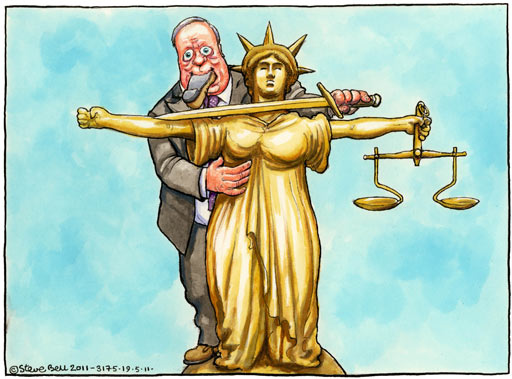
Home Secretary made to suffer in silence for police spending cuts
Plans to cut spending on the police by 20 per cent over four years were condemned by the Police Federation

In any event, I was quite impressed with the analysis provided by Daniel Finklestein and John McTiernan on Newsnight last night. Basically, the message was that we can no longer afford to imprison so many for such long periods of time. This is why we now have to accept alternatives.
Wednesday, May 18, 2011
Jailhouselawyer nails Ken Clarke on prisoners votes
Jailhouselawyer nails Ken Clarke on prisoners votes
Victoria Derbyshire: Very quick last call, it's John in Hull, he is the man who started the campaign to get prisoners the right to vote. John, good morning.
John Hirst: Good morning.
Victoria Derbyshire: Very quick question to Ken Clarke.
John Hirst: Err. When do you intend to give all convicted prisoners the vote? I mean it's been over 6 years since the case was won over there. And on Thursday you are going on Question Time with the man, Jack Straw, who didn't do anything for 5 years and you have done anything for a year, when do you intend doing something?
Ken Clarke: Whe're never going to give every convicted criminal the vote. And there's no judgment that requires us to do so. We're still considering to what extent we will give prisoners who have committed minor offences the vote, but we're going to have to reflect on that because of the the the reaction to the human rights case and the debate we had in Parliament. The Government is still considering what to do and if anything in response to it. But if you committed the rather dreadful crime you committed before you would not get the vote, I'd be flatly against you getting the vote. Now you are out you can vote. And, I hope you vote responsibly, and vote for a tough and effective policy to crime and you support my views on reoffending and I hope you don't offend again".
Victoria Derbyshire: Very quick last call, it's John in Hull, he is the man who started the campaign to get prisoners the right to vote. John, good morning.
John Hirst: Good morning.
Victoria Derbyshire: Very quick question to Ken Clarke.
John Hirst: Err. When do you intend to give all convicted prisoners the vote? I mean it's been over 6 years since the case was won over there. And on Thursday you are going on Question Time with the man, Jack Straw, who didn't do anything for 5 years and you have done anything for a year, when do you intend doing something?
Ken Clarke: Whe're never going to give every convicted criminal the vote. And there's no judgment that requires us to do so. We're still considering to what extent we will give prisoners who have committed minor offences the vote, but we're going to have to reflect on that because of the the the reaction to the human rights case and the debate we had in Parliament. The Government is still considering what to do and if anything in response to it. But if you committed the rather dreadful crime you committed before you would not get the vote, I'd be flatly against you getting the vote. Now you are out you can vote. And, I hope you vote responsibly, and vote for a tough and effective policy to crime and you support my views on reoffending and I hope you don't offend again".

Ryan Giggs wants to search journalists' email and text records
Ryan Giggs wants to search journalists' email and text records
Ryan Giggs, the footballer with the injunction against The Sun and Imogen Thomas, has asked the UK High Court to grant him permission to search through emails and text messages of journalists at the Sun newspaper, according to media reports.
Link to story.
This is known as a fishing expedition!
Ryan Giggs, the footballer with the injunction against The Sun and Imogen Thomas, has asked the UK High Court to grant him permission to search through emails and text messages of journalists at the Sun newspaper, according to media reports.
Link to story.
This is known as a fishing expedition!
Jeff King: Should prisoners have the right to vote?
Jeff King: Should prisoners have the right to vote?
MAY 18, 2011 · 12:28 PM

I think they should, and want to explain why in a way that addresses the issue recently faced by the courts and by Parliament. The prisoner voting saga culminated in the Hirst v UK (No.2) [2005] ECHR 681 case before the Grand Chamber of the European Court of Human Rights, and the nearly five hour debate on the floor of the House of Commons which ended with a 234-22 vote in favour of a resolution that “supports the current situation in which no prisoner is able to vote except those imprisoned for contempt, default or on remand.”: House of Commons Debates, 10 February 2011, Vol 523, No.116, 493-586. The saga, for Parliament, represented two distinct issues: whether the Strasbourg Court was exceeding its competency; and whether prisoners ought, as a moral and human rights matter, to have the right to vote. This blog entry is concerned only with the second of these questions, but as it turns out, the status of the right to vote as a human right is highly relevant to the resolution of this moral issue.
The debate in the Commons was supposed to address that moral question in order to satisfy the finding in Hirst that the impugned 1983 law, which carried forth without debate a policy adopted in 1870, could not be justified as being necessary in a democratic society given that Parliament had not debated the issue in light of modern day penal policy: Hirst v UK, [79]; but see Joint Dissenting Opinion of Justice Wildhaber et. al., [7]. However, the Commons was almost entirely preoccupied with the question of whether Strasbourg had exceeded its authority or was staffed with incompetent judges. Indeed, the matter swung so much that way, that the Attorney General was forced to remind the House of the point of the debate, eliciting the following hilarious exchange:
The Attorney General (Mr. D Grieve): ‘Members might also wish to focus on why they consider the current ban, or some variant of it, to be reasonable and proportionate in our own national context. It was the absence of debate of that issue that appeared to make the Court take the view that our ban was indiscriminate.’ (HC Debate, 513)
Chris Bryant (Lab): ‘Really?’ (513)
Ben Gumner (Con): ‘I am slightly worried by what my right hon. and learned friend said earlier about the purpose of this debate.’ (515)
David Davidson (Con): ‘Does the AG accept that, in being a lawyer, he has the problem of over-complicating matters? [Laughter.[sic]] Is not the basic issue whether we in this country should decide our line on whether prisoners should be able to vote – or should it be decided by somebody else?’ (517)
So much for reasonable disagreement about the scope of the right to vote. In fact, as Liora Lazarus has noted on this blog in her response to Graham Gee, it was almost impossible to find any discussion which acknowledged the existence of the right and tried to delineate its scope. Only a few could arguably have been said to address the issue that way: see Long (HC Debates, 532-33); Qureshi (535-36); Corbyn (538-39). In fairness, a few MPs did address the moral issue moderately squarely, and at times the debate was very impressive on all sides of the issue. The most frequent argument against prisoner voting is that such criminals had broken the social contract: HC Debate, 527, 544, 563. One can be tempted here to get philosophically pedantic, and claim that no one actually signed any social contract, and that a ‘hypothetical contract is not simply a pale form of an actual contract; it is no contract at all.’ (Dworkin: Taking Rights Seriously (1977: 17-18). But what the MPs surely meant is that community life entails obligations of reciprocity, one in which the benefits of the state system and mutual forbearance come with the burdens of obedience to the rules adopted fairly by the community. One can at once see the allure and limitations of this argument. It is among the better reasons for why we normally obey community rules (though not always, see Raz, The Authority of Law (1979: Ch.12). But it’s less convincing to those who have had poor life chances, and received a slim share of the alleged benefits of forbearance. The link between inequality and incarceration is shocking: Wilkinson and Pickett, The Spirit Level (2010: ch.11). And let it not be forgotten that due to exactly this type of reasoning, which essentially justifies depriving voting for life, one in eight African-American men is ineligible to vote in America: Cole, ‘Can our shameful prisons be reformed?’, NY Rev Books, 19 Nov 2009, §4. The fact that Britain tailors the disenfranchisement to the prison term is less cruel, but it borrows the same reasoning.
But I want to suggest that the argument is misguided for another reason. It implicitly fails to recognise a very relevant dimension of the issue, namely that the right to vote is a fundamental human right. It is not a privilege, like a driving license or access to the gym on weeknights. The denial of this claim, including immediately by the two sponsors of the resolution, was a veritable leitmotif of the debate:
Jack Straw: ‘the issue before us today – is by no stretch of the imagination a breach of fundamental human rights. Rather it is a matter of penal policy…’ (HC Debates, 502; see also 493).
David Davis: ‘[T]here is an important point about not confusing the rights that are properly held by everybody who is a British citizen…with those much more circumscribed rights that are given to prisoners.’ ): (493).
Many others: 537, 539, 542, 545, 548, 553, 556, 557, 577 (debate on that point), 578.
But the right to vote is a human right. Participation in self-government is the most basic expression of the principle of equality, a recognition that each person has basic, equal and presumptively irrevocable civic status in the society. So the many MPs who denied that idea are wrong as a matter of law, and of morality: see in addition to Art.3, AP.1 of the ECHR, the International Covenant on Civil and Political Rights, art. 25(b); Waldron, Law and Disagreement (1999: Ch.11), and cf. Griffin, On Human Rights (2008: ch.15, but note 254-255). (Some parliamentarians became exercised over the Court’s deriving a right to vote from the duty to hold periodic elections in Art.3, AP1 (see Hirst v UK, [56]-[62]) but that is hardly an interpretive stretch by comparison to equality rights for transsexuals or gays in the military). The fact that it is a human right means it is among the most basic conditions for human dignity, autonomy, and citizenship. One does not forfeit a fundamental human right as the default penalty for non-compliance with law.
So what does that mean then? I would say this: it is of the essence of basic human rights that they are qualified or limited, if at all, only for a legitimate or compelling state interest achieved by proportionate means (i.e. are necessary and strike a fair balance). I think this admittedly legalistic proportionality principle neatly encapsulates the presumptive or peremptory force, or urgency, we attach to rights in the realm of moral practical reasoning as well. Limitations of those types of interests require special justification.
We recognise this principle in the human rights law relating to prisoners, who continue to enjoy nearly all their other human rights while in prison, to the extent that they are exercised compatibly with the basic regimen of prison life: Hirst v UK, [69]. But don’t we take away the prisoner’s right to liberty? How can one say that this can go but the right to vote must stay? This is believed to be the ace in the back pocket of those opposing prisoner voting. It is a difficult issue, but the analogy breaks down upon close examination.
In Hirst, the UK offered three legitimate state aims: (1) it would punish crime; (2) it would prevent crime; and (3) it would enhance civic responsibility and promote respect for the rule of law: Hirst v UK, [50], [74]-[75]. Consider these aims and the deprivation of liberty. As to punishment, it is notable that we do not incarcerate all offenders. Typically it is only the more serious and violent ones. In these cases, it is plausible to say that incarceration is necessary to punish, because it may well be the only acceptable social response that constitutes a grave or real sanction for the offender in the relevant circumstances. Second, imprisonment at least arguably constitutes a deterrent, and, more importantly, it takes serious criminals off the streets or out of bank boardrooms where, if left, they would be liable to continue harming the public. Third, the rehabilitation/civic responsibility function of prisons is sharply contested. But there is at least a prima facie argument that without rattling the jailhouse keys, it would be hard to induce offenders to take up activities designed to facilitate their constructive re-entry into civil society, including especially the conditions for release on license (parole).
Disenfranchisement cuts a poor figure next to the deprivation of liberty, at least when these aims are contemplated. Taking them in reverse order, the idea that denial of the vote enhances civic responsibility is ludicrous. It is the very negation of their civic capacity, a message of mandatory disengagement, and of revoked social status: see HD Debates, 576-577 (Lorely Burt MP (LibDem), a former prison governor); see also 536 (Qureshi (Lab)), 538-39 (Corbyn (Lab)), 545 (Brake(LibDem)). Second, denying the vote will in no way deter people from crime, given that many prisoners would not vote anyway, and the loss of the vote would add nothing by way of discouragement, for most offenders, to the loss of liberty. And the vote itself will not harm the public through the choice of harmful candidates. (This public protection rationale may justify, in my view, disenfranchisement in cases such as post-war Germany or Rwanda, or in cases of electoral fraud, where there is a special proportionality akin to expulsion from a profession for misconduct). We thus arrive at the third argument – that it is necessary to punish the criminal. I see why some will think this is punishment, even though for most prisoners it will not be. But it is not necessary to punish, because the deprivation of liberty and subsequent difficulties in re-joining society constitute the real and effective forms of punishment. It is true that it is additional punishment for those that care, but then that does not make it necessary, nor does it explain why some other form of additional punishment (no doubt more effective if pain is the goal) could not be sought.
At the very base then, my argument amounts to this: we do not give violent prisoners the vote because they “deserve” it; we do so because they are presumptively entitled to vote as a basic human right, not as a privilege, and we have no good argument for saying it is necessary to take it away.
Jeff King is a Fellow and Tutor in Law at Balliol College, Oxford.
MAY 18, 2011 · 12:28 PM

I think they should, and want to explain why in a way that addresses the issue recently faced by the courts and by Parliament. The prisoner voting saga culminated in the Hirst v UK (No.2) [2005] ECHR 681 case before the Grand Chamber of the European Court of Human Rights, and the nearly five hour debate on the floor of the House of Commons which ended with a 234-22 vote in favour of a resolution that “supports the current situation in which no prisoner is able to vote except those imprisoned for contempt, default or on remand.”: House of Commons Debates, 10 February 2011, Vol 523, No.116, 493-586. The saga, for Parliament, represented two distinct issues: whether the Strasbourg Court was exceeding its competency; and whether prisoners ought, as a moral and human rights matter, to have the right to vote. This blog entry is concerned only with the second of these questions, but as it turns out, the status of the right to vote as a human right is highly relevant to the resolution of this moral issue.
The debate in the Commons was supposed to address that moral question in order to satisfy the finding in Hirst that the impugned 1983 law, which carried forth without debate a policy adopted in 1870, could not be justified as being necessary in a democratic society given that Parliament had not debated the issue in light of modern day penal policy: Hirst v UK, [79]; but see Joint Dissenting Opinion of Justice Wildhaber et. al., [7]. However, the Commons was almost entirely preoccupied with the question of whether Strasbourg had exceeded its authority or was staffed with incompetent judges. Indeed, the matter swung so much that way, that the Attorney General was forced to remind the House of the point of the debate, eliciting the following hilarious exchange:
The Attorney General (Mr. D Grieve): ‘Members might also wish to focus on why they consider the current ban, or some variant of it, to be reasonable and proportionate in our own national context. It was the absence of debate of that issue that appeared to make the Court take the view that our ban was indiscriminate.’ (HC Debate, 513)
Chris Bryant (Lab): ‘Really?’ (513)
Ben Gumner (Con): ‘I am slightly worried by what my right hon. and learned friend said earlier about the purpose of this debate.’ (515)
David Davidson (Con): ‘Does the AG accept that, in being a lawyer, he has the problem of over-complicating matters? [Laughter.[sic]] Is not the basic issue whether we in this country should decide our line on whether prisoners should be able to vote – or should it be decided by somebody else?’ (517)
So much for reasonable disagreement about the scope of the right to vote. In fact, as Liora Lazarus has noted on this blog in her response to Graham Gee, it was almost impossible to find any discussion which acknowledged the existence of the right and tried to delineate its scope. Only a few could arguably have been said to address the issue that way: see Long (HC Debates, 532-33); Qureshi (535-36); Corbyn (538-39). In fairness, a few MPs did address the moral issue moderately squarely, and at times the debate was very impressive on all sides of the issue. The most frequent argument against prisoner voting is that such criminals had broken the social contract: HC Debate, 527, 544, 563. One can be tempted here to get philosophically pedantic, and claim that no one actually signed any social contract, and that a ‘hypothetical contract is not simply a pale form of an actual contract; it is no contract at all.’ (Dworkin: Taking Rights Seriously (1977: 17-18). But what the MPs surely meant is that community life entails obligations of reciprocity, one in which the benefits of the state system and mutual forbearance come with the burdens of obedience to the rules adopted fairly by the community. One can at once see the allure and limitations of this argument. It is among the better reasons for why we normally obey community rules (though not always, see Raz, The Authority of Law (1979: Ch.12). But it’s less convincing to those who have had poor life chances, and received a slim share of the alleged benefits of forbearance. The link between inequality and incarceration is shocking: Wilkinson and Pickett, The Spirit Level (2010: ch.11). And let it not be forgotten that due to exactly this type of reasoning, which essentially justifies depriving voting for life, one in eight African-American men is ineligible to vote in America: Cole, ‘Can our shameful prisons be reformed?’, NY Rev Books, 19 Nov 2009, §4. The fact that Britain tailors the disenfranchisement to the prison term is less cruel, but it borrows the same reasoning.
But I want to suggest that the argument is misguided for another reason. It implicitly fails to recognise a very relevant dimension of the issue, namely that the right to vote is a fundamental human right. It is not a privilege, like a driving license or access to the gym on weeknights. The denial of this claim, including immediately by the two sponsors of the resolution, was a veritable leitmotif of the debate:
Jack Straw: ‘the issue before us today – is by no stretch of the imagination a breach of fundamental human rights. Rather it is a matter of penal policy…’ (HC Debates, 502; see also 493).
David Davis: ‘[T]here is an important point about not confusing the rights that are properly held by everybody who is a British citizen…with those much more circumscribed rights that are given to prisoners.’ ): (493).
Many others: 537, 539, 542, 545, 548, 553, 556, 557, 577 (debate on that point), 578.
But the right to vote is a human right. Participation in self-government is the most basic expression of the principle of equality, a recognition that each person has basic, equal and presumptively irrevocable civic status in the society. So the many MPs who denied that idea are wrong as a matter of law, and of morality: see in addition to Art.3, AP.1 of the ECHR, the International Covenant on Civil and Political Rights, art. 25(b); Waldron, Law and Disagreement (1999: Ch.11), and cf. Griffin, On Human Rights (2008: ch.15, but note 254-255). (Some parliamentarians became exercised over the Court’s deriving a right to vote from the duty to hold periodic elections in Art.3, AP1 (see Hirst v UK, [56]-[62]) but that is hardly an interpretive stretch by comparison to equality rights for transsexuals or gays in the military). The fact that it is a human right means it is among the most basic conditions for human dignity, autonomy, and citizenship. One does not forfeit a fundamental human right as the default penalty for non-compliance with law.
So what does that mean then? I would say this: it is of the essence of basic human rights that they are qualified or limited, if at all, only for a legitimate or compelling state interest achieved by proportionate means (i.e. are necessary and strike a fair balance). I think this admittedly legalistic proportionality principle neatly encapsulates the presumptive or peremptory force, or urgency, we attach to rights in the realm of moral practical reasoning as well. Limitations of those types of interests require special justification.
We recognise this principle in the human rights law relating to prisoners, who continue to enjoy nearly all their other human rights while in prison, to the extent that they are exercised compatibly with the basic regimen of prison life: Hirst v UK, [69]. But don’t we take away the prisoner’s right to liberty? How can one say that this can go but the right to vote must stay? This is believed to be the ace in the back pocket of those opposing prisoner voting. It is a difficult issue, but the analogy breaks down upon close examination.
In Hirst, the UK offered three legitimate state aims: (1) it would punish crime; (2) it would prevent crime; and (3) it would enhance civic responsibility and promote respect for the rule of law: Hirst v UK, [50], [74]-[75]. Consider these aims and the deprivation of liberty. As to punishment, it is notable that we do not incarcerate all offenders. Typically it is only the more serious and violent ones. In these cases, it is plausible to say that incarceration is necessary to punish, because it may well be the only acceptable social response that constitutes a grave or real sanction for the offender in the relevant circumstances. Second, imprisonment at least arguably constitutes a deterrent, and, more importantly, it takes serious criminals off the streets or out of bank boardrooms where, if left, they would be liable to continue harming the public. Third, the rehabilitation/civic responsibility function of prisons is sharply contested. But there is at least a prima facie argument that without rattling the jailhouse keys, it would be hard to induce offenders to take up activities designed to facilitate their constructive re-entry into civil society, including especially the conditions for release on license (parole).
Disenfranchisement cuts a poor figure next to the deprivation of liberty, at least when these aims are contemplated. Taking them in reverse order, the idea that denial of the vote enhances civic responsibility is ludicrous. It is the very negation of their civic capacity, a message of mandatory disengagement, and of revoked social status: see HD Debates, 576-577 (Lorely Burt MP (LibDem), a former prison governor); see also 536 (Qureshi (Lab)), 538-39 (Corbyn (Lab)), 545 (Brake(LibDem)). Second, denying the vote will in no way deter people from crime, given that many prisoners would not vote anyway, and the loss of the vote would add nothing by way of discouragement, for most offenders, to the loss of liberty. And the vote itself will not harm the public through the choice of harmful candidates. (This public protection rationale may justify, in my view, disenfranchisement in cases such as post-war Germany or Rwanda, or in cases of electoral fraud, where there is a special proportionality akin to expulsion from a profession for misconduct). We thus arrive at the third argument – that it is necessary to punish the criminal. I see why some will think this is punishment, even though for most prisoners it will not be. But it is not necessary to punish, because the deprivation of liberty and subsequent difficulties in re-joining society constitute the real and effective forms of punishment. It is true that it is additional punishment for those that care, but then that does not make it necessary, nor does it explain why some other form of additional punishment (no doubt more effective if pain is the goal) could not be sought.
At the very base then, my argument amounts to this: we do not give violent prisoners the vote because they “deserve” it; we do so because they are presumptively entitled to vote as a basic human right, not as a privilege, and we have no good argument for saying it is necessary to take it away.
Jeff King is a Fellow and Tutor in Law at Balliol College, Oxford.
Jovial Kenneth Clarke has a field day on rape
Jovial Kenneth Clarke has a field day on rape
 Kenneth Clarke
 Rapeseed Field
 Kenneth Clarke
 Rapeseed Field
Long prison sentences fail not just offenders, but society too
Long prison sentences fail not just offenders, but society too
The tough US sentencing model appeals to the vengeance-hungry British press, but rehabilitation is the key to tacking crime
Mark Johnson, The Guardian, Wednesday 18 May 2011
 'Money spent on banging people up for years is money thrown away because offenders come back again and again.' Photograph by David Sillitoe for the Guardian
When the Ministry of Justice (MoJ) released figures this month comparing reoffending rates, commentators fell over each other jumping to conclusions. According to the MoJ, longer sentences (of two to four years) resulted in a lower rate of reoffending than shorter sentences. Community orders and suspended sentences also led to less reoffending than sentences of under a year, but most newspapers chose to ignore any fact which might have obstructed their inalienable right to call for stiffer sentencing.
The biggest predictor of reoffending is not length of sentence but age. Inmates released after a four-year term are older and their offending goes down accordingly. They have also had the benefit of interventions which those serving short sentences do not enjoy. In addition, they are supported on release by an offender manager.
The MoJ research could have confounded the pundits if it had investigated other factors. For instance, when services are extended to provide help finding jobs and housing on release, reoffending drops. This is true whatever the length of sentence. It is also proven that facilitating consistent family contact during a sentence increases the chance of successful resettlement: this, too, is unrelated to length of sentence.
Since the figures prompted predictable calls for more sentences, longer sentences and tougher jails, let's look at a nation where exactly that formula has been applied. The US began to follow the path now prescribed by British commentators at the end of the last century.
Where has it led them? Well, first to the highest incarceration rate in the world. According to research by King's College London, in 2009 there were almost 2.3 million Americans in jail: that is more than 756 prisoners for every 100,000 citizens compared with 153 in England and Wales – and our own incarceration rate is high compared with most of Europe.
Thanks to a zero-tolerance approach to drugs and a policy of three strikes and you're in (for life!), petty criminals and small-time drug dealers are incarcerated for the long-term with the dangerous and violent. Most people who study prisons agree that a stay in a US penitentiary is a horrific experience but there is, shamefully, no overall monitoring body to assess levels of assault and abuse within jails. An insider study of one anonymous prison discovered that over 20% of inmates had been raped. In some states it is legal to use dogs not just to sniff out drugs but to attack non-compliant inmates.
However, someone is gaining from the high prisoner numbers: the companies which are running America's privatised jails. Taxpayers' money has turned prisons into big business. They thrive on high inmate numbers and low staffing levels and for prisoners this can only mean a lot of lock-down. And in the privatised world, the prospect of seriously denting profits by cutting prisoner numbers is a disincentive to successful rehabilitation programmes.
Let's see if the UK pundits calling for us to emulate the American system are right. How effective are longer sentences, a tough work regime and hellish jail experience when it comes to cutting crime in the US? The answer is no more effective than our own. Half of US prisoners are back inside within three years and two-thirds are rearrested in this time. No surprises there. I've never yet met an offender who was deterred from crime by the length of sentence.
I hope our government will have the guts to ignore the vengeance-hungry press and public who read a few statistics and think they know how to run a jail. Money spent on banging people up for years or on punishing community payback is money thrown away because offenders come back again and again.
Economics alone means that our penal system should be based not on punishment but on rehabilitation to cut the crime rate instead of detaining the same people over and over again. Can we afford the $49bn (£30.2bn) the US spends on running prisons? Let's keep the American model where it belongs – across the Atlantic.
Comment: This writer is beginning to earn my respect.
The tough US sentencing model appeals to the vengeance-hungry British press, but rehabilitation is the key to tacking crime
Mark Johnson, The Guardian, Wednesday 18 May 2011
 'Money spent on banging people up for years is money thrown away because offenders come back again and again.' Photograph by David Sillitoe for the Guardian
When the Ministry of Justice (MoJ) released figures this month comparing reoffending rates, commentators fell over each other jumping to conclusions. According to the MoJ, longer sentences (of two to four years) resulted in a lower rate of reoffending than shorter sentences. Community orders and suspended sentences also led to less reoffending than sentences of under a year, but most newspapers chose to ignore any fact which might have obstructed their inalienable right to call for stiffer sentencing.
The biggest predictor of reoffending is not length of sentence but age. Inmates released after a four-year term are older and their offending goes down accordingly. They have also had the benefit of interventions which those serving short sentences do not enjoy. In addition, they are supported on release by an offender manager.
The MoJ research could have confounded the pundits if it had investigated other factors. For instance, when services are extended to provide help finding jobs and housing on release, reoffending drops. This is true whatever the length of sentence. It is also proven that facilitating consistent family contact during a sentence increases the chance of successful resettlement: this, too, is unrelated to length of sentence.
Since the figures prompted predictable calls for more sentences, longer sentences and tougher jails, let's look at a nation where exactly that formula has been applied. The US began to follow the path now prescribed by British commentators at the end of the last century.
Where has it led them? Well, first to the highest incarceration rate in the world. According to research by King's College London, in 2009 there were almost 2.3 million Americans in jail: that is more than 756 prisoners for every 100,000 citizens compared with 153 in England and Wales – and our own incarceration rate is high compared with most of Europe.
Thanks to a zero-tolerance approach to drugs and a policy of three strikes and you're in (for life!), petty criminals and small-time drug dealers are incarcerated for the long-term with the dangerous and violent. Most people who study prisons agree that a stay in a US penitentiary is a horrific experience but there is, shamefully, no overall monitoring body to assess levels of assault and abuse within jails. An insider study of one anonymous prison discovered that over 20% of inmates had been raped. In some states it is legal to use dogs not just to sniff out drugs but to attack non-compliant inmates.
However, someone is gaining from the high prisoner numbers: the companies which are running America's privatised jails. Taxpayers' money has turned prisons into big business. They thrive on high inmate numbers and low staffing levels and for prisoners this can only mean a lot of lock-down. And in the privatised world, the prospect of seriously denting profits by cutting prisoner numbers is a disincentive to successful rehabilitation programmes.
Let's see if the UK pundits calling for us to emulate the American system are right. How effective are longer sentences, a tough work regime and hellish jail experience when it comes to cutting crime in the US? The answer is no more effective than our own. Half of US prisoners are back inside within three years and two-thirds are rearrested in this time. No surprises there. I've never yet met an offender who was deterred from crime by the length of sentence.
I hope our government will have the guts to ignore the vengeance-hungry press and public who read a few statistics and think they know how to run a jail. Money spent on banging people up for years or on punishing community payback is money thrown away because offenders come back again and again.
Economics alone means that our penal system should be based not on punishment but on rehabilitation to cut the crime rate instead of detaining the same people over and over again. Can we afford the $49bn (£30.2bn) the US spends on running prisons? Let's keep the American model where it belongs – across the Atlantic.
Comment: This writer is beginning to earn my respect.
Tuesday, May 17, 2011
Prison solves problem of illegal mobile phones
Prison solves problem of illegal mobile phones
Smuggled mobile phones are a headache for the Prison Service. But a jail in Nottingham may have found the solution
 Fights over access to phones are common in prison. Photograph: Mikael Karlsson/Alamy
Illegal mobile phones in jail are a challenging issue for the Prison Service. Thousands have been confiscated over recent years and thousands are still in daily use by prisoners. Tabloid newspapers tell us that the phones are used by criminals carrying on their business from inside. Why else would they need mobiles, they ask, when there are telephones on the landings of every jail in the country? But the headlines mask the truth.
Phones were installed on prison landings after the Lord Justice Woolf inquiry into the Strangeways prison riot in 1990. Before then, prisoners used to rely on letters; a slow method of communication for all, and impossible for thousands of illiterate prisoners. Woolf criticised the meagre contact between prisoners and their families, and recommended installing telephones on prison landings.
But getting access to a phone is not easy. Most prisoners can only call out during prisoner association periods. The times of these vary, but can be as little as one hour a day. This causes problems, and arguments and fights over calls are a regular occurrence.
Inside Time, the national newspaper for prisoners, published this from a prisoner at Risley jail, in Cheshire, who complained he was unable to call his seriously ill father every day: "There are four phones here on B wing, but only three work," he wrote.
"Association is from 6pm to 7pm, but it is usually 6.15pm before we are unlocked. There are 120 inmates on this wing; if we had the full hour and everyone had 10 minutes on the phone, that would allow 18 prisoners to make calls."
He went on: "Every act of violence I have witnessed here has been due to the phones, or lack of them. The situation is open to bullying and causes mental distress to those who can't phone home."
But there is a better way. At Lowdham Grange, a category-B prison in Nottingham, prisoners can make phone calls from landlines in their cells 24 hours a day. Prisoners there submit a list of numbers to be approved, then pay in advance for their calls, which can be monitored.
I ask one ex-offender just released from Lowdham Grange how many contraband mobiles were in the prison. "Very few," he says, "they are not needed, when men can phone their families at any time day or night." He admits to having used illicit mobiles in other jails, but only because the usual method of telephoning home was so restrictive.
But elsewhere, most prisoners resort to keeping an illicit mobile in their cell. Although some of these are smuggled in by prisoners, many are brought in by prison staff (there is a going rate for doing so).
One prisoner's wife says her husband regularly calls her on a clandestine mobile. She works evenings, so is unable to talk to him through legal channels. She accepts he is breaking prison rules, but believes regular contact is important. "I like to keep him abreast of family life, involve him in decision making, it makes him feel part of the family he is away from," she says. "But it would be nice to do it legitimately."
Lowdham Grange is operated by Serco, which has also installed landlines in some cells at Dovegate prison, Staffordshire. Serco is so confident that they are not being abused that it plans to install phones in all five jails it operates in England.
"The introduction of in-cell telephony at Lowdham Grange was followed by significant improvements in prison security, including a marked reduction in attempts to smuggle mobile phones into the establishment," says Vicky O'Dea, prisons operations director at Serco. "The number of prisoners failing random mandatory drug tests also fell following the introduction of the scheme."
She says the phones have made the prison safer. "Prisoner safety improved – there were fewer assaults, less bullying and fewer incidents of self-harm. Prisoners could make phone calls in more decent conditions, and the frequency and quality of contact with their families increased. Maintaining family contact is a proven factor in reducing the likelihood that prisoners will reoffend; consequently, introducing the phones led to an improvement in rehabilitation."
For now, state-run prisons have been reluctant to adopt the same stance. The prison service says it is "exploring the possibilities of a pilot installation [of in-cell phones] in a state-run establishment, as we recognise the advantages and benefits of such a system".
Meanwhile, most prisoners will have to keep hanging on.
Smuggled mobile phones are a headache for the Prison Service. But a jail in Nottingham may have found the solution
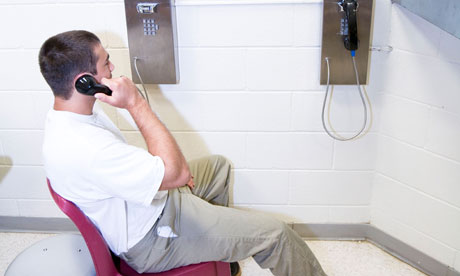 Fights over access to phones are common in prison. Photograph: Mikael Karlsson/Alamy
Illegal mobile phones in jail are a challenging issue for the Prison Service. Thousands have been confiscated over recent years and thousands are still in daily use by prisoners. Tabloid newspapers tell us that the phones are used by criminals carrying on their business from inside. Why else would they need mobiles, they ask, when there are telephones on the landings of every jail in the country? But the headlines mask the truth.
Phones were installed on prison landings after the Lord Justice Woolf inquiry into the Strangeways prison riot in 1990. Before then, prisoners used to rely on letters; a slow method of communication for all, and impossible for thousands of illiterate prisoners. Woolf criticised the meagre contact between prisoners and their families, and recommended installing telephones on prison landings.
But getting access to a phone is not easy. Most prisoners can only call out during prisoner association periods. The times of these vary, but can be as little as one hour a day. This causes problems, and arguments and fights over calls are a regular occurrence.
Inside Time, the national newspaper for prisoners, published this from a prisoner at Risley jail, in Cheshire, who complained he was unable to call his seriously ill father every day: "There are four phones here on B wing, but only three work," he wrote.
"Association is from 6pm to 7pm, but it is usually 6.15pm before we are unlocked. There are 120 inmates on this wing; if we had the full hour and everyone had 10 minutes on the phone, that would allow 18 prisoners to make calls."
He went on: "Every act of violence I have witnessed here has been due to the phones, or lack of them. The situation is open to bullying and causes mental distress to those who can't phone home."
But there is a better way. At Lowdham Grange, a category-B prison in Nottingham, prisoners can make phone calls from landlines in their cells 24 hours a day. Prisoners there submit a list of numbers to be approved, then pay in advance for their calls, which can be monitored.
I ask one ex-offender just released from Lowdham Grange how many contraband mobiles were in the prison. "Very few," he says, "they are not needed, when men can phone their families at any time day or night." He admits to having used illicit mobiles in other jails, but only because the usual method of telephoning home was so restrictive.
But elsewhere, most prisoners resort to keeping an illicit mobile in their cell. Although some of these are smuggled in by prisoners, many are brought in by prison staff (there is a going rate for doing so).
One prisoner's wife says her husband regularly calls her on a clandestine mobile. She works evenings, so is unable to talk to him through legal channels. She accepts he is breaking prison rules, but believes regular contact is important. "I like to keep him abreast of family life, involve him in decision making, it makes him feel part of the family he is away from," she says. "But it would be nice to do it legitimately."
Lowdham Grange is operated by Serco, which has also installed landlines in some cells at Dovegate prison, Staffordshire. Serco is so confident that they are not being abused that it plans to install phones in all five jails it operates in England.
"The introduction of in-cell telephony at Lowdham Grange was followed by significant improvements in prison security, including a marked reduction in attempts to smuggle mobile phones into the establishment," says Vicky O'Dea, prisons operations director at Serco. "The number of prisoners failing random mandatory drug tests also fell following the introduction of the scheme."
She says the phones have made the prison safer. "Prisoner safety improved – there were fewer assaults, less bullying and fewer incidents of self-harm. Prisoners could make phone calls in more decent conditions, and the frequency and quality of contact with their families increased. Maintaining family contact is a proven factor in reducing the likelihood that prisoners will reoffend; consequently, introducing the phones led to an improvement in rehabilitation."
For now, state-run prisons have been reluctant to adopt the same stance. The prison service says it is "exploring the possibilities of a pilot installation [of in-cell phones] in a state-run establishment, as we recognise the advantages and benefits of such a system".
Meanwhile, most prisoners will have to keep hanging on.
Subscribe to:
Posts (Atom)