Site Meter

Wednesday, May 04, 2011

Prison Service admits considerable staff corruption threat

Prison Service admits considerable staff corruption threat

As a prison officer in London is jailed for two years for corruption, Channel 4 News obtains an internal prison service document warning about the scale of the threat.


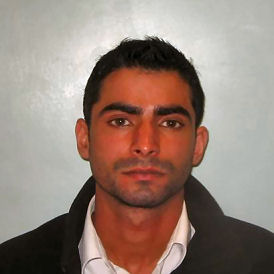
Mohammed Mirza, a 24 year-old who worked as a prison officer at Feltham Young Offenders Insititute, was sentenced at Southwark Crown Court for conspiring with a prisoner and the prisoner's mother to smuggle three mobile phones into the prison.

Mirza stood to gain £500 for his efforts - a prison officer's starting salary is £17,187.

His case is just one example of a corruption problem which is affecting prisons across England and Wales.

Channel 4 News has obtained an internal prison service document which gives one of the most candid assessments yet of the scale of the threat. The document titled 'Prison Drugs Supply Reduction - A Good Practice Guide' was obtained by think-tank Policy Exchange through a Freedom of Information request.

In a chapter headed 'Staff Corruption', the prison service admits the threat of corruption of prison staff is "considerable". It goes on to say: "The unpalatable but inevitable conclusion is that corrupt staff constitutes a significant supply route for drugs into prisons."

Tackling the problem

The Ministry of Justice gave Channel 4 News figures which they say show they are tackling the problem.

In the last three years, 92 prison staff have been dismissed, 78 convicted, and 167 staff who work for other agencies within the prison service have been excluded from such work.

A unit within the Metropolitan Police was set up three years ago to deal exclusively with prison corruption issues in London: the first of its kind in the country.

Head of the Prison Service Michael Spurr told Channel 4 News: "I am absolutely clear there are corrupt staff; I am absolutely clear we have to tackle that and not pretend it doesn't exist. I'm clear that we must work through what intelligence we've got about the potential for corruption - and then identify those involved and take action."

Lincolnshire Police unlawfully harass the public

Lincolnshire Police unlawfully harass the public

When the police start bothering people who are not engaged in a criminal activity, then it is unlawful. It amounts to harassment. Instead of the super rich getting super injunctions, this is the kind of activity which warrants the courts issuing injunctions to prevent the abuse of power.

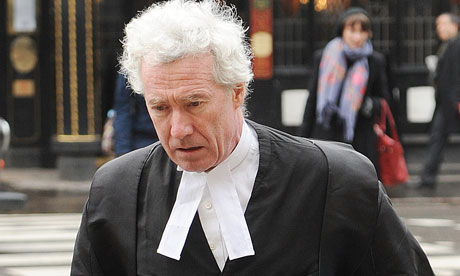
Jonathan Sumption, QC, the odd man out!

Jonathan Sumption, QC, the odd man out!


At a time when the UK is attacking the legitimacy of the highest court in Europe, the European Court of Human Rights. One of the accusations being that some of the judges lack prior judicial experience. The UK appoints a lawyer with no prior judicial experience to the highest court in the UK, the United Kingdom Supreme Court!

Why?

It exposes hypocrisy of the highest order. It means that the UK's criticism of the ECtHR is unjustified. It leaves a taste in the mouth that this is a political appointment. Is the UK so short of judges with the necessary judicial experience for the UKSC that it has to appoint a lawyer who has no judicial experience whatsoever over qualified judges?

Security breach let huge quantity of drugs into prison

Security breach let huge quantity of drugs into prison

By Tom Pugh, PA

Wednesday, 4 May 2011


Huge quantities of drugs and mobile phones filtered into a prison because of a "serious compromise" in security, an independent report has revealed.

The security breach was uncovered at the mobile temporary unit at Camp Hill on the Isle of Wight last year but has since been dealt with.

The rise in the amount of drugs and mobile phones at the Category C site had an impact on the regime and the level of violence, the prison's Independent Monitoring Board (IMB) report said.

Drug debts and substance abuse leads to intimidation, bullying and violence, and roof-top protests were sparked by inmates scared of violence and wanting to be moved, it added.

The board said it was concerned about the number of roof-top incidents at Camp Hill, resulting in specialist teams from the mainland being deployed at high cost.

More than 100 vulnerable spots where prisoners could gain access to out-of-bounds areas were identified in a recent survey at Camp Hill. But this was not deemed unusual as it is a Category C level jail, the board said.

HMP Isle of Wight was formed following the merging of the former Parkhurst, Albany and Camp Hill prisons in April 2009 in an effort to cut overall budget costs.

The report said: "The amount of drugs freely available, especially in Camp Hill site, is wholly unacceptable, and causes bullying and prisoners living in real fear of their safety.

"Parkhurst and Albany sites suffer from illegal drugs less, but the sale of prescribed drugs, by one prisoner to another, causes great problems and funds should be provided in order to properly control the issue and taking of prescribed medication."

The board said it found it "totally unacceptable and unbelievable" that, in an establishment housing almost 1,700 prisoners, there was only one dog handler.

"Taking normal working hours, annual leave and training into account, this leaves the jail unprotected for a cumulative total of over 130 days a year," the report went on.

It urged ministers to review the situation urgently.

The IMB praised prison and police intelligence for foiling an elaborate escape plan using a helicopter last summer.

Murderer Brian Lawrence, who was convicted of killing a friend of his ex-lover and hiring a hitman to kill two others, used letters, Sudoku puzzles and writing in lemon juice as invisible ink to disguise his plans.

The operation was thought to involve using a nearby pop concert as diversion tactics because musicians regularly arrived and left by helicopter.

A Prison Service spokesman said: "We thank the Independent Monitoring Board at HMP Isle of Wight for their report, which will be fully considered by ministers. We will respond to the board in due course."

Sovereignty not dead, but Quebec 'decided to get some air': experts

Sovereignty not dead, but Quebec 'decided to get some air': experts

By Philip Authier, Montreal Gazette May 3, 2011 9:29 PM


Sovereigntists are licking their wounds, shocked and not sure really where to turn now that they have been reduced to a tiny rump of four MPs in the House of Commons. Photograph by: Christinne Muschi, Reuters

MONTREAL — It was all supposed to happen like clockwork.

Re-elect the Bloc Quebecois in Ottawa. Elect the Parti Quebecois in Quebec City.

After that, "Everything again becomes possible," Bloc leader Gilles Duceppe boldly announced May 15 when he spoke to PQ delegates at a policy convention.

The bravado is gone now. So are the seats. And the money.

Instead, sovereigntists are licking their wounds, not sure really where to turn now that they have been reduced to a rump of four MPs in the House of Commons.

Is it all over? It does not look good for the Bloc, that's for sure.

Gone are the generous federal research budgets, paid staff, chauffeur-driven cars, the right to stand up daily and try and discredit the federal system in the name of defending Quebec's interests.

All that was useful to the PQ and its ultimate goal. After nearly two decades and five successful election campaigns, it's got to hurt.

Duceppe, who quit the party leadership Monday evening in the wake of the debacle, had planned a news conference Tuesday but it was cancelled at the last minute.

After vanishing, he quietly deactivated his campaign Twitter and Facebook accounts. Bloc officials stopped returning calls.

Under media pressure, Bloc vice-president Vivian Barbot issued a statement in which she said the Bloc is not dead and will continue to represent Quebecers' interests in Ottawa "with the same rigour which has always characterized us," Barbot said.

She added that despite the loss of seats, the Bloc nonetheless won 24 per cent of the popular vote.

"Our party thus remains a significant political tool for a good number of Quebecers," said Barbot.

"You know people have often spoken of the disappearance of the Bloc but it has never disappeared," said Louis Plamondon, one of only four Bloc MPs who survived the NDP slaughter Monday.

But back at the sovereigntist mother ship, the Parti Quebecois, the mood was grim, the spin machine was in full swing to downplay what many say was a setback by "the cousins" in Ottawa.

Even if the Bloc was virtually wiped off the map Monday, PQ leader Pauline Marois denied Quebecers were turning their backs on sovereignty.

She argued the Bloc meltdown does not matter because sovereignty was not an issue in the election.

"Sovereignty is just as alive as it ever was," Marois said at a news conference in Quebec City.

She said the Bloc's 23 per cent share of the vote is still well below the usual score sovereignty gets in polls — about 40 per cent — so all is not lost.

Asked by a reporter point blank if the Bloc is dead, Marois dodged.

"Listen, we're going to take a little time to let the dust settle," she said.

Was the federalist side crowing? Premier Jean Charest played it cool, avoiding any kind of preachy triumphalism.

"Quebecers have shown an interest in re-involving themselves in the affairs of the country," Charest said.

"At the same time, sovereignty remains the legitimate choice of a significant number of Quebecers. As the leader of the Quebec Liberal Party and premier, it is a choice which I recognize and respect. The debate will continue essentially in Quebec."

Analysts interviewed by The Gazette said Tuesday that to conclude that Monday's elections means the end of sovereignty would be naive and simplistic.

The Quebec voter is a much more complex animal, as shown in this campaign.

On the other hand, there is food for thought for the movement in the way the campaign unfolded and in the results.

Universite de Sherbrooke political science professor Jean-Herman Guay said that for the first time in a long time, Quebec voters "were seduced without the seducer draping himself in blue."

What that means is NDP leader Jack Layton won Quebecers' hearts without promising a thing in the way of reforms to the federation. Layton made only a vague promise in the campaign that he would seek the "winning conditions," for Quebec to one day sign the Constitution.

Layton was equally fuzzy when Duceppe tried to box him in on the NDP's pledge to one day apply the Charter of the French Language to federal institutions.

"Over the weeks, the Quebec question, far from being a positive stake, became a source of boredom," Guay said in an analysis published in La Presse Tuesday.

"The Bloc's idea that it could maintain its legitimacy by posing as the only ones who could speak for Quebec, instead became a source of irritation."

Quebecers' desire for change also worked against the Bloc.

After 20 years in Ottawa and the same leader for 14 of them, "the Bloc became, for many, an old party which seemed to be marking time in the role of victim, constantly accusing the others of not respecting Quebec."

Universite Laval political communications expert, Thierry Giasson, said the tired worn-out impression was further reinforced when the Bloc trotted out such sovereigntist warhorses as former PQ leader Jacques Parizeau and union leader Gerald Larose in the dying days of the campaign in an attempt to stir up its sovereignty base.

Giasson said that was a mistake because the Bloc has always done its best among voters when it didn't talk too much about sovereignty.

Quebecers were happy to vote Bloc because they never saw it as a vote for separation. That is a provincial matter.

"I think Quebecers looked at this and said, 'I don't think I want to get aboard,' " Giasson said. "There was a definite backlash effect."

"People sensed panic. The Bloc trotted out this kind of forced line that they are sovereigntists and Quebecers and patriotic which seems to have repulsed many people.

"People said, 'No, no, I am a Quebecer. I am quite comfortable with my identity, I am proud of my roots, I'm French, I'm nationalist but I won't vote for you."

Giasson said that is a reaction the sovereignty movement will need to analyze carefully because it does not bode well for the future. The Bloc has already announced for a post-mortem caucus and executive meeting to figure out how it went so wrong.

Giasson adds sovereigntists have always had an affinity with the social democratic NDP because it resembles the left-leaning Bloc and PQ.

The vote was an easy transfer for many under the circumstances because people could vote NDP as the same time as sticking to their separatist convictions.

"I think they (Quebecers) aspired to something else and the NDP was deft enough to present an alternative of openness and the Layton line, 'give us a try," caught on like wildfire.

And nowhere did the line spread faster than during that old-fashioned social networking system known as the Easter weekend where families ate and talked about the campaign.

It fell right after the French debate when Layton performed so well, notes Jean-Francois Lisee, a former PQ adviser to Jacques Parizeau and Lucien Bouchard.

"At first, it (voting Jack) was almost a joke," Lisee says. "Then a challenge. In the end, why not? At Easter, over the chocolate, we were only talking about this.

'So you think this too? My uncle, who is red, does too. My brother-in-law who is blue, is going to. Soon enough, all of Quebec seemed up for it. Why not us?"

Lisee, who makes the argument on his blog, adds people need to consider the context surrounding the campaign, too.

Quebec's Liberal government is detested, so is the Conservative government in Ottawa. In Montreal, people want to flush the mayor out of power.

Why did they vote NDP?

"To escape, but of what? From prison? Exactly. The prison that is the status quo."

"Where will the escape lead us? Quebecers don't know. They think Jack is a good guy. He seems to understand Quebec.

"Are Quebecers less nationalist, less sovereigntist than before? Well, no. They just did what they felt like doing.

"The Quebec voter decided to get some air, lots of air. They have broken out of the routine, old habits, but they are still prisoners of Canada."

© Copyright (c) The Montreal Gazette

Tuesday, May 03, 2011

Osama Bin Laden shot as he surrendered!

Osama Bin Laden shot as he surrendered!

US Navy Seals supposedly engaged in a 40 minute firefight killed bin Laden, his courier, son and one of his wives.

What took them so long?

Were any of them even armed?

Was the unarmed Osama murdered because he resisted by engaging in a pillow fight?

UPDATE: Security officials have told Channel 4 News that Osama bin Laden was captured alive and shot dead by US special forces. The claims were apparently made by bin Laden's daughter.

Osama Bin Laden executed by US death squad

Osama Bin Laden executed by US death squad

"US officials suggest that, when confronted at the high-security complex in Abbottabad, Bin Laden did not have a weapon and did not fire at his assailants. With some questions being raised as to why Bin Laden was shot dead, and whether he was executed, rather than taken into custody".

EUROPEAN COURT OF HUMAN RIGHTS: Legitimacy Report

EUROPEAN COURT OF HUMAN RIGHTS: Legitimacy Report

European Court of Human Rights: Legitimacy Report

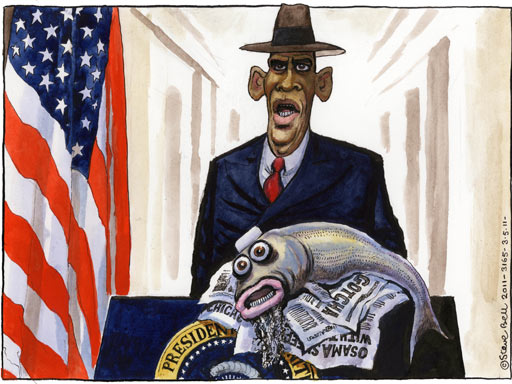
Obama the Codfather: Osama sleeps with the fishes!

Obama the Codfather: Osama sleeps with the fishes!

Osama Bin Laden was held in CIA secret prison in Pakistan for 10 years!

Osama Bin Laden was held in CIA secret prison in Pakistan for 10 years!

Diagram of the CIA secret prison in Abbottabad, an area with a military garrison, in Pakistan.

During the Battle of Tora Bora in Afghanistan in December 2001, Osama Bin Laden was wounded and taken prisoner in the mountains by allied forces and handed over to the CIA for interrogation.

World Press Freedom Day

World Press Freedom Day

Strasbourg/London, 03.05.2011


Council of Europe and PEN International call for stronger protection of freedom of expression


The Secretary General of the Council of Europe, Thorbjørn Jagland, and the President of PEN International, John Ralston Saul, today made the following joint statement to mark World Press Freedom Day on 3 May. They added that they are making this joint statement to express their concern over the growing threats to freedom of expression.

“Journalists and writers across the world are imprisoned and silenced every year for saying or writing things that did not please those in power. Now we are witnessing the imprisonment of bloggers, citizen journalists, web-activists – even simple Internet users, for legitimately exercising their right to freedom of expression.

It has never been easier to exercise our rights to expression and information, but it has also never been easier to interfere with them.

When freedom of expression cannot be exercised fully by media professionals or by writers, the freedom of each of us, of every citizen, is endangered. Our rights to receive information and to freely form and to hold views and opinions are limited. Our right to informed participation is eroded. Ultimately, democracy is compromised.

Freedom of speech is one of the essential pillars of a genuine democracy, it requires extraordinary protection. This is enshrined in Article 19 of the UN Declaration of Human Rights, Article 19 of the International Covenant on Civil and Political Rights and Article 10 of the European Convention on Human Rights.

We urge all governments, civil society actors, technical communities and the private sector to work together to protect freedom of expression in our common interest” Mr. Jagland and Mr. Saul said. “The Council of Europe and PEN International, drawing on our respective strengths, are currently looking at ways that we can cooperate to this end.”

***

The Council of Europe is a political organisation set up in 1949. The Council of Europe promotes human rights, democracy and the rule of law throughout the continent. It develops common responses to social, cultural and legal challenges in its 47 member States, which are bound by the European Convention on Human Rights. The European Court of Human Rights rules on individual or state applications alleging violations of the rights and freedoms it protects.

PEN International celebrates literature and promotes freedom of expression. Founded in 1921, its global community of writers now spans more than 100 countries. Its programmes, campaigns, events and publications connect writers and readers wherever they are in the world. PEN International operates in all five continents, with 144 PEN Centres in 102 countries. In 2010 it monitored over 700 cases worldwide of writers and journalists killed, disappeared, attacked, threatened or on trial.

Monday, May 02, 2011

Osama Bin Laden looking the worse for wear

Osama Bin Laden looking the worse for wear


Obituary: Osama Bin Laden

"Will we see pictures of the dead Bin Laden? When Saddam's sons were killed, pictures of their corpses were released by the American military, on the grounds that it was crucial for Iraqis to believe they were no more. This time, we're told that Bin Laden has already been buried at sea, the Saudis having refused to repatriate his body. The CIA say they have pictures from yesterday's assassination, and that the pictures of Bin Laden circulating right now (which have been picked up by some of the British media) are fake".

Osama Bin Laden looking the worse for wear or is that because of a photoshop?

Story behind fake photo

Surely some mistake?

Surely some mistake?

"At one point 32 fire engines from the 39 stations in the county were out on calls, a Lancashire Fire and Rescue spokeswoman said".

It does not add up...

No to Diana Johnson: Yes to AV

No to Diana Johnson: Yes to AV

Diana Johnson, a former minister, who just managed to beat a Liberal Democrat, Denis Healy, challenge in Hull North by 641 votes would have lost her seat under AV.

Vote yes to AV for Denis Healy

Diana Johnson who was criticised for her involvement in the expenses scandal.

Revealed: the 29 anti-reform MPs who would lose their seats under the AV system

Many people have died for the right to vote

Many people have died for the right to vote

Put an end to election apathy and show your solidarity with protesters around the world by casting a ballot, write Ronald F. Caza, Sara Ulmer and Yan Zawisza.

Utpal Baruah, REUTERS
Photograph by: UTPAL BARUAH, REUTERS


Recent events in North Africa and the Middle East, which still dominate the news, force us to realize the importance of exercising our own right to vote.

In the past several months, the voices of Tunisians, Egyptians, Libyans and the people of many other nations have cried out in unison for the right to elect representative governments which, in many places for the first time, would determine by democratic means the destiny of these countries and their citizens. In fact, all over the world, be it in Haiti, Sudan, Iraq or Afghanistan, we have seen the images of citizens ready to die, and far too many that have, for the right to express themselves on a very fundamental question: Who will make the important decisions affecting their lives and those of their families? So much is expressed in the most simple of gestures: casting a ballot.

The rise of these democratic movements prompts us to recall the very beginnings of our democracy.

In Athens in the sixth century B.C., male citizens were free to attend and speak at the assembly and to vote on the laws presented.

These democratic principles, which disappeared with the fall of the Athenian Empire, re-emerged centuries later in Europe, thanks in large part to European philosophers of the 17th and 18th centuries. In England, John Locke instigated the idea that government did not derive its authority from divine will, but rather through a contract between individuals and society. In France, Jean-Jacques Rousseau insisted on the principle of general will and the responsibility of each citizen to protect the life and liberty of all.

Armed with these ideas, citizens fighting for the right to participate in the political process and to shape their own destinies were able to free themselves from the rule of two of the most powerful empires of that period (as a result of the American Revolution in 1775 and the French Revolution in 1789).

Countless individuals sacrificed their lives so that in the future, all of us could be free from authoritarian rule. And let us never forget that the first step taken by an oppressive regime motivated by hate and the desire to retain power is to eliminate its citizens’ “right to vote.”

In Canada, before Confederation, authority rested in the hands of only a few influential people who could count on the support of the Governor General, representative of the English monarch. Gradually over time, citizens united to make their voices heard. Finally in 1848, Nova Scotia was the first colony in British North America to achieve responsible government, that is, a government requiring the support of its citizens. In the years that followed, the concept of responsible government made its way across the colonies, although it remained effectively a shadow of the system of voting we know today.

At the time of Confederation in 1867, only 11 per cent of the population was allowed to vote. The fundamental criteria were that the voter be male and 21 years of age or older. However, rules varying from province to province could also require a minimum of property or income and sometimes even limited the right to vote based on profession or ethnicity.

In 1916, what was called “universal manhood suffrage” was largely achieved when most men aged 21 and over were allowed to vote.

In 1918, women obtained the right to vote in federal elections, but it was only in 1951, when the Northwest Territories granted women the right to vote, that women could finally vote in all elections in Canada. Asian-Canadians, prevented from voting for extensive periods of time in some parts of the country, were only permanently given this right for good in 1949. And finally, as astonishing as it may seem, aboriginal people were only granted the right to vote in federal elections in 1960, and in all provinces only in 1969.

Since that time, the right to vote has only continued to expand. In 1970, the minimum voting age was lowered from 21 to 18 years of age. Since 1982, Section 3 of the Canadian Charter of Rights and Freedoms recognizes that: “Every citizen of Canada has the right to vote in an election of members of the House of Commons or of a legislative assembly.” The Supreme Court of Canada, which had already described voting as “the most important democratic duty which most Canadians will undertake in their lives: their choice as to who will govern them” and qualified it as a “sacred democratic function as a citizen,” invoked Section 3 to declare unconstitutional a provision of the Canada Elections Act that prevented prisoners serving a sentence of two years or more from voting.

Since this 2002 decision, all Canadian citizens possess the right to vote, with the exception of the chief electoral officer and assistant chief electoral officer. Now, all Canadian citizens, from billionaires to the homeless, have the right to vote, and each of those votes are equal.

Unfortunately, while the right to vote has been recognized as a fundamental right and in essence a duty, a new problem has emerged over the past several years: more and more Canadians are choosing not to vote.

During the 2008 elections, only 59 per cent of electors voted and less than 40 per cent of those aged between 18 and 24 cast a ballot. If this trend continues, our government will soon be elected by a minority of its citizens. Will we then still be able to speak of a representative government?

Why is it so important to vote in federal elections? From a practical point of view, the party that will be called on to form the next government will have the authority to take, on behalf of all of us, fundamental decisions that will significantly impact our lives. This is not simply a question of financial issues, as important as those are, but also of issues such as whether to send our citizens to war and of nominating the next justices of the Supreme Court of Canada, who will decide on matters affecting the fundamental rights of citizens vis-à-vis the state for decades to come.

We should not lose sight of the fact that once elected, a majority government is not legally bound by its campaign promises. We must therefore ensure that the party elected to lead this country reflects the values and visions of the majority of Canada’s citizens.

To explain why they haven’t voted, some say that their vote has no impact on the final result, but this is simply false. History shows us that a handful of votes can make all the difference. In 2008, one member of Parliament was elected by a margin of 17 votes and another by a margin of 22 votes. In simple terms, this means that if only nine and 11 voters respectively had voted for the second place candidate rather than the winner, those few votes would have changed the result. The vote of each person can have a profound impact on the results of the elections.

That is why, although voting requires only a simple gesture, it is the most important tool by which to participate in the future of our country.

Exercising your right to vote couldn’t be easier. All the information you need to vote, including where to vote, can be found on Elections Canada’s website (elections.ca) or by calling 1-800-463-6868.

Given current events, the least we can do is to vote in solidarity with those in North Africa and the Middle East who are literally dying to vote. Let us make sure that the politicians hear our voices, as a sign of respect for the families of those who have given their lives this year in the hopes of obtaining that same democratic right.

It is time to stand up and be counted.

Ronald F. Caza is a partner and Sara Ulmer and Yan Zawisza are students-at-law at the law firm Heenan Blaikie.
© Copyright (c) The Ottawa Citizen

Sunday, May 01, 2011

Interlaken process: The carrot and the stick

Interlaken process: The carrot and the stick


Ministerial conference in Interlaken


Interlaken Conference/Interlaken Declaration/Interlaken process

STATUTE OF THE COUNCIL OF EUROPE

Article 3

Every member of the Council of Europe must accept the principles of the rule of law and of the enjoyment by all persons within its jurisdiction of human rights and fundamental freedoms, and collaborate sincerely and effectively in the realisation of the aim of the Council as specified in Chapter I.

Article 8

Any member of the Council of Europe which has seriously violated Article 3 may be suspended from its rights of representation and requested by the Committee of Ministers to withdraw under Article 7. If such member does not comply with this request, the Committee may decide that it has ceased to be a member of the Council as from such date as the Committee may determine.

Following on from the Interlaken Conference...


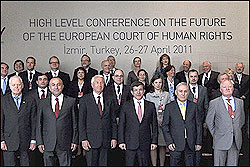
Council of Europe conference adopts the ''Izmir Declaration'' on the future of the European Court of Human Rights

Ministry of Justice press release

Clarke: European Court should allow for genuine differences of national approach

26 April 2011


It is arguable that a reading of other Member States to the Council of Europe speechs at the Izir Conference run contrary to Ken Clarke sticking out a British stiff upper lip.

The UK is acting like a stubborn mule.


The UK must get past its sticking point. And fully comply with Hirst v UK (No2).

Kenneth Clarke admits the UK is a failing State

Kenneth Clarke admits the UK is a failing State

"The substantive articles contained in the HRA are exactly the same as in the ECHR. However two of the Articles are not included, Article 1 and Article 13. Under Article 1 of the ECHR rights and freedoms included in the Convention shall be secured to all people within the jurisdiction. Article 13 is the Right to an Effective Remedy. The Government felt it was not necessary to incorporate these Articles as the HRA means that convention rights are secured though domestic courts available to all and this in itself provides the effective remedy".

The Government may well have thought it was not necessary to incorporate the following Articles into the HRA 1998, I contend that it is necessary to amend the Act to include the omissions.

"Article 1 – Obligation to respect human rights

The High Contracting Parties shall secure to everyone within their jurisdiction the rights and freedoms defined in Section I of this Convention.

Article 13 – Right to an effective remedy

Everyone whose rights and freedoms as set forth in this Convention are violated shall have an effective remedy before a national authority notwithstanding that the violation has been committed by persons acting in an official capacity
".

What is wrong with the Government view is that it appears to be an attempt to get out of oblgations made under international law by way of domestic legislation. And, access to the courts is not necessarily the same as getting an effective remedy. It cannot be assumed that judges will necessarily reach a fair verdict. Especially by way of judicial review in cases of the Individual v the State. Prison case law is littered with cases where High Court judges have decided to prop up the State.

This calls into question the doctrines of the Separation of Powers and Supremacy of Parliament.

A solution to this problem may well be found in the European law principle of subsidiarity.

Particularly as Kenneth Clarke had this to say in his speech at the Izir Conference (26 – 27 April 2011):

"In Britain, it is going to be really quite difficult to persuade Parliament to pass legislation to comply with the Court’s judgment on vote for prisoners. This is regarded by our Parliament as a domestic political issue, on which there are valid arguments on both sides".

I cannot accept that being British is an excuse for ignoring to fully comply with a ECtHR judgment. For example, in 2006 the Republic of Ireland in response to Hirst v UK (No2) passed legislation to allow all prisoners to have postal votes. In addition Labour under Tony Blair's leadership brought in the HRA, and then made a statement in the Commons that prisoners would not get the vote under a Labour Government. This is proof that it is not difficult to persuade Parliament to legislate when it wants to.Blair's 'frenzied law making' : a new offence for every day spent in office.

So, the issue is not that it is difficult rather it is the lack of will to change the law which is the real problem. The question whether convicted prisoners should be allowed the vote was answered in the affirmative by the ECtHR. Because the UK allows individual petition to the ECtHR, the UK is surrendering sovereignty on the issue of determining human rights to the ECtHR. Therefore this approach is outdated: "This is regarded by our Parliament as a domestic political issue, on which there are valid arguments on both sides". The issue of human rights is an international legal and political issue. The UK is trying to forget that it is in the dock in this Individual v the State case. And that the UK submitted its arguments to the Court and lost the case, therefore any arguments submitted at the time have lost any validity. Only the winning side's arguments remain valid. This is what Parliament has difficulty with, that an individual could beat the State in a fair legal fight.

What Kenneth Clarke appears to fail to appreciate is that he is admitting that the UK is failing to deliver on its promise to deliver human rights to all its citizens. That there is a systemic failure. That there is an underlying structural fault. The UK is a failing nation State. If the UK is saying it cannot cope then it is inviting Strasbourg to provide the solution. So, instead of doing things a British way then it will have to be done a European way. Either the UK adopts the subsidiarity principle willingly or forcibly, or the UK will be forced to leave the Council of Europe and EU.

Should the European Court be allowed to dash my hopes of a cure?

Should the European Court be allowed to dash my hopes of a cure?

An imminent European ruling on stem cell research would deprive me, and others who have currently uncurable medical conditions, of hope, says Alasdair Palmer.

By Alasdair Palmer 7:00PM BST 30 Apr 2011


Comment:

"The European Court is at it again. No, not the court that has determined that Britain must give prisoners the vote, whatever our domestic law says – that's the Court of Human Rights in Strasbourg. The villain this time is the Court that interprets EU directives for member states, and it's in Brussels, not Strasbourg".

I think that it is a good idea that disabled people, like Alasdair Palmer, are employed by the Daily Telegraph and Channel 4. However, just because someone is disabled does not give them a right to attack another national minority, that is, those with the social status of prisoners.

Why Alasdair Palmer should attack prisoners is beyond me. The villain of the piece is not the ECtHR but the UK which is in the dock and was found guilty of violating convicted prisoners human right to the vote.

If he was to find himself in prison, it would be the other prisoners who would look after him and not the system. When writing this woe is me, self-pitying, piece I think he should have left the prisoners out of it all together because they are not to blame for his condition. He just comes across as an angry, bitter and twisted bloke not deserving of pity.

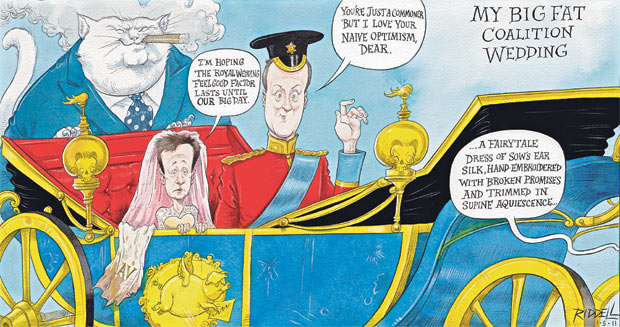
The happy couple

The happy couple

Chris Riddell on coalition nuptuals


Saturday, April 30, 2011

China releases prominent human rights lawyer Teng Biao

China releases prominent human rights lawyer Teng Biao

The Chinese authorities have released a prominent Chinese human rights lawyer Teng Biao after 70 days in custody.


Rights group said he was freed on Friday afternoon and his wife was quoted as saying that he "is okay".

Mr Teng's release came shortly after China and the US held two-day of talks on human rights issues in Beijing.

But in a separate development, another well-known Chinese human rights lawyer Li Fangping has disappeared, human rights groups said.

His alleged disappearance "the very same day... suggests that security forces are conducting a carefully planned assault on outspoken human rights defenders in a calculated effort to eviscerate China's rights defence movement", Phelim Kine from New York-based Human Rights Watch organisation was quoted as saying by the AFP news agency.

China has not publicly commented on the reports of Mr Li's disappearance.

The advocacy group China Aid said both Mr Teng and Mr Li were members of the Chinese Christian Rights Defence Association.

Friday's release of Teng followed the talks in between Chinese officials and US Assistant Secretary of State Michael Ponser in Beijing.

Mr Posner told reporters that he had voiced Washington's "deep concerns" about the crackdown on dissidents and human rights activists, following appeals on the internet for mass protests similar to those that have rocked a number of Arab countries.

The organisation Chinese Human Rights Defenders (CHRD) says dozens of activists have been taken into police custody or placed under house arrest in recent months.