Votes for prisoners: Bang to rights
Reluctance to meet our obligations to the European court of human rights makes it harder to uphold rights everywhere
Editorial The Guardian, Monday 24 January 2011
It has been a rough week for the coalition, and the Lib Dems' ambitions for constitutional reform have had the worst of it. The battle for the alternative vote teeters between success and disaster, while the attempt to allow prisoners the vote is taking on water. Complying with the 2004 ruling from the European court of human rights is still on the agenda, but in so weak a manner as to be likely to provoke a new legal challenge. This is not just an argument about human rights. It is a surrogate for an attack on the ECHR, led by Eurosceptic libertarian Tory MP David Davis in an unprincipled alliance with Labour's top command-and-control merchant, Jack Straw.
More than five years ago, the ECHR found that the UK's blanket ban on votes for prisoners was a breach of their human rights. To comply with the ruling, the UK government had to decide on what grounds prisoners could be disenfranchised. Despite complaints from Strasbourg, Labour procrastinated. The matter was unresolved when the coalition came in. Credit to Nick Clegg for including it in his constitutional reform remit, and coming up with a solution – votes for those sentenced to less than four years, with judicial discretion to remove the right in certain circumstances – which most thought would answer the case. Now he has been forced to concede that only those sentenced to less than a year should be enfranchised. The former proposal would have allowed about half the UK's adult prisoners to vote, the latter barely one in 10. Human rights lawyers will be standing by their BlackBerries.
There are two points here. First, as correspondents argued on these pages recently, it is morally right that prisoners should both pay their debt to society while continuing to remain a part of it. But the broader point is that the purpose of human rights legislation is to protect unpopular minorities. By definition, governments will find compliance politically uncomfortable. But noncompliance – failing to reach the basic standard that the British architects of the ECHR laid down 60 years ago – should be considered worse.
The Strasbourg court has little in the way of sanctions. The upholding of human rights elsewhere – in, say, Chechnya, or Lithuania – depends in part on the readiness of this country and others to accept and comply with the spirit of its rulings. There are many proposals for improving the court's workings, but no one has suggested an alternative to its authority resting on consensus and the capacity of signatories to be embarrassed when they are found in breach. David Cameron's churlish intention to do as little as possible to meet our obligations makes it harder to uphold rights everywhere.

A mixture of law, politics, autobiography and humour. Once described as "The Devilish Advocate" (Guardian), I do have the ability to provoke a response. Sometimes it comes from someone who uses a thought process, and sometimes from jerks usually associated with the knee.
Site Meter

Monday, January 24, 2011


Sunday, January 23, 2011
Prisoners in Hong Kong vote in local election
Prisoners in Hong Kong vote in local election
2011 Village Representative Election completed
Hong Kong (HKSAR) - The 2011 Village Representative Election (VRE), held over four consecutive Sundays, concluded successfully today (January 23).
Rounding up the four polling days, a total of 808 candidates from 246 villages contested 414 seats, including 273 Indigenous Inhabitants Representatives (IIRs) and 141 Resident Representatives (RRs). The overall turnout rate reached 63.56%, of which the respective turnouts for the IIR and the RR Elections were 63.85% and 63.19%, with 50,824 voters casting their votes.
This year, a total of 86,425 out of the 182,702 registered electors are female, representing a rate of 47.3%. There are 39 validly nominated female candidates, accounting for more than 10% increase as compared to that of the 2007 VRE.
As for today, the total turnout rate was 61.22%, with 11,738 of the 19,173 registered voters casting their votes. 187 candidates from 64 villages contested 94 seats, including 59 IIRs and 35 RRs, in respective villages.
This is the first VRE that prisoners or remanded unconvicted persons, who have registered as electors, can vote at dedicated polling stations. In the four polling days, 42prisoners and remanded unconvicted persons cast their votes.
There were 1,484 seats for the 2011 Village Representative Election, with 944 seats returned uncontested and 126 seats left vacant with no valid nomination.
The tenure of office for the new term of Village Representatives will run from April 1, 2011 to March 31, 2015.
The major role of an IIR is to reflect views on the affairs of an indigenous village on behalf of the indigenous inhabitants of that Village, and to deal with all affairs relating to the lawful traditional rights and interests, and the traditional way of life, of those indigenous inhabitants.
The major role of an RR is to reflect views on the affairs of a village on behalf of the residents of that village. An RR shall not deal with any affairs relating to the lawful traditional rights and interests of indigenous inhabitants.
Source: HKSAR Government
2011 Village Representative Election completed
Hong Kong (HKSAR) - The 2011 Village Representative Election (VRE), held over four consecutive Sundays, concluded successfully today (January 23).
Rounding up the four polling days, a total of 808 candidates from 246 villages contested 414 seats, including 273 Indigenous Inhabitants Representatives (IIRs) and 141 Resident Representatives (RRs). The overall turnout rate reached 63.56%, of which the respective turnouts for the IIR and the RR Elections were 63.85% and 63.19%, with 50,824 voters casting their votes.
This year, a total of 86,425 out of the 182,702 registered electors are female, representing a rate of 47.3%. There are 39 validly nominated female candidates, accounting for more than 10% increase as compared to that of the 2007 VRE.
As for today, the total turnout rate was 61.22%, with 11,738 of the 19,173 registered voters casting their votes. 187 candidates from 64 villages contested 94 seats, including 59 IIRs and 35 RRs, in respective villages.
This is the first VRE that prisoners or remanded unconvicted persons, who have registered as electors, can vote at dedicated polling stations. In the four polling days, 42prisoners and remanded unconvicted persons cast their votes.
There were 1,484 seats for the 2011 Village Representative Election, with 944 seats returned uncontested and 126 seats left vacant with no valid nomination.
The tenure of office for the new term of Village Representatives will run from April 1, 2011 to March 31, 2015.
The major role of an IIR is to reflect views on the affairs of an indigenous village on behalf of the indigenous inhabitants of that Village, and to deal with all affairs relating to the lawful traditional rights and interests, and the traditional way of life, of those indigenous inhabitants.
The major role of an RR is to reflect views on the affairs of a village on behalf of the residents of that village. An RR shall not deal with any affairs relating to the lawful traditional rights and interests of indigenous inhabitants.
Source: HKSAR Government
Peter Bone MP: It's time for an ‘in’ or ‘out’ referendum on Europe
Peter Bone MP: It's time for an ‘in’ or ‘out’ referendum on Europe

Today I am writing the article not in my normal position as a right-wing Conservative but for the first time as a coalitionist. I am writing it not as a Eurosceptic, but as someone who is trying to bridge the gap between Euro-enuthusiasts and Eurosceptics.
It has been nearly 36 years since the last referendum on Europe. This means that no one under the age of 54 has had their say on the European Union. This referendum however, was not on whether we should stay in or come out of the European Union; this was to see whether or not we stayed in the Common Market. The exact question was ‘Do you think the United Kingdom should stay in the European Community (the Common Market)?’ In other words, the question was wholly about trade, not in any way about the European Union. The British people have never been consulted on the European Union.
If my amendment 48 to the European Union Bill is passed tomorrow, there would have to be a binding ‘in’ or ‘out’ referendum on our membership of the European Union, if two hurdles are first cleared:
1. A referendum is triggered under the European Union Bill due to a proposed transfer of competency; and
2. The British people vote against such a transfer of power.
My amendment will give people the chance of what we have been deprived of since joining the European Union. That chance is to vote for whether or not the British people in fact want to be in the European Union. This would be a momentous occasion and finally put an end to the debate once and for all. Whether the people vote to stay in or to withdraw from the European Union, at least they would have a choice. This would also allow Euro-enthusiasts and Eurosceptics to unite in allowing the British people the final say.
Having an ‘in’ or ‘out’ referendum would be in line with the Liberal Democrats' manifesto, which stated that:
“The European Union has evolved significantly since the last public vote on membership over thirty years ago. Liberal Democrats therefore remain committed to an in/out referendum”
This would surely therefore please the Lib Dems and gain their support, having a referendum on something that they want, rather than having a referendum on something that was not in either the Conservative or the Liberal Democrat manifesto, such as the AV referendum.
Surely then, the only reason this amendment will not gain support from the Liberal Democrats is out of fear of the outcome - and this surely is not a reason not to let the people of Britain have a choice.
However, the Lib Dems and their supporters would not be the only political party to be pleased with a referendum. The Tory supporters would be especially happy; in my view the vast majority want such a vote. Most Conservative MPs support my amendment in either public or in private.
In my opinion many of the public want the chance to vote on whether we stay ‘in’ or ‘out’ of the European Union, and this amendment would give them this chance.
However, what I believe to be one of the fundamental issues concerning this Bill, is what David Cameron, our Prime Minister so admirably stood up for in the Party manifesto. The Conservative manifesto stated that we needed to have more free votes in committee on important key issues (page 67, Invitation to join the Government of Britain; Conservative manifesto 2010). Clearly this is indeed a key issue, one that affects so many millions of British people, so Conservative MPs should be given a free vote on it. This should not be a whipped vote, it should be for Parliament to decide.
If this amendment were to become law, I believe it would stop a future government supporting a transfer of powers to the European Union; it would also give who was ever in power a very strong bargaining position with the European Union. Any future government that tried to transfer powers to the European Union without the safe guard of and ‘in’ or ‘out’ referendum, would, I think, be in the most serious difficulty.
There are job cuts, tax increases and spending cuts, which I believe have all been essential to cut the deficit. But how can it be correct that during the last five years of the Labour Government, our net contributions to the European Union were £19.8 billion, yet under the first five years of the Coalition Government, it will be £41 billion? Drastic cuts at home, vast spending in the European Union. I think enough is enough and we should come out of the European Union.
However, it is totally irrelevant what I think; it’s what the British people think that’s important. It is time for an ‘in’ or ‘out’ referendum on the European Union.
Peter Bone is Conservative MP for Wellingborough.
Comment: I am all for democracy. And pro-European Union. I am in support of a referendum which asks the question "In or Out?". But, it would need two things to satisfy me. Firstly, that it is decided not by an ill-informed public but instead by a well informed public. Secondly, that all prisoners must be able to exercise their vote in the referendum.
Today I am writing the article not in my normal position as a right-wing Conservative but for the first time as a coalitionist. I am writing it not as a Eurosceptic, but as someone who is trying to bridge the gap between Euro-enuthusiasts and Eurosceptics.
It has been nearly 36 years since the last referendum on Europe. This means that no one under the age of 54 has had their say on the European Union. This referendum however, was not on whether we should stay in or come out of the European Union; this was to see whether or not we stayed in the Common Market. The exact question was ‘Do you think the United Kingdom should stay in the European Community (the Common Market)?’ In other words, the question was wholly about trade, not in any way about the European Union. The British people have never been consulted on the European Union.
If my amendment 48 to the European Union Bill is passed tomorrow, there would have to be a binding ‘in’ or ‘out’ referendum on our membership of the European Union, if two hurdles are first cleared:
1. A referendum is triggered under the European Union Bill due to a proposed transfer of competency; and
2. The British people vote against such a transfer of power.
My amendment will give people the chance of what we have been deprived of since joining the European Union. That chance is to vote for whether or not the British people in fact want to be in the European Union. This would be a momentous occasion and finally put an end to the debate once and for all. Whether the people vote to stay in or to withdraw from the European Union, at least they would have a choice. This would also allow Euro-enthusiasts and Eurosceptics to unite in allowing the British people the final say.
Having an ‘in’ or ‘out’ referendum would be in line with the Liberal Democrats' manifesto, which stated that:
“The European Union has evolved significantly since the last public vote on membership over thirty years ago. Liberal Democrats therefore remain committed to an in/out referendum”
This would surely therefore please the Lib Dems and gain their support, having a referendum on something that they want, rather than having a referendum on something that was not in either the Conservative or the Liberal Democrat manifesto, such as the AV referendum.
Surely then, the only reason this amendment will not gain support from the Liberal Democrats is out of fear of the outcome - and this surely is not a reason not to let the people of Britain have a choice.
However, the Lib Dems and their supporters would not be the only political party to be pleased with a referendum. The Tory supporters would be especially happy; in my view the vast majority want such a vote. Most Conservative MPs support my amendment in either public or in private.
In my opinion many of the public want the chance to vote on whether we stay ‘in’ or ‘out’ of the European Union, and this amendment would give them this chance.
However, what I believe to be one of the fundamental issues concerning this Bill, is what David Cameron, our Prime Minister so admirably stood up for in the Party manifesto. The Conservative manifesto stated that we needed to have more free votes in committee on important key issues (page 67, Invitation to join the Government of Britain; Conservative manifesto 2010). Clearly this is indeed a key issue, one that affects so many millions of British people, so Conservative MPs should be given a free vote on it. This should not be a whipped vote, it should be for Parliament to decide.
If this amendment were to become law, I believe it would stop a future government supporting a transfer of powers to the European Union; it would also give who was ever in power a very strong bargaining position with the European Union. Any future government that tried to transfer powers to the European Union without the safe guard of and ‘in’ or ‘out’ referendum, would, I think, be in the most serious difficulty.
There are job cuts, tax increases and spending cuts, which I believe have all been essential to cut the deficit. But how can it be correct that during the last five years of the Labour Government, our net contributions to the European Union were £19.8 billion, yet under the first five years of the Coalition Government, it will be £41 billion? Drastic cuts at home, vast spending in the European Union. I think enough is enough and we should come out of the European Union.
However, it is totally irrelevant what I think; it’s what the British people think that’s important. It is time for an ‘in’ or ‘out’ referendum on the European Union.
Peter Bone is Conservative MP for Wellingborough.
Comment: I am all for democracy. And pro-European Union. I am in support of a referendum which asks the question "In or Out?". But, it would need two things to satisfy me. Firstly, that it is decided not by an ill-informed public but instead by a well informed public. Secondly, that all prisoners must be able to exercise their vote in the referendum.
Labour 'heavies' run riot in the House of Lords
Labour 'heavies' run riot in the House of Lords
Labour peers are threatening to wreck David Cameron's flagship bill on voting reform, with another series of all night sittings in the Lords this week.


By Melissa Kite, Deputy political editor 9:00PM GMT 22 Jan 2011
The House of Lords - A gentlemanly place where politics is done discreetly over whisky and cigars.
The Speaker never even needs to shout "order" because, well, their Lordships don't overstep the mark. They would never do anything so crass as to shout or talk over each other.
Imagine the horror of this civilised breed, therefore, when last week the Upper House was transformed into a bear pit of flying insults and political dirty tricks as a cadre of battle-hardened former Labour MPs, newly ennobled, set about disrupting legislation on voting reform.
As the Lords brace themselves for a rerun this week, the Labour peers responsible have been denounced as "thugs" by older peers who claim they are ending hundreds of years of convention in the Upper House by behaving with all the etiquette of a herd of stampeding rhinoceroses.
Convention states that their Lordships do not hold up government legislation unduly, but scrutinise it as effectively and swiftly as possible. If they have objections, they are expected to meet with ministers to iron out compromises – a move known as "going through the usual channels".
But former Labour MPs used to the cut and thrust of the bruising politics of the Blair and Brown years are holding to no such conventions and indeed appear to be thoroughly enjoying making trouble for David Cameron as they attempt to talk the Parliamentary Voting System and Constituencies Bill out of time.
The Labour filibuster was so effective last week that they succeeded in disrupting the legislation during three all night sittings and the Bill must return for three more all night sessions starting tomorrow.
They have the Government held to ransom, and David Cameron now faces losing the Bill unless he does a deal with Labour peers, who were last night refusing to play ball despite the entreaties of their own party leadership.
Such tactics have fuelled potentially disastrous bad feeling. Veteran peers are particularly angry at the behaviour of a group of former Labour MPs they are calling "the Scottish mafia".
Led by the formidable Tommy McAvoy, a notoriously combative former Labour chief whip in the Commons, now Lord McAvoy, they include Lord Martin, the former Commons Speaker, Lord Foulkes and Baroness Liddell, both former ministers.
Lord Prescott, the former Deputy Prime Minister, is also proving an unstoppable force.
As older peers slumbered in the early hours during last week's debates, Lord Prescott was on his feet helping Labour to talk the Bill out of time by making a long speech about his time as a democracy monitor in Armenia.
What this had to do with voting reform in Britain was obviously extremely tenuous. It just wasn't cricket, said more experienced peers.
Lord Kinnock, the former Labour leader, also joined in the filibuster and at one point shouted out a very uncouth "Rubbish!".
Lord Boeteng, a former minister, held the Bill up by reading aloud an entire article on an unrelated subject from the Evening Standard, a move that was seen as shockingly brazen. Lord Foulkes recited a long list of villages in his former constituency.
It all added up to one thing, according to veteran peers: These chaps simply do not know how to behave. They are "bringing House of Commons habits to The Other Place".
As Lord McAvoy talked he was denounced by the Lib Dem peer Lord Rennard as "an expert in intimidation". Indeed, many of the older Tory and Lib Dem peers simply could not keep pace with the drive and stamina of the Labour gang.
At one stage, in the early hours of the morning, an astonishing 46 Labour peers who had been in the chamber all day and all night sat wide-awake on the Opposition benches. On the other side a few stray Tories and Lib Dems slumbered.
"We were just no match for them," said one. "They are really, really good at this. They are shameless. There is no way we are going to crack them. We just can't close them down."
Lord McAvoy is unrepentant: "I do not care which Government they are," he has declared sarcastically, "if there are complaints about alleged filibustering, take it up with the usual channels and get a response."
The Conservatives are aghast at such behaviour. Insiders say Mr Cameron is so angry he is determined to face them down.
But senior Tories are urging him to do a deal or lose the Bill, which paves the way for a referendum on voting reform, a key promise he made to Nick Clegg when he entered into coalition.
Clearly things are going to the wire. Peers are taking up to three hours on each amendment put down and there are 50 amendments left to debate, with only three days this week to do it.
Electoral rules state that the Bill must go through by mid-February if a referendum is to be held as planned on May 5.
As one government peer put it: "We are completely buggered if we don't do a deal. There is no way we can get this through unless we offer concessions."
The proposed deal being worked on is thought to centre around controversial boundary changes in the Bill.
The Coalition may be prepared to modify the changes to allow slightly bigger constituencies, which would be marginally more favourable to Labour.
But the Labour rebels are still hardballing, and have audaciously told their party leader Ed Miliband that they will not play ball with any deal he does with Cameron.
Even if they do eventually come on side, the bad feeling left behind by such tactics will remain.
Peers feel they have "done violence" to Upper House traditions which have served it well for centuries.
Sir George Young, the Commons leader, hinted at the frustration when he said: "When I came into this House (the Commons) some time ago, all the rough trade was done here, and down the other end there were non-partisan, short focused debates in a revising chamber.
"The rough trade now seems to have gone down the other end. The other place runs the risks of losing the moral high tone if its Members continue to proceed as they are."
Some peers are so upset that they are changing their views on Lords reform. Traditionalist Tories even are coming around to proposals being championed by Nick Clegg for a majority elected chamber in the wake of the filibuster.
As one senior Conservative peer said: "If Labour are just going to pack the House with thugs like this, we would be better off with elections."
Comment: It was only 3 weeks ago that the Establishment was condemning prisoners for running riot at Ford open prison...
The one voting reform which those in the House of Lords could debate is prisoners human rights to the franchise.
Labour peers are threatening to wreck David Cameron's flagship bill on voting reform, with another series of all night sittings in the Lords this week.


By Melissa Kite, Deputy political editor 9:00PM GMT 22 Jan 2011
The House of Lords - A gentlemanly place where politics is done discreetly over whisky and cigars.
The Speaker never even needs to shout "order" because, well, their Lordships don't overstep the mark. They would never do anything so crass as to shout or talk over each other.
Imagine the horror of this civilised breed, therefore, when last week the Upper House was transformed into a bear pit of flying insults and political dirty tricks as a cadre of battle-hardened former Labour MPs, newly ennobled, set about disrupting legislation on voting reform.
As the Lords brace themselves for a rerun this week, the Labour peers responsible have been denounced as "thugs" by older peers who claim they are ending hundreds of years of convention in the Upper House by behaving with all the etiquette of a herd of stampeding rhinoceroses.
Convention states that their Lordships do not hold up government legislation unduly, but scrutinise it as effectively and swiftly as possible. If they have objections, they are expected to meet with ministers to iron out compromises – a move known as "going through the usual channels".
But former Labour MPs used to the cut and thrust of the bruising politics of the Blair and Brown years are holding to no such conventions and indeed appear to be thoroughly enjoying making trouble for David Cameron as they attempt to talk the Parliamentary Voting System and Constituencies Bill out of time.
The Labour filibuster was so effective last week that they succeeded in disrupting the legislation during three all night sittings and the Bill must return for three more all night sessions starting tomorrow.
They have the Government held to ransom, and David Cameron now faces losing the Bill unless he does a deal with Labour peers, who were last night refusing to play ball despite the entreaties of their own party leadership.
Such tactics have fuelled potentially disastrous bad feeling. Veteran peers are particularly angry at the behaviour of a group of former Labour MPs they are calling "the Scottish mafia".
Led by the formidable Tommy McAvoy, a notoriously combative former Labour chief whip in the Commons, now Lord McAvoy, they include Lord Martin, the former Commons Speaker, Lord Foulkes and Baroness Liddell, both former ministers.
Lord Prescott, the former Deputy Prime Minister, is also proving an unstoppable force.
As older peers slumbered in the early hours during last week's debates, Lord Prescott was on his feet helping Labour to talk the Bill out of time by making a long speech about his time as a democracy monitor in Armenia.
What this had to do with voting reform in Britain was obviously extremely tenuous. It just wasn't cricket, said more experienced peers.
Lord Kinnock, the former Labour leader, also joined in the filibuster and at one point shouted out a very uncouth "Rubbish!".
Lord Boeteng, a former minister, held the Bill up by reading aloud an entire article on an unrelated subject from the Evening Standard, a move that was seen as shockingly brazen. Lord Foulkes recited a long list of villages in his former constituency.
It all added up to one thing, according to veteran peers: These chaps simply do not know how to behave. They are "bringing House of Commons habits to The Other Place".
As Lord McAvoy talked he was denounced by the Lib Dem peer Lord Rennard as "an expert in intimidation". Indeed, many of the older Tory and Lib Dem peers simply could not keep pace with the drive and stamina of the Labour gang.
At one stage, in the early hours of the morning, an astonishing 46 Labour peers who had been in the chamber all day and all night sat wide-awake on the Opposition benches. On the other side a few stray Tories and Lib Dems slumbered.
"We were just no match for them," said one. "They are really, really good at this. They are shameless. There is no way we are going to crack them. We just can't close them down."
Lord McAvoy is unrepentant: "I do not care which Government they are," he has declared sarcastically, "if there are complaints about alleged filibustering, take it up with the usual channels and get a response."
The Conservatives are aghast at such behaviour. Insiders say Mr Cameron is so angry he is determined to face them down.
But senior Tories are urging him to do a deal or lose the Bill, which paves the way for a referendum on voting reform, a key promise he made to Nick Clegg when he entered into coalition.
Clearly things are going to the wire. Peers are taking up to three hours on each amendment put down and there are 50 amendments left to debate, with only three days this week to do it.
Electoral rules state that the Bill must go through by mid-February if a referendum is to be held as planned on May 5.
As one government peer put it: "We are completely buggered if we don't do a deal. There is no way we can get this through unless we offer concessions."
The proposed deal being worked on is thought to centre around controversial boundary changes in the Bill.
The Coalition may be prepared to modify the changes to allow slightly bigger constituencies, which would be marginally more favourable to Labour.
But the Labour rebels are still hardballing, and have audaciously told their party leader Ed Miliband that they will not play ball with any deal he does with Cameron.
Even if they do eventually come on side, the bad feeling left behind by such tactics will remain.
Peers feel they have "done violence" to Upper House traditions which have served it well for centuries.
Sir George Young, the Commons leader, hinted at the frustration when he said: "When I came into this House (the Commons) some time ago, all the rough trade was done here, and down the other end there were non-partisan, short focused debates in a revising chamber.
"The rough trade now seems to have gone down the other end. The other place runs the risks of losing the moral high tone if its Members continue to proceed as they are."
Some peers are so upset that they are changing their views on Lords reform. Traditionalist Tories even are coming around to proposals being championed by Nick Clegg for a majority elected chamber in the wake of the filibuster.
As one senior Conservative peer said: "If Labour are just going to pack the House with thugs like this, we would be better off with elections."
Comment: It was only 3 weeks ago that the Establishment was condemning prisoners for running riot at Ford open prison...
The one voting reform which those in the House of Lords could debate is prisoners human rights to the franchise.
Saturday, January 22, 2011
Jon Collins: Voting is a right not a privilege, even in jail
Jon Collins: Voting is a right not a privilege, even in jail
Yorkshire Post Published Date: 20 January 2011

THE news that two senior backbench MPs, the former Home and Justice Secretary, Jack Straw, and the civil liberties campaigner and former Shadow Home Secretary, David Davis, have succeeded in securing a vote in the House of Commons on prisoners' voting rights, has, yet again, reignited the long-running debate on this issue.
It is six years since the European Court of Human Rights ruled that the UK's disenfranchisement of all sentenced prisoners is illegal, yet the ban on prisoners voting remains in place.
Before Christmas, however, the Government at last took some welcome and positive steps towards addressing this, announcing that it intends to change the law to allow prisoners sentenced to less than four years, to vote, though Downing Street indicated yesterday that only individuals serving less than 12 months may be entitled to do so.
So why should prisoners get the vote? Arguably most significantly, the European Court of Human Rights has clearly stated that barring all convicted prisoners from voting is illegal, breaching the right to free elections.
The Government cannot ignore the rule of law by picking and choosing which court decisions it complies with. The message that this sends is a poor one, for people in prison and for society as a whole, and it is disgraceful that this issue has not been acted on before now.
The UK has been strongly criticised by the Council of Europe for its inaction, and any further delays are likely to lead to further sanctions.
The ban is also undemocratic. It is based on the outdated concept of "civic death", which entails the withdrawal of citizenship rights as punishment. However, people are sent to prison to lose their liberty, not their identity, and those who are sentenced to prison remain citizens.
Indeed, prisoners do not suffer "civic death" in other ways. They remain bound by the laws of the country, continue to have rights to services such as healthcare, and pay tax on their savings and any other earnings that they receive during their sentence.
In addition, the ban on prisoners voting may be damaging to efforts to rehabilitate them. Prisoners are, all too often, some of the most marginalised individuals in society, with far higher levels of physical and mental ill-health, alcohol and drug dependency, poor educational attainment, unemployment and homelessness, than the general population.
Taking away their right to vote can only exacerbate their exclusion, removing any sense of civic involvement. Conversely, allowing prisoners to vote would encourage them to act responsibly and engage with society. It is difficult to argue that this would not be beneficial, and prison governors are among those who support prisoners voting as an ordinary part of resettlement.
In purely practical terms, the Government also faces paying out significant compensation if it fails to end the ban on prisoners voting. A huge number of claims have already been made to the European Court of Human Rights following the failure of the previous Government to end the ban ahead of last year's General Election, and while these cases are currently on hold temporarily following the Government's announcement that some prisoners will get the vote, the Prime Minister has stated that failing to act now could cost the UK £160m.
At a time when public money is extremely scarce, it seems incredibly wasteful to squander it on unnecessary legal wrangling and compensation payments.
The Government should, therefore, be praised for making progress on this issue. However, its decision to limit the right to vote to those prisoners serving less than one year, is the wrong one. Not only is it unlikely to meet the requirements of the European Court of Human Rights, which has ruled in another case that an approach based on sentence-length is illegal, but it also runs contrary to the underlying principle that voting is a fundamental right in a democracy.
As the constitutional court of South Africa stated, when giving prisoners the vote: "The universality of the franchise is important not only for nationhood and democracy. The vote of each and every citizen is a badge of dignity and personhood. Quite literally, it says that everybody counts."
As the then Home Secretary, Winston Churchill, stated in 1910: "The mood and temper of the public in regard to the treatment of crime and criminals is one of the most unfailing tests of the civilisation of any country."
We can be proud of a prison service that endeavours to treat every prisoner with decency and respect, regardless of their offence or the length of their sentence. Yet denying prisoners the right to vote has no place in such a system. Voting is a right, not a privilege, and disenfranchising prisoners is both unlawful and undemocratic.
The Government should stand by its decision to take long-overdue action on the important issue of prisoners' voting rights. Indeed it should go further by giving all prisoners the vote without further delay.
# Jon Collins is director of the Criminal Justice Alliance.
Yorkshire Post Published Date: 20 January 2011

THE news that two senior backbench MPs, the former Home and Justice Secretary, Jack Straw, and the civil liberties campaigner and former Shadow Home Secretary, David Davis, have succeeded in securing a vote in the House of Commons on prisoners' voting rights, has, yet again, reignited the long-running debate on this issue.
It is six years since the European Court of Human Rights ruled that the UK's disenfranchisement of all sentenced prisoners is illegal, yet the ban on prisoners voting remains in place.
Before Christmas, however, the Government at last took some welcome and positive steps towards addressing this, announcing that it intends to change the law to allow prisoners sentenced to less than four years, to vote, though Downing Street indicated yesterday that only individuals serving less than 12 months may be entitled to do so.
So why should prisoners get the vote? Arguably most significantly, the European Court of Human Rights has clearly stated that barring all convicted prisoners from voting is illegal, breaching the right to free elections.
The Government cannot ignore the rule of law by picking and choosing which court decisions it complies with. The message that this sends is a poor one, for people in prison and for society as a whole, and it is disgraceful that this issue has not been acted on before now.
The UK has been strongly criticised by the Council of Europe for its inaction, and any further delays are likely to lead to further sanctions.
The ban is also undemocratic. It is based on the outdated concept of "civic death", which entails the withdrawal of citizenship rights as punishment. However, people are sent to prison to lose their liberty, not their identity, and those who are sentenced to prison remain citizens.
Indeed, prisoners do not suffer "civic death" in other ways. They remain bound by the laws of the country, continue to have rights to services such as healthcare, and pay tax on their savings and any other earnings that they receive during their sentence.
In addition, the ban on prisoners voting may be damaging to efforts to rehabilitate them. Prisoners are, all too often, some of the most marginalised individuals in society, with far higher levels of physical and mental ill-health, alcohol and drug dependency, poor educational attainment, unemployment and homelessness, than the general population.
Taking away their right to vote can only exacerbate their exclusion, removing any sense of civic involvement. Conversely, allowing prisoners to vote would encourage them to act responsibly and engage with society. It is difficult to argue that this would not be beneficial, and prison governors are among those who support prisoners voting as an ordinary part of resettlement.
In purely practical terms, the Government also faces paying out significant compensation if it fails to end the ban on prisoners voting. A huge number of claims have already been made to the European Court of Human Rights following the failure of the previous Government to end the ban ahead of last year's General Election, and while these cases are currently on hold temporarily following the Government's announcement that some prisoners will get the vote, the Prime Minister has stated that failing to act now could cost the UK £160m.
At a time when public money is extremely scarce, it seems incredibly wasteful to squander it on unnecessary legal wrangling and compensation payments.
The Government should, therefore, be praised for making progress on this issue. However, its decision to limit the right to vote to those prisoners serving less than one year, is the wrong one. Not only is it unlikely to meet the requirements of the European Court of Human Rights, which has ruled in another case that an approach based on sentence-length is illegal, but it also runs contrary to the underlying principle that voting is a fundamental right in a democracy.
As the constitutional court of South Africa stated, when giving prisoners the vote: "The universality of the franchise is important not only for nationhood and democracy. The vote of each and every citizen is a badge of dignity and personhood. Quite literally, it says that everybody counts."
As the then Home Secretary, Winston Churchill, stated in 1910: "The mood and temper of the public in regard to the treatment of crime and criminals is one of the most unfailing tests of the civilisation of any country."
We can be proud of a prison service that endeavours to treat every prisoner with decency and respect, regardless of their offence or the length of their sentence. Yet denying prisoners the right to vote has no place in such a system. Voting is a right, not a privilege, and disenfranchising prisoners is both unlawful and undemocratic.
The Government should stand by its decision to take long-overdue action on the important issue of prisoners' voting rights. Indeed it should go further by giving all prisoners the vote without further delay.
# Jon Collins is director of the Criminal Justice Alliance.
David Cameron seeks deal on votes for prisoners to avoid his first defeat

This man, Joe Murphy, calls himself Political Editor of the London Evening Standard. I would argue that he is setting a very poor standard to follow with this: "David Cameron seeks deal on votes for prisoners to avoid his first defeat".
He writes: "Downing Street was today hoping to secure a compromise over votes for prisoners as David Cameron attempted to avoid his first Commons defeat since taking power.
"With the Government facing a possible £100 million bill for compensation payouts to inmates, ministers are trapped between being defeated in the courts or beaten in the Commons.
"Government whips hope to persuade rebels to agree a compromise motion stating that the number of prisoners getting the vote should be kept to a "minimum" rather than zero. A senior source said: "If the House says 'keep it to a minimum', that would be helpful because it would become part of our legal case and would reduce the number of payouts to prisoners." Former home secretary Jack Straw and his former shadow, Tory MP David Davis, have united to put the Government under pressure to keep the current law that states that nobody can vote while serving time for crimes. They won time for a Commons debate in February when Mr Cameron's majority could be in severe jeopardy. However, the Government would ignore a motion for a blanket ban because lawyers say that is now illegal under human rights laws.
"There are 2,500 compensation cases waiting for judgment. Mr Cameron said the idea of paying tens of millions to convicted criminals "sickened" him but officials say those serving short sentences are certain to win after a ruling by the European Court of Human Rights.
"Ministers plan to give any prisoner serving less than four years a vote in Westminster and European elections. Labour says it should be one year - a limit that was ruled illegal in Austria under the same laws.
"Mr Straw said: "This is a really tricky issue. I had to handle it for three years in the knowledge that there was no majority in the House of Commons for change."
"Mr Davis said it was a "crisis" caused by the ECHR interfering. "It's for Parliament to stand up and say 'no, this is our decision, not yours'," he said".
Comment: As Political Editor of the London Evening Standard, I would have expected Joe Murphy to be aware of the legal ruling in Hirst v UK (No2) which also maps out the political landscape. The first mistake that Joe Murphy makes is to give the impression that David Cameron is in the position to seek any deal on votes for prisoners.
According to Foulkes' Administrative Law: "Administrative law is the law relating to public administration. It is concerned with the legal forms and constitutional status of public authorities; with their powers and duties and with the procedures followed in exercising them; with their legal relationships with one another, with the public and employees...
"The basic and traditional functions of the state are those of securing the community against external aggression and internal strife and of keeping itself going out of taxation...
"In addition, the need to attempt to secure human rights...".
Whilst the Eurosceptics might deem that European influence in our politics constitutes an attack upon our sovereignity, this it has to be said is a extremist view and without any reasonable foundation. And whilst the Prisoners Votes Case is causing some MPs what mighe be called strife, again this is extreme and the strife referred to is violent protest. We would fare better if measures prevented tax avoiders like Lord Ashcroft to pay the full price rather than to get away with his ill-gotten gains. This just leaves us with "...the need to attempt to secure human rights...", which is what this piece is really all about. In short, what I am saying is that there is an obligation upon David Cameron to address this issue rather than concern himself with trying to conserve his personal thirst for staying in power. In effect, what he is trying to get away with is sacrifice convicted prisoners human rights for private purpose. And that is an abuse of public power.
Foulkes' states: "There is a need for public power and it's efficient exercise: there is a need for protection against abuse of power". And, it is because of this that I studied administrative law - to protect prisoners from abuse of power. There can be no deal struck with David Cameron which does not ensure that all convicted prisoners get their human right to vote. He has the option of meeting my demand or resigning his office. It follows that there is no room with this for David Cameron to secure a compromise.
My understanding is that because convicted prisoners were denied their vote in both the 2009 European and 2010 general election, the bill for the taxpayers already stands at £135m, and if those eligible to vote are not able to do so at the May 2011 Scotland, Wales and Northern Ireland elections and AV for England, then the bill could be as musch as £270m. In my view, I don't believe that being defeated in the Commons is anywhere near as big as the trouble in store for the UK at the Debate & Vote : Wednesday 26 January 2011 At the Parliamentary Assembly of the Council of Europe (PACE) On the subject of Implementation of judgments of the European Court of Human Rights.
Therefore, the government is concentrating on a minor mutiny in the ranks behind the lines when it should instead be focused upon the far bigger threat to the UK's position from Strasbourg. The "senior source" is mistaken in believing that Strasbourg will accept minimum compliance when it has already stated that only full compliance of the ruling in Hirst v UK (No2) is acceptable, therefore the government has no legal case at all, and it follows that therte will be no reduction in relation to compensation payouts for convicted prisoners.
It is laughable that Jack Straw and David Davis think their sideshow will have a bigger impact than the main attraction in Strasbourg on Wednesday 26 January 2011 At the Parliamentary Assembly of the Council of Europe. In addition, both Jack Straw and David Davis are to become targets of litigation in the courts brought by the Association of Prisoners for comments made to the media outside of parliamentary privilege, and for Jack Straw's unlawful conduct whilst Secretary of State for Justice. Also, Jack Straw will be accused of contempt of Parliament for misleading Parliament in relation to lying over his statement that there has been no case where the government has failed to legislate following an incompatibility ruling under the HRA. Smith v Scott is one such example where no amended legislation took place.
David Cameron's position may well be under threat from within the Tory party, but that is of no concern to Europe because it is the UK State and not a political party which is bound by international law. It is not just the blanket ban on votes which is illegal, but any disenfranchisement which cannot be justified. Any arbitrary less than 4 years or even less than 1 year bans are illegal.
The 2,500 cases in the pipeline at the ECtHR are not, per se, compensation cases, but cases alleging a breach of human right in denial of the franchise, although claims for damages for loss of the vote will be attached to the cases. It is immaterial to the issue whether David Cameron states it makes him physically ill at the thought of giving prisoners the vote, because he is simply playing to the gallery.
My case argued that my human rights were breached under s.3 of ROPA 1983, which refers to the general and local elections, and the Court victory includes local elections, so it's back to the drawing board chaps! And, 2 years and under ruled unlawful in Canada and the Court criticised Kennedy LJ, in my High Court application for deferring to Parliament.
Jack Straw is a liar, it is not a tricky issue at all but a simple issue complicated by politicians trying to get around the ruling. Straw should have either laid a draft Bill before Parliament or made a s.10 remedial order under the HRA to amend s.3 of ROPA.
As Del Boy used to say, David Davis is a "prize plonker"! The politicians first turned it into a drama and then created a crisis. It is not the ECtHR which can be accused of interfering because the UK signed up to individual petition and the Court has the authority to make the decision it arrived at. Parliament abdicated responsibility when it refused to debate the issue. Therefore, the decision is not for Parliament but under the subsudiarity principle Parliament should have ensured that the Secretary of State for Justice fulfilled his legal responsibilities.
Friday, January 21, 2011
Why deny prisoners the vote?

Why deny prisoners the vote?
Reluctance to enfranchise prisoners is a hangover from the age of John Locke – a view of rights that sees the vote as a privilege
By Martin Kettle, Guardian, Friday 21 January 2011 16.13 GMT
Is the right to vote a fundamental human right? You could be forgiven for assuming that the answer is yes, given the way that so many modern politicians talk about it. Yet the phrase "right to vote" does not occur in the universal declaration of human rights adopted by the United Nations in 1948. Nor is it to be found in the European convention on human rights of two years later.
These are interesting and surely significant omissions. Somehow, it is hard to believe that the exclusion of such a resonant individual entitlement as the right to vote from two such landmark documents can be entirely accidental.
But its absence from them is a reminder that voting rights are an issue not just of human rights but also of political power. And this may help to explain why, in this era of supposedly universal human rights, the idea that prisoners might be allowed to vote triggers such outrage and resistance among so many British politicians of all parties.
To be fair to the UN declaration, while it does not speak of a right to vote in the same fundamentalist sense that it talks about a right to life, it does say that elections "shall be by universal and equal suffrage". This goes much further than the European convention, which only gets round to the subject of elections in its additional protocols, in which signatory states pledge to ensure "the free expression of the people in the choice of the legislature".
Ironically, however, it was under this much vaguer and more guarded protocol that the European court of human rights found in 2005 by 12 votes to five that John Hirst, a British prisoner serving a sentence for manslaughter, possessed a right to vote. As the minority judgment made clear, this was a bit of a stretch. Nevertheless, the court's ruling required the British government to act. It called time on existing UK electoral law, which has a blanket disqualification on all serving prisoners from voting in elections.
Both the last government and the current one have tried to wriggle off the hook and to delay their legal obligation to act on the Hirst judgment.
Politically, this one is a no-brainer. Not only are there are no voters in prisons, there are no votes in prison reform either, and the tabloid press gives no quarter on the issue. Public opinion overwhelmingly opposes giving prisoners the vote, with 76% against and only 17% for in a recent YouGov poll.
Legally, the issue is pretty clear too. But it points in the opposite direction. Governments, like citizens, should obey the law once a case has been decided. As a founding signatory to the convention, Britain is obliged to act on the basis of the court's rulings. There is, as the cabinet office minister Mark Harper told MPs last month, "a legal obligation".
Philosophically, however, the case for allowing prisoners to vote is very powerful. Prisoners are human beings. They are sent to prison as punishment not for punishment. They remain citizens in all respects save loss of liberty. They possess legal rights and human rights in other respects. So why deny them the vote? Sixteen European countries allow all prisoners to vote in elections; Britain and Ireland are the only ones in Europe with a long and rooted tradition of democracy that deny prisoners the vote. The US, with its legal and political roots in English law, shares this culture of disenfranchisement.
The reluctance to let prisoners vote rests on a view of rights that sees the vote as a privilege. It goes back to John Locke and beyond. Locke argued that human rights existed in nature, but that the need to form well-governed states involved a contract that allowed properly constituted governments to place restrictions on natural rights. The criminal, almost by definition, has no part in this contract.
The objections of the politicians of 2011 to the Hirst ruling are full of echoes of Locke long ago. "Civic rights go with civic responsibility," the current attorney general, Dominic Grieve, said last year, "but these rights have been flagrantly violated by those who have committed imprisonable offences." Giving the vote to serious offenders was not "moral or even decent", added the former shadow home secretary David Davis this week.
But it depends on your morality. If your morality is that of Locke's era, the vote is a privilege that comes with having a stake – a financial stake – in society. In that era, there were not merely no votes for prisoners but no votes for women, for the homeless, for the property-less, for the non-tax-paying or for the illiterate either. Yet few would argue today that a homeless, illiterate or jobless person – let alone a woman – should not be entitled to vote. Our view of voting is based on an approach of rights not privileges. Criminals are, of course, different from the homeless or the jobless. But they are all adult human beings. In today's morality – and increasingly in today's law too – human rights are inherent in all human beings, irrespective of everything from gender to wealth. So why, on grounds of political principle rather than political pragmatism, deny rights to prisoners?
For all its many problems, modern imprisonment no longer implies the medieval notion of "civil death". Prisoners no longer forfeit their property or their rights when the gates close behind them. However imperfectly it may operate, our penal system sees prisoners as citizens behind bars, who can rejoin society and lead good and full lives. As human beings, prisoners are like you and me. They have inalienable human rights. And one of those rights, in the modern world, should be the right to vote.
Most prisoners would vote Conservative

Most prisoners would vote Conservative
By Daniel Hannan, Politics, Last updated: January 21st, 2011
 Anyone but David Cameron, he makes us all physically ill!
So says David Aaronovitch, observing that they tend to be “if not entrepreneurs then certainly preneurs”. He may well be right. A prison visitor friend tells me that, in her experience, very few offenders are interested in politics, but that those who are are generally Tories.
Is this an argument either for or against enfranchising convicts? Of course not. To be honest, suffrage for felons is not an issue about which I get especially exercised. On the one hand, there is overwhelming popular opposition to the measure, and there is no dishonour, in a democracy, in politicians following public opinion. On the other hand, the purest democracy in Europe – Switzerland – would not countenance the disfranchisement of jailed offenders. For the Swiss, the right to cast a ballot is almost sacred. And, as I never tire of pointing out, we could learn a great deal from the Switzers.
No, the really objectionable thing here is not the idea of ballots in Belmarsh, but the fact that elected legislators are being told what to do by unelected jurists. Let MPs debate the issue, let them decide what is proper, and then let them insist that their decision prevail.
After all, what is the point of prisoners – or anyone else – voting if the Parliament they elect is no longer sovereign?
omment: I have served 35 years, not as a mere prison visitor, and in my experience prisoners tend to be conservative with a small c. In my experience, prisoners also tend to be interested in politics. Prison politics, in particular. If you think that in the outside world there is the bear pit of politics, you ought to try some prison politics. Because convicted prisoners were denied their human right to vote in the last general election, Inside Time organised an election special where the candidates and their policies were published. The prisoners also voted, and it also ended in a coalition result. That is, between the LibDems and the BNP! There are those like Mark Pritchard, for example, who appear to be more BNP in outlook than Tory.
Given that Daniel Hannan is a MEP, and that the 3 objectives of the Council of Europe are Human Rights, Democracy and Rule of Law, it beggars belief that he has not turned his attention to the enfranchisement of convicted prisoners in the UK! Especially, given Article 3 of the First Protocol of the Convention, and the ECtHR decision in Hirst v UK (No2) wherein the Court applied the principle of universal suffrage. The Court also dismissed public opinion as a ground for disenfranchisement in a democratic country. Therefore, dishonour does attach to the national disgrace of not fully complying with the Court's judgment in my case. It is also dishonourable not to abide by the UK's obligations under the Convention.
It beggars belief that a MEP is spouting that the judges to the Court are unelected, when it is clear from the Convention that they are indeed elected judges! The UK had the opportunity to debate this issue but chose instead to abdicate responsibility. I caught them out, the UK was found guilty and must now pay the full price. The time for debate is past. All the UK can do now, under international law, is fully comply with the Court judgment. Daniel Hannan should be aware of the fact that the Court decision is final. What part of the Executive, Parliament and the Judiciary, the 3 arms of the State being taken hostage by prisoners and adjudged to be guilty by the highest court in Europe does Daniel Hannan not understand?
Daniel Hannan displays such ignorance of the reality of the situation it is almost unbelievable. I suspect it is actually intellectual dishonesty at work. The point of prisoners voting is that as part of the Big Society every vote should count. Parliament is only sovereign within the UK. When the UK signed up in Europe, it loses those parts of sovereignity relating to Europe. The UK is but 1/47th of the Council of Europe, and but 1/27th of the European Union and as such any claim to sovereignity by the UK within Europe is laughably arrogant. When in Europe do as the Europeans do. Simples!
Democracy And The Vote
Democracy And The Vote
By Harry Barnes
The democratic principle requires that within an appropriate electoral area each person should have one vote. Any deviation from this principle requires a precise and equally principled justification. I can only see two main acceptable restrictions on such franchise rights. One that a person is considered to be too young to vote. As we should err on the side of caution in withholding franchise rights, I would like to see people enfranchised from the date of their 16th birthday. A second restriction on franchise rights needs to apply to those who have a serious mental condition such that they can not exercise a choice and there is a danger that persons they are dependent upon will exercise their voting rights in their place.
If we add to this list of restrictions, we need to be able to establish a solid and principled case. To say that prisoners who have been convicted of particularly nasty crimes should be excluded, is not a good argument in itself as it merely appeals to popular feelings of disgust for them. But to exclude people from the franchise because we judge them to be evil is a worrying approach. It could lead to different people wishing to exclude a variety of categories of the electorate by using arguments which are racist, xenophobic, sexist, anti-capitalist or what you will.
Furthermore it is not just prisoners who are currently excluded from the franchise. In the United Kingdom the ban includes those who are settled here from overseas nations other than Ireland or Commonwealth Nations. Then there is the lack of attention we pay to efficiency of the electoral registration system. Millions who qualify are missing from registers. These involve a high percentage of the homeless, the rootless, ethnic minorities, the poor and the young. An extra reason for votes at 16 is that those who are due to attain the vote at that age could initially be placed on electoral registers at school when they are"attainers" at the age of 15. If we achieve 100% electoral registration for 16 year olds, it will be easier for the registration system to keep people on registers as they grow older.
Are there no people who should be excluded from electoral registers outside of the two main categories I mentioned in my opening paragraph? There are only two more that I can think of. First, under the principle I am arguing from there is no need for people to register in more than one place at the same time and then choose which of their franchise rights they use on any particular occasion. And if people register in more than one place, there is no automatic check to ensure that they have only used their franchise the once at any one time. Secondly, there is no case for British Citizens settled overseas having the vote in this country. Under the democratic principles I am arguing from, they should be given the vote in the country in which they are resident. We should support any of their efforts to achieve these rights in their country of settlement.
If my arguments are to be challenged, then I hope that critics will either seek to show how their arguments fit in with democratic principles. It is, of course, possible to argue against the democratic principles I have used on fascist, stalinist, elitist, populist and other non-democratic grounds. We should judge the opposition to "votes for prisoners" to see which of these perspectives they fit into.
Of course, democracy requires much more than democratic voting rights. But it is seriously hampered without them.
Related content: We Should Not Pick And Choose As To Who Is Entitled To The Vote
By Harry Barnes
The democratic principle requires that within an appropriate electoral area each person should have one vote. Any deviation from this principle requires a precise and equally principled justification. I can only see two main acceptable restrictions on such franchise rights. One that a person is considered to be too young to vote. As we should err on the side of caution in withholding franchise rights, I would like to see people enfranchised from the date of their 16th birthday. A second restriction on franchise rights needs to apply to those who have a serious mental condition such that they can not exercise a choice and there is a danger that persons they are dependent upon will exercise their voting rights in their place.
If we add to this list of restrictions, we need to be able to establish a solid and principled case. To say that prisoners who have been convicted of particularly nasty crimes should be excluded, is not a good argument in itself as it merely appeals to popular feelings of disgust for them. But to exclude people from the franchise because we judge them to be evil is a worrying approach. It could lead to different people wishing to exclude a variety of categories of the electorate by using arguments which are racist, xenophobic, sexist, anti-capitalist or what you will.
Furthermore it is not just prisoners who are currently excluded from the franchise. In the United Kingdom the ban includes those who are settled here from overseas nations other than Ireland or Commonwealth Nations. Then there is the lack of attention we pay to efficiency of the electoral registration system. Millions who qualify are missing from registers. These involve a high percentage of the homeless, the rootless, ethnic minorities, the poor and the young. An extra reason for votes at 16 is that those who are due to attain the vote at that age could initially be placed on electoral registers at school when they are"attainers" at the age of 15. If we achieve 100% electoral registration for 16 year olds, it will be easier for the registration system to keep people on registers as they grow older.
Are there no people who should be excluded from electoral registers outside of the two main categories I mentioned in my opening paragraph? There are only two more that I can think of. First, under the principle I am arguing from there is no need for people to register in more than one place at the same time and then choose which of their franchise rights they use on any particular occasion. And if people register in more than one place, there is no automatic check to ensure that they have only used their franchise the once at any one time. Secondly, there is no case for British Citizens settled overseas having the vote in this country. Under the democratic principles I am arguing from, they should be given the vote in the country in which they are resident. We should support any of their efforts to achieve these rights in their country of settlement.
If my arguments are to be challenged, then I hope that critics will either seek to show how their arguments fit in with democratic principles. It is, of course, possible to argue against the democratic principles I have used on fascist, stalinist, elitist, populist and other non-democratic grounds. We should judge the opposition to "votes for prisoners" to see which of these perspectives they fit into.
Of course, democracy requires much more than democratic voting rights. But it is seriously hampered without them.
Related content: We Should Not Pick And Choose As To Who Is Entitled To The Vote
Terence Blacker: Give prisoners a stake in our democracy
Terence Blacker: Give prisoners a stake in our democracy
Friday, 21 January 2011
Talking in a prison library not so long ago, I was startled to learn of the prisoners' favourite writer. Almost all of them read, liked and believed the work of David Icke, the former goalkeeper who has said that he is the son of God, that senior politicians are satanic paedophiles, and that the world is ruled by lizard-humans, who include George W Bush, the late Queen Mother and, more mysteriously, Kris Kristofferson.
It was surprisingly difficult to make the case against Icke. I sensed that, listening to me, the prisoners had already decided that I was a lizard, and that my argument was simply more lizard-talk. Besides, a belief system in which power rests in the hands of a mindless, scaly elite seemed to suit their situation.
Right now, they might have a point. A ruling by the European Court of Human Rights has united Britain's normally factional political and media classes, turned Jack Straw and David Davis into brothers-in-arms, and caused the mighty choir of press and online moralists to sing with one voice. This almost unprecedented level of accord has been prompted by the suggestion that the British Government – and others in Europe – should clarify whether prisoners have a constitutional right to vote in elections.
The Prime Minister has confessed that the mere thought of convicts voting makes him "physically ill" – quite a claim. He is in charge of a government which likes to claim that over the past decade the state has "abused and eroded fundamental human freedoms and historic civil liberties". He can oversee the loss of hundreds of thousands of jobs, know that more young people are out of work than ever before, slash and burn his way through the welfare system, turn a blind eye to the closure of libraries across the country, and maintain throughout a plump smile on his smooth, rosy features.
Yet the idea that criminals should play a part in democracy apparently risks a nasty mess all over the carpet of 10 Downing Street. Disingenuously, those who argue against the voting rights of prisoners have invoked that old favourite, the danger posed by unelected European judges to the British Parliament. At heart, though, their argument is not about sovereignty but about the right to punish. Those who have done wrong, they believe, have forfeited their most basic democratic right.
It is faintly alarming to hear politicians discussing who should be allowed to vote for them and who should be excluded from the process. Once democracy becomes conditional upon the good behaviour of citizens, it is fatally compromised. As soon as a general principle is in place which sees law-breakers deprived of their right to vote, it can be modified at will by politicians.
Why not, for example, deprive a convicted criminal of the right to vote for the rest of his or her life, as happens in some parts of the world? Perhaps certain crimes should automatically invoke a democratic penalty, and those crimes could be changed over time to reflect the mood of the moment. Democracy is not an easy system – it involves giving a voice in society to those many of us would prefer to remain silent – but the current clamour on behalf of decent, law-abiding citizens is in reality atriumph for a bullying, tabloid morality over logic, decency and forgiveness.
Kenneth Clarke, the Justice Secretary, was on the right track when he attacked the "bang 'em up approach" to prison. Locking up people without seeking to change them was, as he said, "what you would expect from Victorian England". It is the reason why reoffending rates among released short-sentence prisoners has been on the increase.
How strange it is that the same note of common sense and sympathy is not heard in the debate about prisoners' voting rights. If justice is to include, along with punishment, the prospect of some sort of reparation, it is right to allow those inside a small but important stake in the society outside, as represented by the ballot box.
Friday, 21 January 2011
Talking in a prison library not so long ago, I was startled to learn of the prisoners' favourite writer. Almost all of them read, liked and believed the work of David Icke, the former goalkeeper who has said that he is the son of God, that senior politicians are satanic paedophiles, and that the world is ruled by lizard-humans, who include George W Bush, the late Queen Mother and, more mysteriously, Kris Kristofferson.
It was surprisingly difficult to make the case against Icke. I sensed that, listening to me, the prisoners had already decided that I was a lizard, and that my argument was simply more lizard-talk. Besides, a belief system in which power rests in the hands of a mindless, scaly elite seemed to suit their situation.
Right now, they might have a point. A ruling by the European Court of Human Rights has united Britain's normally factional political and media classes, turned Jack Straw and David Davis into brothers-in-arms, and caused the mighty choir of press and online moralists to sing with one voice. This almost unprecedented level of accord has been prompted by the suggestion that the British Government – and others in Europe – should clarify whether prisoners have a constitutional right to vote in elections.
The Prime Minister has confessed that the mere thought of convicts voting makes him "physically ill" – quite a claim. He is in charge of a government which likes to claim that over the past decade the state has "abused and eroded fundamental human freedoms and historic civil liberties". He can oversee the loss of hundreds of thousands of jobs, know that more young people are out of work than ever before, slash and burn his way through the welfare system, turn a blind eye to the closure of libraries across the country, and maintain throughout a plump smile on his smooth, rosy features.
Yet the idea that criminals should play a part in democracy apparently risks a nasty mess all over the carpet of 10 Downing Street. Disingenuously, those who argue against the voting rights of prisoners have invoked that old favourite, the danger posed by unelected European judges to the British Parliament. At heart, though, their argument is not about sovereignty but about the right to punish. Those who have done wrong, they believe, have forfeited their most basic democratic right.
It is faintly alarming to hear politicians discussing who should be allowed to vote for them and who should be excluded from the process. Once democracy becomes conditional upon the good behaviour of citizens, it is fatally compromised. As soon as a general principle is in place which sees law-breakers deprived of their right to vote, it can be modified at will by politicians.
Why not, for example, deprive a convicted criminal of the right to vote for the rest of his or her life, as happens in some parts of the world? Perhaps certain crimes should automatically invoke a democratic penalty, and those crimes could be changed over time to reflect the mood of the moment. Democracy is not an easy system – it involves giving a voice in society to those many of us would prefer to remain silent – but the current clamour on behalf of decent, law-abiding citizens is in reality atriumph for a bullying, tabloid morality over logic, decency and forgiveness.
Kenneth Clarke, the Justice Secretary, was on the right track when he attacked the "bang 'em up approach" to prison. Locking up people without seeking to change them was, as he said, "what you would expect from Victorian England". It is the reason why reoffending rates among released short-sentence prisoners has been on the increase.
How strange it is that the same note of common sense and sympathy is not heard in the debate about prisoners' voting rights. If justice is to include, along with punishment, the prospect of some sort of reparation, it is right to allow those inside a small but important stake in the society outside, as represented by the ballot box.
Honest John v dishonest MPs
Honest John v dishonest MPs
The gospel according to honest John
"59. As pointed out by the applicant, the right to vote is not a privilege. In the twenty-first century, the presumption in a democratic State must be in favour of inclusion, as may be illustrated, for example, by the parliamentary history of the United Kingdom and other countries where the franchise was gradually extended over the centuries from select individuals, elite groupings or sections of the population approved of by those in power. Universal suffrage has become the basic principle" (Hirst v UK (No2)
Twitter #prisonersforvotes
The gospel according to honest John
"59. As pointed out by the applicant, the right to vote is not a privilege. In the twenty-first century, the presumption in a democratic State must be in favour of inclusion, as may be illustrated, for example, by the parliamentary history of the United Kingdom and other countries where the franchise was gradually extended over the centuries from select individuals, elite groupings or sections of the population approved of by those in power. Universal suffrage has become the basic principle" (Hirst v UK (No2)
Twitter #prisonersforvotes
Thursday, January 20, 2011
Ministers in climbdown over prisoner vote rights
Ministers in climbdown over prisoner vote rights
By Nick Robinson BBC political editor
The government is preparing to scale back plans to give the right to vote to thousands of prisoners serving sentences of under four years.

Ministers, who proposed law changes after a European Court of Human Rights ruling, now hope to limit the right to those sentenced to a year or less.
However, they say they are aware this policy could be tested in the courts and that they might lose again.
The initial voting plans faced strong opposition from Conservative MPs.
David Cameron himself recently said giving inmates the vote made him feel "ill" but warned at the time that the government faced paying out more than £160m in compensation if it did not do so.
Ministers proposed changing the law on voting rights for convicted prisoners, who are currently all banned from voting, following a ruling by the European court dating from 2004 that was upheld the following year.
Backbench meeting
John Hirst, a prisoner convicted of manslaughter, successfully argued that his human rights had been violated by not being allowed to take part in elections.
The government had indicated it was prepared to grant voting rights to all prisoners serving under four years.
However, the prime minister is now thought to accept that the Commons is unlikely to vote for a proposal that could involve granting the vote to up to 28,000 prisoners, including 6,000 jailed for violent crime, more than 1,700 sex offenders, more than 4,000 burglars and 4,300 imprisoned for drug offences.
The BBC understands that ministers now hope they will be able to give the vote only to those prisoners sentenced to serve a year or less.
Ministers are aware they might lose again in the courts and that even this concession may not persuade many MPs who want to make a stand against the Strasbourg court.
The Commons will have the opportunity to defy the court's ruling in a couple of weeks' time when the Commons debates a motion tabled by the Conservative David Davis and Labour's Jack Straw.
Mr Cameron met the executive of the 1922 Committee of Conservative MPs on Wednesday and was left in no doubt about the strength of feeling on this issue.
'Absolute minimum'
Hirst told the BBC the government's attempts to water down the plans did not "have a cat in hell's chance" of succeeding.
"If I'd have gone to court and said I'm not accepting a judge's life sentence where would that put us?" he said.
"You have to accept that the law applies to everybody and it applies to the government, and David Cameron is not above the law and he'll find out that very shortly."
Everyone was entitled to their human rights, he added, and no prisoners should be barred from voting.
The Cabinet Office said ministers were determined to do "the absolute minimum" to meet their legal obligations and would ensure the most serious offenders were barred.
"Removing the blanket ban on prisoners voting is not a choice but a legal obligation as a result of a court ruling," a spokesman said.
"Failure to implement the ruling would not only put the government in breach of its international obligations but risk paying out taxpayers' money in compensation claims."
Shadow justice secretary Sadiq Khan welcomed the government's "U-turn".
He said: "The government should be standing up for the victims of crime but instead they are slashing police numbers and giving dangerous convicted prisoners the vote."
But the director of the Prison Reform Trust, Juliet Lyon, said the professionals running the penal system now felt it was time to enfranchise convicts.
"It's been described as 'nasty medicine'," she told BBC Breakfast, "when it should be seen as people taking responsibility."
The voting rights of prisoners is a UK-wide issue and will affect Scotland and Northern Ireland even though the administration of justice is devolved.
The Westminster government has said it will work closely with ministers in both regions before legislation is introduced.
By Nick Robinson BBC political editor
The government is preparing to scale back plans to give the right to vote to thousands of prisoners serving sentences of under four years.

Ministers, who proposed law changes after a European Court of Human Rights ruling, now hope to limit the right to those sentenced to a year or less.
However, they say they are aware this policy could be tested in the courts and that they might lose again.
The initial voting plans faced strong opposition from Conservative MPs.
David Cameron himself recently said giving inmates the vote made him feel "ill" but warned at the time that the government faced paying out more than £160m in compensation if it did not do so.
Ministers proposed changing the law on voting rights for convicted prisoners, who are currently all banned from voting, following a ruling by the European court dating from 2004 that was upheld the following year.
Backbench meeting
John Hirst, a prisoner convicted of manslaughter, successfully argued that his human rights had been violated by not being allowed to take part in elections.
The government had indicated it was prepared to grant voting rights to all prisoners serving under four years.
However, the prime minister is now thought to accept that the Commons is unlikely to vote for a proposal that could involve granting the vote to up to 28,000 prisoners, including 6,000 jailed for violent crime, more than 1,700 sex offenders, more than 4,000 burglars and 4,300 imprisoned for drug offences.
The BBC understands that ministers now hope they will be able to give the vote only to those prisoners sentenced to serve a year or less.
Ministers are aware they might lose again in the courts and that even this concession may not persuade many MPs who want to make a stand against the Strasbourg court.
The Commons will have the opportunity to defy the court's ruling in a couple of weeks' time when the Commons debates a motion tabled by the Conservative David Davis and Labour's Jack Straw.
Mr Cameron met the executive of the 1922 Committee of Conservative MPs on Wednesday and was left in no doubt about the strength of feeling on this issue.
'Absolute minimum'
Hirst told the BBC the government's attempts to water down the plans did not "have a cat in hell's chance" of succeeding.
"If I'd have gone to court and said I'm not accepting a judge's life sentence where would that put us?" he said.
"You have to accept that the law applies to everybody and it applies to the government, and David Cameron is not above the law and he'll find out that very shortly."
Everyone was entitled to their human rights, he added, and no prisoners should be barred from voting.
The Cabinet Office said ministers were determined to do "the absolute minimum" to meet their legal obligations and would ensure the most serious offenders were barred.
"Removing the blanket ban on prisoners voting is not a choice but a legal obligation as a result of a court ruling," a spokesman said.
"Failure to implement the ruling would not only put the government in breach of its international obligations but risk paying out taxpayers' money in compensation claims."
Shadow justice secretary Sadiq Khan welcomed the government's "U-turn".
He said: "The government should be standing up for the victims of crime but instead they are slashing police numbers and giving dangerous convicted prisoners the vote."
But the director of the Prison Reform Trust, Juliet Lyon, said the professionals running the penal system now felt it was time to enfranchise convicts.
"It's been described as 'nasty medicine'," she told BBC Breakfast, "when it should be seen as people taking responsibility."
The voting rights of prisoners is a UK-wide issue and will affect Scotland and Northern Ireland even though the administration of justice is devolved.
The Westminster government has said it will work closely with ministers in both regions before legislation is introduced.
Far fewer prisoners will now get the right to vote
Far fewer prisoners will now get the right to vote
Backbench rebellion prompts change to inmates with sentences of one year
Patrick Wintour Guardian Thursday 20 January 2011
 David Davis, the former shadow home secretary. Photograph: Richard Saker for the Observer
Faced by a backbench rebellion, the government is to slash the number of prisoners to be given the right to vote, even though it is likely to increase the risk of successful compensation claims against the government in court.
After a European court of human rights judgment, ministers responded by planning to give prisoners serving sentences of less than four years the right to vote. That is likely to be scaled back to those with sentences of one year.
The change follows talks at lunchtime yesterday between prime minister David Cameron and leading members of the Conservative 1922 backbench committee.
It represents a victory for the former shadow home secretary, David Davis, who was pressing for a rethink. Davis and the former Labour justice secretary, Jack Straw, recently won Commons time to stage a debate on the issue in about three weeks' time.
The debate would have exposed the scale of government divisions over the issue, but ministers will hope that the concession, more than halving the number of prisoners who will be entitled to vote, can quell backbench anger.
The four-year cut off would have given as many as 28,000 prisoners the right to vote – including some found guilty of violent crimes.
Ministers have said that more than 2,500 prisoners are likely to seek compensation on the basis that their rights have been violated, but they claim that the case law on the issue is still shifting in Europe, making it possible the British courts will sanction giving the vote to a relatively small number of prisoners.
Some Conservatives see the issue as one of principle: that the UK parliament and not the courts, interpreting the European convention, should decide.
The justice secretary Ken Clarke said yesterday that it was the exponential growth of judicial review and not the European convention that was doing the most to circumscribe the freedom of ministerial action in the UK.
Backbench rebellion prompts change to inmates with sentences of one year
Patrick Wintour Guardian Thursday 20 January 2011
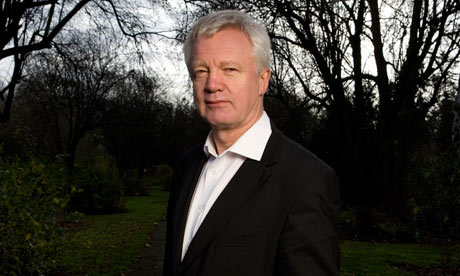 David Davis, the former shadow home secretary. Photograph: Richard Saker for the Observer
Faced by a backbench rebellion, the government is to slash the number of prisoners to be given the right to vote, even though it is likely to increase the risk of successful compensation claims against the government in court.
After a European court of human rights judgment, ministers responded by planning to give prisoners serving sentences of less than four years the right to vote. That is likely to be scaled back to those with sentences of one year.
The change follows talks at lunchtime yesterday between prime minister David Cameron and leading members of the Conservative 1922 backbench committee.
It represents a victory for the former shadow home secretary, David Davis, who was pressing for a rethink. Davis and the former Labour justice secretary, Jack Straw, recently won Commons time to stage a debate on the issue in about three weeks' time.
The debate would have exposed the scale of government divisions over the issue, but ministers will hope that the concession, more than halving the number of prisoners who will be entitled to vote, can quell backbench anger.
The four-year cut off would have given as many as 28,000 prisoners the right to vote – including some found guilty of violent crimes.
Ministers have said that more than 2,500 prisoners are likely to seek compensation on the basis that their rights have been violated, but they claim that the case law on the issue is still shifting in Europe, making it possible the British courts will sanction giving the vote to a relatively small number of prisoners.
Some Conservatives see the issue as one of principle: that the UK parliament and not the courts, interpreting the European convention, should decide.
The justice secretary Ken Clarke said yesterday that it was the exponential growth of judicial review and not the European convention that was doing the most to circumscribe the freedom of ministerial action in the UK.
Birds in mid-flight photographed by Roy Hancliff
Birds in mid-flight photographed by Roy Hancliff
 An osprey in mid flight
Picture: ROY HANCLIFF / BARCROFT MEDIA
For Cherrypie...
More here.
 An osprey in mid flight
Picture: ROY HANCLIFF / BARCROFT MEDIA
For Cherrypie...
More here.
Wednesday, January 19, 2011
Ministers in climbdown over prison vote rights
Ministers in climbdown over prison vote rights
By Nick Robinson BBC political editor
The government is preparing to scale back plans to give the right to vote to thousands of prisoners serving sentences of under four years.
Ministers now hope to limit the right to those sentenced to less than a year and are prepared to take the risk of being sued.
David Cameron recently said giving inmates the vote made him feel "ill".
But he warned that the government faced paying out more than £160m in compensation if it did not do so.
Ministers proposed changing the law on prisoners' voting rights following a ruling by the European Court of Human Rights.
Cameron meeting
John Hirst, a prisoner convicted of manslaughter, successfully argued that his human rights had been violated by not being allowed to take part in elections.
But Mr Cameron is now thought to accept that the Commons is unlikely to vote for a proposal which could involve granting the vote to up to 28,000 prisoners, including 6,000 jailed for violent crime, more than 1,700 sex offenders, more than 4,000 burglars and 4,300 imprisoned for drug offences.
The BBC understands that ministers now hope they will be able to give the vote only to those prisoners sentenced to serve a year or less.
They are aware, however, that this policy will be tested in the courts and that they might lose again.
Even this concession may not persuade many MPs who want to make a stand against the Strasbourg court.
The Commons will have the opportunity to defy the court's ruling in a couple of weeks' time when the Commons debates a motion tabled by the Conservative David Davis and Labour's Jack Straw.
The prime minister met the executive of the 1922 Committee of Conservative MPs on Wednesday and was left in no doubt about the strength of feeling on this issue.
Comment: It is only right that Ministers are climbing down on their their new proposals for a “four year cut-off” policy, because it would not have satisfied the Committee of Ministers, Council of Europe, Parliamentary Assembly of the Council of Europe and European Court of Human Rights, all are demanding that the UK gives all convicted prisoners their human right to vote under Article 3 of the First Protocol of the European Convention of Human Rights.
Given that all convicted prisoners must have the human right to vote, and less than 4 years would not suffice, it follows that 12 months and less is even more unsatisfactory. Not only with the MoJ get sued, there will be sanctions imposed by Europe for non-compliance with my case.
Already because the UK failed to fully comply over the last 5 years, the taxpayers face a bill of £135m. If the vote is not given in time for the elections in Scotland, Wales and Northern Ireland and AV in England by 6 May 2011, then the bill will be doubled to £270m. It's the taxpayers money that David Cameron is throwing away into the pockets of prisoners. If they are not fiddling their expenses they are set on charing the public in other ways!
Of course Ministers should not only have proposed changing the law, there is a requirement that the UK does so. All Kenneth Clarke needs to do is make a remedial order under s.10 of the HRA 1998 to amend s.3 of the Representation of the People Act 1983. Sorted. Simples.
By Nick Robinson BBC political editor
The government is preparing to scale back plans to give the right to vote to thousands of prisoners serving sentences of under four years.
Ministers now hope to limit the right to those sentenced to less than a year and are prepared to take the risk of being sued.
David Cameron recently said giving inmates the vote made him feel "ill".
But he warned that the government faced paying out more than £160m in compensation if it did not do so.
Ministers proposed changing the law on prisoners' voting rights following a ruling by the European Court of Human Rights.
Cameron meeting
John Hirst, a prisoner convicted of manslaughter, successfully argued that his human rights had been violated by not being allowed to take part in elections.
But Mr Cameron is now thought to accept that the Commons is unlikely to vote for a proposal which could involve granting the vote to up to 28,000 prisoners, including 6,000 jailed for violent crime, more than 1,700 sex offenders, more than 4,000 burglars and 4,300 imprisoned for drug offences.
The BBC understands that ministers now hope they will be able to give the vote only to those prisoners sentenced to serve a year or less.
They are aware, however, that this policy will be tested in the courts and that they might lose again.
Even this concession may not persuade many MPs who want to make a stand against the Strasbourg court.
The Commons will have the opportunity to defy the court's ruling in a couple of weeks' time when the Commons debates a motion tabled by the Conservative David Davis and Labour's Jack Straw.
The prime minister met the executive of the 1922 Committee of Conservative MPs on Wednesday and was left in no doubt about the strength of feeling on this issue.
Comment: It is only right that Ministers are climbing down on their their new proposals for a “four year cut-off” policy, because it would not have satisfied the Committee of Ministers, Council of Europe, Parliamentary Assembly of the Council of Europe and European Court of Human Rights, all are demanding that the UK gives all convicted prisoners their human right to vote under Article 3 of the First Protocol of the European Convention of Human Rights.
Given that all convicted prisoners must have the human right to vote, and less than 4 years would not suffice, it follows that 12 months and less is even more unsatisfactory. Not only with the MoJ get sued, there will be sanctions imposed by Europe for non-compliance with my case.
Already because the UK failed to fully comply over the last 5 years, the taxpayers face a bill of £135m. If the vote is not given in time for the elections in Scotland, Wales and Northern Ireland and AV in England by 6 May 2011, then the bill will be doubled to £270m. It's the taxpayers money that David Cameron is throwing away into the pockets of prisoners. If they are not fiddling their expenses they are set on charing the public in other ways!
Of course Ministers should not only have proposed changing the law, there is a requirement that the UK does so. All Kenneth Clarke needs to do is make a remedial order under s.10 of the HRA 1998 to amend s.3 of the Representation of the People Act 1983. Sorted. Simples.
More dodgy legal advice from Carl Gardner
More dodgy legal advice from Carl Gardner
Prisoners’ votes: another dodgy ruling from the European Court
by Carl Gardner on January 18, 2011
The European Court of Human Rights has ruled today that an Italian prisoner’s rights were breached where he was sentenced to prison for life, and as a result lost the right to vote indefinitely. The ECtHR’s ruling in Scoppola v Italy (the judgment is only available in French for the moment, I’m afraid) will cause concern among ministers in London – and for good reason. The ruling is legally questionable. But if the judges in Strasbourg do maintain this line in future, their new “four year cut-off” policy may be indefensible in the courts, and they could have to make more concessions.
I last wrote about this issue before Christmas, when the government announced its proposed “four year rule”: prisoners serving less than four years will be entitled to vote, while those serving four years or more will not. That stance was clearly a calculated risk by ministers: following the key ruling in Hirst v UK in 2005, the judgment in Frodl v Austria went far further, strongly suggested the UK would have to give almost all prisoners the vote, and that any disenfranchisement could only relate to a very narrow category of prisoners and be imposed by the sentencing judge in an individual case. On that approach, no “bright line” policy based on four years, ten years or even life imprisonment would be permitted. So the government must have been mightily relieved when in its “pilot judgment” in Greens & MT v UK, the court appeared to step back from Frodl (paras. 113-114):
it was recently held in Frodl … that … any decision on disenfranchisement should be taken by a judge and there must be a link between the offence committed and issues relating to elections and democratic institutions… However… As the Court emphasised in Hirst, there are numerous ways of organising and running electoral systems… The Court recalls that its role in this area is a subsidiary one: the national authorities are, in principle, better placed than an international court to evaluate local needs and conditions and, as a result … the role of the domestic policy-maker should be given special weight ……
the Court considers that a wide range of policy alternatives are available to the Government in the present context…. Emphasising the wide margin of appreciation in this area (see Hirst, § 61), the Court is of the view that it is for the Government, following appropriate consultation, to decide in the first instance how to achieve compliance with Article 3 of Protocol No. 1 when introducing legislative proposals.
That judgment re-opened the door to the kind of “bright lines” approach the government then decided to take, based on a four-year cut-off.
Scoppola, though, appears to take the Court’s thinking straight back to Frodl. In this case, Italian law deprives prisoners of the vote automatically if they are sentenced to three years imprisonment or more – a system closely resembling the UK government’s current policy. The Strasbourg judges have concluded that breaches the right to free elections not because three years is too low, but, just as in Frodl, because any such generalised cut-off is impermissible (para. 43; the translation is mine):
The Court finally recalls that in its recent case law in applying the criteria established in the case of Hirst v. United Kingdom (No. 2), it is essential that the decision on disenfranchisement be taken by a judge and be appropriately reasoned.
There’s no cause for immediate panic in Whitehall. As a matter of international law, the UK is entitled to stand on Hirst and Greens, and see if its new policy survives any challenge in the courts. But there is clearly a shocking inconsistency in the approaches of the judges in Strasbourg, the decision arrived at here unanimously being based on a clearly different, more formalistic and intrusive approach from that also taken unanimously in the more politically sensible Greens judgment.
No wonder senior MPs are concerned about this. Jack Straw and David Davis are being unrealistic if they think Hirst and Greens can be ignored or overruled, even by Parliament. But judges can take unreasonable stands too, and in Frodl and now Scoppola, some Strasbourg judges have gone far too far in laying down in precise detail what national policies must be.
Comment: It has to be said that it is a bit much coming from the man who used to provide legal advice to the Labour administration, to write this headline "Prisoners’ votes: another dodgy ruling from the European Court". Bearing in mind that Labour was responsible for the Dodgy Dossier over WMD, and dodgy consultation exercises for prisoners votes by Charles Falconer! The highest court in Europe is wrong and Carl Gardner is right? He's having a laugh!
"The ruling is legally questionable". What is questionable is that a lawyer in the UK has the cheek to question the judges ruling. Lawyers argue their cases under the adversarial procedure, and the judges decide which side is right and which side is wrong. Here we have a lawyer not involved in the case, and clearly "ignorance of the law is no excuse" siding with the losers. The ECtHR will maintain this line in future quite simply because the Court will have relied upon the leading legal authority, Hirst v UK (No2). The coalition's “four year cut-off” policy is indefensible, and they will have to make more concessions. For example, all convicted prisoners must get the vote.
I am puzzled by Carl's use of the term "calculated risk". Answers.com suggests this definition: "A chance taken after careful estimation of the probable outcome, as in Taking their dispute to arbitration was definitely a calculated risk. This term uses calculated in the sense of "planned with forethought," a usage from the mid-1800s. Its pairing with risk dates from World War II, when the chances for losing bombers were taken into account before a bombing mission was sent out. After the war the term was transferred to other undertakings where taking a chance to succeed had to be weighed against the costs of failure". The coalition gamble has not paid off. This is not surprising given that it is a matter for the Council of Europe and not the UK to interpret the ruling in my case. I recall Charles Falconer giving his erroneous interpretation of my case on The World at One, and he had not even read it to see what it did say! Carl is wrong to claim that Frodl went "far further" than Hirst No 2. Frodl merely reaffirmed what was decided in my case, and the Court stated that it had applied the Hirst test and exactly what this entails. The UK was not only found guilty in my case, but has also now been caught out trying to wriggle off the hook altogether and failing that to try and get away with minimal compliance. The cost of this failure means that the taxpayers will be saddled with a £135m bill in damages for convicted prisoners denied the vote. I disagree with Carl that the Court in any way stepped back from Hirst/Frodl in Greens and MT v UK. In fact, by judging that the UK was in violation of my case and giving the UK 6 months to fully comply or else this fast streamed the process saving me the bother of lodging Rule 11 'infringment proceedings' with the Committee of Ministers.
I don't accept that any "bright-lines" rule benefitted the UK at all because, like I said, the interpretation of my case wasn't a matter for the UK to determine being the losing party in the dispute. The margin of appreciation relates to, for example, whether the UK puts polling booths in the prisons or instead allows prisoners postal ballots. It certainly did not extend to the discretion of which prisoners can and cannot have the human right to vote! This would be akin to saying which prisoners are or are not human beings. Long gone are the days when the Lord of the Manor gave the poor the privilege of the crumbs from his table.
I beg to differ with Carl yet again, there is cause for panic in Whitehall as my campaign marches down it. Once more Carl gets it wrong, as a matter of international law the Council of Europe takes a stand on Hirst No2. Because Frodl was decided applying the Hirst test it also stands firm, and as the appeal application lodged by Austria was rejected by the Grand Chamber it supports Hirst No2. Greens cannot be relied upon as yet simply because it does not become final until both parties to the case decide not to appeal to the Grand Chamber within 3 months of it being decided in the Chamber. The policy would not survive a challenge in the courts, simply because Hirst v UK (No2) is binding on the courts as well as the Executive and Parliament. Carl is forgetting that it is the Council of Europe, Committee of Ministers, ECtHR and Parliamentary Assembly of the Council of Europe which have to be satisfied and not any court in the UK. Carl, no surprise, is wrong again in his view that the Court is being inconsistent in its decisions. This was argued by the UK at the Grand Chamber in my case, and firmly rejected by the Court which explained away the UK's illogical thinking by logically explaining the consistent approach taken in each case cited by the UK.
Carl is right to dimiss the antics of Jack Straw and David Davis. I will also agree that some judges can take unreasonable stands, for example, that taken by Kennedy LJ, in my case before the High Court in London. I think what Carl fails to appreciate in the reasonable stands taken in Frodl and Scoppola is that in Hirst No2 it clearly states that where it is identified that that has been a systemic failure, as with the non-compliance in my case, then the Court will step in and put the Member State's house in order to conform with the Convention. Basically, if the Member State does not like this interference it must lump it or it has the choice of leaving the Council of Europe and (since the Lisbon Treaty) EU. However, the UK will then be a rogue or pariah State and (since November 2010) also face sanctions from the UN under the Interlaken process.
Prisoners’ votes: another dodgy ruling from the European Court
by Carl Gardner on January 18, 2011
The European Court of Human Rights has ruled today that an Italian prisoner’s rights were breached where he was sentenced to prison for life, and as a result lost the right to vote indefinitely. The ECtHR’s ruling in Scoppola v Italy (the judgment is only available in French for the moment, I’m afraid) will cause concern among ministers in London – and for good reason. The ruling is legally questionable. But if the judges in Strasbourg do maintain this line in future, their new “four year cut-off” policy may be indefensible in the courts, and they could have to make more concessions.
I last wrote about this issue before Christmas, when the government announced its proposed “four year rule”: prisoners serving less than four years will be entitled to vote, while those serving four years or more will not. That stance was clearly a calculated risk by ministers: following the key ruling in Hirst v UK in 2005, the judgment in Frodl v Austria went far further, strongly suggested the UK would have to give almost all prisoners the vote, and that any disenfranchisement could only relate to a very narrow category of prisoners and be imposed by the sentencing judge in an individual case. On that approach, no “bright line” policy based on four years, ten years or even life imprisonment would be permitted. So the government must have been mightily relieved when in its “pilot judgment” in Greens & MT v UK, the court appeared to step back from Frodl (paras. 113-114):
it was recently held in Frodl … that … any decision on disenfranchisement should be taken by a judge and there must be a link between the offence committed and issues relating to elections and democratic institutions… However… As the Court emphasised in Hirst, there are numerous ways of organising and running electoral systems… The Court recalls that its role in this area is a subsidiary one: the national authorities are, in principle, better placed than an international court to evaluate local needs and conditions and, as a result … the role of the domestic policy-maker should be given special weight ……
the Court considers that a wide range of policy alternatives are available to the Government in the present context…. Emphasising the wide margin of appreciation in this area (see Hirst, § 61), the Court is of the view that it is for the Government, following appropriate consultation, to decide in the first instance how to achieve compliance with Article 3 of Protocol No. 1 when introducing legislative proposals.
That judgment re-opened the door to the kind of “bright lines” approach the government then decided to take, based on a four-year cut-off.
Scoppola, though, appears to take the Court’s thinking straight back to Frodl. In this case, Italian law deprives prisoners of the vote automatically if they are sentenced to three years imprisonment or more – a system closely resembling the UK government’s current policy. The Strasbourg judges have concluded that breaches the right to free elections not because three years is too low, but, just as in Frodl, because any such generalised cut-off is impermissible (para. 43; the translation is mine):
The Court finally recalls that in its recent case law in applying the criteria established in the case of Hirst v. United Kingdom (No. 2), it is essential that the decision on disenfranchisement be taken by a judge and be appropriately reasoned.
There’s no cause for immediate panic in Whitehall. As a matter of international law, the UK is entitled to stand on Hirst and Greens, and see if its new policy survives any challenge in the courts. But there is clearly a shocking inconsistency in the approaches of the judges in Strasbourg, the decision arrived at here unanimously being based on a clearly different, more formalistic and intrusive approach from that also taken unanimously in the more politically sensible Greens judgment.
No wonder senior MPs are concerned about this. Jack Straw and David Davis are being unrealistic if they think Hirst and Greens can be ignored or overruled, even by Parliament. But judges can take unreasonable stands too, and in Frodl and now Scoppola, some Strasbourg judges have gone far too far in laying down in precise detail what national policies must be.
Comment: It has to be said that it is a bit much coming from the man who used to provide legal advice to the Labour administration, to write this headline "Prisoners’ votes: another dodgy ruling from the European Court". Bearing in mind that Labour was responsible for the Dodgy Dossier over WMD, and dodgy consultation exercises for prisoners votes by Charles Falconer! The highest court in Europe is wrong and Carl Gardner is right? He's having a laugh!
"The ruling is legally questionable". What is questionable is that a lawyer in the UK has the cheek to question the judges ruling. Lawyers argue their cases under the adversarial procedure, and the judges decide which side is right and which side is wrong. Here we have a lawyer not involved in the case, and clearly "ignorance of the law is no excuse" siding with the losers. The ECtHR will maintain this line in future quite simply because the Court will have relied upon the leading legal authority, Hirst v UK (No2). The coalition's “four year cut-off” policy is indefensible, and they will have to make more concessions. For example, all convicted prisoners must get the vote.
I am puzzled by Carl's use of the term "calculated risk". Answers.com suggests this definition: "A chance taken after careful estimation of the probable outcome, as in Taking their dispute to arbitration was definitely a calculated risk. This term uses calculated in the sense of "planned with forethought," a usage from the mid-1800s. Its pairing with risk dates from World War II, when the chances for losing bombers were taken into account before a bombing mission was sent out. After the war the term was transferred to other undertakings where taking a chance to succeed had to be weighed against the costs of failure". The coalition gamble has not paid off. This is not surprising given that it is a matter for the Council of Europe and not the UK to interpret the ruling in my case. I recall Charles Falconer giving his erroneous interpretation of my case on The World at One, and he had not even read it to see what it did say! Carl is wrong to claim that Frodl went "far further" than Hirst No 2. Frodl merely reaffirmed what was decided in my case, and the Court stated that it had applied the Hirst test and exactly what this entails. The UK was not only found guilty in my case, but has also now been caught out trying to wriggle off the hook altogether and failing that to try and get away with minimal compliance. The cost of this failure means that the taxpayers will be saddled with a £135m bill in damages for convicted prisoners denied the vote. I disagree with Carl that the Court in any way stepped back from Hirst/Frodl in Greens and MT v UK. In fact, by judging that the UK was in violation of my case and giving the UK 6 months to fully comply or else this fast streamed the process saving me the bother of lodging Rule 11 'infringment proceedings' with the Committee of Ministers.
I don't accept that any "bright-lines" rule benefitted the UK at all because, like I said, the interpretation of my case wasn't a matter for the UK to determine being the losing party in the dispute. The margin of appreciation relates to, for example, whether the UK puts polling booths in the prisons or instead allows prisoners postal ballots. It certainly did not extend to the discretion of which prisoners can and cannot have the human right to vote! This would be akin to saying which prisoners are or are not human beings. Long gone are the days when the Lord of the Manor gave the poor the privilege of the crumbs from his table.
I beg to differ with Carl yet again, there is cause for panic in Whitehall as my campaign marches down it. Once more Carl gets it wrong, as a matter of international law the Council of Europe takes a stand on Hirst No2. Because Frodl was decided applying the Hirst test it also stands firm, and as the appeal application lodged by Austria was rejected by the Grand Chamber it supports Hirst No2. Greens cannot be relied upon as yet simply because it does not become final until both parties to the case decide not to appeal to the Grand Chamber within 3 months of it being decided in the Chamber. The policy would not survive a challenge in the courts, simply because Hirst v UK (No2) is binding on the courts as well as the Executive and Parliament. Carl is forgetting that it is the Council of Europe, Committee of Ministers, ECtHR and Parliamentary Assembly of the Council of Europe which have to be satisfied and not any court in the UK. Carl, no surprise, is wrong again in his view that the Court is being inconsistent in its decisions. This was argued by the UK at the Grand Chamber in my case, and firmly rejected by the Court which explained away the UK's illogical thinking by logically explaining the consistent approach taken in each case cited by the UK.
Carl is right to dimiss the antics of Jack Straw and David Davis. I will also agree that some judges can take unreasonable stands, for example, that taken by Kennedy LJ, in my case before the High Court in London. I think what Carl fails to appreciate in the reasonable stands taken in Frodl and Scoppola is that in Hirst No2 it clearly states that where it is identified that that has been a systemic failure, as with the non-compliance in my case, then the Court will step in and put the Member State's house in order to conform with the Convention. Basically, if the Member State does not like this interference it must lump it or it has the choice of leaving the Council of Europe and (since the Lisbon Treaty) EU. However, the UK will then be a rogue or pariah State and (since November 2010) also face sanctions from the UN under the Interlaken process.
I am no fan of Jack Straw's but...
I am no fan of Jack Straw's but...
...the brown stuff will be hitting the fan and it's facing him.
Email...
Hi Gavin
I take issue with the following...
"1255 Also on Daily Politics former Home Secretary Jack Straw says giving prisoners the right to vote was "offensive to the public". He tells the programme that a ruling by a European Court that a blanket ban on prisoners getting the vote was illegal had caused a "constitutional crisis". Tory MP David Davis says a compromise government plan to give the vote to prisoners serving sentences less than four years is wrong and the matter must be decided by Parliament. They are making a joint Parliamentary bid to stop the vote being given to prisoners".
The BBC has failed to provide a proper balance by not providing any balance in the report whatsoever.
In my case (the Council of Europe has confirmed by email that I own the case bearing my name under intellectual property rights) Hirst v UK (No2), the UK had argued that granting convicted prisoners the vote would offend public opinion. The Court ruled:
"70. There is, therefore, no question that a prisoner forfeits his Convention rights merely because of his status as a person detained following conviction. Nor is there any place under the Convention system, where tolerance and broadmindedness are the acknowledged hallmarks of democratic society, for automatic disenfranchisement based purely on what might offend public opinion".
Para 4 of Judge Caflisch's concurring opinion states:
"Accordingly, concluded the Government, the finding of a violation would be a surprise and offensive to many (judgment, §§ 47 and 49). That may well be so, but the decisions taken by this Court are not made to please or indispose members of the public, but to uphold human rights principles".
Therefore, it is clear that the legal position is that public opinion be excluded. This case will not be reheard in the court of public opinion. Nor does the Council of Europe allow it to be retried once the Grand Chamber has made its decision which is final and binding upon the UK.
Whilst it is accepted that the UK is facing a constitutional crisis, it needs to be put into context.
Hirst v UK (No2) is the name of a legal case, case law, but it goes further than that. Within the UK are the three arms of the State, the Executive, Parliament and Judiciary. It is often mistakenly assumed that it is only against the government. However, reading my case exposes that the Separation of Powers doctrine which is supposed to provide the balances and checks between the three arms of the State to prevent abuse failed to operate properly in my case. This is why the last administration and the present administration have all of a sudden found that we need constitutional reforms. Neither administration has informed the public that it is as a result of my case and that they are being forced upon them by Europe.
David Davis is right for the wrong reasons. My case clearly states that all convicted prisoners must get the vote. This was reaffirmed in Frodl v Austria and that the Hirst test must be met.
The joint Parliamentary bid is not only hot air but is also a side show. The main event will be a "Debate & Vote : Wednesday 26 January 2011
At the Parliamentary Assembly of the Council of Europe (PACE)
On the subject of Implementation of judgments of the European Court of Human Rights
Draft resolution
The Assembly, in particular, urges the following states to give priority to specific problems:
The United Kingdom must put to an end the practice of delaying full implementation of Court judgments with respect to politically sensitive issues, such as prisoners’ voting rights.
... it is essential that states parties fulfil their obligation under Article 46 of the Convention to ensure the full and rapid implementation of judgments of the Court.
The execution process for some of these judgments (where it has begun) has become somewhat politicised at the national level and consequently the JCHR has identified what it perceives as an emerging practice of “minimal compliance’; where some action has been taken by the United Kingdom but far from enough. This has been highlighted by the JCHR30 as a problem in that it increases the possibility of repetitive cases by failing to put an end to a root problem, thus creating further litigation.31
The Councilof Europe reserves the right to take appropriate action should the state concerned continuously fail to take appropriate measures required by a judgment of the Court, or should the national parliament fail to exert appropriate pressure on the government to implement judgments of the Court;".
Therefore, I think it is only right that the BBC corrects the false impression given and reports the facts instead.
I am aware that the present problems faced by the coalition stem from Charles Falconer originally providing false information about my case on The World at One, and as Juliet Lyon (PRT) was in the studio at the same time giving an interview, she can bear me out what really happened. Basically, Jack Straw has been covering Falconer's arse and it is time it was exposed.
Best wishes
John Hirst
Besides sending the above email I have complained to the BBC and been given the Case No. 552305
...the brown stuff will be hitting the fan and it's facing him.
Email...
Hi Gavin
I take issue with the following...
"1255 Also on Daily Politics former Home Secretary Jack Straw says giving prisoners the right to vote was "offensive to the public". He tells the programme that a ruling by a European Court that a blanket ban on prisoners getting the vote was illegal had caused a "constitutional crisis". Tory MP David Davis says a compromise government plan to give the vote to prisoners serving sentences less than four years is wrong and the matter must be decided by Parliament. They are making a joint Parliamentary bid to stop the vote being given to prisoners".
The BBC has failed to provide a proper balance by not providing any balance in the report whatsoever.
In my case (the Council of Europe has confirmed by email that I own the case bearing my name under intellectual property rights) Hirst v UK (No2), the UK had argued that granting convicted prisoners the vote would offend public opinion. The Court ruled:
"70. There is, therefore, no question that a prisoner forfeits his Convention rights merely because of his status as a person detained following conviction. Nor is there any place under the Convention system, where tolerance and broadmindedness are the acknowledged hallmarks of democratic society, for automatic disenfranchisement based purely on what might offend public opinion".
Para 4 of Judge Caflisch's concurring opinion states:
"Accordingly, concluded the Government, the finding of a violation would be a surprise and offensive to many (judgment, §§ 47 and 49). That may well be so, but the decisions taken by this Court are not made to please or indispose members of the public, but to uphold human rights principles".
Therefore, it is clear that the legal position is that public opinion be excluded. This case will not be reheard in the court of public opinion. Nor does the Council of Europe allow it to be retried once the Grand Chamber has made its decision which is final and binding upon the UK.
Whilst it is accepted that the UK is facing a constitutional crisis, it needs to be put into context.
Hirst v UK (No2) is the name of a legal case, case law, but it goes further than that. Within the UK are the three arms of the State, the Executive, Parliament and Judiciary. It is often mistakenly assumed that it is only against the government. However, reading my case exposes that the Separation of Powers doctrine which is supposed to provide the balances and checks between the three arms of the State to prevent abuse failed to operate properly in my case. This is why the last administration and the present administration have all of a sudden found that we need constitutional reforms. Neither administration has informed the public that it is as a result of my case and that they are being forced upon them by Europe.
David Davis is right for the wrong reasons. My case clearly states that all convicted prisoners must get the vote. This was reaffirmed in Frodl v Austria and that the Hirst test must be met.
The joint Parliamentary bid is not only hot air but is also a side show. The main event will be a "Debate & Vote : Wednesday 26 January 2011
At the Parliamentary Assembly of the Council of Europe (PACE)
On the subject of Implementation of judgments of the European Court of Human Rights
Draft resolution
The Assembly, in particular, urges the following states to give priority to specific problems:
The United Kingdom must put to an end the practice of delaying full implementation of Court judgments with respect to politically sensitive issues, such as prisoners’ voting rights.
... it is essential that states parties fulfil their obligation under Article 46 of the Convention to ensure the full and rapid implementation of judgments of the Court.
The execution process for some of these judgments (where it has begun) has become somewhat politicised at the national level and consequently the JCHR has identified what it perceives as an emerging practice of “minimal compliance’; where some action has been taken by the United Kingdom but far from enough. This has been highlighted by the JCHR30 as a problem in that it increases the possibility of repetitive cases by failing to put an end to a root problem, thus creating further litigation.31
The Councilof Europe reserves the right to take appropriate action should the state concerned continuously fail to take appropriate measures required by a judgment of the Court, or should the national parliament fail to exert appropriate pressure on the government to implement judgments of the Court;".
Therefore, I think it is only right that the BBC corrects the false impression given and reports the facts instead.
I am aware that the present problems faced by the coalition stem from Charles Falconer originally providing false information about my case on The World at One, and as Juliet Lyon (PRT) was in the studio at the same time giving an interview, she can bear me out what really happened. Basically, Jack Straw has been covering Falconer's arse and it is time it was exposed.
Best wishes
John Hirst
Besides sending the above email I have complained to the BBC and been given the Case No. 552305
Tuesday, January 18, 2011
Prisoners Voting Rights (Part 1)
Prisoners Voting Rights (Part 1)
Comment: The snap, crackle and pop is the wood on my fire!
Comment: The snap, crackle and pop is the wood on my fire!
We're off
We're off
Nick Robinson 16:09 UK time, Tuesday, 18 January 2011

David Davis and Jack Straw have got their way. The Commons will get the chance to vote - probably in the middle of February - for a motion to defy the European Court of Human Rights on prisoner voting.
Their motion states that:
"This House... is of the opinion that A) legislative decisions of this nature should be a matter for democratically elected lawmakers and B) that on the merits of the issue the current policy... is confirmed."
I wouldn't want to be a Tory MP trying to convince backbenchers why they should not vote for that.
Straw is carrying around a speech by the former Law Lord - Lord Hoffmann in which he criticised the European Court of Human Rights.
"It has been unable to resist the temptation to aggrandise its jurisdiction and to impose uniform rules on Member States. It considers itself the equivalent of the Supreme Court of the United States, laying down a federal law of Europe."
He went on to say that:
"[I]t lacks constitutional legitimacy...this is not an expression of populist Euroscepticism. Whatever one may say about the wisdom or even correctness of decisions of the Court of Justice in Luxembourg, no one can criticise their legitimacy in laying down uniform rules for the European Union in those areas which fall within the scope of the Treaty. But the Convention does not give the Strasbourg court equivalent legitimacy."
Incidentally, the government is keen to point out that Straw's own consultation paper on this issue (when he was justice secretary) proposed enfranchising prisoners for all elections not just Westminster and European elections and granted no judicial discretion to disenfranchise individual prisoners as part of their sentence.
Update, 1616: A reminder of what David Cameron's stated views are on prisoner voting:
"It makes me physically ill even to contemplate having to give the vote to anyone who is in prison. Frankly, when people commit a crime and go to prison, they should lose their rights, including the right to vote. But we are in a situation that I am afraid we have to deal with. This is potentially costing us £160 million, so we have to come forward with proposals, because I do not want us to spend that money; it is not right. So, painful as it is, we have to sort out yet another problem that was just left to us by the last government."
Update, 1718: The prime minister welcomes the plan for the Commons to hold a debate on whether prisoners should be given the vote as demanded by the European Court of Human Rights and believes that it "could be helpful", I'm told. David Cameron is said to want as few prisoners as possible to be given the vote and is still seeking legal advice as to whether it will be possible to successfully defend a policy of giving the vote to prisoners who are serving one year or less (rather than as currently planned four years or less).
Ministers are also examining whether there could be a legal presumption against prisoners getting the vote with judges able to grant voting rights at their discretion.
One possibility is that ministers could try to use a vote in the Commons to strenghten their negotiating position with the Strasbourg court.
Comment: Nick Robinson, you are as well informed as a shelled pea!
Nick Robinson 16:09 UK time, Tuesday, 18 January 2011

David Davis and Jack Straw have got their way. The Commons will get the chance to vote - probably in the middle of February - for a motion to defy the European Court of Human Rights on prisoner voting.
Their motion states that:
"This House... is of the opinion that A) legislative decisions of this nature should be a matter for democratically elected lawmakers and B) that on the merits of the issue the current policy... is confirmed."
I wouldn't want to be a Tory MP trying to convince backbenchers why they should not vote for that.
Straw is carrying around a speech by the former Law Lord - Lord Hoffmann in which he criticised the European Court of Human Rights.
"It has been unable to resist the temptation to aggrandise its jurisdiction and to impose uniform rules on Member States. It considers itself the equivalent of the Supreme Court of the United States, laying down a federal law of Europe."
He went on to say that:
"[I]t lacks constitutional legitimacy...this is not an expression of populist Euroscepticism. Whatever one may say about the wisdom or even correctness of decisions of the Court of Justice in Luxembourg, no one can criticise their legitimacy in laying down uniform rules for the European Union in those areas which fall within the scope of the Treaty. But the Convention does not give the Strasbourg court equivalent legitimacy."
Incidentally, the government is keen to point out that Straw's own consultation paper on this issue (when he was justice secretary) proposed enfranchising prisoners for all elections not just Westminster and European elections and granted no judicial discretion to disenfranchise individual prisoners as part of their sentence.
Update, 1616: A reminder of what David Cameron's stated views are on prisoner voting:
"It makes me physically ill even to contemplate having to give the vote to anyone who is in prison. Frankly, when people commit a crime and go to prison, they should lose their rights, including the right to vote. But we are in a situation that I am afraid we have to deal with. This is potentially costing us £160 million, so we have to come forward with proposals, because I do not want us to spend that money; it is not right. So, painful as it is, we have to sort out yet another problem that was just left to us by the last government."
Update, 1718: The prime minister welcomes the plan for the Commons to hold a debate on whether prisoners should be given the vote as demanded by the European Court of Human Rights and believes that it "could be helpful", I'm told. David Cameron is said to want as few prisoners as possible to be given the vote and is still seeking legal advice as to whether it will be possible to successfully defend a policy of giving the vote to prisoners who are serving one year or less (rather than as currently planned four years or less).
Ministers are also examining whether there could be a legal presumption against prisoners getting the vote with judges able to grant voting rights at their discretion.
One possibility is that ministers could try to use a vote in the Commons to strenghten their negotiating position with the Strasbourg court.
Comment: Nick Robinson, you are as well informed as a shelled pea!
Subscribe to:
Posts (Atom)