Inmate Kevan Thakrar cleared over prison guards attack
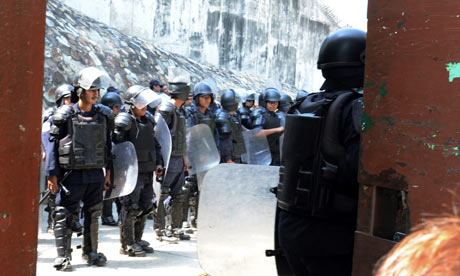
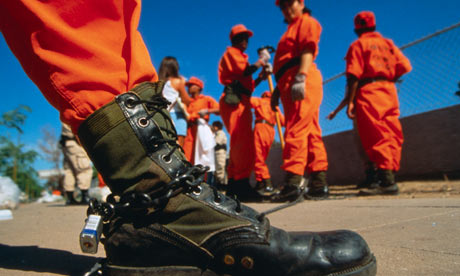
A man serving life for three murders has been cleared over a prison attack in which he stabbed three guards.
Kevan Thakrar, 24, admitted lashing out at the guards with a broken bottle at Frankland Prison, County Durham, but claimed it was in self-defence.
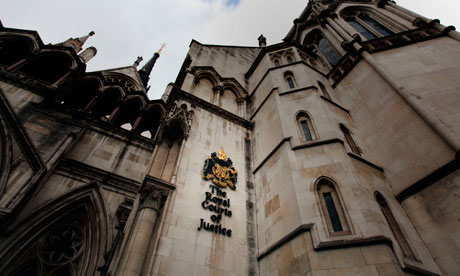
Thakrar, from Stevenage, Hertfordshire, was cleared of two counts of attempted murder and three counts of wounding with intent at Newcastle Crown Court.
Ex-Frankland governor David Thompson hit out at the verdict.
Thakrar is serving a life sentence for the drug-related murder of three men and the attempted murder of two women in 2007.
The court heard he was suffering from post-traumatic stress disorder as a result of previous prison experiences.
Thakrar was accused of trying to murder officers Craig Wylde and Claire Lewis and the wounding with intent of a third guard, Neil Walker, in March last year.
He claimed he attacked the officers in self-defence in a "pre-emptive strike" following ill-treatment and abuse at the high-security prison, the jury heard.
'Dismayed and humiliated'
The court heard Thakrar endured years of racist bullying and abuse at Frankland Prison and said he had been victimised since his arrest for the murders of three men and the attempted murder of two women.
Officers denied a "culture of racism" at the County Durham jail.
During the trial Thakrar said he was sorry that the guards were hurt but said "it should not have come to that".
Mr Thompson, who retired last month but was in charge at the time, described the injured officers as "decent people".
He said Mr Wylde and Ms Lewis would not work in the prison service again and Mr Walker saved Ms Lewis from worse injuries by intervening.
He said: "Staff at Frankland and elsewhere across the service will feel let down, dismayed and humiliated by part of the criminal justice system in which they serve.
"Colleagues in other professional agencies have expressed their dismay at how a case like this can be conducted in a manner where the victims feel they are on trial, that they have done something wrong, and then for the assailant to be exonerated."
Mark Leech, editor of national prisoners magazine Converse, said: "It is shocking that David Thompson, the former governor of Frankland Prison, has completely dismissed the view of the jury who sat patiently and listened to all the evidence."
Mr Justice Simon expressed sympathy to the injured guards.
He said: "It was not part of the defence case in any way that they brought their injuries upon themselves."
Cleared inmate Kevan Thakrar: Guard tells of stabbing
A prison guard who was stabbed by an inmate serving life for three murders has spoken of his fears after the prisoner was cleared.
Comment: It is an incredible verdict by the jury. It is pointless the Prison Officers' Association (POA) considering a private prosecution against Thakrar because it is doubtful he has any money even if the screws were successful, and the Prison Service would not be liable to pay the damages on his behalf.
Site Meter
Friday, November 11, 2011
Oils well that ends well in Libya
Hague facing questions over Libya deal
William Hague, the Foreign Secretary, is facing questions over his role in a controversial oil deal in Libya involving a company run by a Conservative donor.
Mr Hague had a private meeting with a representative of Heritage Oil in March and has exchanged letters with an aide over the past few months, it has emerged.
In October, the company was awarded a $19.5 million [£12.23 million] oil deal in Libya which it believes will provide it with a foothold in the region.
Hague facing questions over Libya deal
William Hague, the Foreign Secretary, is facing questions over his role in a controversial oil deal in Libya involving a company run by a Conservative donor.
Mr Hague had a private meeting with a representative of Heritage Oil in March and has exchanged letters with an aide over the past few months, it has emerged.
In October, the company was awarded a $19.5 million [£12.23 million] oil deal in Libya which it believes will provide it with a foothold in the region.
Thursday, November 10, 2011
BBC involved in failure to report news
BBC announces Rock legends REM announce split
Meanwhile, in other news, on 20-21 September 2011, in Europe...
Your Excellency, Mr Commissioner for Human Rights,
Dear conference participants,
Colleagues,
Let me welcome you here, in Kyiv, on the occasion of the International Conference for the Prevention of Human Rights Violations, which is held in the framework of Ukraine’s Chairmanship of the Committee of Ministers of the Council of Europe in cooperation with the Directorate of Monitoring of the Council of Europe Directorate General of Human Rights and Legal Affairs.
General recognition of the fact that human rights violations had been the most important obstacle on the path of the society progress was one of the positive steps made by the international community after the World War II.
The result of that step was the emergence of a new sphere of international law, international human rights law. Treaties, pacts, conventions, which are the source of this sphere, have a number of features not typical for classical international law.
In particular, they provide for certain rights and freedoms that belong to each individual, establish the control mechanism over human rights observance and require that States parties to those international instruments recognise and implement these rights properly.
Another feature of agreements in this sphere of law is their uniform nature which leads to setting minimum standards for certain rights and freedoms which, at the same time, are the standards that have to develop in parallel with the society and its needs.
However, the post-war experience of international law in this sphere shows that human rights require not only guarantees of their proper implementation in accordance with the minimum standards but also such means that would be capable to "fence off" an individual of possible encroachments on his or her rights.
In my opinion, the establishment of such mechanisms for the prevention of human rights violations is the responsibility of each State which wishes to be recognized as one governed by rule of law.
But, without any doubt, this goal cannot be achieved without help of international organisations that proclaimed human rights their fundamental principle.
The most prominent example here is the activity of the European Court of Human Rights.
In particular, there are no countries on the European continent that have not benefited from the activity of the European Court of Human Rights which, despite its workload and the need of pressing reform, was and remains not only the most influential regional mechanism of human rights protection but also is the body that, in cooperation with the Committee of Ministers of the Council of Europe, compels the States to improve their domestic laws so as to prevent violation of rights guaranteed by the Convention for the Protection of Human Rights and Fundamental Freedoms.
In particular, it is pilot judgments procedure developed to deal with systemic violations of human rights that might become the evidence of preventive approach of the European Court of Human Rights.
It is clear that the approach of the European Court will have a positive impact only if its judgements are implemented efficiently under the supervision of the Committee of Ministers of the Council of Europe. Having two pilot judgments against Ukraine as examples, I would like to say that this mechanism is becoming a real prevention of human rights violations since it identifies the problems and provides highly professional advice on how to resolve the said problem.
In this connection, I am glad to see that today, here, in Kyiv, we have an opportunity to talk at the highest professional level about prevention of human rights violations with representatives of the Parliamentary Assembly of the Council of Europe, the European Court of Human Rights, the European Committee for the Prevention of Torture, the European Commission against Racism and Intolerance, the Committee of Ministers of the Council of Europe, and to reach conclusions that will become the guidance for the Member States of the Council of Europe in the coming years.
Kyiv, 20-21 September 2011
CommDH/Speech(2011)10
English only
Prevent violations through systematic work for human rights
Speech by Thomas Hammarberg, Commissioner for Human Rights of the Council of Europe
at the Conference on the Prevention of Human Rights Violations
We have to speed up progress in turning human rights principles into reality. The rights proclaimed and agreed to are too often not met in the everyday lives of Europeans. After having visited most member states, I am aware of the disappointment felt by many and remain impatient about the shortcomings in fulfilling human rights obligations.
All states encounter challenges in their work for the full realisation of human rights. It takes time and effort to develop a culture of respect for human rights. Scarce resources are often invoked as the main obstacle. Conflicts, corruption, racism and intolerance are other barriers to progress. Even without such hindrances we know that human rights are never fully implemented. There will always be improvements to be made. One reason is that minimum requirements change with economic and social developments.
Politicians have a responsibility – the implementation of human rights principles is largely a question of political will. It is unfortunate that key concepts and the language of human rights have often been politicised and demeaned in political discourse. It also happens that government politicians object strongly when shortcomings in their own countries are exposed by mechanisms set up to verify the practical implementation of agreed standards. Yet those responsible have in all cases an obligation to demonstrate the political will to address the identified problems.
We have to be systematic about human rights work. The objective is to build a society which takes human rights seriously: a society which endeavours to ensure that all its members can fully enjoy their rights. This requires a systematic approach for the prevention of violations and the implementation of the agreed standards.
Too little attention has been paid to the more practical, every-day work the public authorities need to carry out when implementing rights. Problems experienced include lack of knowledge and awareness of human rights, problems with coordinating different actors and levels of society and lack of human rights perspective in budgeting and planning processes. These factors can, alone or in combination, lead to human rights violations.
The first step in systematic work for human rights is to assess the current human rights situation. This should include an honest identification of existing problems. The reports of European and international monitoring mechanisms are very useful at this stage but a thorough analysis of existing policies and practices should be carried out at the national level. It is also essential to gauge the role and ability of different authorities, the judiciary and human rights structures to contribute to human rights work.
Human rights planning and budgeting is the second step. National action plans or strategies should be developed to address the already identified human rights challenges. Such plans should contain concrete activities coupled with time-frames and targets and indicate the authorities responsible for their implementation. The purpose of systematic work is to make continuous progress in all areas of human rights.
Most member states of the Council of Europe have developed strategies or action plans targeting specific problems, such as gender inequalities, racism and discrimination, abuse of children or trafficking in human beings. Azerbaijan, Croatia, Lithuania, Norway, Moldova, Spain and Sweden have also adopted comprehensive action plans for human rights. When accompanied with an honest acknowledgment of problems and political will to make progress such plans have proved useful for clarifying the authorities’ responsibilites and addressing gaps in human rights protection.
Equally important is that human rights planning is coordinated with the budgetary process to secure proper funding. It is necessary to review budget proposals from a human rights perspective to inform politicians of the consequences of their decisions and to hold them accountable.
The Human Rights Centre at Queen’s University in Belfast applied budget analysis in a recent research project into the effects of public expenditure on economic and social rights in Northern Ireland. It analysed various examples of government resource allocation in areas such as housing and linked them with the realisation of specific human rights standards.
Broad consultation and participation is crucial for the assessment and planning stages alike. This should involve all relevant authorities and actors, including national human rights structures, civil society and representatives of disadvantaged groups of people. Such an inclusive approach will contribute to the legitimacy of national strategies, create shared ownership and make implementation effective.
High-level political support is necessary to provide impetus and ensure continuity. Politicians and the leadership of the authorities and agencies responsible for the implementation of national action plans should be involved from the start. The government and the parliament should be committed to the national action plan. Active participation by representatives from the political opposition during the planning process can contribute to the continuity of the work.
The implementation phase should be well coordinated and integrated in the ordinary work of public authorities. A government authority would usually be identified as the coordinating unit and the communications hub. Networks and other joint coordination bodies can then be set up for cooperation between the authorities and the exchange of experiences and information. Such cooperation is also useful for reporting to international human rights monitoring mechanisms and may in fact save resources and minimise overlap in reporting obligations.
In Sweden, a Delegation for Human Rights was set up as part of the national action plan to support government agencies, municipalities and county councils in their work for human rights. It also stimulated public debate on human rights and involved a wide range of civil society organisations and the business community as focus groups in its activities.
Authorities at all levels should become aware of the fact that they also work for the implementation of human rights. Human rights work can be mainstreamed in the ordinary activities of both central and local authorities when they plan and deliver services to the public. Individuals are not merely clients but holders of rights as well.
Local authorities are key partners. They should be encouraged to review the local human rights situation and coordinate efforts to address human rights challenges. Monitoring is needed for the provision of health care, education, housing and social services, whether provided by private or public actors, using the rights-based approach. There are several cities in Europe, such as Graz in Austria, Nuremberg in Germany and Utrecht in the Netherlands, which have adopted a strong local human rights approach.
Non-governmental actors should also be involved in the continuous work for human rights. Focus groups for the representatives of civil society, national minorities, national human rights structures and business can be established for this purpose. It is important to create an enabling environment for the activities of NGOs and human rights defenders.
Ombudsmen, human rights institutions and equality bodies need independence and adequate resources to be effective in their work for human rights. The economic crisis has highlighted their importance in defending the rights of vulnerable groups of people. Their mandates should comply with the UN Paris Principles on the status of national human rights institutions. Such institutions can also be set up or be present at the regional and local level to facilitate easy access for those whose rights may have been violated.
Another major building block of systematic work is human rights education, training and awareness raising. Concrete and accessible language should be used in human rights education and participatory learning methods developed. Training is needed for public officials and professionals whose work relates to the human rights of others. They should have an up-to-date knowledge of the international standards relevant to their field of competence. The aim of broader awareness raising is to foster a human rights culture among the public. The media play a central role in this.
Action plans and strategies should be reviewed regularly and evaluated when they are completed. In Norway, the implementation of the national action plan for the prevention of violence against women could be followed on a dedicated website which included regularly up-dated information on the progress of the different measures of the plan.
It is equally important to assess the process, in terms of participation, inclusiveness and transparency, as it is to evaluate the end result. The conclusions of this review should be openly presented and debated in public, preferably in the parliament as well. All those who participated in the planning process should be able to contribute to the evaluation.
In the long run, it is also necessary to set up adequate systems for data collection and analysis of the human rights situation. Collection of sensitive data should be voluntary and coupled with safeguards to prevent the identification of individuals belonging to a particular group. Information made available by national human rights structures and civil society should be taken into account when collecting and analysing data.
Systematic work for human rights is a continuous process. The prerequisite is the determination to work harder for protecting the human rights and fundamental freedoms of everybody. Assessments of the human rights situation, national action plans and evaluation exercises are tools for clarifying and gauging the steps to be taken to reach our objectives. They inform us of what has worked and what has not.
There is a need to counter hypocrisy and to be more serious about preventing human rights violations. Criticism must be responded to in a constructive spirit and by making a conscious effort to secure the broadest possible support for human rights. Capacities must be built in every-day work to ensure that human rights are made a reality in all walks of life. What matters are results and the determination to achieve them.
Comment: Time to up the pressure generally on human rights, and in particular convicted prisoners human right to vote.
BBC announces Rock legends REM announce split
Meanwhile, in other news, on 20-21 September 2011, in Europe...
Your Excellency, Mr Commissioner for Human Rights,
Dear conference participants,
Colleagues,
Let me welcome you here, in Kyiv, on the occasion of the International Conference for the Prevention of Human Rights Violations, which is held in the framework of Ukraine’s Chairmanship of the Committee of Ministers of the Council of Europe in cooperation with the Directorate of Monitoring of the Council of Europe Directorate General of Human Rights and Legal Affairs.
General recognition of the fact that human rights violations had been the most important obstacle on the path of the society progress was one of the positive steps made by the international community after the World War II.
The result of that step was the emergence of a new sphere of international law, international human rights law. Treaties, pacts, conventions, which are the source of this sphere, have a number of features not typical for classical international law.
In particular, they provide for certain rights and freedoms that belong to each individual, establish the control mechanism over human rights observance and require that States parties to those international instruments recognise and implement these rights properly.
Another feature of agreements in this sphere of law is their uniform nature which leads to setting minimum standards for certain rights and freedoms which, at the same time, are the standards that have to develop in parallel with the society and its needs.
However, the post-war experience of international law in this sphere shows that human rights require not only guarantees of their proper implementation in accordance with the minimum standards but also such means that would be capable to "fence off" an individual of possible encroachments on his or her rights.
In my opinion, the establishment of such mechanisms for the prevention of human rights violations is the responsibility of each State which wishes to be recognized as one governed by rule of law.
But, without any doubt, this goal cannot be achieved without help of international organisations that proclaimed human rights their fundamental principle.
The most prominent example here is the activity of the European Court of Human Rights.
In particular, there are no countries on the European continent that have not benefited from the activity of the European Court of Human Rights which, despite its workload and the need of pressing reform, was and remains not only the most influential regional mechanism of human rights protection but also is the body that, in cooperation with the Committee of Ministers of the Council of Europe, compels the States to improve their domestic laws so as to prevent violation of rights guaranteed by the Convention for the Protection of Human Rights and Fundamental Freedoms.
In particular, it is pilot judgments procedure developed to deal with systemic violations of human rights that might become the evidence of preventive approach of the European Court of Human Rights.
It is clear that the approach of the European Court will have a positive impact only if its judgements are implemented efficiently under the supervision of the Committee of Ministers of the Council of Europe. Having two pilot judgments against Ukraine as examples, I would like to say that this mechanism is becoming a real prevention of human rights violations since it identifies the problems and provides highly professional advice on how to resolve the said problem.
In this connection, I am glad to see that today, here, in Kyiv, we have an opportunity to talk at the highest professional level about prevention of human rights violations with representatives of the Parliamentary Assembly of the Council of Europe, the European Court of Human Rights, the European Committee for the Prevention of Torture, the European Commission against Racism and Intolerance, the Committee of Ministers of the Council of Europe, and to reach conclusions that will become the guidance for the Member States of the Council of Europe in the coming years.
Kyiv, 20-21 September 2011
CommDH/Speech(2011)10
English only
Prevent violations through systematic work for human rights
Speech by Thomas Hammarberg, Commissioner for Human Rights of the Council of Europe
at the Conference on the Prevention of Human Rights Violations
We have to speed up progress in turning human rights principles into reality. The rights proclaimed and agreed to are too often not met in the everyday lives of Europeans. After having visited most member states, I am aware of the disappointment felt by many and remain impatient about the shortcomings in fulfilling human rights obligations.
All states encounter challenges in their work for the full realisation of human rights. It takes time and effort to develop a culture of respect for human rights. Scarce resources are often invoked as the main obstacle. Conflicts, corruption, racism and intolerance are other barriers to progress. Even without such hindrances we know that human rights are never fully implemented. There will always be improvements to be made. One reason is that minimum requirements change with economic and social developments.
Politicians have a responsibility – the implementation of human rights principles is largely a question of political will. It is unfortunate that key concepts and the language of human rights have often been politicised and demeaned in political discourse. It also happens that government politicians object strongly when shortcomings in their own countries are exposed by mechanisms set up to verify the practical implementation of agreed standards. Yet those responsible have in all cases an obligation to demonstrate the political will to address the identified problems.
We have to be systematic about human rights work. The objective is to build a society which takes human rights seriously: a society which endeavours to ensure that all its members can fully enjoy their rights. This requires a systematic approach for the prevention of violations and the implementation of the agreed standards.
Too little attention has been paid to the more practical, every-day work the public authorities need to carry out when implementing rights. Problems experienced include lack of knowledge and awareness of human rights, problems with coordinating different actors and levels of society and lack of human rights perspective in budgeting and planning processes. These factors can, alone or in combination, lead to human rights violations.
The first step in systematic work for human rights is to assess the current human rights situation. This should include an honest identification of existing problems. The reports of European and international monitoring mechanisms are very useful at this stage but a thorough analysis of existing policies and practices should be carried out at the national level. It is also essential to gauge the role and ability of different authorities, the judiciary and human rights structures to contribute to human rights work.
Human rights planning and budgeting is the second step. National action plans or strategies should be developed to address the already identified human rights challenges. Such plans should contain concrete activities coupled with time-frames and targets and indicate the authorities responsible for their implementation. The purpose of systematic work is to make continuous progress in all areas of human rights.
Most member states of the Council of Europe have developed strategies or action plans targeting specific problems, such as gender inequalities, racism and discrimination, abuse of children or trafficking in human beings. Azerbaijan, Croatia, Lithuania, Norway, Moldova, Spain and Sweden have also adopted comprehensive action plans for human rights. When accompanied with an honest acknowledgment of problems and political will to make progress such plans have proved useful for clarifying the authorities’ responsibilites and addressing gaps in human rights protection.
Equally important is that human rights planning is coordinated with the budgetary process to secure proper funding. It is necessary to review budget proposals from a human rights perspective to inform politicians of the consequences of their decisions and to hold them accountable.
The Human Rights Centre at Queen’s University in Belfast applied budget analysis in a recent research project into the effects of public expenditure on economic and social rights in Northern Ireland. It analysed various examples of government resource allocation in areas such as housing and linked them with the realisation of specific human rights standards.
Broad consultation and participation is crucial for the assessment and planning stages alike. This should involve all relevant authorities and actors, including national human rights structures, civil society and representatives of disadvantaged groups of people. Such an inclusive approach will contribute to the legitimacy of national strategies, create shared ownership and make implementation effective.
High-level political support is necessary to provide impetus and ensure continuity. Politicians and the leadership of the authorities and agencies responsible for the implementation of national action plans should be involved from the start. The government and the parliament should be committed to the national action plan. Active participation by representatives from the political opposition during the planning process can contribute to the continuity of the work.
The implementation phase should be well coordinated and integrated in the ordinary work of public authorities. A government authority would usually be identified as the coordinating unit and the communications hub. Networks and other joint coordination bodies can then be set up for cooperation between the authorities and the exchange of experiences and information. Such cooperation is also useful for reporting to international human rights monitoring mechanisms and may in fact save resources and minimise overlap in reporting obligations.
In Sweden, a Delegation for Human Rights was set up as part of the national action plan to support government agencies, municipalities and county councils in their work for human rights. It also stimulated public debate on human rights and involved a wide range of civil society organisations and the business community as focus groups in its activities.
Authorities at all levels should become aware of the fact that they also work for the implementation of human rights. Human rights work can be mainstreamed in the ordinary activities of both central and local authorities when they plan and deliver services to the public. Individuals are not merely clients but holders of rights as well.
Local authorities are key partners. They should be encouraged to review the local human rights situation and coordinate efforts to address human rights challenges. Monitoring is needed for the provision of health care, education, housing and social services, whether provided by private or public actors, using the rights-based approach. There are several cities in Europe, such as Graz in Austria, Nuremberg in Germany and Utrecht in the Netherlands, which have adopted a strong local human rights approach.
Non-governmental actors should also be involved in the continuous work for human rights. Focus groups for the representatives of civil society, national minorities, national human rights structures and business can be established for this purpose. It is important to create an enabling environment for the activities of NGOs and human rights defenders.
Ombudsmen, human rights institutions and equality bodies need independence and adequate resources to be effective in their work for human rights. The economic crisis has highlighted their importance in defending the rights of vulnerable groups of people. Their mandates should comply with the UN Paris Principles on the status of national human rights institutions. Such institutions can also be set up or be present at the regional and local level to facilitate easy access for those whose rights may have been violated.
Another major building block of systematic work is human rights education, training and awareness raising. Concrete and accessible language should be used in human rights education and participatory learning methods developed. Training is needed for public officials and professionals whose work relates to the human rights of others. They should have an up-to-date knowledge of the international standards relevant to their field of competence. The aim of broader awareness raising is to foster a human rights culture among the public. The media play a central role in this.
Action plans and strategies should be reviewed regularly and evaluated when they are completed. In Norway, the implementation of the national action plan for the prevention of violence against women could be followed on a dedicated website which included regularly up-dated information on the progress of the different measures of the plan.
It is equally important to assess the process, in terms of participation, inclusiveness and transparency, as it is to evaluate the end result. The conclusions of this review should be openly presented and debated in public, preferably in the parliament as well. All those who participated in the planning process should be able to contribute to the evaluation.
In the long run, it is also necessary to set up adequate systems for data collection and analysis of the human rights situation. Collection of sensitive data should be voluntary and coupled with safeguards to prevent the identification of individuals belonging to a particular group. Information made available by national human rights structures and civil society should be taken into account when collecting and analysing data.
Systematic work for human rights is a continuous process. The prerequisite is the determination to work harder for protecting the human rights and fundamental freedoms of everybody. Assessments of the human rights situation, national action plans and evaluation exercises are tools for clarifying and gauging the steps to be taken to reach our objectives. They inform us of what has worked and what has not.
There is a need to counter hypocrisy and to be more serious about preventing human rights violations. Criticism must be responded to in a constructive spirit and by making a conscious effort to secure the broadest possible support for human rights. Capacities must be built in every-day work to ensure that human rights are made a reality in all walks of life. What matters are results and the determination to achieve them.
Comment: Time to up the pressure generally on human rights, and in particular convicted prisoners human right to vote.
Prisoners Are Not More Ghanaian Than Those In The Diaspora - NPP
Central Regional Secretary of the opposition New Patriotic Party (NPP), Kwamena Duncan, is demanding that political parties have access to the prisons to campaign since that is the only way to convince those behind bars to vote for the party of their choice, if indeed President Mills and the Electoral Commission is bent on allowing prisoners to exercise their franchise in the 2012 General Elections.
He is also demanding that Ghanaians living in the diaspora be allowed to cast their vote in next year’s election stressing that prisoners are not more Ghanaian than those living outside the shores of the country.
He recalled that in 2008 when Professor Mills was an opposition leader, he strongly opposed efforts by the then Kufuor led NPP government to enable Ghanaians living abroad to vote, and added that if today President Mills wants prisoners to be accorded their rights to vote as enshrined in the constitution, then Ghanaians living in the diaspora must enjoy the same privilege which is by right.
"What is good for the goose is equally good for the gander...Are the prisoners more Ghanaian than those living in the diaspora? Does the right to vote inure more to prisoners than to other Ghanaians living abroad?” he asked.
Quoting extensively from Article 42 of the 1992 Constitution which considers voting as both a right and a responsibility, Kwamena Duncan said, "Every citizen of Ghana of sound mind has the right to vote and entitled to be registered as a voter for the purpose of public elections and referenda."
To him, the significant contributions of Ghanaian citizens living abroad to the country's economy, cannot be overlooked since their remittances far outstrip the Overseas Development Assistance (ODA) or international aid to the country.
Empirical evidence indicates that in 2010, remittances or private unrequited transfers (net) in the year amounted to $2.12 billion, claims the World Bank Ghana Country office. And that amount exceeds the total volume of ODA that the country received in that year.
President Mills on Tuesday gave indications that his administration will ensure prison inmates exercise their franchise in 2012 when he commissioned the Ankaful Maximum Prison in the Central regional capital of Cape Coast.
According to the President, the move is in conformity with a ruling given by the Supreme Court, which stipulated that inmates have the right to vote.
“The Supreme Court in a recent ruling stated that inmates have the right to vote during elections and I want to assure them that our government would abide by the Supreme Court ruling and therefore enable the Electoral Commission to put in place the necessary machinery and structures to enable inmates to exercise their God given rights," President Mills said.
However, the NPP Central Regional General Secretary believes the President’s interest in ensuring that prisoners vote stems only from the political benefits he stands to gain.
Contributing to discussions on Peace FM’s Kokrokoo Morning Show, Kwamena Duncan posited that “it is only a failing government, a President that is groping in the dark that would want prisoners to vote only because that is an easier way to garner votes to stay in power.”
He accused President Mills of now hinging his hopes on the votes of prisoners to retain power because defeat is staring at him in the 2012 elections as a result of the NDC’s failed electoral promises to Ghanaians.
According to him, the only thing that could have informed President Mills’ decision to allow prisoners to vote is that “they are scampering for votes because things are not going well for them”. He said the NDC’s thinking is that they will get their support largely from those in the prison and those who are not from literate background.
Central Regional Secretary of the opposition New Patriotic Party (NPP), Kwamena Duncan, is demanding that political parties have access to the prisons to campaign since that is the only way to convince those behind bars to vote for the party of their choice, if indeed President Mills and the Electoral Commission is bent on allowing prisoners to exercise their franchise in the 2012 General Elections.
He is also demanding that Ghanaians living in the diaspora be allowed to cast their vote in next year’s election stressing that prisoners are not more Ghanaian than those living outside the shores of the country.
He recalled that in 2008 when Professor Mills was an opposition leader, he strongly opposed efforts by the then Kufuor led NPP government to enable Ghanaians living abroad to vote, and added that if today President Mills wants prisoners to be accorded their rights to vote as enshrined in the constitution, then Ghanaians living in the diaspora must enjoy the same privilege which is by right.
"What is good for the goose is equally good for the gander...Are the prisoners more Ghanaian than those living in the diaspora? Does the right to vote inure more to prisoners than to other Ghanaians living abroad?” he asked.
Quoting extensively from Article 42 of the 1992 Constitution which considers voting as both a right and a responsibility, Kwamena Duncan said, "Every citizen of Ghana of sound mind has the right to vote and entitled to be registered as a voter for the purpose of public elections and referenda."
To him, the significant contributions of Ghanaian citizens living abroad to the country's economy, cannot be overlooked since their remittances far outstrip the Overseas Development Assistance (ODA) or international aid to the country.
Empirical evidence indicates that in 2010, remittances or private unrequited transfers (net) in the year amounted to $2.12 billion, claims the World Bank Ghana Country office. And that amount exceeds the total volume of ODA that the country received in that year.
President Mills on Tuesday gave indications that his administration will ensure prison inmates exercise their franchise in 2012 when he commissioned the Ankaful Maximum Prison in the Central regional capital of Cape Coast.
According to the President, the move is in conformity with a ruling given by the Supreme Court, which stipulated that inmates have the right to vote.
“The Supreme Court in a recent ruling stated that inmates have the right to vote during elections and I want to assure them that our government would abide by the Supreme Court ruling and therefore enable the Electoral Commission to put in place the necessary machinery and structures to enable inmates to exercise their God given rights," President Mills said.
However, the NPP Central Regional General Secretary believes the President’s interest in ensuring that prisoners vote stems only from the political benefits he stands to gain.
Contributing to discussions on Peace FM’s Kokrokoo Morning Show, Kwamena Duncan posited that “it is only a failing government, a President that is groping in the dark that would want prisoners to vote only because that is an easier way to garner votes to stay in power.”
He accused President Mills of now hinging his hopes on the votes of prisoners to retain power because defeat is staring at him in the 2012 elections as a result of the NDC’s failed electoral promises to Ghanaians.
According to him, the only thing that could have informed President Mills’ decision to allow prisoners to vote is that “they are scampering for votes because things are not going well for them”. He said the NDC’s thinking is that they will get their support largely from those in the prison and those who are not from literate background.
Wednesday, November 09, 2011
Jonathan Sumption is a Qualified Cunt!
"There is no reason why the protection of convention rights should necessarily require the same measures in a country like the United Kingdom, which has for many years enjoyed a strong tradition of public service, a high degree of participation in public life, functioning democratic institutions and an independent judiciary, as they do in countries like, say, Romania, Russia or Turkey," the QC said.
Jonathan Sumption is presently earning millions of pounds representing a Russian gangster.
For the record, the minimum human rights listed under the European Convention are meant to be guaranteed by Member States including Romania, Russia, Turkey and the UK. For Jonathan Sumption to claim that the UK should not be required to honour its international law obligations is totally unacceptable for a UKSC judge. Perhaps, how and why he was appointed in the first place needs to be investigated? The last thing the UKSC needs is a corrupt judge!
"There is no reason why the protection of convention rights should necessarily require the same measures in a country like the United Kingdom, which has for many years enjoyed a strong tradition of public service, a high degree of participation in public life, functioning democratic institutions and an independent judiciary, as they do in countries like, say, Romania, Russia or Turkey," the QC said.
Jonathan Sumption is presently earning millions of pounds representing a Russian gangster.
For the record, the minimum human rights listed under the European Convention are meant to be guaranteed by Member States including Romania, Russia, Turkey and the UK. For Jonathan Sumption to claim that the UK should not be required to honour its international law obligations is totally unacceptable for a UKSC judge. Perhaps, how and why he was appointed in the first place needs to be investigated? The last thing the UKSC needs is a corrupt judge!
Sinking Mills banks hopes on prisoners' votes - NPP activist
Central Regional Secretary of the New Patriotic Party (NPP), Kwamena Duncan, has said that the Mills-led government - knowing defeat is staring at them in the 2012 elections because they have totally failed Ghanaians– are banking their hopes on the votes of prisoners to retain power.
President John Evans Atta Mills on Tuesday said his administration would back a recent ruling by the Supreme Court that prisoners had the right to vote during elections and assured the Electoral Commission of government’s willingness to support them to put in place the necessary machinery and structures to enable inmates to exercise their franchise.
Though the news has been welcomed by many, including the chairman of the opposition party, Jake Obetsebi Lamptey as a good cause, the NPP Central Regional Secretary thinks the President is being hypocritical because his interest in ensuring that prisoners vote stems only from the political benefits he stands to gain.
Kwamena Duncan said President Mills, in his view, had made calculations in his mind and is hoping that prison inmates would be more sympathetic to the ruling National Democratic Congress (NDC).
He was contributing to discussions on Peace FM’s current affairs programme Kokrokoo Wednesday.
“It is only a government that is failing, a President that is groping in the dark that would want prisoners to vote only because that is an easier way to garner votes to stay in power", Mr Duncan added.
Kwamena was particularly incensed at the president’s decision since Mills, as an opposition leader in the past election, kicked vehemently against efforts by the Kufuor- government to enable Ghanaians living abroad to exercise their franchise.
He questioned whether prisoners were more Ghanaian than those living in the diaspora.
Central Regional Secretary of the New Patriotic Party (NPP), Kwamena Duncan, has said that the Mills-led government - knowing defeat is staring at them in the 2012 elections because they have totally failed Ghanaians– are banking their hopes on the votes of prisoners to retain power.
President John Evans Atta Mills on Tuesday said his administration would back a recent ruling by the Supreme Court that prisoners had the right to vote during elections and assured the Electoral Commission of government’s willingness to support them to put in place the necessary machinery and structures to enable inmates to exercise their franchise.
Though the news has been welcomed by many, including the chairman of the opposition party, Jake Obetsebi Lamptey as a good cause, the NPP Central Regional Secretary thinks the President is being hypocritical because his interest in ensuring that prisoners vote stems only from the political benefits he stands to gain.
Kwamena Duncan said President Mills, in his view, had made calculations in his mind and is hoping that prison inmates would be more sympathetic to the ruling National Democratic Congress (NDC).
He was contributing to discussions on Peace FM’s current affairs programme Kokrokoo Wednesday.
“It is only a government that is failing, a President that is groping in the dark that would want prisoners to vote only because that is an easier way to garner votes to stay in power", Mr Duncan added.
Kwamena was particularly incensed at the president’s decision since Mills, as an opposition leader in the past election, kicked vehemently against efforts by the Kufuor- government to enable Ghanaians living abroad to exercise their franchise.
He questioned whether prisoners were more Ghanaian than those living in the diaspora.
Hirst v Executive, Parliament and Judiciary Case No. 1KH04685 (Update)
Dear Mr Hirst
Attached below is a copy of a letter sent from our Legal Services Office to Kingston upon Hull County Court on 8 November 2011.
Kind regards
House of Commons Information Office
House of Commons
London
SW1A 2TT
UPDATE: 15:10
Dear Sir or Madam
Thank you for your email and the attached letter to the County Court.
It would appear that your office and Assistant Counsel have missed a few
points. Allow me to clarify them.
Firstly, I contacted your office by phone and email to enquire the address
for service of the summons. Your office failed to respond to my question.
Instead, the Assistant Counsel contacted the court allegedly "in order to
answer that question". Surely, I should have been contacted instead? In any
event, I notice that the letter to the court refers to the House of Commons
Legal Services Office. So, in a round about way, I am now in possession of
the answer I first sought.
Secondly, it would appear that the Assistant Counsel complains to the court
that "The House has not been served with any claim". Given that your office
failed to supply me with the requested information in the first place, this
is not surprising. I needed the information to supply to the court to enable
the court to serve The House with my claim. In future I would appreciate it
if the House of Commons Information Office supplied the necessary
information requested.
Thirdly, the Assistant Counsel obtained a copy of the Particulars of Claim
from the Court office. It beggars belief that the Assistant Counsel has
written "We can see no issues in the Particulars of Claim which should lie
against the House of Commons". Might I suggest Spec Savers or remove the
rose tinted spectacles? Under the European law subsidiarity principle, which
Kenneth Clarke and Dominic Grieve have both recently stated should apply to
the UK, "It is the responsibility of all the state organs - the executive,
the courts and the legislature - to prevent or remedy human rights
violations at the national level". These words are in my Particulars of
Claim, and given the legislature's alleged failure in this respect, it
follows that the issues should, and do, lie against the House of Commons.
Fourthly, I contend that it is an abuse of process to attempt to persuade
the District Judge not to do his job, of providing a check upon State human
rights abuse, and strike out my claim. Clearly, the Assistant Counsel has
failed to address the issues I raised and failed to state why they should
not lie against the House of Commons.
Therefore, I respectfully invite you to hand over the case to a more senior
Counsel, who, with a bit of luck, might just know what s/he is dealing with.
I look forward to your response.
Kind regards
John Hirst
Dear Mr Hirst
Attached below is a copy of a letter sent from our Legal Services Office to Kingston upon Hull County Court on 8 November 2011.
Kind regards
House of Commons Information Office
House of Commons
London
SW1A 2TT
UPDATE: 15:10
Dear Sir or Madam
Thank you for your email and the attached letter to the County Court.
It would appear that your office and Assistant Counsel have missed a few
points. Allow me to clarify them.
Firstly, I contacted your office by phone and email to enquire the address
for service of the summons. Your office failed to respond to my question.
Instead, the Assistant Counsel contacted the court allegedly "in order to
answer that question". Surely, I should have been contacted instead? In any
event, I notice that the letter to the court refers to the House of Commons
Legal Services Office. So, in a round about way, I am now in possession of
the answer I first sought.
Secondly, it would appear that the Assistant Counsel complains to the court
that "The House has not been served with any claim". Given that your office
failed to supply me with the requested information in the first place, this
is not surprising. I needed the information to supply to the court to enable
the court to serve The House with my claim. In future I would appreciate it
if the House of Commons Information Office supplied the necessary
information requested.
Thirdly, the Assistant Counsel obtained a copy of the Particulars of Claim
from the Court office. It beggars belief that the Assistant Counsel has
written "We can see no issues in the Particulars of Claim which should lie
against the House of Commons". Might I suggest Spec Savers or remove the
rose tinted spectacles? Under the European law subsidiarity principle, which
Kenneth Clarke and Dominic Grieve have both recently stated should apply to
the UK, "It is the responsibility of all the state organs - the executive,
the courts and the legislature - to prevent or remedy human rights
violations at the national level". These words are in my Particulars of
Claim, and given the legislature's alleged failure in this respect, it
follows that the issues should, and do, lie against the House of Commons.
Fourthly, I contend that it is an abuse of process to attempt to persuade
the District Judge not to do his job, of providing a check upon State human
rights abuse, and strike out my claim. Clearly, the Assistant Counsel has
failed to address the issues I raised and failed to state why they should
not lie against the House of Commons.
Therefore, I respectfully invite you to hand over the case to a more senior
Counsel, who, with a bit of luck, might just know what s/he is dealing with.
I look forward to your response.
Kind regards
John Hirst
Lord Taylor of Warwick: "I have a role to play in House of Lords"
When a Chinese takeaway arrived last month, Lord Taylor of Warwick was officially advised that he should allow only his arms to leave his home to collect the food, or risk breaching his curfew.
Imprisoned earlier this year for defrauding the parliamentary expenses system, the peer must still wear an electronic tag around his ankle, meaning his legs are forbidden from leaving his house after 7.15pm.
However, despite facing several more weeks of effective house arrest, Taylor is determined to make a political comeback. Next May, he is planning to walk back into the House of Lords, take his seat on the red benches, and use his time in prison to inform debate.
Peers are currently powerless to block Taylor’s controversial return, much to the annoyance of some of his colleagues.
“Well I have been punished,” he said. “What I would say is that Parliament should be reflective of society. I have a role to play, something to contribute.
“I’m sure there will be critics who will say, 'How dare he show his face again in the House of Lords’. But when there is a debate about prison reform most of them will be talking from theory, I’ll be talking from practice.”
Taylor, a former barrister and judge who was one of the first black members of the Lords, claimed thousands of pounds in taxpayer-funded expenses after declaring that his nephew’s house in Oxford was his “main residence” – which then allowed him to receive an overnight allowance for peers who live outside London. He also claimed expenses for travelling to Oxford.
However, he had never stayed in Oxford, residing instead at his home in Ealing, West London, and was criticised by the judge for “a protracted course of dishonesty”.
He has repaid in full the wrongly claimed expenses.
Today, the disgraced peer becomes the first of the six politicians who were imprisoned in the wake of the expenses scandal to publicly discuss his incarceration.
“Wandsworth Prison is not a holiday camp. I wouldn’t recommend it,” he said. “When I was being led in to the sweat box [the cell in the prison van] there was a black jailer who was putting me in and he looked at me and recognised me and his eyes were just moist and he said, 'No man, this is not for you’. I think he felt worse than I did.
“As we were driving into Wandsworth Prison, on the radio, Madonna was singing have a happy holiday. And I thought, 'You must be joking’.
“You get checked in, you are strip searched basically.
“I remember as they looked at each item, 'No you can’t have that, yes you can have that’, then they put this book out, 'What’s this then, what’s all this then?’ And I said, 'It’s my Bible’. 'Can he have the Bible guv’nor?’ …I thought, 'This is surreal’.
“You are put into prison clothes, I wouldn’t say they were Versace. You’ve got a choice of grey or grey.”
Taylor said that he decided not to opt to be held in a segregated wing of the prison – but instead decided to spend his time alongside “normal” prisoners.
However, to his surprise, his cellmate was not a murderer, drug dealer or mugger but another expenses cheat – the Labour MP Elliot Morley (who claimed for a
so-called phantom mortgage).
The men were to spend only four days together at Wandsworth Prison but quickly developed a close bond.
“I think the prison officers were quite amused by that,” he said. “They said they’ve got a special cell ready for me.
“And actually Elliot and I got on extremely well. No problems at all.
“We didn’t discuss our crimes in detail but we did discuss… it was more emotions, how we were feeling. I seem to remember that Elliot didn’t have a watch so he relied on me to tell him what the time was. It’s the simple things that count.
“The mirror in the cell was plastic, it was so scratched you can’t see yourself. So all I could see was a kind of brown blob. So the first morning shaving was an experience. I came out looking like I’d been in the ring with George Foreman. But you soon get used to it.”
Taylor, once he had got used to the showers working for only 10 seconds at a time, said he was “surprised” by the welcoming reception he received from other prisoners. He only recounts one unpleasant incident, when he was threatened by a 6ft 4in Panamanian, who, he was repeatedly warned, “wanted to cut me up”. He managed to defuse the situation with a joke.
As a former lawyer and judge, he soon took up an unofficial role as the in-house prison lawyer, helping his fellow inmates to draft letters and offering them help on potential appeals.
After a month in the Category B Wandsworth Prison, he was moved to Stamford Hill, an open prison – where he was soon handed a less intellectually demanding job.
“At Stamford Hill, I was a toilet cleaner, quite proud. One of the most important jobs in the prison. I kept those toilets pretty clean. I got on with it. I had no issue with doing that.”
In the past, politicians who have been shamed and sent to prison have often disappeared quietly into political obscurity. The other expenses cheats have been barred from their parties and ejected from the House of Commons.
However, official rules currently prevent the barring of Taylor from the House of Lords and he insisted that he had paid his price – and had important views on prison reform that will make him a valuable resource in the debate on the subject.
“The luxury at Wandsworth is the exercise period,” he said. “You are in your cell for 22 and a half hours a day. If it’s not raining you are allowed to go around the exercise yard which is precisely 129 paces. I can tell you that now.
“You literally just walk around it. And I looked around and it was surreal. This is Belsen, this is Victorian. I thought, 'Is this 2011?’
“It’s just the starkness of the whole place. Everything was grey, gloomy. Yes it was summer. It was just the depression. A lot of people were depressed. People’s self-worth goes. I soon realised I had a role to play.”
He says that he wants to campaign to improve literacy in prisons, to ensure that prisoners receive proper education and access to apprenticeships.
“When there is a debate about prison reform most of them [politicians] will be talking from theory, but I’ll be talking from practice … I think I should be judged on that basis.
“I’ve heard the jangling of the keys from the inside. You know, most politicians, yes they’ve visited a prison but they’ve only heard the jangling of the keys from the outside of the door.
“I don’t want to be someone who is seen as an apologist for criminals or offenders but I want to be someone who will say, 'Look there is a better way’. There is a way in which we can reduce offending by making offenders more responsible.”
But does he really think it’s right that he should be able to claim expenses again and receive taxpayer support for his work?
“Well I have been punished. One is surely allowed … David Cameron is always saying that we should be allowed a second chance. I have always been someone who works hard, I want to give my time back to the public again.
“We’re not paid and I’m not suggesting we should be. I want to try and make amends by serving the public.”
When a Chinese takeaway arrived last month, Lord Taylor of Warwick was officially advised that he should allow only his arms to leave his home to collect the food, or risk breaching his curfew.
Imprisoned earlier this year for defrauding the parliamentary expenses system, the peer must still wear an electronic tag around his ankle, meaning his legs are forbidden from leaving his house after 7.15pm.
However, despite facing several more weeks of effective house arrest, Taylor is determined to make a political comeback. Next May, he is planning to walk back into the House of Lords, take his seat on the red benches, and use his time in prison to inform debate.
Peers are currently powerless to block Taylor’s controversial return, much to the annoyance of some of his colleagues.
“Well I have been punished,” he said. “What I would say is that Parliament should be reflective of society. I have a role to play, something to contribute.
“I’m sure there will be critics who will say, 'How dare he show his face again in the House of Lords’. But when there is a debate about prison reform most of them will be talking from theory, I’ll be talking from practice.”
Taylor, a former barrister and judge who was one of the first black members of the Lords, claimed thousands of pounds in taxpayer-funded expenses after declaring that his nephew’s house in Oxford was his “main residence” – which then allowed him to receive an overnight allowance for peers who live outside London. He also claimed expenses for travelling to Oxford.
However, he had never stayed in Oxford, residing instead at his home in Ealing, West London, and was criticised by the judge for “a protracted course of dishonesty”.
He has repaid in full the wrongly claimed expenses.
Today, the disgraced peer becomes the first of the six politicians who were imprisoned in the wake of the expenses scandal to publicly discuss his incarceration.
“Wandsworth Prison is not a holiday camp. I wouldn’t recommend it,” he said. “When I was being led in to the sweat box [the cell in the prison van] there was a black jailer who was putting me in and he looked at me and recognised me and his eyes were just moist and he said, 'No man, this is not for you’. I think he felt worse than I did.
“As we were driving into Wandsworth Prison, on the radio, Madonna was singing have a happy holiday. And I thought, 'You must be joking’.
“You get checked in, you are strip searched basically.
“I remember as they looked at each item, 'No you can’t have that, yes you can have that’, then they put this book out, 'What’s this then, what’s all this then?’ And I said, 'It’s my Bible’. 'Can he have the Bible guv’nor?’ …I thought, 'This is surreal’.
“You are put into prison clothes, I wouldn’t say they were Versace. You’ve got a choice of grey or grey.”
Taylor said that he decided not to opt to be held in a segregated wing of the prison – but instead decided to spend his time alongside “normal” prisoners.
However, to his surprise, his cellmate was not a murderer, drug dealer or mugger but another expenses cheat – the Labour MP Elliot Morley (who claimed for a
so-called phantom mortgage).
The men were to spend only four days together at Wandsworth Prison but quickly developed a close bond.
“I think the prison officers were quite amused by that,” he said. “They said they’ve got a special cell ready for me.
“And actually Elliot and I got on extremely well. No problems at all.
“We didn’t discuss our crimes in detail but we did discuss… it was more emotions, how we were feeling. I seem to remember that Elliot didn’t have a watch so he relied on me to tell him what the time was. It’s the simple things that count.
“The mirror in the cell was plastic, it was so scratched you can’t see yourself. So all I could see was a kind of brown blob. So the first morning shaving was an experience. I came out looking like I’d been in the ring with George Foreman. But you soon get used to it.”
Taylor, once he had got used to the showers working for only 10 seconds at a time, said he was “surprised” by the welcoming reception he received from other prisoners. He only recounts one unpleasant incident, when he was threatened by a 6ft 4in Panamanian, who, he was repeatedly warned, “wanted to cut me up”. He managed to defuse the situation with a joke.
As a former lawyer and judge, he soon took up an unofficial role as the in-house prison lawyer, helping his fellow inmates to draft letters and offering them help on potential appeals.
After a month in the Category B Wandsworth Prison, he was moved to Stamford Hill, an open prison – where he was soon handed a less intellectually demanding job.
“At Stamford Hill, I was a toilet cleaner, quite proud. One of the most important jobs in the prison. I kept those toilets pretty clean. I got on with it. I had no issue with doing that.”
In the past, politicians who have been shamed and sent to prison have often disappeared quietly into political obscurity. The other expenses cheats have been barred from their parties and ejected from the House of Commons.
However, official rules currently prevent the barring of Taylor from the House of Lords and he insisted that he had paid his price – and had important views on prison reform that will make him a valuable resource in the debate on the subject.
“The luxury at Wandsworth is the exercise period,” he said. “You are in your cell for 22 and a half hours a day. If it’s not raining you are allowed to go around the exercise yard which is precisely 129 paces. I can tell you that now.
“You literally just walk around it. And I looked around and it was surreal. This is Belsen, this is Victorian. I thought, 'Is this 2011?’
“It’s just the starkness of the whole place. Everything was grey, gloomy. Yes it was summer. It was just the depression. A lot of people were depressed. People’s self-worth goes. I soon realised I had a role to play.”
He says that he wants to campaign to improve literacy in prisons, to ensure that prisoners receive proper education and access to apprenticeships.
“When there is a debate about prison reform most of them [politicians] will be talking from theory, but I’ll be talking from practice … I think I should be judged on that basis.
“I’ve heard the jangling of the keys from the inside. You know, most politicians, yes they’ve visited a prison but they’ve only heard the jangling of the keys from the outside of the door.
“I don’t want to be someone who is seen as an apologist for criminals or offenders but I want to be someone who will say, 'Look there is a better way’. There is a way in which we can reduce offending by making offenders more responsible.”
But does he really think it’s right that he should be able to claim expenses again and receive taxpayer support for his work?
“Well I have been punished. One is surely allowed … David Cameron is always saying that we should be allowed a second chance. I have always been someone who works hard, I want to give my time back to the public again.
“We’re not paid and I’m not suggesting we should be. I want to try and make amends by serving the public.”
Tuesday, November 08, 2011
The man formerly known as Jon Venables should be re-released from prison
Prison is no place for anyone to be if they are suffering from a “fragile mental state”. Even the man formerly known as Jon Venables should be treated with humanity. Perhaps, he should be treated in a mental hospital? In any event, I suspect that he is not deemed a risk to the public and therefore should be released again. I cannot accept that it is justified to continue his detention “for the foreseeable future” on the ground "for his own safety because of the risk that he will reveal his true identity if he is released".
Mexican jail raid brings in peacocks, drugs and women
Police carry out surprise search of Acapulco prison and find birds, marijuana, knives and prostitutes
Authorities say a surprise search at a prison in Acapulco resulted in the discovery of two peacocks, 100 fighting cocks, two sacks filled with marijuana and 19 prostitutes.
Police in the Mexican resort city also found dozens of televisions, several bottles of alcohol and knives.
Arturo Martinez, the Guerrero state spokesman, said federal and state police searched the prison before dawn on Monday.
He did not say how the women, birds and other banned objects got into the prison, referring to the peacocks as "pets". Cockfighting is popular in parts of Mexico.
Acapulco has been plagued by crime since last year when gangs began fighting for control after the arrest of Edgar Valdez Villarreal, also known as "La Barbie".
Police carry out surprise search of Acapulco prison and find birds, marijuana, knives and prostitutes
Authorities say a surprise search at a prison in Acapulco resulted in the discovery of two peacocks, 100 fighting cocks, two sacks filled with marijuana and 19 prostitutes.
Police in the Mexican resort city also found dozens of televisions, several bottles of alcohol and knives.
Arturo Martinez, the Guerrero state spokesman, said federal and state police searched the prison before dawn on Monday.
He did not say how the women, birds and other banned objects got into the prison, referring to the peacocks as "pets". Cockfighting is popular in parts of Mexico.
Acapulco has been plagued by crime since last year when gangs began fighting for control after the arrest of Edgar Valdez Villarreal, also known as "La Barbie".
Monday, November 07, 2011
Power of Lord Chancellor curbed and UKSC instigated by Council of Europe
"Unlike the European Parliament (an institution of the European Union), the Parliamentary Assembly of the Council of Europe (PACE) its powers extend only to the ability to investigate, recommend and advise. Even so, its recommendations on issues such as human rights have significant weight in the European political context. The European Parliament and other European Union institutions often refer to the work of PACE, especially in the field of human rights, legal co-operation and cultural co-operation".
Two major changes which occured in the UK began in PACE.
"For debate in the Standing Committee
Doc. 9798
28 April 2003
Office of the Lord Chancellor in the constitutional system of the United Kingdom
Report
Committee on Legal Affairs and Human Rights
Rapporteur: Mr Erik Jurgens, Netherlands, Socialist Group
Summary
In the United Kingdom, the office of Lord Chancellor combines the functions of a Cabinet minister (with responsibilities including a central role in making judicial appointments), presiding officer of the upper house of the legislature, and head of the judiciary (including a role as an active judge presiding over the highest courts in the jurisdiction). This presents grave inconsistencies with the principle of separation of powers, which has become a part of the common basic constitutional traditions of Europe. In particular, the appearance of independence and impartiality of the judiciary – required by Article 6 of the European Convention on Human Rights – is compromised by the Lord Chancellor’s exercise of both judicial and executive functions. A further conflict of interest arises from his acting both as legislator and judge, compounded by the fact that the highest court as a whole consists of the Appellate Committee of the House of Lords, the upper house of the legislature. Whilst the office of Lord Chancellor may be venerable and as yet remain unchallenged before the European Court of Human Rights, continuation of the current system creates real problems of lack of transparency and thus of lack of respect for the rule of law.
To resolve these issues, therefore, the Parliamentary Assembly recommends to the United Kingdom authorities that the Lord Chancellor establish a constitutional convention whereby he no longer sits as a judge, and that consideration be given to the creation of a Supreme Court whose members could not at the same time be members of the upper house of the legislature.
Draft resolution
6. Accordingly the Assembly recommends to the United Kingdom authorities:
i. to invite the Lord Chancellor to announce publicly that he deems it proper and necessary no longer to sit as an acting judge, thus creating a “constitutional convention” which would effectively sever the link between his judicial and other functions;
ii. to consider the creation of a Supreme Court whose members could not at the same time be members of the upper house of the legislature".
"Unlike the European Parliament (an institution of the European Union), the Parliamentary Assembly of the Council of Europe (PACE) its powers extend only to the ability to investigate, recommend and advise. Even so, its recommendations on issues such as human rights have significant weight in the European political context. The European Parliament and other European Union institutions often refer to the work of PACE, especially in the field of human rights, legal co-operation and cultural co-operation".
Two major changes which occured in the UK began in PACE.
"For debate in the Standing Committee
Doc. 9798
28 April 2003
Office of the Lord Chancellor in the constitutional system of the United Kingdom
Report
Committee on Legal Affairs and Human Rights
Rapporteur: Mr Erik Jurgens, Netherlands, Socialist Group
Summary
In the United Kingdom, the office of Lord Chancellor combines the functions of a Cabinet minister (with responsibilities including a central role in making judicial appointments), presiding officer of the upper house of the legislature, and head of the judiciary (including a role as an active judge presiding over the highest courts in the jurisdiction). This presents grave inconsistencies with the principle of separation of powers, which has become a part of the common basic constitutional traditions of Europe. In particular, the appearance of independence and impartiality of the judiciary – required by Article 6 of the European Convention on Human Rights – is compromised by the Lord Chancellor’s exercise of both judicial and executive functions. A further conflict of interest arises from his acting both as legislator and judge, compounded by the fact that the highest court as a whole consists of the Appellate Committee of the House of Lords, the upper house of the legislature. Whilst the office of Lord Chancellor may be venerable and as yet remain unchallenged before the European Court of Human Rights, continuation of the current system creates real problems of lack of transparency and thus of lack of respect for the rule of law.
To resolve these issues, therefore, the Parliamentary Assembly recommends to the United Kingdom authorities that the Lord Chancellor establish a constitutional convention whereby he no longer sits as a judge, and that consideration be given to the creation of a Supreme Court whose members could not at the same time be members of the upper house of the legislature.
Draft resolution
6. Accordingly the Assembly recommends to the United Kingdom authorities:
i. to invite the Lord Chancellor to announce publicly that he deems it proper and necessary no longer to sit as an acting judge, thus creating a “constitutional convention” which would effectively sever the link between his judicial and other functions;
ii. to consider the creation of a Supreme Court whose members could not at the same time be members of the upper house of the legislature".
Here's the question. But where's the answer?
Doc. 12133
25 January 2010
Urgent need for the adoption of measures implementing a judgment of the European Court of Human Rights
Written question no 581 to the Committee of Ministers presented by Mr Pourgourides
In light of the urgent need for the adoption of measures implementing the European Court of Human Rights judgment in the case of Hirst (No.2) v. the United Kingdom, of 6 October 2005,
Mr Pourgourides,
To ask the Committee of Ministers,
What steps is the Committee of Ministers taking to follow-up the Interim Resolution adopted at its December 2009 Human Rights meeting, which calls upon the United Kingdom authorities to implement measures ensuring that the forthcoming general election will be performed in a way which is compliant with the European Convention on Human Rights, as interpreted by the Court?
Signed:
POURGOURIDES Christos, Cyprus, EPP/CD
Notice in the question to follow that there is a written reply.
Link.
Doc. 12133
25 January 2010
Urgent need for the adoption of measures implementing a judgment of the European Court of Human Rights
Written question no 581 to the Committee of Ministers presented by Mr Pourgourides
In light of the urgent need for the adoption of measures implementing the European Court of Human Rights judgment in the case of Hirst (No.2) v. the United Kingdom, of 6 October 2005,
Mr Pourgourides,
To ask the Committee of Ministers,
What steps is the Committee of Ministers taking to follow-up the Interim Resolution adopted at its December 2009 Human Rights meeting, which calls upon the United Kingdom authorities to implement measures ensuring that the forthcoming general election will be performed in a way which is compliant with the European Convention on Human Rights, as interpreted by the Court?
Signed:
POURGOURIDES Christos, Cyprus, EPP/CD
Notice in the question to follow that there is a written reply.
Link.
Poppy-wearing idiot William Hague tells ECtHR not to focus on UK human rights breaches!
Meeting beetwen William Hague (l), UK Foreign Secretary and Thorbjorn Jagland, Secretary General of the Council of Europe
Foreign Secretary William Hague has today confirmed the United Kingdom’s commitment to reforming the European Court of Human Rights.
It wants a more “focussed court,” which is not used as a substitute for national judicial systems, so that the Strasbourg human rights court can be as “strong for the future as it has been in the past.”
Speaking at a press conference today to launch the United Kingdom’s chairmanship of the Committee of Ministers, Hague said change was necessary to allow the court to “operate effectively.”
“Human rights are central to our foreign policy. The overarching theme of our chairmanship will be the promotion and protection of human rights. We want the court to be able to uphold human rights but we are worried about its huge workload – a backlog of over 150,000 applications.
“We are worried too that at times it has been too ready to substitute its own judgements for that of national courts and parliaments. We want the court to operate effectively. It is in need of reform and we will use our chairmanship to drive the reform process forward.”
The Foreign Secretary also underlined the United Kingdom’s support for EU accession to the European Convention on Human rights but said “time and trouble” needed to be taken to “get it right” at the beginning.
Meeting beetwen William Hague (l), UK Foreign Secretary and Thorbjorn Jagland, Secretary General of the Council of Europe
Foreign Secretary William Hague has today confirmed the United Kingdom’s commitment to reforming the European Court of Human Rights.
It wants a more “focussed court,” which is not used as a substitute for national judicial systems, so that the Strasbourg human rights court can be as “strong for the future as it has been in the past.”
Speaking at a press conference today to launch the United Kingdom’s chairmanship of the Committee of Ministers, Hague said change was necessary to allow the court to “operate effectively.”
“Human rights are central to our foreign policy. The overarching theme of our chairmanship will be the promotion and protection of human rights. We want the court to be able to uphold human rights but we are worried about its huge workload – a backlog of over 150,000 applications.
“We are worried too that at times it has been too ready to substitute its own judgements for that of national courts and parliaments. We want the court to operate effectively. It is in need of reform and we will use our chairmanship to drive the reform process forward.”
The Foreign Secretary also underlined the United Kingdom’s support for EU accession to the European Convention on Human rights but said “time and trouble” needed to be taken to “get it right” at the beginning.
Sadiq Khan writes a pile of Tory shit
The Council of Europe: this is Britain’s human rights opportunity
Chairing the Council of Europe will provide an opportunity to push for more national freedom, says Sadiq Khan.
Today, the UK takes over chairmanship of the Council of Europe – an organisation of 47 nations and 800 million people stretching from the west coast of Ireland to Vladivostok. One of the inspirations for its creation was Winston Churchill’s 1946 speech at the University of Zurich, in which he advocated a body to foster truth and understanding that could prevent the continent being ravaged again by conflict.
Among the council’s earliest achievements was the European Convention on Human Rights (ECHR) and its associated court based in Strasbourg. As this is the first time in a generation that the United Kingdom has held the chairmanship of the council, the next six months will provide a golden opportunity for the Government to put its money where its mouth is and press for reform of the court. It is a small window of opportunity, so ministers will have to move quickly and decisively if they are to bring about the changes they claim to seek.
And there’s no doubt that the human rights court does need reforming if it is to maintain any legitimacy across Europe. In particular, it must not lose sight of something called the “margin of appreciation”. This is a principle that the court itself developed, under which uniform judgments are not imposed on states when there is no European-wide consensus as to the interpretation of specific rights.
Of course, it is essential that common standards are maintained in many areas of fundamental rights, such as freedom from torture or slavery – as we repeatedly demand of other nations. But where social policy is concerned, member states should be allowed to interpret rulings which suit their own circumstances and traditions.
One recent example where the court should have applied the margin of appreciation is the UK’s blanket ban on prisoner voting. In demanding that this be lifted, the human rights judges failed to give the UK the appropriate leeway it merited. Instead, the court should let this country decide who is allowed to vote and should also respect the response to its judgment from our elected legislature.
The court also faces a hefty backlog of cases – currently 150,000 and growing by 20,000 a year. This is partly a product of the court’s success: citizens of the new democracies in Eastern Europe are flocking to Strasbourg asking to be brought up to an acceptable level of rights – often basic liberties that the UK has long taken for granted. Unfortunately, they can wait years to obtain a decision, something the Government must try to speed up during its six months in charge.
Improving the quality of the judges is also important if the court is to retain a reputation as an international body of the highest calibre. The UK should insist on enhanced procedures for selecting qualified judges and we should use our standing as champions of human rights with some of the world’s best judges to raise the standard in Strasbourg to the level we expect at home.
We must also ensure the court focuses on worthy cases. This means insisting upon screening mechanisms that sift out irrelevant cases early on. Furthermore, the court is swamped with similar – often identical – cases, so judges need a system to consolidate them, reducing caseloads.
Similarly, improving awareness of the workings of the court, and what cases are in its scope, should reduce demand in Strasbourg. For this to be addressed involves an element of subsidiarity – the principle that member states should secure human rights themselves and that recourse to the court should be a last resort. The last Labour government recognised this by enshrining the convention into British law through the Human Rights Act. This reduced the need for UK citizens to take cases to Strasbourg and allowed our courts to develop their own interpretation of the European convention’s rights, while also providing a lead to other council members.
Whether the Government can point to any success over the next six months will depend in part on whether inroads have been made into the massive backlog of cases, and on reductions in the rate of new cases. It will also be measured by the extent to which the court accepts that countries should be given a wider margin of appreciation in social policy. In addition, the Government must exploit the opportunity our chairmanship provides to educate the nation about the workings of the ECHR – how membership benefits not just us but the whole continent. After all, the convention, inspired by the Universal Declaration of Human Rights and drafted largely by a Conservative, David Maxwell Fyfe, is a blueprint for spreading traditional British values on human rights across Europe.
Since the UK will not chair the Council of Europe again until 2035, we will put party politics aside and work in the national interest to bring about a more efficient and effective human rights court. Labour will support the Government in its endeavours and measure its success against the tests I have set out here. But we will not sanction watering down the protection that the convention provides to the people of this country and beyond.
• Sadiq Khan is shadow justice secretary
Comment:
Sadiq Khan was born in 1970 in London, to a family of Pakistani immigrants. Don't you just love it when someone tries to be more British than the British? More Tory than the Tories? Sadiq Khan concludes that Labour will measure the Coalition success against the tests he has set out here. Just who does he think he is setting himself up above others where he decides if they come up to his standards? The tests he refers to are not even his own but those laid down by the Council of Europe. And the Council of Europe has already decided that first Labour and then the Coalition have failed to pass the Hirst test as laid down in Hirst v UK (No2) and reaffirmed in Frodl v Austria, Greens and MT v UK, and Scoppola v Italy.
"The Council of Europe: this is Britain’s human rights opportunity
Chairing the Council of Europe will provide an opportunity to push for more national freedom".
Britain's human rights opportunity was 60 years ago when we signed up to abide by the Convention, but then failed to incorporate it into domestic law.The UK is chair of the Committee of Ministers and not the Council of Europe. The UK surrendered some national freedom to join the European freedom club. Nationalism in Europe has not gone down too well since the Nazi regime invaded many countries in Europe. The only way that the UK will regain national freedom is to withdraw from the Council of Europe and European Union. As it stands the UK is but 1/47th of the Council of Europe and 1/27th of the EU. That is only 1 vote in each case and being chairman does not give the UK any more say than those countries exercising their votes.The European Court of Human Rights has been undergoing reform since 2002. Therefore, Sadiq Khan is clearly out of touch or is trying to mislead readers when he states that the Government needs to "press for reform of the court".
This need for reform of the Court is clearly spelt out in a letter to Jack Straw in 2004 when he was Foreign Secretary. Why didn't he act quickly and decisively way back then?
The margin of appreciation does not allow Member States to decide which human rights under the Convention it will abide by, nor which human beings are entitled to them. For example, it allows the UK to decide whether to put polling booths in prisons or whether to allow convicted prisoners the postal vote.
It is pathetic that first Kenneth Clarke, then Dominic Grieve and now Sadiq Khan attempt to minimise the UK's human rights abuse as operating social policy. Hitler's social policy was the extermination of 6,000,000 Jews, gypsies, etc, during World war 2. The UK has been found guilty of breaching convicted prisoners human rights to vote. The UK needs to be coming up with a final solution to the Hirst problem and not attempting to cover it up by calling it something else.
It is laughable that Sadiq Khan writes about our standing as champions of human rights. In 2010, the UK was found guilty of 10 human rights violations by the ECtHR. 3,500 of the 150,000 backlog of cases are from the UK.The subsidiarity principle requires that all of the Convention be incorporated into domestic law, and not just parts of it as with the HRA. The UK cannot secure human rights until Articles 1 and 13 are incorporated. It also requires the Executive, Parliament and Judiciary to act responsibily and not abdicate responsibility as has happened with the Prisoners Votes Case. The last Labour government failed to recognise this. That is why the Coalition is still stuck with the problem today.
Sadiq Khan should start to tell the truth rather than trying to rewrite history to suit his own ends. Europe does not want traditional British values spreading across Europe, when it includes ignoring peoples human rights. Europe has a far better standard laid out in the Convention, and the sooner the UK wakes up to this the better it will be for all concerned.
The Council of Europe: this is Britain’s human rights opportunity
Chairing the Council of Europe will provide an opportunity to push for more national freedom, says Sadiq Khan.
Today, the UK takes over chairmanship of the Council of Europe – an organisation of 47 nations and 800 million people stretching from the west coast of Ireland to Vladivostok. One of the inspirations for its creation was Winston Churchill’s 1946 speech at the University of Zurich, in which he advocated a body to foster truth and understanding that could prevent the continent being ravaged again by conflict.
Among the council’s earliest achievements was the European Convention on Human Rights (ECHR) and its associated court based in Strasbourg. As this is the first time in a generation that the United Kingdom has held the chairmanship of the council, the next six months will provide a golden opportunity for the Government to put its money where its mouth is and press for reform of the court. It is a small window of opportunity, so ministers will have to move quickly and decisively if they are to bring about the changes they claim to seek.
And there’s no doubt that the human rights court does need reforming if it is to maintain any legitimacy across Europe. In particular, it must not lose sight of something called the “margin of appreciation”. This is a principle that the court itself developed, under which uniform judgments are not imposed on states when there is no European-wide consensus as to the interpretation of specific rights.
Of course, it is essential that common standards are maintained in many areas of fundamental rights, such as freedom from torture or slavery – as we repeatedly demand of other nations. But where social policy is concerned, member states should be allowed to interpret rulings which suit their own circumstances and traditions.
One recent example where the court should have applied the margin of appreciation is the UK’s blanket ban on prisoner voting. In demanding that this be lifted, the human rights judges failed to give the UK the appropriate leeway it merited. Instead, the court should let this country decide who is allowed to vote and should also respect the response to its judgment from our elected legislature.
The court also faces a hefty backlog of cases – currently 150,000 and growing by 20,000 a year. This is partly a product of the court’s success: citizens of the new democracies in Eastern Europe are flocking to Strasbourg asking to be brought up to an acceptable level of rights – often basic liberties that the UK has long taken for granted. Unfortunately, they can wait years to obtain a decision, something the Government must try to speed up during its six months in charge.
Improving the quality of the judges is also important if the court is to retain a reputation as an international body of the highest calibre. The UK should insist on enhanced procedures for selecting qualified judges and we should use our standing as champions of human rights with some of the world’s best judges to raise the standard in Strasbourg to the level we expect at home.
We must also ensure the court focuses on worthy cases. This means insisting upon screening mechanisms that sift out irrelevant cases early on. Furthermore, the court is swamped with similar – often identical – cases, so judges need a system to consolidate them, reducing caseloads.
Similarly, improving awareness of the workings of the court, and what cases are in its scope, should reduce demand in Strasbourg. For this to be addressed involves an element of subsidiarity – the principle that member states should secure human rights themselves and that recourse to the court should be a last resort. The last Labour government recognised this by enshrining the convention into British law through the Human Rights Act. This reduced the need for UK citizens to take cases to Strasbourg and allowed our courts to develop their own interpretation of the European convention’s rights, while also providing a lead to other council members.
Whether the Government can point to any success over the next six months will depend in part on whether inroads have been made into the massive backlog of cases, and on reductions in the rate of new cases. It will also be measured by the extent to which the court accepts that countries should be given a wider margin of appreciation in social policy. In addition, the Government must exploit the opportunity our chairmanship provides to educate the nation about the workings of the ECHR – how membership benefits not just us but the whole continent. After all, the convention, inspired by the Universal Declaration of Human Rights and drafted largely by a Conservative, David Maxwell Fyfe, is a blueprint for spreading traditional British values on human rights across Europe.
Since the UK will not chair the Council of Europe again until 2035, we will put party politics aside and work in the national interest to bring about a more efficient and effective human rights court. Labour will support the Government in its endeavours and measure its success against the tests I have set out here. But we will not sanction watering down the protection that the convention provides to the people of this country and beyond.
• Sadiq Khan is shadow justice secretary
Comment:
Sadiq Khan was born in 1970 in London, to a family of Pakistani immigrants. Don't you just love it when someone tries to be more British than the British? More Tory than the Tories? Sadiq Khan concludes that Labour will measure the Coalition success against the tests he has set out here. Just who does he think he is setting himself up above others where he decides if they come up to his standards? The tests he refers to are not even his own but those laid down by the Council of Europe. And the Council of Europe has already decided that first Labour and then the Coalition have failed to pass the Hirst test as laid down in Hirst v UK (No2) and reaffirmed in Frodl v Austria, Greens and MT v UK, and Scoppola v Italy.
"The Council of Europe: this is Britain’s human rights opportunity
Chairing the Council of Europe will provide an opportunity to push for more national freedom".
Britain's human rights opportunity was 60 years ago when we signed up to abide by the Convention, but then failed to incorporate it into domestic law.The UK is chair of the Committee of Ministers and not the Council of Europe. The UK surrendered some national freedom to join the European freedom club. Nationalism in Europe has not gone down too well since the Nazi regime invaded many countries in Europe. The only way that the UK will regain national freedom is to withdraw from the Council of Europe and European Union. As it stands the UK is but 1/47th of the Council of Europe and 1/27th of the EU. That is only 1 vote in each case and being chairman does not give the UK any more say than those countries exercising their votes.The European Court of Human Rights has been undergoing reform since 2002. Therefore, Sadiq Khan is clearly out of touch or is trying to mislead readers when he states that the Government needs to "press for reform of the court".
This need for reform of the Court is clearly spelt out in a letter to Jack Straw in 2004 when he was Foreign Secretary. Why didn't he act quickly and decisively way back then?
The margin of appreciation does not allow Member States to decide which human rights under the Convention it will abide by, nor which human beings are entitled to them. For example, it allows the UK to decide whether to put polling booths in prisons or whether to allow convicted prisoners the postal vote.
It is pathetic that first Kenneth Clarke, then Dominic Grieve and now Sadiq Khan attempt to minimise the UK's human rights abuse as operating social policy. Hitler's social policy was the extermination of 6,000,000 Jews, gypsies, etc, during World war 2. The UK has been found guilty of breaching convicted prisoners human rights to vote. The UK needs to be coming up with a final solution to the Hirst problem and not attempting to cover it up by calling it something else.
It is laughable that Sadiq Khan writes about our standing as champions of human rights. In 2010, the UK was found guilty of 10 human rights violations by the ECtHR. 3,500 of the 150,000 backlog of cases are from the UK.The subsidiarity principle requires that all of the Convention be incorporated into domestic law, and not just parts of it as with the HRA. The UK cannot secure human rights until Articles 1 and 13 are incorporated. It also requires the Executive, Parliament and Judiciary to act responsibily and not abdicate responsibility as has happened with the Prisoners Votes Case. The last Labour government failed to recognise this. That is why the Coalition is still stuck with the problem today.
Sadiq Khan should start to tell the truth rather than trying to rewrite history to suit his own ends. Europe does not want traditional British values spreading across Europe, when it includes ignoring peoples human rights. Europe has a far better standard laid out in the Convention, and the sooner the UK wakes up to this the better it will be for all concerned.
Saturday, November 05, 2011
Robbed by ‘victims’!
From Mark Holey HMP Wolds
This 40% deduction from wages currently some five hundred prisoners have to pay out of their wages to put into victims of crime fund is not only an injustice to those convicted but also another kick in the teeth to our families. I am currently in a Cat-C but hope to be in a D-cat next year, out of the £10 per week I currently get. I save a third of it to send out to my young family, a third goes on weekly phone calls to them and the last third goes on items such as toiletries and to help towards buying presents for my children (both catalogue purchases and the items I make myself through a craft club which I pay for materials used) this leaves nothing to save for my future.
This government does not take into consideration the plight that prisoners families are currently suffering and there is little or no help for them whilst we pay our debt to society which I must add is supposed to be the loss of liberty and nothing else! I am not saying victims of crime isn’t a worthy and worthwhile cause but there is help already out there for them yet prisoners families still suffer not only the stigmatism of having someone incarcerated but the financial burden due to the loss of weekly wages and financial security that was once there. Not all of us in orison were drug dealers, con-men, thieves, or robbers, some of us used to work and support our families legally and enjoyed doing so.
This 40% deduction will not go directly into the pockets of our victims as with all government departments a massive chunk goes on administration costs and if the victim is on benefits then they will see little or none of this money.
I am asking you and your readers if there is any legal action or angles for us to fight this added torment and punishment.
Related content:
The Victims Levy and the Prisoners Earnings ACT 1996
From Andrew Sperling - Consultant Solicitor-Advocate (Higher Courts Civil)
I am issuing an application on behalf of one of my clients for judicial review of the recent Prison Service Instruction 48/2011 which has brought into operation the Prisoners Earnings Act 1996 (the ‘victims levy’). The effect of this Act and the PSI is that, from 26.9.11, prisoners who undertake work in the community and earn over £20/week will be subject to a levy of 40% of their remaining earnings (ie: the excess over £20). The levy is paid to Victim Support with a view to the support of victims and communities.
I am trying to map out the ways that the 'victim levy' is affecting different types of prisoners - female, disabled, young and elderly, as well as the majority male indeterminate and determinate population. I would be very grateful to hear from any prisoners who have been affected by this measure, with information about:
• whether or not any compensation has already been paid to the victim in their case
• the financial situation of the prisoner - including whether the levy will make it impossible for them to travel to work or to take home leave
• the consequences for the prisoner and his family in terms of preparing and saving for release
• Any other information about the effects of the levy.
Please contact me at the address below.
Andrew Sperling
Consultant Solicitor-Advocate (Higher Courts Civil)
Scott-Moncrieff & Associates LLP
Office 7, 19 Greenwood Place, London NW5 1LB
From Mark Holey HMP Wolds
This 40% deduction from wages currently some five hundred prisoners have to pay out of their wages to put into victims of crime fund is not only an injustice to those convicted but also another kick in the teeth to our families. I am currently in a Cat-C but hope to be in a D-cat next year, out of the £10 per week I currently get. I save a third of it to send out to my young family, a third goes on weekly phone calls to them and the last third goes on items such as toiletries and to help towards buying presents for my children (both catalogue purchases and the items I make myself through a craft club which I pay for materials used) this leaves nothing to save for my future.
This government does not take into consideration the plight that prisoners families are currently suffering and there is little or no help for them whilst we pay our debt to society which I must add is supposed to be the loss of liberty and nothing else! I am not saying victims of crime isn’t a worthy and worthwhile cause but there is help already out there for them yet prisoners families still suffer not only the stigmatism of having someone incarcerated but the financial burden due to the loss of weekly wages and financial security that was once there. Not all of us in orison were drug dealers, con-men, thieves, or robbers, some of us used to work and support our families legally and enjoyed doing so.
This 40% deduction will not go directly into the pockets of our victims as with all government departments a massive chunk goes on administration costs and if the victim is on benefits then they will see little or none of this money.
I am asking you and your readers if there is any legal action or angles for us to fight this added torment and punishment.
Related content:
The Victims Levy and the Prisoners Earnings ACT 1996
From Andrew Sperling - Consultant Solicitor-Advocate (Higher Courts Civil)
I am issuing an application on behalf of one of my clients for judicial review of the recent Prison Service Instruction 48/2011 which has brought into operation the Prisoners Earnings Act 1996 (the ‘victims levy’). The effect of this Act and the PSI is that, from 26.9.11, prisoners who undertake work in the community and earn over £20/week will be subject to a levy of 40% of their remaining earnings (ie: the excess over £20). The levy is paid to Victim Support with a view to the support of victims and communities.
I am trying to map out the ways that the 'victim levy' is affecting different types of prisoners - female, disabled, young and elderly, as well as the majority male indeterminate and determinate population. I would be very grateful to hear from any prisoners who have been affected by this measure, with information about:
• whether or not any compensation has already been paid to the victim in their case
• the financial situation of the prisoner - including whether the levy will make it impossible for them to travel to work or to take home leave
• the consequences for the prisoner and his family in terms of preparing and saving for release
• Any other information about the effects of the levy.
Please contact me at the address below.
Andrew Sperling
Consultant Solicitor-Advocate (Higher Courts Civil)
Scott-Moncrieff & Associates LLP
Office 7, 19 Greenwood Place, London NW5 1LB
Why 'John Lewis jails' are better for corporations than for prisoners
A thinktank wants to cut crime with 'John Lewis jails', but the plan to get prisoners working looks more like a new opportunity for giant corporations
Yesterday afternoon, it was announced that the prison population has hit its all-time high: at 87,749, it is 76 higher than the previous record set at the start of last month. They promised us a rehabilitation revolution. When Ken Clarke gruffly took the stage to spell out the government's prison policy, in June last year, he said reoffending had to be brought down; he said prison sentences didn't necessarily work; he talked about the "bang em up" culture, and how it produced more hardened criminals; he hinted at sentencing reform, and alternatives to custody. The overwhelming impression was that with this man in charge, there would be fewer people in prison.
There followed what commentators call "disarray": David Cameron backed Clarke, at the same time insisting he believed in short sentences – which two positions are basically opposite (and not in a sophisticated way). Michael Howard piled in; backbenchers were displeased. The prison population grew. It has now topped 87,000 prisoners for 12 weeks in a row. Maximum capacity is 89,000. Relations between prisoners and staff are already deteriorating. One professional wondered, off the record, if "this is the year it's all going to kick off".
A thinktank wants to cut crime with 'John Lewis jails', but the plan to get prisoners working looks more like a new opportunity for giant corporations
Yesterday afternoon, it was announced that the prison population has hit its all-time high: at 87,749, it is 76 higher than the previous record set at the start of last month. They promised us a rehabilitation revolution. When Ken Clarke gruffly took the stage to spell out the government's prison policy, in June last year, he said reoffending had to be brought down; he said prison sentences didn't necessarily work; he talked about the "bang em up" culture, and how it produced more hardened criminals; he hinted at sentencing reform, and alternatives to custody. The overwhelming impression was that with this man in charge, there would be fewer people in prison.
There followed what commentators call "disarray": David Cameron backed Clarke, at the same time insisting he believed in short sentences – which two positions are basically opposite (and not in a sophisticated way). Michael Howard piled in; backbenchers were displeased. The prison population grew. It has now topped 87,000 prisoners for 12 weeks in a row. Maximum capacity is 89,000. Relations between prisoners and staff are already deteriorating. One professional wondered, off the record, if "this is the year it's all going to kick off".
Friday, November 04, 2011
ECtHR issues warning to Lord Judge, etc
The European Court of Human Rights is to step up its monitoring role of Member States, like the UK, which fail to incorporate the Court's case law in national legislation.
"One of the key issues for the future development of a human rights platform is how we ensure that national judicial authorities adopt the Convention in their national legal systems, so that when the court makes a judgment they will be obliged to adopt it in domestic case law".
Incidentally, the ECtHR is also to get a new website at the cost of €350,000.
The European Court of Human Rights is to step up its monitoring role of Member States, like the UK, which fail to incorporate the Court's case law in national legislation.
"One of the key issues for the future development of a human rights platform is how we ensure that national judicial authorities adopt the Convention in their national legal systems, so that when the court makes a judgment they will be obliged to adopt it in domestic case law".
Incidentally, the ECtHR is also to get a new website at the cost of €350,000.
Going up in the world
Hitachi L42VK04 42 Inch Full HD 1080p Freeview LCD TV.
Was£449.99
Now £299.99
Save 1/3
2 years ago I bought a 42 inch LG for the front room and it cost £495. Yesterday Argos emailed me to inform me about the above deal. As it is only available for 5 days, I decided to buy one on the spur of the moment for my bedroom. I obtained it on a buy now and pay nothing for 6 months.
Hitachi L42VK04 42 Inch Full HD 1080p Freeview LCD TV.
Was
Now £299.99
Save 1/3
2 years ago I bought a 42 inch LG for the front room and it cost £495. Yesterday Argos emailed me to inform me about the above deal. As it is only available for 5 days, I decided to buy one on the spur of the moment for my bedroom. I obtained it on a buy now and pay nothing for 6 months.
Texas judge won't face charges for beating daughter
Police say it is too late to prosecute after YouTube footage shows William Adams thrashing daughter, 16, with a belt
Child abusing Texas judge William Adams. Photograph: AP
The Texas judge who gives his daughter a savage beating in an internet video viewed more than 2m times will not face police charges but has stopped presiding over child abuse cases.
Police say it is too late to prosecute after YouTube footage shows William Adams thrashing daughter, 16, with a belt
Child abusing Texas judge William Adams. Photograph: AP
The Texas judge who gives his daughter a savage beating in an internet video viewed more than 2m times will not face police charges but has stopped presiding over child abuse cases.
Thursday, November 03, 2011
Did Dominic Grieve's manifestly unreasonable plea fall upon deaf ears?
Dominic Grieve starts off by stating that the topic of prisoners’ votes is an acute controversy in the UK. There is the view that convicted prisoners should have the vote. They are entitled to hold this view. But, there is a reasonably held view that they should be denied the vote.
The Court of Appeal in Chester was unquestionably correct when it stated that there are deep philosophical differences.
Grieve refers to the Backbench Business Committee’s sham debate in the Commons to retain the voting ban.
No consensus in Europe on the issue, again mentions reasonably held view to deny the franchise.
He asks a question, how are these deep philosophical differences to be resolved? He submits that this should be a political question. He states that this should be for national Parliaments to answer. He adds that this view is supported by the jurisprudence of the Court. And states that it falls within the margin of appreciation.
Grieve states that the Court should only intervene when the social policy is manifestly without reasonable foundation.
He states that it cannot reasonably be argued that UK’s blanket policy is manifestly without reasonable foundation.
He invites the Court to revisit the conclusion in Hirst. Commends it to the Court. States it would be a brave step. But the right one in principle.
He invites the Court to reject in Scoppola the requirement for judicial determination for disenfranchisement. He states it is contrary to the majority in Hirst.
He states that Frodl was wrongly decided and misinterpreted Hirst.
He asks the Court to reject the ruling in Greens which relied upon Frodl.
UK Government
Dominic Grieve, Attorney General and MP, and James Eadie, COUNSEL;
Derek Walton, Ahila Sornarajah, AGENTS;
Janet Hall, Phillipa Baker, ADVISORS.
As bonfire night appoaches Dominic Grieve's big bang theory sounded more like a damp squib. Notice 6 in the UK legal team. How much did all this cost the taxpayers?
Government tells European judges no right to meddle with UK prisoner vote policy
Dominic Grieve, the Attorney General, has told a panel of powerful European judges they should not interfere in the UK's ban on votes for prisoners.
The Government’s top legal adviser argued in the European Court of Human Rights that its judges should not be telling countries what to do on controversial social questions.
He travelled to Strasbourg to urge the court "not follow the road of seeking to impose restrictive uniform solutions".
“The issue of voting rights for convicted prisoners has been the subject of acute controversy in the United Kingdom in recent years,” Mr Grieve told the judges.
Issues such as whether to give prisoners votes are a “political question” for national parliaments to decide, he added.
The Attorney General’s efforts to curb the powers of European judges comes the week after the Prime Minister promised to claw back powers from Brussels.
David Cameron said he would demand more British control over employment and social laws in return for supporting a new European treaty to shore up the single currency.
The UK is already on a collision course with Europe over the issue of prisoner voting. The European court has ruled that Britain must lift its blanket ban on prisoners participating in elections.
However, parliament earlier this year decided to keep laws stopping people in jail from voting, setting its laws at odds with the European judgement.
Mr Grieve’s appearance in the European court was a rare “intervention” in a separate case due to be ruled on next year.
The judges were considering Italy’s battle with Franco Scoppola, who is serving a life sentence for murdering his wife and wants to be allowed to vote.
Mr Grieve was allowed to make his submission as a “third party”. He said that when ruling on the UK, the court had not given sufficient weight to “different approaches between states to the same social issue”.
“Such restrictions are inevitably bound up with the political culture and political evolution of each state,” Mr Grieve said. “Provided that restrictions on the right to vote are not arbitrary and do not prejudice the free expression of the opinion of the people, different states are properly entitled … to take different views.”
Britain was meant to have shown “progress” in lifting its ban on prisoner voting by October.
But the European Court has now granted the UK a temporary reprieve, saying it does not have to take action until six months after the verdict in the Italian case.
The Attorney General’s intervention is likely to please backbench Conservative MPs who argued in parliament last week that Europe has too many powers.
A cross-party group of rebels wanted UK citizens to have a vote on whether to leave the Europe Union.
Almost 80 Conservative MPs disobeyed their leader by voting for the motion in favour of a referendum.
Mr Cameron has promised to attempt a repatriation of powers, but he risks alienating Lib Dem members of his government who strongly support Britain’s relationship with Europe.
European judges have no right to rule on prisoner voting, says Grieve
Attorney general calls for politicians to be given back powers over the 'culture of their own particular state' in address to European court of human rights
Attorney General Dominic Grieve Tells European Court Of Human Rights To Back Off On Prisoner Votes
The coalition government’s top legal adviser, the Attorney General Dominic Grieve appeared before the Justices of the European Court Of Human Rights (ECtHR) and politely but firmly told them not to interfere with decisions by individual countries on whether to grant voting rights to prisoners.
Earlier in the year, the Parliament voted with overwhelming majority to reject the ruling by the ECtHR to grant voting rights to prisoners. The United Kingdom was told that if we do not comply with the ECtHR decision, then the public purse would have to compensate prisoners for violating the human rights.
However, the ECtHR has granted an extension and said that the UK would not have to comply with the decision until the Strasbourg case makes a decision on Italy vs Franco Scoppola, a murderer who wants his voting rights back. The Attorney General Dominic Grieve appeared before the Strasbourg Court as an interested third party and echoed the thoughts of the Lord Chief Justice who has recently said that Strasbourg decision is not binding on Britain.
The Attorney General told the Strasbourg Court that in ordering the UK to grant voting rights to prisoners, the ECtHR had failed to take into account the “different approaches” adopted by different countries on “same social issues”.
“Such restrictions are inevitably bound up with the political culture and political evolution of each state,” Mr Grieve said. “Provided that restrictions on the right to vote are not arbitrary and do not prejudice the free expression of the opinion of the people, different states are properly entitled … to take different views.”
The Attorney General argued that it is not up to the ECtHR but member states to ensure that they comply with Human Rights. “The United Kingdom agrees that this should be the guiding principle governing the relationship between our national courts and the European Court of Human Rights.”
However, he did acknowledge that the UK would have to still comply with decisions from the ECtHR but however pointed out that the court in Strasbourg should not interfere in cases “that have already been properly considered by the national courts applying the Convention.”
The decision by the government to challenge the ECtHR would please Cameron’s backbenchers who are keen for him to bring back powers both from Brussels and Strasbourg.
Dominic Grieve starts off by stating that the topic of prisoners’ votes is an acute controversy in the UK. There is the view that convicted prisoners should have the vote. They are entitled to hold this view. But, there is a reasonably held view that they should be denied the vote.
The Court of Appeal in Chester was unquestionably correct when it stated that there are deep philosophical differences.
Grieve refers to the Backbench Business Committee’s sham debate in the Commons to retain the voting ban.
No consensus in Europe on the issue, again mentions reasonably held view to deny the franchise.
He asks a question, how are these deep philosophical differences to be resolved? He submits that this should be a political question. He states that this should be for national Parliaments to answer. He adds that this view is supported by the jurisprudence of the Court. And states that it falls within the margin of appreciation.
Grieve states that the Court should only intervene when the social policy is manifestly without reasonable foundation.
He states that it cannot reasonably be argued that UK’s blanket policy is manifestly without reasonable foundation.
He invites the Court to revisit the conclusion in Hirst. Commends it to the Court. States it would be a brave step. But the right one in principle.
He invites the Court to reject in Scoppola the requirement for judicial determination for disenfranchisement. He states it is contrary to the majority in Hirst.
He states that Frodl was wrongly decided and misinterpreted Hirst.
He asks the Court to reject the ruling in Greens which relied upon Frodl.
UK Government
Dominic Grieve, Attorney General and MP, and James Eadie, COUNSEL;
Derek Walton, Ahila Sornarajah, AGENTS;
Janet Hall, Phillipa Baker, ADVISORS.
As bonfire night appoaches Dominic Grieve's big bang theory sounded more like a damp squib. Notice 6 in the UK legal team. How much did all this cost the taxpayers?
Government tells European judges no right to meddle with UK prisoner vote policy
Dominic Grieve, the Attorney General, has told a panel of powerful European judges they should not interfere in the UK's ban on votes for prisoners.
The Government’s top legal adviser argued in the European Court of Human Rights that its judges should not be telling countries what to do on controversial social questions.
He travelled to Strasbourg to urge the court "not follow the road of seeking to impose restrictive uniform solutions".
“The issue of voting rights for convicted prisoners has been the subject of acute controversy in the United Kingdom in recent years,” Mr Grieve told the judges.
Issues such as whether to give prisoners votes are a “political question” for national parliaments to decide, he added.
The Attorney General’s efforts to curb the powers of European judges comes the week after the Prime Minister promised to claw back powers from Brussels.
David Cameron said he would demand more British control over employment and social laws in return for supporting a new European treaty to shore up the single currency.
The UK is already on a collision course with Europe over the issue of prisoner voting. The European court has ruled that Britain must lift its blanket ban on prisoners participating in elections.
However, parliament earlier this year decided to keep laws stopping people in jail from voting, setting its laws at odds with the European judgement.
Mr Grieve’s appearance in the European court was a rare “intervention” in a separate case due to be ruled on next year.
The judges were considering Italy’s battle with Franco Scoppola, who is serving a life sentence for murdering his wife and wants to be allowed to vote.
Mr Grieve was allowed to make his submission as a “third party”. He said that when ruling on the UK, the court had not given sufficient weight to “different approaches between states to the same social issue”.
“Such restrictions are inevitably bound up with the political culture and political evolution of each state,” Mr Grieve said. “Provided that restrictions on the right to vote are not arbitrary and do not prejudice the free expression of the opinion of the people, different states are properly entitled … to take different views.”
Britain was meant to have shown “progress” in lifting its ban on prisoner voting by October.
But the European Court has now granted the UK a temporary reprieve, saying it does not have to take action until six months after the verdict in the Italian case.
The Attorney General’s intervention is likely to please backbench Conservative MPs who argued in parliament last week that Europe has too many powers.
A cross-party group of rebels wanted UK citizens to have a vote on whether to leave the Europe Union.
Almost 80 Conservative MPs disobeyed their leader by voting for the motion in favour of a referendum.
Mr Cameron has promised to attempt a repatriation of powers, but he risks alienating Lib Dem members of his government who strongly support Britain’s relationship with Europe.
European judges have no right to rule on prisoner voting, says Grieve
Attorney general calls for politicians to be given back powers over the 'culture of their own particular state' in address to European court of human rights
Attorney General Dominic Grieve Tells European Court Of Human Rights To Back Off On Prisoner Votes
The coalition government’s top legal adviser, the Attorney General Dominic Grieve appeared before the Justices of the European Court Of Human Rights (ECtHR) and politely but firmly told them not to interfere with decisions by individual countries on whether to grant voting rights to prisoners.
Earlier in the year, the Parliament voted with overwhelming majority to reject the ruling by the ECtHR to grant voting rights to prisoners. The United Kingdom was told that if we do not comply with the ECtHR decision, then the public purse would have to compensate prisoners for violating the human rights.
However, the ECtHR has granted an extension and said that the UK would not have to comply with the decision until the Strasbourg case makes a decision on Italy vs Franco Scoppola, a murderer who wants his voting rights back. The Attorney General Dominic Grieve appeared before the Strasbourg Court as an interested third party and echoed the thoughts of the Lord Chief Justice who has recently said that Strasbourg decision is not binding on Britain.
The Attorney General told the Strasbourg Court that in ordering the UK to grant voting rights to prisoners, the ECtHR had failed to take into account the “different approaches” adopted by different countries on “same social issues”.
“Such restrictions are inevitably bound up with the political culture and political evolution of each state,” Mr Grieve said. “Provided that restrictions on the right to vote are not arbitrary and do not prejudice the free expression of the opinion of the people, different states are properly entitled … to take different views.”
The Attorney General argued that it is not up to the ECtHR but member states to ensure that they comply with Human Rights. “The United Kingdom agrees that this should be the guiding principle governing the relationship between our national courts and the European Court of Human Rights.”
However, he did acknowledge that the UK would have to still comply with decisions from the ECtHR but however pointed out that the court in Strasbourg should not interfere in cases “that have already been properly considered by the national courts applying the Convention.”
The decision by the government to challenge the ECtHR would please Cameron’s backbenchers who are keen for him to bring back powers both from Brussels and Strasbourg.
Wednesday, November 02, 2011
High court judge who beat his wife is sacked
James Allen removed from his judicial post after being convicted of hitting his wife during argument at family home
A deputy high court judge who hit his wife during an argument has been sacked for bringing the judiciary into disrepute, officials have said.
James Allen QC was removed from his judicial positions after being given a 12-month supervision order by district judge Daphne Wickham at Bradford magistrates court in June.
During a trial that ended earlier in June, Allen, 61, claimed that his wife, Melanie, inflicted injuries on her own face during the incident at their house in Woolley in Wakefield, West Yorkshire, on 20 February last year.
Melanie Allen, 44, backed up her husband's story when she gave evidence in court. She also said she had self-harmed in the past.
But Wickham said she did not believe the couple's account and found James Allen guilty of common assault. His wife was not in court, although the district judge was told they are still together.
Wickham also ordered Allen to pay £5,000 towards the £5,421 cost of the prosecution. The court heard that most of this was spent on expert medical opinion.
James Allen removed from his judicial post after being convicted of hitting his wife during argument at family home
A deputy high court judge who hit his wife during an argument has been sacked for bringing the judiciary into disrepute, officials have said.
James Allen QC was removed from his judicial positions after being given a 12-month supervision order by district judge Daphne Wickham at Bradford magistrates court in June.
During a trial that ended earlier in June, Allen, 61, claimed that his wife, Melanie, inflicted injuries on her own face during the incident at their house in Woolley in Wakefield, West Yorkshire, on 20 February last year.
Melanie Allen, 44, backed up her husband's story when she gave evidence in court. She also said she had self-harmed in the past.
But Wickham said she did not believe the couple's account and found James Allen guilty of common assault. His wife was not in court, although the district judge was told they are still together.
Wickham also ordered Allen to pay £5,000 towards the £5,421 cost of the prosecution. The court heard that most of this was spent on expert medical opinion.
Is the "81 Group" the National Front of the Tory party?
I am reminded of squabbling children wanting to sit in the front passenger seat next to the driver, with the likes of Mark Pritchard the backbench Tory MP with his authoritarian, racial and nationalist views. But, Nick Clegg is firmly sat in the front passenger seat next to the driver David Cameron. "Babies and toddlers love to mimic mummy and daddy", especially driving the car. So David Cameron provided imitation steering wheels to keep his backbench MPs quiet.
I wonder how many car accidents have been caused by noisy and disruptive kids in the backseat?
Mark Prickhard imitates Gary Glitter as he sings "I'm the leader, I'm the leader, I'm the leader of the gang I am...".
I cannot help thinking that this internal squabbling in the Tory party, over the lack of frontbench seats to accommodate all those who think they should be sitting upfront, may well lead to none of them getting in the Cabinet after the next general election because the electorate may well think that it is the same old nasty party and will instead vote for Labour.
I am reminded of squabbling children wanting to sit in the front passenger seat next to the driver, with the likes of Mark Pritchard the backbench Tory MP with his authoritarian, racial and nationalist views. But, Nick Clegg is firmly sat in the front passenger seat next to the driver David Cameron. "Babies and toddlers love to mimic mummy and daddy", especially driving the car. So David Cameron provided imitation steering wheels to keep his backbench MPs quiet.
I wonder how many car accidents have been caused by noisy and disruptive kids in the backseat?
Mark Prickhard imitates Gary Glitter as he sings "I'm the leader, I'm the leader, I'm the leader of the gang I am...".
I cannot help thinking that this internal squabbling in the Tory party, over the lack of frontbench seats to accommodate all those who think they should be sitting upfront, may well lead to none of them getting in the Cabinet after the next general election because the electorate may well think that it is the same old nasty party and will instead vote for Labour.
Tuesday, November 01, 2011
Civil Society needs to monitor the media, politicians and the Council of Europe
Reform of the European Court of Human Rights began back in 2001. The European Ministerial Conference on Human Rights, held in Rome in November 2000 considered that the effectiveness of the Convention system was an issue. The problem being the ever increasing case load before the ECtHR. This increase is not just as a result of more Member States joining the Council of Europe, but also more applications being received from long established Member States where the Court's judgments had not been implemented.
Since 1950 the Convention has been supplemented and amended several times by Member States using additional Protocols to reflect the changing needs and to developments in European society. Protocol 14 is designed to amend the control system of the Convention.
"11. Indeed, the Convention’s control system is unique: the Parties agree to subject themselves to international judicial supervision of their obligation to secure to everyone within their jurisdiction the rights and freedoms set out in the Convention. This control is exercised by the Court, which gives judgments on individual applications brought under Article 34 of the Convention and on state applications – which are extremely rare (3) – brought under Article 33. The Court’s judgments are binding on respondent Parties and their execution is supervised by the Committee of Ministers of the Council of Europe.
12. The principle of subsidiarity underlies all the measures taken to increase the effectiveness of the Convention’s control system. Under Article 1 of the Convention, it is with the High Contracting Parties that the obligation lies “to secure to everyone within their jurisdiction the rights and freedoms” guaranteed by the Convention, whereas the role of the Court, under Article 19, is “to ensure the observance of the engagements undertaken by the High Contracting Parties in the Convention”. In other words, securing rights and freedoms is primarily the responsibility of the Parties; the Court’s role is subsidiary".
"14. Measures required to ensure the long-term effectiveness of the control system established by the Convention in the broad sense are not restricted to Protocol No. 14. Measures must also be taken to prevent violations at national level and improve domestic remedies, and also to enhance and expedite execution of the Court’s judgments.(4) Only a comprehensive set of interdependent measures tackling the problem from different angles will make it possible to overcome the Court’s present overload.
Measures to be taken at national level
15. In accordance with the principle of subsidiarity, the rights and freedoms enshrined in the Convention must be protected first and foremost at national level. Indeed this is where such protection is most effective. The responsibility of national authorities in this area must be reaffirmed and the capacity of national legal systems to prevent and redress violations must be reinforced. States have a duty to monitor the conformity of their legislation and administrative practice with the requirements of the Convention and the Court’s case-law. In order to achieve this, they may have the assistance of outside bodies. If fully applied, these measures will relieve the pressure on the Court in several ways: they should not only help to reduce the number of well-founded individual applications by ensuring that national laws are compatible with the Convention, or by making findings of violations or remedying them at national level, they will also alleviate the Court’s work in that well-reasoned judgments already given on cases at national level make adjudication by the Court easier. It goes without saying, however, that these effects will be felt only in the medium term.
Measures to be taken concerning execution of judgments
16. Execution of the Court’s judgments is an integral part of the Convention system. The measures that follow are designed to improve and accelerate the execution process. The Court’s authority and the system’s credibility both depend to a large extent on the effectiveness of this process. Rapid and adequate execution has, of course, an effect on the influx of new cases: the more rapidly general measures are taken by States Parties to execute judgments which point to a structural problem, the fewer repetitive applications there will be. In this regard, it would be desirable for states, over and above their obligations under Article 46, paragraph 1, of the Convention, to give retroactive effect to such measures and remedies. Several measures advocated in the above-mentioned recommendations and resolutions (see footnote 4) pursue this aim. In addition, it would be useful if the Court and, as regards the supervision of the execution of judgments, the Committee of Ministers, adopted a special procedure so as to give priority treatment to judgments that identify a structural problem capable of generating a significant number of repetitive applications, with a view to securing speedy execution of the judgment. The most important Convention amendment in the context of execution of judgments of the Court involves empowering the Committee of Ministers to bring infringement proceedings in the Court against any state which refuses to comply with a judgment.
17. The measures referred to in the previous paragraph are also designed to increase the effectiveness of the Convention system as a whole. While the supervision of the execution of judgments generally functions satisfactorily, the process needs to be improved to maintain the system’s effectiveness" (Link).
There is evidence that since 26 June 2002 Jack Straw, when Foreign Secretary, has been aware of the reform of the Convention system (Link). So, there is no legitimate excuse for Labour not doing anything when in power.
Recently, the Tories in the Coalition have been making a lot of noises about how they intend to spearhead reform of the ECtHR. As has been shown above this reform is not a Tory initiative at all. More to the point, the Tories idea of reform is all about trying to stop the Court finding the UK guilty of human rights violations. This fails to take responsibility for ensuring we get our human rights under the Convention, and providing for an effective remedy before a national authority.
Apart from the Tories being part of the problem rather than the cure, there is a failing of the Committee of Ministers itself in supervising execution of the Court's judgments. For example, it requires a vote by a two thirds majority to send a case back to the Court for a ruling that a Member State has failed to comply with a judgment of the Court. Given that the Committee of Ministers is made up of representatives from Member States, and given that many Member States have failed to comply with judgments of the Court this is an impediment to the effectiveness of the Convention system. The guilty are not pointing the finger at others who are equally guilty. In my view, it should be the individual applicants who should decide whether to send a case back to the Court for a ruling on non-compliance.
A Court judgment has the twin elements of providing individual measures for a breach of a Convention right, and general measures to prevent further abuses in future for others.
One of the factors to ensure democracy is a vigilant public. Civil Society must start to get involved in monitoring politicians to ensure that our human rights do not get abused, and if they do that we have an effective remedy at national level. Given politicians closeness to the mainstream media, this vigilance should extend to monitoring the media. Plans are afoot to try to curb the power of the internet to stop it being used to monitor the mainstream media and politicians. Civil Society must prevent these plans going ahead. Civil Society needs to engage more with the Council of Europe because it claims to represent 800 million Europeans. If it is not monitored effectively the result will just be more a case of the Council of Europe representing the interests of politicians and not Civil Society.
Reform of the European Court of Human Rights began back in 2001. The European Ministerial Conference on Human Rights, held in Rome in November 2000 considered that the effectiveness of the Convention system was an issue. The problem being the ever increasing case load before the ECtHR. This increase is not just as a result of more Member States joining the Council of Europe, but also more applications being received from long established Member States where the Court's judgments had not been implemented.
Since 1950 the Convention has been supplemented and amended several times by Member States using additional Protocols to reflect the changing needs and to developments in European society. Protocol 14 is designed to amend the control system of the Convention.
"11. Indeed, the Convention’s control system is unique: the Parties agree to subject themselves to international judicial supervision of their obligation to secure to everyone within their jurisdiction the rights and freedoms set out in the Convention. This control is exercised by the Court, which gives judgments on individual applications brought under Article 34 of the Convention and on state applications – which are extremely rare (3) – brought under Article 33. The Court’s judgments are binding on respondent Parties and their execution is supervised by the Committee of Ministers of the Council of Europe.
12. The principle of subsidiarity underlies all the measures taken to increase the effectiveness of the Convention’s control system. Under Article 1 of the Convention, it is with the High Contracting Parties that the obligation lies “to secure to everyone within their jurisdiction the rights and freedoms” guaranteed by the Convention, whereas the role of the Court, under Article 19, is “to ensure the observance of the engagements undertaken by the High Contracting Parties in the Convention”. In other words, securing rights and freedoms is primarily the responsibility of the Parties; the Court’s role is subsidiary".
"14. Measures required to ensure the long-term effectiveness of the control system established by the Convention in the broad sense are not restricted to Protocol No. 14. Measures must also be taken to prevent violations at national level and improve domestic remedies, and also to enhance and expedite execution of the Court’s judgments.(4) Only a comprehensive set of interdependent measures tackling the problem from different angles will make it possible to overcome the Court’s present overload.
Measures to be taken at national level
15. In accordance with the principle of subsidiarity, the rights and freedoms enshrined in the Convention must be protected first and foremost at national level. Indeed this is where such protection is most effective. The responsibility of national authorities in this area must be reaffirmed and the capacity of national legal systems to prevent and redress violations must be reinforced. States have a duty to monitor the conformity of their legislation and administrative practice with the requirements of the Convention and the Court’s case-law. In order to achieve this, they may have the assistance of outside bodies. If fully applied, these measures will relieve the pressure on the Court in several ways: they should not only help to reduce the number of well-founded individual applications by ensuring that national laws are compatible with the Convention, or by making findings of violations or remedying them at national level, they will also alleviate the Court’s work in that well-reasoned judgments already given on cases at national level make adjudication by the Court easier. It goes without saying, however, that these effects will be felt only in the medium term.
Measures to be taken concerning execution of judgments
16. Execution of the Court’s judgments is an integral part of the Convention system. The measures that follow are designed to improve and accelerate the execution process. The Court’s authority and the system’s credibility both depend to a large extent on the effectiveness of this process. Rapid and adequate execution has, of course, an effect on the influx of new cases: the more rapidly general measures are taken by States Parties to execute judgments which point to a structural problem, the fewer repetitive applications there will be. In this regard, it would be desirable for states, over and above their obligations under Article 46, paragraph 1, of the Convention, to give retroactive effect to such measures and remedies. Several measures advocated in the above-mentioned recommendations and resolutions (see footnote 4) pursue this aim. In addition, it would be useful if the Court and, as regards the supervision of the execution of judgments, the Committee of Ministers, adopted a special procedure so as to give priority treatment to judgments that identify a structural problem capable of generating a significant number of repetitive applications, with a view to securing speedy execution of the judgment. The most important Convention amendment in the context of execution of judgments of the Court involves empowering the Committee of Ministers to bring infringement proceedings in the Court against any state which refuses to comply with a judgment.
17. The measures referred to in the previous paragraph are also designed to increase the effectiveness of the Convention system as a whole. While the supervision of the execution of judgments generally functions satisfactorily, the process needs to be improved to maintain the system’s effectiveness" (Link).
There is evidence that since 26 June 2002 Jack Straw, when Foreign Secretary, has been aware of the reform of the Convention system (Link). So, there is no legitimate excuse for Labour not doing anything when in power.
Recently, the Tories in the Coalition have been making a lot of noises about how they intend to spearhead reform of the ECtHR. As has been shown above this reform is not a Tory initiative at all. More to the point, the Tories idea of reform is all about trying to stop the Court finding the UK guilty of human rights violations. This fails to take responsibility for ensuring we get our human rights under the Convention, and providing for an effective remedy before a national authority.
Apart from the Tories being part of the problem rather than the cure, there is a failing of the Committee of Ministers itself in supervising execution of the Court's judgments. For example, it requires a vote by a two thirds majority to send a case back to the Court for a ruling that a Member State has failed to comply with a judgment of the Court. Given that the Committee of Ministers is made up of representatives from Member States, and given that many Member States have failed to comply with judgments of the Court this is an impediment to the effectiveness of the Convention system. The guilty are not pointing the finger at others who are equally guilty. In my view, it should be the individual applicants who should decide whether to send a case back to the Court for a ruling on non-compliance.
A Court judgment has the twin elements of providing individual measures for a breach of a Convention right, and general measures to prevent further abuses in future for others.
One of the factors to ensure democracy is a vigilant public. Civil Society must start to get involved in monitoring politicians to ensure that our human rights do not get abused, and if they do that we have an effective remedy at national level. Given politicians closeness to the mainstream media, this vigilance should extend to monitoring the media. Plans are afoot to try to curb the power of the internet to stop it being used to monitor the mainstream media and politicians. Civil Society must prevent these plans going ahead. Civil Society needs to engage more with the Council of Europe because it claims to represent 800 million Europeans. If it is not monitored effectively the result will just be more a case of the Council of Europe representing the interests of politicians and not Civil Society.
Prison works? Plans to get inmates working are not practical, say governors
Prison works?
Plans to get inmates working are not practical, say governors
Could prisoner work plans take jobs from unemployed?
By Gerry Northam File on 4, BBC Radio 4
The government wants outside companies to more than double the number of jobs available in prison industries. Is this possible? And if it is, does it risk taking work away from law-abiding jobseekers?
The Justice Secretary Ken Clarke has won praise from all sides for his plan for "regime change" in English and Welsh prisons, making them into places of hard work and reform.
That is certainly not the reality for most prisoners now.
Just look at the statistics - there are 87,000 inmates and just 9,000 full-time jobs in prison industries.
Thousands more are employed in cleaning, cooking and other in-house occupations.
But for tens of thousands of prisoners, daily life consists of little more than sitting in a cell with two other convicts, smoking and watching daytime television.
Frances Crook of the Howard League for Penal Reform thinks this is a poor return for the taxpayer on a prison place costing £41,000 a year.
"There are 30,000 adult men serving long sentences and they spend years, sometimes decades, wearing pyjamas and pottering about as if it's an old people's home. It is completely purposeless," she says.
For thousands on shorter sentences, too, there is little activity to promote Mr Clarke's aim of reform - encouraging them to go straight.
More than half the prisoners released are re-convicted within a year and for some prisons, the figure is almost three-quarters.
So the government wants there to be a 40-hour working week for a growing number of inmates, with jobs that will teach them (perhaps for the first time) the habit of getting up in the morning and putting in a full day's work.
They may also learn skills that could make them more employable when they are released. Getting a job outside is linked to a lower chance of re-offending.
Ken Clarke puts it like this: "If you want less crime you've got to have fewer criminals, and that includes reforming a few of the criminals we have got inside by re-introducing them - or introducing them - to an honest day's work."
'Pie in the sky'
At the moment, many prisoners work part-time every week in a range of industries.
They stitch prison uniforms, pack plastic cutlery and headphones for airline passengers, work in laundries, run printing presses and make window frames.
It is this kind of work that Ken Clarke wants to see grow. His target is to increase the number of full-time prison industry jobs from 9,000 to 20,000 by the end of the decade.
But here is the problem - building workshops costs money.
One prison governor told File on 4 that the estimate for upgrading the electricity supply in his Victorian prison to accommodate more work was £300,000, which was simply not impossible in the current environment.
Since prison budgets are being cut, the justice secretary will depend on private companies coming in to set up workshops and create his 11,000 new jobs.
The model he praised in his conference speech this year was a metal workshop in a private jail in Fazakerley on Merseyside, HM Prison Altcourse.
But the assistant secretary of the Prison Officers Association (POA), Joe Simpson, says that Ken Clarke's idea of a 40-hour working week for many prisoners is "pie in the sky".
The normal prison regime could not make that much time available without an increase in staff, which is not on the cards.
"He is asking the impossible," he says.
Nonetheless, at HMP Altcourse they have found a way to make it happen. Inmates in the metal workshop, run by an external entrepreneur, work for 41.5 hours per week with only 30 minutes for lunch.
They drill and weld steel frames for office furniture which is sold outside. Along the way they acquire skills and gain NVQs which could prove valuable after their release.
Exploitation?
For their working week, prisoners are paid up to £28 - about one-eighth of the minimum wage if this work were being conducted outside.
The business pays the jail's management more than this, with a supplement to cover premises, prison staffing and security at the workshop. It still represents a considerable saving on rates outside.
So how does the businessman running the scheme, David Norburn, answer concerns that he is using the prison as a source of cheap labour and taking away much-needed work from honest job-seekers?
"All these products would have been imported from India," he says. "We are winning that business back. We want to be commercial but have ethics."
He qualifies this slightly, insisting that 90% of the work in the prison would be done abroad if it were not for HMP Altcourse.
The remaining jobs are in building prototypes, which might be done locally, but then mass production would again go overseas.
Whether the entire expansion of prison industries can be achieved at the expense of foreign workers is unclear.
Ken Clarke has a ministerial working group urgently examining the principles and practicalities of prison work.
He knows only too well the power of a hostile headline, and his plans could struggle to survive a succession of front pages featuring newly-redundant factory workers whose jobs had been taken at cheap rates by convicted criminals.
"I am ultra-sensitive about the fact that I do not want to threaten some small business where we put law-abiding people out of work," he says.
"I don't think we can possibly exploit prison labour as just cheap labour."
But being sensitive about a problem is not the same as solving it.
The justice secretary and the business people advising him have to wrestle with this conundrum: if prisons are not going to offer cheap labour, why would private companies want to build workshops inside them?
Plans to get inmates working are not practical, say governors
Could prisoner work plans take jobs from unemployed?
By Gerry Northam File on 4, BBC Radio 4
The government wants outside companies to more than double the number of jobs available in prison industries. Is this possible? And if it is, does it risk taking work away from law-abiding jobseekers?
The Justice Secretary Ken Clarke has won praise from all sides for his plan for "regime change" in English and Welsh prisons, making them into places of hard work and reform.
That is certainly not the reality for most prisoners now.
Just look at the statistics - there are 87,000 inmates and just 9,000 full-time jobs in prison industries.
Thousands more are employed in cleaning, cooking and other in-house occupations.
But for tens of thousands of prisoners, daily life consists of little more than sitting in a cell with two other convicts, smoking and watching daytime television.
Frances Crook of the Howard League for Penal Reform thinks this is a poor return for the taxpayer on a prison place costing £41,000 a year.
"There are 30,000 adult men serving long sentences and they spend years, sometimes decades, wearing pyjamas and pottering about as if it's an old people's home. It is completely purposeless," she says.
For thousands on shorter sentences, too, there is little activity to promote Mr Clarke's aim of reform - encouraging them to go straight.
More than half the prisoners released are re-convicted within a year and for some prisons, the figure is almost three-quarters.
So the government wants there to be a 40-hour working week for a growing number of inmates, with jobs that will teach them (perhaps for the first time) the habit of getting up in the morning and putting in a full day's work.
They may also learn skills that could make them more employable when they are released. Getting a job outside is linked to a lower chance of re-offending.
Ken Clarke puts it like this: "If you want less crime you've got to have fewer criminals, and that includes reforming a few of the criminals we have got inside by re-introducing them - or introducing them - to an honest day's work."
'Pie in the sky'
At the moment, many prisoners work part-time every week in a range of industries.
They stitch prison uniforms, pack plastic cutlery and headphones for airline passengers, work in laundries, run printing presses and make window frames.
It is this kind of work that Ken Clarke wants to see grow. His target is to increase the number of full-time prison industry jobs from 9,000 to 20,000 by the end of the decade.
But here is the problem - building workshops costs money.
One prison governor told File on 4 that the estimate for upgrading the electricity supply in his Victorian prison to accommodate more work was £300,000, which was simply not impossible in the current environment.
Since prison budgets are being cut, the justice secretary will depend on private companies coming in to set up workshops and create his 11,000 new jobs.
The model he praised in his conference speech this year was a metal workshop in a private jail in Fazakerley on Merseyside, HM Prison Altcourse.
But the assistant secretary of the Prison Officers Association (POA), Joe Simpson, says that Ken Clarke's idea of a 40-hour working week for many prisoners is "pie in the sky".
The normal prison regime could not make that much time available without an increase in staff, which is not on the cards.
"He is asking the impossible," he says.
Nonetheless, at HMP Altcourse they have found a way to make it happen. Inmates in the metal workshop, run by an external entrepreneur, work for 41.5 hours per week with only 30 minutes for lunch.
They drill and weld steel frames for office furniture which is sold outside. Along the way they acquire skills and gain NVQs which could prove valuable after their release.
Exploitation?
For their working week, prisoners are paid up to £28 - about one-eighth of the minimum wage if this work were being conducted outside.
The business pays the jail's management more than this, with a supplement to cover premises, prison staffing and security at the workshop. It still represents a considerable saving on rates outside.
So how does the businessman running the scheme, David Norburn, answer concerns that he is using the prison as a source of cheap labour and taking away much-needed work from honest job-seekers?
"All these products would have been imported from India," he says. "We are winning that business back. We want to be commercial but have ethics."
He qualifies this slightly, insisting that 90% of the work in the prison would be done abroad if it were not for HMP Altcourse.
The remaining jobs are in building prototypes, which might be done locally, but then mass production would again go overseas.
Whether the entire expansion of prison industries can be achieved at the expense of foreign workers is unclear.
Ken Clarke has a ministerial working group urgently examining the principles and practicalities of prison work.
He knows only too well the power of a hostile headline, and his plans could struggle to survive a succession of front pages featuring newly-redundant factory workers whose jobs had been taken at cheap rates by convicted criminals.
"I am ultra-sensitive about the fact that I do not want to threaten some small business where we put law-abiding people out of work," he says.
"I don't think we can possibly exploit prison labour as just cheap labour."
But being sensitive about a problem is not the same as solving it.
The justice secretary and the business people advising him have to wrestle with this conundrum: if prisons are not going to offer cheap labour, why would private companies want to build workshops inside them?
i Editor's Letter: How was your Halloween?
So, how was Halloween for you? Do you have a toddler or tween that likes dressing up and seeking candy with menaces (see photos of your children on p23)?
Or have you moved on to the later teen stage, where it is suddenly so uncool to do anything but eat the chocolates. They will, of course, find it super-cool again when they are old enough to blag their way into a club in barely-there sexy scare-wear.
Or did you as an older person living alone dread this past weekend? The constant ringing of the bell, shouting on your doorstep, and the threats of damage — threats that have started increasingly to be fulfilled in recent years. Did you show compliance, with glowing pumpkins and bowls of sweets a-plenty, or did you turn off all the lights and retire to bed early, wishing the night away?
What an odd time of the year — as i’s Mike McCarthy wrote so elegantly on Friday. The ever more popular (or commercial?) feast of Halloween, and our quaint tradition of turning the clocks back, inviting us all to lament we aren’t tortoises for six months of the year. Next, there is that other celebration whose “terrorist” origins it doesn’t do us well to dwell on for too long: Guy Fawkes Night.
If you were to look west in our part of London you might think Guy had come early such is the joyful explosion that is the five-day Hindu, Buddhist, Sikh and Jain Diwali festival that (this year) began last week. You don’t have to understand the origin of each celebration to feel they mark the passing of those summer salad days, and usher in that run-up to Christmas. I used to hate this time of the year — so unsettling. But now I agree more with the American writer Elizabeth Lawrence: “Everyone must take time to sit and watch the leaves turn.” That would be a lovely luxury, but at the very least we should all check up on our pets and OAPs.
[See yesterday's post and JHL's and Cherrypie's take on it all.]
So, how was Halloween for you? Do you have a toddler or tween that likes dressing up and seeking candy with menaces (see photos of your children on p23)?
Or have you moved on to the later teen stage, where it is suddenly so uncool to do anything but eat the chocolates. They will, of course, find it super-cool again when they are old enough to blag their way into a club in barely-there sexy scare-wear.
Or did you as an older person living alone dread this past weekend? The constant ringing of the bell, shouting on your doorstep, and the threats of damage — threats that have started increasingly to be fulfilled in recent years. Did you show compliance, with glowing pumpkins and bowls of sweets a-plenty, or did you turn off all the lights and retire to bed early, wishing the night away?
What an odd time of the year — as i’s Mike McCarthy wrote so elegantly on Friday. The ever more popular (or commercial?) feast of Halloween, and our quaint tradition of turning the clocks back, inviting us all to lament we aren’t tortoises for six months of the year. Next, there is that other celebration whose “terrorist” origins it doesn’t do us well to dwell on for too long: Guy Fawkes Night.
If you were to look west in our part of London you might think Guy had come early such is the joyful explosion that is the five-day Hindu, Buddhist, Sikh and Jain Diwali festival that (this year) began last week. You don’t have to understand the origin of each celebration to feel they mark the passing of those summer salad days, and usher in that run-up to Christmas. I used to hate this time of the year — so unsettling. But now I agree more with the American writer Elizabeth Lawrence: “Everyone must take time to sit and watch the leaves turn.” That would be a lovely luxury, but at the very least we should all check up on our pets and OAPs.
[See yesterday's post and JHL's and Cherrypie's take on it all.]
Subscribe to:
Posts (Atom)