Site Meter

Monday, August 01, 2011

In defence of Anders Behring Breivik

In defence of Anders Behring Breivik

"Power corrupts and absolute power corrupts absolutely" (Lord Acton).

"well I'm a one man band
nobody knows nor understands
is there anybody out there wanna lend me a hand
with my one man band" (Leo Sayer/D. Courtney).

What follows are sections from Anders Behring Breivik's manifesto. He is a Walter Mitty character who crossed the divide between fantasy and reality, with tragic and fatal consequencies. The tragicomedy for Anders Behring Breivik being the invention of 9 comrades in arms, when the reality was that his ideas were just too extreme even for right wing extremists. The PCCTS was necessary for his legitimate authority, and under this authority he self appointed himself as The Justiciar Knight Commander. The power made him judge, jury and executioner.


Pauperes commilitones Christi Templique Solomonici (PCCTS), the Knights Templar

The PCCTS’s history is a journey of sacrifice, spanning almost a thousand years. Through it all, certain characteristics have remained consistent – strength and honour, courage and martyrdom. The current need for these principles has lead to the re-founding of this ancient Christian European military order.

Re-founding of Pauperes commilitones Christi Templique Solomonici – PCCTS, the Knights Templar

The European Military Order and Criminal Tribunal (the PCCTS - Knights Templar) was created by and for the free indigenous peoples of Europe. One of the primary purposes of the tribunal and order is to attempt/contribute to seize political and military control of Western European multiculturalist regimes and to try, judge and punish Western European cultural Marxist/multiculturalist perpetrators (category A, B and C traitors) for crimes committed against the indigenous peoples of Europe from 1955 until this day.

Pauperes commilitones Christi Templique Solomonici – PCCTS (the Poor Fellow-Soldiers of Christ and of the Temple of Solomon), the Knights Templar was re-founded in London in 2002 by representatives from eight European countries, for the purpose of serving the interests of the free indigenous peoples of Europe and to fight against the ongoing European Jihad (referred to as the “third Jihad”). The Knights Templar was re-founded as a pan-European nationalist military order and a military/criminal tribunal with two primary objectives. The order is to serve as an armed Indigenous Rights Organisation and as a Crusader Movement (anti-Jihad movement).

The founding session (two meetings consisting of 4 founding members and host as a security precaution) was held in London, United Kingdom – Apr, 2002.

The jurisdiction of the order and tribunal includes (but is not limited to) all Western European countries and the Balkans.

The European Military Order and Criminal Tribunal (the PCCTS - Knights Templar) have found all European category A, B and C traitors guilty of a series of crimes against Europeans (charges 1-8). All European category A and B traitors have been sentenced to death. Punishment is pending awaiting effectuation by Justiciar Knights.

Founding principles of the Order/Tribunal

The purpose of the order/tribunal, PCCTS, is to consolidate Europeans and create and develop a significant armed defensive force through “open source warfare”, by marketing the developed decentralised platform with self-organising features. This will be achieved by our continued efforts to call and request that all Europeans accept the duties which are expected from each and every free, patriotic individual. All free Europeans have a right and a duty to become “Justiciar Knights” for the order/tribunal with the purpose of:


• Oppose all hate-ideologies; communism (anti-individualistic), cultural Marxism/multiculturalism (anti-European), Islam (anti-kafr) and national socialism (anti-Jewish).

• 100 year plan to contribute to seize political power in Western European countries currently controlled by anti-nationalists (cultural Marxist/multiculturalist regimes). Bring freedom and cultural and demographical sustainability to all Europeans

• Serve and protect the indigenous peoples of Europe and all other loyal and patriotic European individuals

• Preserve European culture, traditions and heritage

• Stop the ongoing European cultural and demographical genocide facilitated by the cultural Marxists/multiculturalists, suicidal humanists, and capitalist globalist elites

• Prevent the deconstruction of Christendom in Europe

• Prevent further Islamic demographic warfare - disallow the Muslim invasion/colonisation of Europe

• Repulse Islam from Europe by the initiation of future deportation campaigns

• Effectuate punishment for Western European cultural Marxist/multiculturalist/globalist perpetrators for crimes committed against the indigenous peoples of Europe

• Oppose and defeat the Multiculturalist Alliance (MA 100) in Europe using any and all means necessary

• Support Israel’s fight against Jihad

• Liberation of the Middle East Christians from Islamic rule

• Virtues such as the willingness to martyr oneself for the cause, the exercise of discretion, voluntary poverty and devoted obedience to the principles are mandatory for all Justiciar Knights

• Honour the wishes and memories of our forefathers, who secured European security and prosperity in the past

• Follow the PCCTS’s mantra – “Martyrdom before Dhimmitude”.

PCCTS, the Knights Templar ranks – Phase 1

There are currently four different ranks military ranks and three different civilian ranks:

Justiciar Knight Commander or Justiciar Knight Operative; military cell commander or operative (solo or multi cell) of the PCCTS, Knights Templar

The rank "Commander" is generally applied to a person who is accountable for and holds authority over a group or the attempts of a group to achieve a common goal. The Justiciar Knight Commander rank is the highest rank (during phase 1) in the PCCTS, Knights Templar and is held by the cell leader. Other members of the cell go by the rank of Justiciar Knight Operatives. In a one man cell, the individual in charge carries the Commander rank. He may take command of and lead militant, non-KT patriots should the situation allow for it.


National Grand Master Knight Commander;
future military leader in phase 2/3


Pan-European Grand Master Knight Commander;
future international military leader in phase 2/3

Civillian ranks

Grand Master Overseer; non-military administrator for the PCCTS, Knights Templar (future rank)

Master Overseer; non-military leader under the authority of the Grand Master Overseer (future rank)

Overseer; non-military operative under the command of the Master Overseer

What is a “Justiciar Knight” and how do I attain the rank?

The European military order and tribunal; Commilitones Christi Templique Solomonici – PCCTS is represented by self appointed European judges known as ”Justiciar Knights” or “Knight Judges” (Latin: justiciarius=man of justice, judge -- Knight=Eques or Cavaliere in Old Italian, Chevalier in French, Ritter in German)”. Any self appointed Justiciar Knight has been given the authority, by PCCTS on behalf of;

1. The free indigenous peoples of Europe
2. Those Europeans not yet born
3. The legacy of our forefathers and fallen martyrs

- to act as a judge, jury and executioner until the free, indigenous peoples of Europe are no longer threatened by cultural genocide, subject to cultural Marxist/Islamic tyranny or territorial or existential threats through Islamic demographic warfare. It is therefore within any- and every-ones right to act in accordance with the given guidelines.

"One man with courage makes a majority" (Andrew Jackson).

To qualify to act as a ”Justiciar Knight” the individual has to pledge the Knights Templar oath by completing the “Initiation Rite” (see: The PCCTS, Knights Templar Oath – Initiation Rite) and swear to follow the principles of the PCCTS, to protect the interests of all free, indigenous Europeans, European cultures and Christendom in general through armed struggle. Choosing the path of the Justiciar Knight is to walk the path in pursuit of becoming “The Perfect Knight”. Any candidate prepared to walk this road must be willing to forfeit his materialistic ambitions and embrace voluntary poverty and martyrdom.

The Order and Tribunal has concluded that any and all Europeans have not just a right, but a duty to resist through political and military means; cultural Marxist/multiculturalist atrocities and crimes committed against the indigenous peoples of Europe. As such, any European Christian conservative can act as a Justiciar Knight. This includes Christian agnostics and Christian atheists. Although the PCCTS, Knights Templar is a pan-European indigenous rights movement we give all Europeans, regardless of skin colour, the opportunity to become a Justiciar Knight as long as the individual is either a Christian, Christian agnostic or a Christian atheist.

The European Military & Criminal Tribunal, PCCTS, request that any and all Justiciar Knights of Europe; identify and effectuate punishment for category A and B traitors - cultural Marxist/multiculturalist individuals for the violations specified and included in this document; charges 1 – 8.

These charges are directed at all category A and B traitors – individuals who planned, instigated, ordered, committed or otherwise aided and abetted in the planning, preparation or execution of a crime(s) referred to in the mentioned articles. All category A and B traitors shall be held individually responsible for the crime(s).

Any and all individuals who sympathise with the PCCTS principles and/or are affiliated with (but not limited to) the European Resistance Movements (patriotic liberalists or conservatives), nationalist movements of any category, Christian movements or any type of cultural conservative movement are encouraged to volunteer and appoint themselves as Justiciar Knights and fight under the banner of the PCCTS - the cross of the Martyrs.

By doing so, the individual(s) will avoid incriminating anyone in his environment or his or her old “organisation”. Normally, any individual who decides he want to choose the road of the PCCTS, a road of strength and honour, courage and martyrdom, should leave any other organisation for practical reasons (first and foremost in order to protect them). He will then spend a predefined time preparing himself mentally (this cannot be emphasised enough) as well as for planning the actual operation (planning, financing and eventually execution of the plan). This may take longer than 36 months depending on the nature of the assault.

Related content:

Muslims in the West: Can Conflict Be Averted?
by Daniel Pipes and Khalid Durán
United States Institute of Peace
August 1993


Anders Behring Breivik clearly identifies a problem, but his solution to that problem is itself problematic. Irrational fear leading to an irrational act.

He sees it differently...

"The compendium, - “2083 – A European Declaration of Independence” - documents through more than 1000 pages that the fear of Islamisation is all but irrational".

"This irrational fear of nationalistic doctrines is preventing us from stopping our own national/cultural suicide as the Islamic colonization is increasing annually. This book presents the only solutions to our current problems".

Onward Christian soldier marching off to war

Onward Christian soldier marching off to war

A series of open letters to Anders Behring Breivik (1)

Dear Anders

2083: Any particular reason why you chose this futuristic date?

I have heard of the concept of one man’s crusade, and am aware of the history of the crusades and the Knights Templar and the Red Cross emblem and the Freemasonry Knights Templar, however, it appears to me that you have brought them altogether like a pick and mix in Woolworths.

A European Declaration of Independence sounds like a good sub-title, but what does it mean? A Europe independent from whom or what?

De Laude Novae Militiae (In Praise of the New Knighthood). I can see where you are coming from, am aware of the influence that shaped your thinking.

However, just taking the bits which suit you and leaving out those words either side of the text means that you are taking it out of context. It leads to a flawed conclusion.

Have you by any chance got Asperger’s Syndrome?

In any event, your chain appears to be a collection of loose links or pieces of a jig-saw puzzle which need fitting together to complete the picture.

Best wishes

John

August Wikio Top 20 UK in the Law blogs

August Wikio Top 20 UK in the Law blogs

1 Jack of Kent
2 UK Human Rights Blog
3 POLICE INSPECTOR BLOG
4 The Open Rights Group Blog
5 Head of Legal
6 Lords of the Blog
7 Inforrm's Blog
8 XpertHR - Employment Intelligence
9 The 1709 Blog
10 Lawyer Watch
11 Free Movement
12 Employment law from People Management
13 nearlylegal
14 The Landlord Law Blog
15 Pink Tape
16 TechnoLlama
17 Jailhouselawyer's Blog
18 Law and Lawyers
19 Family Lore
20 Marilyn Stowe divorce blog

Ranking made by Wikio

Exclusive: Prison roof protest

Exclusive: Prison roof protest


A prisoner is on the roof of Wessex Wing of Earlstoke Prison protesting being homeless on release in September. The prisoner has a rope around his neck and razors to kill himself if staff approach him.

Yorkshire Day

Yorkshire Day

AUGUST 1 is Yorkshire Day and some of the county’s most famous folk - plus a few ‘honorary’ Yorkshire men - have been telling us what the white rose county means to them.


Yorkshire Day

Saturday, July 30, 2011

Carpeted

Carpeted

On Thursday afternoon as I was passing a carpet shop on Newland Avenue I saw a beige off cut measuring 12ft x 3ft priced at £12. I thought it would be alright to lay it between the fireplace and sofa in the lounge. The carpet shop offered to deliver it free at teatime. Upon delivery I duly laid it down in the lounge.

Then last night as I sat on the sofa smoking my dope and drinking whisky and coke, I thought that the beige carpet would be more suited in the hallway.

Rolled up in the hallway was the old carpet next door had given me about 2 years ago rather than cart it off to the dump. I just never got around to laying it down in the lounge. Also, I didn't fancy unrolling it to find out what state it was in.

As it transpires the blue, red and cream patterned carpet once it had been vacuumed looks ok and I cannot help wondering why next door would get rid of a perfectly good carpet.

In any event, today I have to finnish the job and cut down the carpet to fit properly in the lounge.

Thursday, July 28, 2011

Now you see him now you don't!

Now you see him now you don't!

Click on image to enlarge and see what you are missing

It's nearly that time of year again

It's nearly that time of year again


A couple of days ago as I was talking with one of my dope dealers on his doorstep, I noticed a small cluster of ripened blackberries on a bramble by his door. I mentioned that I would have to take a walk down the Drain to my favourite bramble patch to see if there are enough blackberries to make some jam.

This morning I took Rocky for a walk down the Drain. As I passed the industrial place on Sculcoates Lane, I noticed that a favourite bramble had been cutback. At the garage by the Drain a mechanic came out and asked if I was going to pick any again this year. I told him I intended to do so. He said he had had a look and that they were coming along well. Because I pick some off the garage owned land I give them a couple of jars of jam.

There were some ripe sweet ones and a few not so sweet. Nevertheless I reckoned there was enough to enjoy some with cream or ice cream, and enough to make a first batch of jam.

This afternoon I will once again brave the scratches from the brambles. A small sacrifice to pay for so much pleasure.

UPDATE: I did not go blackberry picking yesterday afternoon. Instead I went this morning. However, upon closer inspection I believe that another week or two will produce better results. Nevertheless I picked enough for a blackberry pie.

Wednesday, July 27, 2011

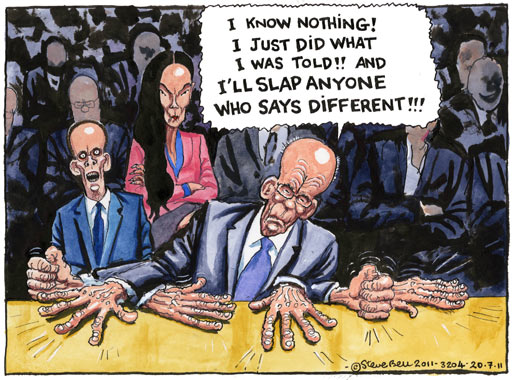
Phone hacking: ministers meet Rupert Murdoch's News Corp every three days

Phone hacking: ministers meet Rupert Murdoch's News Corp every three days

A member of the Cabinet has met executives from Rupert Murdoch’s empire once every three days on average since the Coalition was formed.

By Christopher Hope, and Conrad Quilty-Harper

10:00PM BST 26 Jul 2011


The extent of the Government’s association with the media mogul’s companies was laid bare in official figures showing that 20 Cabinet ministers met senior Murdoch executives 130 times over the past 14 months.

More than a quarter of the meetings were with David Cameron, while a further 17 meetings each were held with George Osborne, the Chancellor, and Dr Liam Fox, the Defence Secretary. Mr Osborne’s meetings included a dinner in New York with Mr Murdoch, the chairman of News Corporation, on December 17 – two weeks before the media regulator was due to rule on the company’s bid for full share ownership of BSkyB.

The Chancellor teamed up again with Mr Murdoch in May and met his son James, the chairman of News International, and Rebekah Brooks, its former chief executive, on three occasions each. Mr Osborne also met Elisabeth Murdoch, Mr Murdoch’s daughter who is tipped to succeed him at News Corp, at a social function last month.

The figures also show that the first media meetings held by both Jeremy Hunt, the Culture Secretary, and Michael Gove, the Education Secretary, after their appointments were with Rupert Murdoch. William Hague, the Foreign Secretary, met senior executives from News International on five occasions. More meetings between Murdoch executives and Dominic Grieve, the Attorney General, and Chris Huhne, the Environment Secretary, are yet to be disclosed.

Ivan Lewis MP, the shadow culture, media and sport secretary, said: “The publication of these lists raises new questions about the discussions David Cameron, George Osborne and Michael Gove had about the BskyB deal, Andy Coulson and phone hacking allegations.

“We now need urgent clarification about whether David Cameron or his ministers sought to influence the BSkyB decision at any stage in the decision-making process. Until David Cameron comes clean and provides total transparency there will continue to be serious questions about his judgment.”

Chris Bryant, the Labour MP, added: “People were paying tribute to the Murdoch court in the hope that their newspapers would support them.

“Clearly the Murdoch media machine was in lobbying overdrive and determined to get the Sky takeover cleared, and the Coalition fell for it hook, line and sinker.”

The meetings were overwhelmingly with Conservative members of the Coalition. Executives from the Murdoch empire only met four times with Nick Clegg, the deputy Prime Minister, and twice with Vince Cable, the Business Secretary.

In all, Mr Gove, a former journalist with The Times whose wife Sarah Vine writes a column for newspaper, met Rupert Murdoch seven times and Mrs Brooks eight times at events including lunches, dinners and social gatherings.

Mr Gove met Mr Murdoch twice in 10 days last month. The most recent meeting, on June 26, was just eight days before it was disclosed that Glenn Mulcaire, the private investigator, allegedly hacked the mobile phone of Milly Dowler, the murdered schoolgirl, on behalf of the News of the World.

Meetings with members of the Murdoch media empire outnumbered those from other media groups by a ratio of two to one.

Out of a total of 252 meetings with media groups between May last year and June 26 this year, Mr Gove, Mr Osborne and Mr Cameron met representatives from News International and News Corp on 60 occasions.

The same three met executives from the Telegraph Media Group on 18 occasions, The Guardian and The Observer six times, the Daily Mail six times and The Independent three times.

Tuesday, July 26, 2011

No way Norway!

No way Norway!

One of the goals of extremists is to get the authorities to overreact to a situation. While it is accepted that Anders Behring Breivik's manifesto advocates using his trial for propaganda purposes, nevertheless holding his trial in secret goes against the grain of a fair and open system of justice.

During his first court appearance, held in camera to ensure security, the 32-year-old Anders Behring Breivik described the killing of 76 people, most of them teenagers enjoying a summer camp, as an act of conscience.

In my experience, security is used to hide abuse by the State. Norway is in danger of abusing Anders Behring Breivik's human rights to a fair trial under Article 6 of the European Convention of Human Rights.

Breivik was initially remanded in custody for eight weeks, the first four in complete solitary confinement during which he will be denied mail and visits to prevent communication with accomplices, if any. Speaking after the hearing Judge Kim Heger said Breivik was being held under section 147 of Norway’s penal code, sub-sections a an b. Sub-section a relates to “destabilisation of society” and b to “creating fear in the population”.

Anders Behring Breivik is a fool to himself for claiming that there are two other cells of terrorists, when it is clear that he is a lone operator. Therefore, keeping him in solitary confinement to prevent his non communication with no accomplices is an overreaction.

The maximum custodial sentence for a crime in Norway is 21 years, a figure that is testament to the country's sincere belief in rehabilitative punishment.

However, if prison authorities believe someone still poses a threat to society they can extend the prison sentence every five years. Two psychiatrists have now been commissioned to assess Breivik's mental health. If he is declared insane he can be held indefinitely.

In a country renowned for its transparency, however, it is highly unusual for a provisional court hearing to be heard in private.


In the UK, the European Court of Human Rights has already ruled that reviews of over 2 years is a breach of human rights under Article 5 of the Convention. In my view, the 5 year rule in Norway would not stand up to a ECtHR challenge.

Solitary confinement has been denounced as torture or "cruel, inhumane and degrading treatment" by several international bodies, including the United Nations and the European Court of Human Rights.

Convicted prisoners are allowed visits, and access to TVs, newspapers and radio and the internet. To deny these to Anders Behring Breivik who has not yet been convicted of any crime, in my view, constitutes an abuse. Then to subject him to what amounts to torture cannot be justified.

Monday, July 25, 2011

Shame on Norway!

Shame on Norway!


Surely the first picture above?


The Telegraph claims this is the First picture of mass killer Anders Breivik leaving court

In any event, Norway is a founder State of the Council of Europe. Initially, the Prime Minister said it would not effect democracy.

However, today we learn that the prosecution asked the judge for permission to abuse the human rights of Anders Behring Breivik. Sadly, the judge authorised it.

It is tragic what occured in Norway, but this does not justify this response.

2083 – A European Declaration of Independence: Anders Behring Breivik

2083 – A European Declaration of Independence: Anders Behring Breivik

Anders Behring Breivik Manifesto 2083 – A European Declaration of Independence By Andrew Berwick

Sunday, July 24, 2011

Norway vows not to buckle under terror

Norway vows not to buckle under terror

Norwegians are determined not to buckle under the unspeakable terror of Friday's attacks, says Norwegian journalist Lars Bevanger. The country hopes it can respond to the terror with more democracy and openness.


The gruesome attacks on Oslo and hundreds of young people at a political summer camp have left us Norwegians reeling and struggling to comprehend what happened, why it happened and how a fellow Norwegian could commit such an atrocity targeting our children.

We like to think of Norway as a peaceful country, the home of the Nobel Peace Prize and a force for good in the world. We like to think Norway is an open democracy embracing all, no matter their backgrounds or beliefs.

We pride ourselves on our freedom of expression. This means we sometimes must accept what for many are unpalatable opinions from individuals who do not share these values, and who argue Norway should not be a place for people of other cultures and backgrounds.

Europe under attack?

As details of the suspected perpetrator of the attacks in Oslo and on Utoeya emerged, it seemed he was one of those individuals. He had been actively spouting his twisted rhetoric in online debates where he argued that Norway and the rest of Western Europe was somehow under attack from multiculturalism. We let him carry on because that is what Norway's open society does.

Others also use online forums to argue against the fundamental freedoms enshrined in Norwegian society because they see so-called foreign cultures as some sort of threat. But we let them carry on, because to silence them would be to abandon our own cherished ideas of freedom.


Anders Behring B., the 32-year-old arrested among the bodies of 85 people at Utoeya, has told police it was he who committed the atrocity and that he also set off the massive bomb that killed at least seven people in central Oslo.

He told his defense lawyer his acts were gruesome but necessary. He says he was behind a 1,500-page publication he called his manifesto, in which he portrayed himself as a crusader leading a revolution which will purge Western Europe of multiculturalism.

To many in Norway it is becoming clear this is not simply a person with extreme right-wing views, or a Christian fundamentalist. In some way he seems as incomprehensible as the heinous acts he says he committed. He portrays himself as being on the outside of our society, and his alleged acts most certainly were not something our society accepts.

Responding with more democracy


Just hours after the attacks, our prime minister told the world not that we will hunt those responsible down and punish them, but that our answer to this unspeakable crime would be more democracy.

As the nation has been counting the dead and communities up and down the country have been coming to terms with their losses, the prime minister's sentiment has been borne out. Where you might expect immense anger, there is very little to be found.

People have gathered together to mourn, to talk and to try to understand. But most of all people have been telling each other again and again what has happened must not be allowed to change our society. No matter who was behind it and what their so-called motives were, it will not shift our cherished fundamental freedoms. No doubt there will be anger, no doubt there will be people feeling the need for revenge. But I and many with me hope these will remain private feelings that will not be allowed to take root in society as a whole.

It has been reassuring too to see political parties from all sides unite behind these same ideas of freedom in the wake of what happened. No one has tried to make political capital on this, and no one seems to be developing an appetite to do so.

In his unfathomable mind, the perpetrator might have wanted to divide Norwegians. He has achieved the opposite; a nation united. In recent days our war time poet Nordahl Grieg has been quoted again and again - his words from World War II echoing with increased resonance: "We are so few in our country. Each fallen a brother and friend."

Author: Lars Bevanger
Editor: Andreas Illmer

Saturday, July 23, 2011

Anders Behring Breivik: Nut Job

Anders Behring Breivik: Nut Job

Anders Behring Breivik

Anders Behring Breivik, the main suspect in the Norwegian bomb attacks and shootings, has been described by police as a Christian fundamentalist with right-wing views.

Perhaps I am missing something, but the bombing and subsequent Massacre of the Innocents does not strike me as being very Christian-like.

Then there is the Nationalist label. Surely, it is not very nationalistic to attack one's own country in this way?

Anders Behring Breivik is described as being anti-Muslim, and yet in both attacks I await to hear of the death toll of Muslims.

Friday, July 22, 2011

UK firms prepared to condone torture for business interests

UK firms prepared to condone torture for business interests.

Those firms on Cameron's torture flight

Barclays
Diageo
Vodafone
Price Waterhouse Cooper
English Premier League (Bill Bush)
Supersport (Tex Teixeira)
De La Rue
Omidyar Network (Stephen King)

Cameron turns blind eye to torture in South Africa

Cameron turns blind eye to torture in South Africa

Cameron’s meeting with South Africa’s president Zuma

The UK was complicit in CIA torture flights, under the Labour administration when first Jack Straw, and then David Miliband, were Foreign Secretary. Under the Coalition William Hague is Foreign and Commonwealth Secretary. Still the UK is complicit in torture, only this time it is being committed in South Africa. Mr Cameron said: "I think it right for Britain to be engaged with South Africa and to be engaged with Africa as a whole. There is a huge opportunity for trade, for growth, for jobs, including jobs at home in the UK".

Whilst our courts are reluctant, and quite rightly so in spite of Dominic Raab's view to the contrary, to deport refugees, failed asylum seekers and foreign criminals to countries where they are likely to be tortured and killed. How can it be legally and morally right to have trade links with such countries where torture is rife? It makes me physically ill at the thought that David Cameron is prepared to turn a Nelsonian blind eye to the obvious!

According to Alex Vines, OBE, Research Director, Regional and Security Studies; and Head, Africa Programme at the Establishment supporting and funded Chatam House states: "David Cameron's first visit to Africa as prime minister is significant. The Prime Minister is visiting Africa's two economic giants, South Africa and Nigeria. Both have robust cultural links with the UK and also offer promising new trade opportunities. The business delegation that Cameron heads is an important statement of the coalition government's objective to have a more balanced relationship with Africa: trade and aid". The trip was cut short for #hackgate and Rwanda and South Sudan lost out in relation to aid, only the business part was deemed important. Given that Nick Clegg sat silent with a long face next to Cameron in the Commons, it leaves me wondering why we have a Deputy Prime Minister at all? In other words, Cameron should not have cut short the trip and instead left Clegg to handle the Commons statement and debate.

Professor Chris Landsberg, head of the Department of Politics at the University of Johannesburg states: "We know that Britain has an agenda for Africa". It is suggested that Cameron is offering a bribe for political support against Libya, that he suffers from Chinaphobia and that he is trying to elbow his way into the "New Scramble for Africa".

What is distburing is that even though prisoners in South Africa have the vote, they may now be worse off than under the Aparthied regime because with the franchise came Torture in South African prisons. Every day that Parliament is in recess, somebody, somewhere, in the South African prison system will be tortured by the guards. It is tragic that we in the UK create a big fuss over a dead girl's phone being hacked into, yet not a murmer about the torture of innocent prisoners.

Thursday, July 21, 2011

Torture in South African prisons

Torture in South African prisons

Taryn Arnott, Ingrid Cloete and Jeremy Gordin*

21 July 2011


Just how prevalent is the practice?

Gautengers woke on Tuesday morning to the prolonged screaming of a prisoner allegedly being tortured in Pretoria central prison.

Talk Radio 702 aired, on the John Robbie morning show, a recording allegedly smuggled out of the prison - of a remand detainee or ATD (awaiting trial detainee, or, as Judge Johann Kriegler prefers to say, "an unsentenced detainee") having an electrified shield being shoved into his body as part of an "interrogation" by a task team of warders.

The detainee - who is still innocent since he has not yet been sentenced - was suspected of having a cell-phone with him. As a result, Correctional Services and the SAPS are investigating allegations of torture against six prison warders.

The issue of whether torture exists in SA prisons, how prevalent it is, and what the authorities are doing about it has thus been pushed - at least for maybe two days - into centre stage again.

Allegations were also made that the same may have happened to some other remand detainees previously, said Correctional Services in a statement released on Wednesday.

It is noteworthy, however, that the government has not yet criminalized torture, despite this being one of the obligations of having ratified the United Nations Convention against Torture and other Cruel, Inhuman and Degrading Treatment or Punishment (UN CAT) in 1998.

Vincent Moaga of the South African Human Rights Commission (HRC) has called for adequate torture legislation to be implemented in line with the UN CAT.

"There have been numerous reports of assaults and unnatural deaths in policing and custodial settings in the recent past," said Clare Ballard of the Civil Society Prison Reform Initiative (CSPRI) on Tuesday. But, for many of these cases, "the alleged perpetrators have been neither investigated nor prosecuted."

One man alleged that he was beaten up so badly by officials at a Free State prison that he is wheelchair-bound and can no longer tie his own shoelaces, according to a letter he sent to the Wits Justice Project (WJP) earlier this year.

The officials allegedly broke his feet and back when he tried to escape from prison. When he attempted to open a case against the officials, he was ignored and threatened instead, he claimed. The man was not given treatment until two days after the attack because, officials told him, he "must first feel the pain", he claimed in the letter.

"Inmates are often subjected to assault - both from inmates and from officials," said Mohlolo Kgopane, director of the Former Convicted Offenders Development Initiative. "These attacks are sometimes reported and sometimes suppressed."

Between 2009 and 2010, 11 inmate deaths resulted from assault by prison officials, according to the latest report by Inspecting Judge of Prisons, Judge Deon van Zyl. Batons, teargas, assault, electric shields or booted feet were cited as the instruments of assault.

In the same year, the Judicial Inspectorate of Prisons (JIOP) received 4 929 complaints of inhumane treatment on inmates and 2 159 complaints of assault on inmates - all by prison officials. Van Zyl's report said that there was "recalcitrance on the part of authorities to take decisive action against correctional officials involved in such cases".

In 2009, the South Gauteng High Court convicted three correctional officials of the murder of three inmates in the Krugersdorp Correctional Centre. The officials were each sentenced to 20 years' imprisonment.

One prisoner in Johannesburg's ‘Sun City' Prison told the Wits Justice Project that inmates are often allegedly beaten up with batons when they are not co-operative.

Earlier this year, another leak from prison to the media caused an outcry around the treatment of prisoners. In April, the Mail and Guardian Online posted CCTV footage of a prisoners' protest at Kimberley Prison, showing officials beating a prisoner with batons. Another clip from the same incident shows another bleeding prisoner being dragged to a corner and ignored by officials.

Incidents of torture and abuse are often ignored in cases in which the perpetrators have friends in high places in the prison, said Kgopane. "Because incidents happen behind closed doors, the public and the long arm of the law are not privy to them," he said.

"When prisoners were protesting for the vote in the mid nineties, stun guns, stun belts and stun batons were introduced into the prisons. These gadgets have been used periodically to ‘play' with inmates," said Golden Miles Bhudu of the South African Prisoners Organisation for Human Rights.

The use of the electric riot shield in non-riot settings was raised as a concern in the Jali Commission Report in 2006, said Ballard.

Incidents of torture are not confined to prisons alone.

The Wits Law Clinic receives on average one case of alleged torture a month, where police are the perpetrators. "Often police competence is low, and torture is perceived to be a more efficient method of finding what one is looking for," said Professor Peter Jordi of the Wits Law Clinic.

Jordi has dealt with numerous cases where police used either electrocution, or smothered suspects with plastic bags, rubber or condoms, in efforts to extract information from them.

In one case, police at the Midrand Police Station allegedly detained a Nigerian man and electrocuted him at regular intervals to obtain information about the whereabouts of a laptop. Charges of robbery against him were withdrawn, and the case of assault against the officers is still pending in court.

While it seems that there is a rise in cases of torture in detention settings, Jordi believes that police are not "reverting to torture" but that "it's always been there."

But "relying on the police to investigate the police is a hopeless pursuit," said Jordi, who seeks civil relief for victims, rather than taking a criminal law approach to these cases.

While Correctional Services states it does not condone torture, it does approve the regulated use of a variety of security equipment within prisons, including "batons, hand cuffs, leg irons, teargas, pepper spray, electric shields and stun belts," said Wednesday's statement.

Minister of Correctional Services Nosiviwe Mapisa-Nqakula visited the man in prison on Wednesday, after which she said that "he is well and confirms that he is not suffering any form of pain nor injury."

Vincent Moaga of the South African Human Rights Commission's has called for a thorough investigation into allegations of torture and has urged for appropriate action to be taken against those who are found to be involved.

While is has been reported that six warders are being investigated in connection with this case of torture, Bhudu believes that nothing will come of the case as "guards guard themselves".

Meanwhile, Adam Carelse, director of the Judicial Inspectorate for Correctional Services, the statutory watchdog body on the treatment of prisoners, refused to comment on the matter.

"The organizations who are supposed to stand up for prisoner rights are not doing so," said Bhudu.

"Torture is one of the most serious violations of human freedom and dignity, and there can be no justification for it," said Ballard.

* Arnott, Cloete and Gordin are members of the Wits Justice Project (WJP), which investigates alleged miscarriages of justice.

Mau Mau Kenyans allowed to sue UK government

Mau Mau Kenyans allowed to sue UK government

Four elderly Kenyans have been given permission to take legal action over alleged British colonial atrocities committed during the Mau Mau uprising.

The High Court in London ruled they could sue over alleged torture directed by the British authorities in the 1950s and 1960s.

Three men and a woman want compensation from the government.

It comes as Foreign Office documents released in May showed that the alleged abuse was "sort of a guilty secret".

The documents give further details of what ministers in London knew about how the colony was attempting to crush the rebellion that paved the way to independence.

They contain reports of British officers implicated in atrocities, including the murder of suspected Mau Mau rebels.

The four Kenyans who can now sue the UK say the documents form a paper trail proving that London knew about and approved torture and abuse in Kenya.

The government has argued that it could not be liable because it happened outside of the UK.

Summary of judgment.

Full judgment here.

Ombudsman warns Government over applying whip

Ombudsman warns Government over applying whip

The Irish Times - Thursday, July 21, 2011

PAUL CULLEN, Political Staff


OMBUDSMAN EMILY O’Reilly has warned the Government against applying the whip at a new Oireachtas committee set up to deal with the grievances of citizens.

Ms O’Reilly said she fully accepted the right of the Joint Committee on Investigations, Oversight and Petitions to reject her findings but she warned that it would be less than satisfactory if the Government applied the party whip on votes.

Ms O’Reilly also warned of serious implications for the independence of her office if the committee were to seek a role in reviewing her office’s decisions.

As far as it was concerned, she said, there were only two avenues open to people who were dissatisfied with the decision of the ombudsman in their case – an internal review or court action.

The new committee, chaired by Sinn Féin TD Peadar Tóibín, plans to introduce a petitions system similar to that operating in other parliaments and to act as a “clearing house”, directing complaints to other bodies.

Ms O’Reilly appealed for an extension of her remit to cover the areas of prisons, aliens and the process of naturalisation. Her office was one of the few ombudsman’s offices in Europe whose jurisdiction was restricted to exclude these areas, she told the committee.

While there was a non-statutory inspector of prisons appointed by the Minister for Justice, there was no independent oversight of complaints about prisons.

She acknowledged debates about prisoner issues could be emotive, but insisted they had the same rights of redress as anyone else in society. Her stance received support from Charlie Flanagan, chairman of the Fine Gael parliamentary party, who said prisoners should have the opportunity to communicate directly with Ms O’Reilly’s office.

Comment: The Coalition should bear in mind the highlighted sentences ready for when the recess is over, in particular in relation to prisoners votes. Bear in mind that the ECtHR has given the UK until 11 October to change the law.

Tuesday, July 19, 2011

The Sun hacked off

The Sun hacked off

Time to abolish the Parole Board?

Time to abolish the Parole Board?

Parole Board publishes Annual Report and Accounts for 2010/11

Download a copy of the Annual Report and Accounts 2010/11

The Report states that Oral hearings – 3 member panels for the hearing of lifer, IPP and ESP cases costs £2,532 per case. There were 25,566 cases. That's a staggering cost of £64,733,112 to the taxpayers!

"Oral hearings

These normally take place in prison. For life sentence prisoners they will usually be chaired by a judge, but some IPP cases will be chaired by an experienced Parole Board member. Where the circumstances of the case warrant it the panel will include a psychologist or psychiatrist. The third person will be an independent or probation member.

In addition to the prisoner and the panel, others who may be present include the legal representative of the prisoner, together with a public protection advocate representing the Secretary of State and the victim, and witnesses such as the prisoner’s offender manager and prison psychologist. The victim might also be in attendance in order to present their victim personal statement.

Oral hearings are used to consider the majority of cases where an indeterminate sentence prisoner is applying for release and also for some cases, involving both determinate and indeterminate sentences, where a prisoner is making representations against a decision to recall them to prison.

Oral hearings are also held before a single member in certain recall cases. The member will hold the hearing either at the prison or remotely using video-link".

Given that "The Parole Board is an independent body that works with its criminal justice partners to protect the public by risk assessing prisoners to decide whether they can be safely released into the community", I am somewhat puzzled why an independent body needs the third person on the panel who will be an independent member?

Instead of hiding behind hazy concepts such as public protection and risk assessment, surely a better system would be where a judge hands down a sentence, that is, time for the crime, and when the prisoner serves his time he is simply released?

The present system is full of flaws. Basically, in making a risk assessment, the Parole Board, in effect, gazes into a crystal ball and makes a prediction for future offending and passes down a sentence for a crime which has not yet been committed. This not only gives the Parole Board too much power, it is an abuse of power which leads to an injustice for the prisoner.

This imbalance of justice is further weighed down against the prisoner when the role of the public protection advocate is subjected to scrutiny. The PPA is "representing the Secretary of State and the victim, and witnesses such as the prisoner’s offender manager and prison psychologist. The victim might also be in attendance in order to present their victim personal statement".

The Secretary of State appoints the Parole Board. His representative then argues a case to his own appointees. The whole purpose of the Criminal Justice System is to remove the prosecution of offenders from victims of crime. This allows for justice to be dispensed in a detached, dispassionate and unbiased manner. So, to bring back the victim into the process makes a mockery of impartial justice. As qualified psychologists are expert witnesses they should not have the benefit of legal representation, rather they should have to defend what they have written themselves.

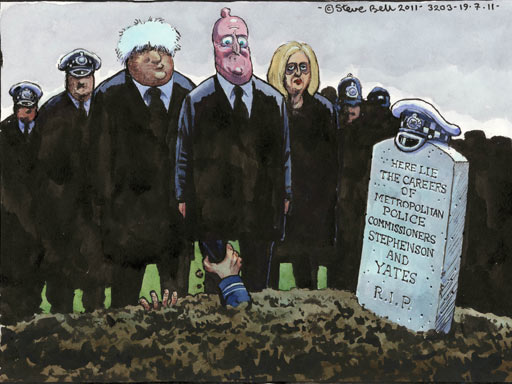
Phone hacking: John Yates's resignation statement in full

Phone hacking: John Yates's resignation statement in full

The full text of the statement given by Metropolitan Police Assistant Commissioner John Yates following his resignation in the wake of the phone-hacking scandal.

Earlier on this afternoon I informed the Home Secretary, the Mayor of London and the Chair of the Police Authority of my intention to resign as Assistant Commissioner of the Metropolitan Police Service. It is with great regret that I make this decision after nearly 30 years as a police officer.

I wish to pay tribute to the many fine officers and police staff with whom I have served. I will miss them hugely, but I know that they will continue to do their utmost to protect the public and of course this great capital city.

We in the Police Service are truly accountable. Those of us who take on the most difficult jobs clearly have to stand up and be counted when things go wrong. However, when we get things wrong, we say so and try and put them right. As I have said very recently, it is a matter of great personal regret that those potentially affected by phone hacking were not dealt with appropriately.

Sadly, there continues to be a huge amount of inaccurate, ill-informed and on occasion downright malicious gossip published about me personally. This has the potential to be a significant distraction in my current role as the national lead for counter-terrorism.

I see no prospect of this improving in the coming weeks and months as we approach one of the most important events in the history of the Metropolitan Police Service, the 2012 Olympic Games. The threats that we face in the modern world are such that I would never forgive myself if I was unable to give total commitment to the task of protecting London and the country during this period. I simply cannot let this situation continue.

It is a matter of great personal frustration that despite my efforts, on a number of occasions, to explain the true facts surrounding my role in these matters since 2009, there remains confusion about what exactly took place.

I have acted with complete integrity and my conscience is clear. I look forward to the future Judge-led inquiry where my role will be examined in a proper and calmer environment and where my actions will be judged on the evidence rather than on innuendo and speculation as they are at present.

Steve Bell: The death of Met officers' careers

Steve Bell: The death of Met officers' careers

Monday, July 18, 2011

Sean Hoare: The Fleet Street Man

Sean Hoare: The Fleet Street Man

Sean Hoare knew how destructive the News of the World could be

The courageous whistleblower who claimed Andy Coulson knew about phone hacking had a powerful motive for speaking out

Nick Davies,guardian.co.uk, Monday 18 July 2011 18.46 BST

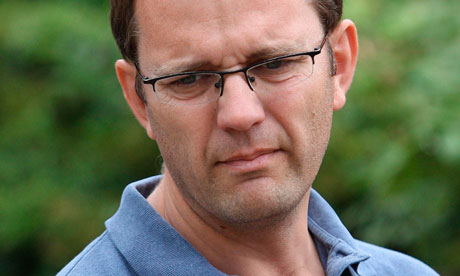
Another Ian Huntley look a like Andy Coulson

At a time when the reputation of News of the World journalists is at rock bottom, it needs to be said that the paper's former showbusiness correspondent Sean Hoare, who died on Monday, was a lovely man.

In the saga of the phone-hacking scandal, he distinguished himself by being the first former NoW journalist to come out on the record, telling the New York Times last year that his former friend and editor, Andy Coulson, had actively encouraged him to hack into voicemail.

That took courage. But he had a particularly powerful motive for speaking. He knew how destructive the News of the World could be, not just for the targets of its exposés, but also for the ordinary journalists who worked there, who got caught up in its remorseless drive for headlines.

Explaining why he had spoken out, he told me: "I want to right a wrong, lift the lid on it, the whole culture. I know, we all know, that the hacking and other stuff is endemic. Because there is so much intimidation. In the newsroom, you have people being fired, breaking down in tears, hitting the bottle."

He knew this very well, because he was himself a victim of the News of the World. As a showbusiness reporter, he had lived what he was happy to call a privileged life. But the reality had ruined his physical health: "I was paid to go out and take drugs with rock stars – get drunk with them, take pills with them, take cocaine with them. It was so competitive. You are going to go beyond the call of duty. You are going to do things that no sane man would do. You're in a machine."

While it was happening, he loved it. He came from a working-class background of solid Arsenal supporters, always voted Labour, defined himself specifically as a "clause IV" socialist who still believed in public ownership of the means of production. But, working as a reporter, he suddenly found himself up to his elbows in drugs and delirium.

He rapidly arrived at the Sun's Bizarre column, then run by Coulson. He recalled: "There was a system on the Sun. We broke good stories. I had a good relationship with Andy. He would let me do what I wanted as long as I brought in a story. The brief was, 'I don't give a fuck'."

He was a born reporter. He could always find stories. And, unlike some of his nastier tabloid colleagues, he did not play the bully with his sources. He was naturally a warm, kind man, who could light up a lamp-post with his talk. From Bizarre, he moved to the Sunday People, under Neil Wallis, and then to the News of the World, where Andy Coulson had become deputy editor. And, persistently, he did as he was told and went out on the road with rock stars, befriending them, bingeing with them, pausing only to file his copy.

He made no secret of his massive ingestion of drugs. He told me how he used to start the day with "a rock star's breakfast" – a line of cocaine and a Jack Daniels – usually in the company of a journalist who now occupies a senior position at the Sun. He reckoned he was using three grammes of cocaine a day, spending about £1,000 a week. Plus endless alcohol. Looking back, he could see it had done him enormous damage. But at the time, as he recalled, most of his colleagues were doing it, too.

"Everyone got overconfident. We thought we could do coke, go to Brown's, sit in the Red Room with Paula Yates and Michael Hutchence. Everyone got a bit carried away."

It must have scared the rest of Fleet Street when he started talking – he had bought, sold and snorted cocaine with some of the most powerful names in tabloid journalism. One retains a senior position on the Daily Mirror. "I last saw him in Little Havana," he recalled, "at three in the morning, on his hands and knees. He had lost his cocaine wrap. I said to him, 'This is not really the behaviour we expect of a senior journalist from a great Labour paper.' He said, 'Have you got any fucking drugs?'"

And the voicemail hacking was all part of the great game. The idea that it was a secret, or the work of some "rogue reporter", had him rocking in his chair: "Everyone was doing it. Everybody got a bit carried away with this power that they had. No one came close to catching us." He would hack messages and delete them so the competition could not hear them, or hack messages and swap them with mates on other papers.

In the end, his body would not take it any more. He said he started to have fits, that his liver was in such a terrible state that a doctor told him he must be dead. And, as his health collapsed, he was sacked by the News of the World – by his old friend Coulson.

When he spoke out about the voicemail hacking, some Conservative MPs were quick to smear him, spreading tales of his drug use as though that meant he was dishonest. He was genuinely offended by the lies being told by News International and always willing to help me and other reporters who were trying to expose the truth. He was equally offended when Scotland Yard's former assistant commissioner, John Yates, assigned officers to interview him, not as a witness but as a suspect. They told him anything he said could be used against him, and, to his credit, he refused to have anything to do with them.

His health never recovered. He liked to say that he had stopped drinking, but he would treat himself to some red wine. He liked to say he didn't smoke any more, but he would stop for a cigarette on his way home. For better and worse, he was a Fleet Street man.

Justice as rough as ever

Justice as rough as ever

Miscarriages of justice are still shockingly common, but 20 years after the release of the Birmingham Six, the issue isn’t fashionable any more.

Jon Robins reports

Ian Huntley look a like Jon Robins :-)

Some 18 months ago, a man walked into the office of Birmingham-based lawyer Maslen Merchant. He had just pleaded guilty to a serious sexual offence against a child. ‘He told me that he wasn’t guilty but had been bullied into pleading guilty by his lawyers,’ says Maslen. Apparently, the man was told that if he was convicted he would get life (‘the same sentence you get for murder’). Petrified, he agreed to go with the lesser offence.

‘It took me about five minutes to have serious concerns that he had a learning disability. His difficulty with speech was a clue,’ Maslen recalls, adding that the ‘real clincher’ was that the man ‘took three attempts to sign his own name’.

That man has since been acquitted after a new defence team led by Maslen commissioned reports from a psychologist and psychiatrist placing him in the bottom 0.3 per cent of the population in terms of IQ, indicating that he was both highly suggestible and suffering a severe learning disability.

It has been two decades since the release of the Birmingham Six – Paddy Hill, Hugh Callaghan, Richard McIlkenny, Gerry Hunter, Billy Power and Johnny Walker – sent shockwaves through the criminal justice landscape. They had been in prison for 16 years.

Their release eventually led to the creation of the Criminal Cases Review Commission (CCRC) 13 years ago as the independent body to investigate miscarriages of justice. Since then, though, such miscarriages seem to have dropped off the radar. The issue has been consigned to some distant Life on Mars past.

The media, which did so much spadework on the issue in the 1970s and 1980s, through, for example, the BBC’s Rough Justice, has given up. The broadcaster pulled the plug on Rough Justice after 25 years in 2007. Michael Jackson, chief executive of Channel 4, dismissed Trial and Error, which also investigated miscarriages, as a ‘bit 1980s’.

Sadly, while miscarriages of justice might have gone out of fashion, they haven’t gone away. The CCRC is deluged by close to 1,000 new applications every year, and rejects 96 per cent. There is growing disquiet about its lack of action (see Red Pepper, Feb/Mar 2010).

Maslen reckons many miscarriages of justice are down to shoddy work done by defence lawyers struggling under the commercial realities of running a high-volume business on a diminishing legal aid budget.

He wonders what the lawyers who advised his client with learning disabilities were playing at. ‘How couldn’t they see he was vulnerable? Why put him under such pressure? Why even mention murder?’ The answer, according to the lawyer, is that putting in the extra work – for example, obtaining medical reports – was such an inconvenience that it was simply not cost-effective. ‘This was a business decision. It was a gross miscarriage of justice.’

Meanwhile, Gareth Peirce, the veteran campaigning lawyer who represented the Birmingham Six, talks of the creation of ‘a new suspect community’ of young Muslims.

That view chimes with the experience of Maslen, who has specialised in miscarriages of justice for 20 years. ‘In the 1970s it almost became an arrestable offence to be Irish in a city centre in England. In the 1980s and 1990s people were arrested for being black in a built up area. Since 9/11 it seems that sufficient suspicion is raised for an arrest if you have a beard and appear to be Muslim.’

Against this backdrop there is growing concern about the CCRC. Veteran campaigning journalist Bob Woffinden has gone so far as to damn the commission as ‘an experiment that failed’. He reckons the CCRC can only take credit for taking seven ‘major cases’ to appeal since 2005. He argues that many notorious cases are left to languish.

The commission has been spared the ‘bonfire of the quangos’, though it faces cuts, but Woffinden argues it exists only to serve as a ‘fig leaf’ for the system. That’s a minority view, though. The CCRC needs to be ‘supported and expanded’, argues Michael Mansfield QC, who has been associated with the overturning of numerous notorious cases from the Birmingham Six to Barry George.

Mansfield urges its critics not to play into the hands of those who would see it consigned to history. ‘There is a strong reactionary lobby that should not be underestimated,’ he says, ‘which embraces the doctrine “prison works” and regards prisoners as almost sub-human, meriting few facilities and, heaven forbid, the right to vote.

Prisoner custody officer sentenced for smuggling drugs into prison

Prisoner custody officer sentenced for smuggling drugs into prison

Samantha Brown - paid to smuggle drugs to prisoners

A female prisoner custody officer who smuggled drugs into HMP Brixton has been jailed for over two years.

Samantha Brown, 22, of Hackney was convicted of misconduct in a public office and conspiracy to supply drugs.

The recipient of her criminal activity, prisoner Leon Jackson, 35 yrs, received a five month jail sentence after being convicted of transmitting sounds and/or images from within the prison. The pair were sentenced on Friday 15 July at Inner London Crown Court.

The pair were apprehended following a pro-active and intelligence led investigation by officers from the London Prison Anti-Corruption Team (LPACT) which revealed that Brown was being paid to traffic cannabis into the prison for Jackson.

A search of Jackson’s cell led to the discovery of a mobile phone he had used to communicate with Brown on a daily basis. Analysis of callhttp://www.blogger.com/img/blank.gif records indicated hundreds of calls were made between the two.

Brown hid the drugs in her bra and passed them to Jackson and other inmates when they attended the crown court.

Acting/Detective Inspector Neil Smithson, LPACT, said: “Police and the Prison Service have identified that the courts are another potential route for drugs to enter prisons. We have worked closely with Serco – who run the court cells – on this case, which should send a message out to court staff that any wrongdoing will lead to arrest and conviction.”

Hat-Tip to Prison Family Voices

David Cameron: #Hackgate Minister without responsibility

David Cameron: #Hackgate Minister without responsibility

Two prisoners escape from jail van in Manchester

Two prisoners escape from jail van in Manchester

Two prisoners have escaped from a jail van after it was ambushed by armed men on the outskirts of Manchester city centre.


A number of men attacked the van in Trinity Way at about 0830 BST, Greater Manchester Police said.

They fled in a Saab, which was later found abandoned in Barrow Street in the Islington area of Salford.

A security guard has been taken to hospital but his injuries are not believed to be life threatening.

Det Sgt Paul Copplestone urged anyone with information to contact Greater Manchester Police.

He said: "We are sure that this incident was witnessed by many people at a very busy time of the morning. The Saab was driven off towards the M602 motorway.

"We would urge witnesses to contact us."

Sunday, July 17, 2011

US Marine gets the young Taliban in his sights in Afghanistan

US Marine gets the young Taliban in his sights in Afghanistan

Click on image to enlarge

photo.

Does this border on kiddie porn?

Does this border on kiddie porn?

I seem to recall a fuss being made about young models and how we should not be sexualising young children.

Steven Spielberg, JJ Abrams, both Coppolas: they all agree that Elle Fanning is one of the most beguilingly mature actresses working today. Not bad for a 13-year-old.

(Click on to image 2)

Perhaps, someone can explain to me how it is that a 13-year-old kid can be mature FFS?

Saturday, July 16, 2011

Downview jail sex case prison governor convicted

Downview jail sex case prison governor convicted

An acting prison governor has been convicted of misconduct in a public office after having a sexual relationship with an inmate.

Russell Thorne (left) and Simon Dykes both denied charges of misconduct in public office

Russell Thorne, 41, of Sutton, London, had the relationship at Downview women's prison, from 2006 to 2010.

He was cleared of another misconduct charge at Guildford Crown Court.

Co-defendant Simon Dykes, 45, of Woking, Surrey, was cleared of three out of six misconduct charges he faced. Verdicts are awaited on three counts.

'Professional suicide'

During the trial, jurors heard Thorne, of Sinclair Drive, demanded the frightened inmate perform a sex act on him, telling her "it's an order".

The court heard the woman fell in love with the prison officer but felt she had to comply with his demands for fear of losing perks that came out of their relationship.

She told the court contraception was not used but she was paranoid she might end up pregnant, and Thorne provided her with laxatives in an attempt to prevent this.

Charges denied by Dykes, of The Paddock, Westcott, related to allegations of sex acts with six women at the jail.

Four accused him of sleeping with them and two others claimed he touched one of them and masturbated outside the other's cell.

The defendant, who was previously in the Army and had also been a fireman, said such behaviour would have been "professional suicide".

'Vulnerable young woman'

Thorne is due to be sentenced at a later date.

After Thorne was convicted, a Prison Service spokesman said: "We take the issue of staff corruption and inappropriate behaviour extremely seriously."

Det Insp Jo Sidaway, from Surrey Police, said: "I hope that this result brings confidence that those entrusted with the care of vulnerable women will be brought to justice if they abuse their position.

And Mark Leech, editor of Converse, the national newspaper for prisoners, said: "Russell Thorne is the worst kind of prison governor.

"He used his position of power to obtain sexual favours from a vulnerable young woman who clearly felt they had no choice."

The case was adjourned until Monday when jurors will continue to consider the outstanding charges against Dykes, who was granted bail.

Friday, July 15, 2011

Killer cops and a corrupt judge

Killer cops and a corrupt judge

David Oluwale was born on 8 September 1930, in Lagos, Nigeria. He belonged to the Yoruba tribe.

David Oluwale

The colonial rule was in decline when David was educated in a Christian grammar school. Leaving school he struggled as an apprentice tailor. There was high unemployment, food shortages, and prices soared. On 16 August 1949, David stowed away on board the Temple Star from Nigeria, for the 2 week journey to Hull. He hid amongst boxes of groundnuts in the hold of the ship, until the captain ordered smoke to be pumped into the hold to smoke out any hiding stowaways. Also on board was the Nigerian national football team on its first ever overseas tour.

Upon arriving at Hull docks, David was arrested and appeared before the magistrates at Hull police court. He was sentenced to 28 days imprisonment, and found himself in Armley Prison, Leeds, on his first day in the "Mother Country".

Geoffrey Ellerker, from Leeds, served in the RAF Police between January 1952-4. He was a Detective Sergeant in the CID at Ireland Wood police station, Leeds, upon promotion to a uniformed Inspector in April 1968, he was transferred to Millgarth Street police station in the city centre. Sergeant Ken Kitching worked under Ellerker. When Ellerker was arrested for perverting the course of justice in relation to a RTC, Inspector Puddefoot replaced him. Kitching continued to work under Puddefoot, until he was arrested and charged, along with Ellerker, for the assault and manslaughter of David Oluwale.

Inspector Geoffrey Ellerker and a police Sergeant were in the front seats of the unmarked police car, and Mr Justice Hinchcliffe sat in the rear, speeding on their way to a Lodge meeting, along Otley Road, when they knocked over and killed an old woman on the Zebra crossing between the Skyrack and Original Oak public houses. The skid marks measured 74 feet! This got changed to 47 feet in the investigation report.

I worked in the Skyrack. I recall seeing the backseat passenger getting out, and after words with Ellerker, the latter arranged for him to be driven off in a police car to the Lodge meeting. I did not know at that time that it was Mr Justice Hinchcliffe, until he gave me 5 years in April 1971 at Leeds Assizes, and I recognised him. In November 1971, Mr Justice Hinchcliffe directed the jury to find both Ellerker and Kitching not guilty of manslaughter!

As David Oluwale was a regular sight on the turf of the Leeds Mob, I did know him. And as I was out doing burglaries in the early hours of the morning, I saw some of the grief that Ellerker and Kitching gave him. In mid April 1969, I was on the green painted bridge over the River Aire, leaning on the guardrail and smoking a Players No6 tipped. My peace was disturbed by an altercation down on the river bank. The silver buttons and cap and helmet badges were clearly visible. These two were definitely larger than the small dark figure. I recall saying to myself 'jump in and swim for it', as the blows reigned down on him, but he just took it all before going down. The uniformed figures just booted the downed figure into the River Aire. I thought maybe he would regain consciousness and climb out. About 2 weeks later, I was informed that police frogmen had fished David Oluwale out of the River Aire down by the sewerage works.

Recently, I have read that this was the first and only Black death in police custody resulting in prosecution and sentence. The only problem with this is that he was not in custody at the time of his death. Unless that is, he was cautioned and arrested between the initial assault in the doorway of John Peters, and the second assault on the river bank. I don't want to put a damper on the Black Rights Movement. Still, the consolation prize is we now know that not only are we dealing with corruption in the police but also in the Judiciary. I am aware that Judge David Savill QC, the son in law of Mr Justice Hinchcliffe, did good works in trying to balance the wrongdoing.

Castle Grove Masonic Hall. Castle Grove, Moor Road, Headingley, Leeds, West Yorkshire, LS6 4BP. Set in a quiet backwater in Far Headingley, Leeds, Castle Grove is the meeting place for 15 Masonic Lodges.

1930, the year David Oluwale was born

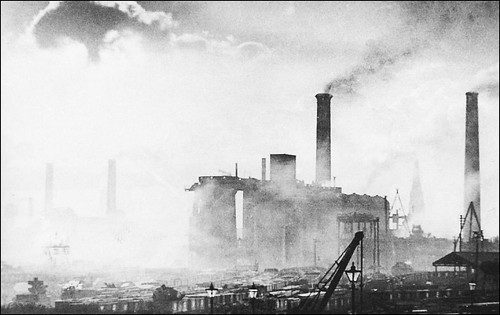
Hunslet Steel Works, Leeds, 1930. Photo taken from Pepper Road. The steel works was built in 1889, and closed in 1934. The spire of Hunslet parish church can be seen between the two chimmneys.


National flag of Nigeria pre 1 October 1960

National flag of Nigeria following Independence from Britain 1 October 1960

The Bridal House 39 The Headrow, Leeds LS1 6PU, West Yorkshire UK. Sometimes David Oluwale slept in this doorway.

EU COMMENT

EU COMMENT

By Patrick O'Flynn, Daily Express, Friday July 15,2011


THE European political elite is rattled because it is being challenged as it has never been challenged before.


Since the Daily Express began its crusade for a referendum on getting Britain out of the EU, we have documented Brussels’ encroachment into many aspects of our public life.

Our coverage of its interference in foreign policy, immigration, social security, jobs, and law and order has thrown Eurocrats on to the defensive.

We have also exposed the huge waste and fraud of EU spending and the actions of the European Court of Human Rights, particularly its bid to force Britain to give the vote to all convicted prisoners. In response, almost 400,000 Daily Express readers have filled out our crusade coupons.

The climate of opinion about the EU has already shifted, leading David Cameron to pledge to try to bring powers home from Brussels.

A crunch point is now looming with experts predicting that the struggling eurozone will either have to move to full political union within months or allow several members to leave and restore their own currencies.

Huge demonstrations in Greece, Spain and Portugal show that the anti-EU message is spreading fast.

In Britain, Sir Stephen Wall, the ex- civil servant who masterminded Tony Blair’s plan to take Britain to the heart of Europe, has admitted that the EU “is on the way out”. The Economist magazine has conceded there is a “non-trivial chance” of Britain leaving the EU. And at least two Cabinet ministers, as well as the Prime Minister’s key adviser Steve Hilton, are said to favour British withdrawal.

As Britain is asked to contribute to bailing-out the stricken eurozone, opinion polls show that more people support the idea of leaving the EU than ever before. Two-thirds of Tory voters now say they want out.

Thursday, July 14, 2011

Poisoned dwarf in contempt of Parliament

Poisoned dwarf in contempt of Parliament

As I recall, the Commons Speaker can insist that any British citizen in apparent contempt of Parliament can be summoned to appear at the Bar of the House to explain and/or apologise.

Why did the poison dwarf preside over the prisoners votes unlawful motion, "debate" and vote, and allow all those MPs to be in contempt of Parliament and not call Order, Order?

Political football game: Italy 1 England 0

Political football game:Italy 1 England 0

The Grand Chamber of the European Court of Human Rights has decided to accept a referral in Scoppola v Italy.

Scoppola No 3 v. Italy (no. 126/05)

The applicant, Franco Scoppola, is an Italian national who was born in 1940 and lives in Parma (Italy). He was sentenced in 2002 by the Assize Court to life imprisonment for murder, attempted murder, ill-treatment of members of his family and unauthorised possession of a firearm. Under Italian law, his life sentence entailed a lifetime ban from public office, amounting to permanent forfeiture of his right to vote.

In its judgment of 18 January 2011, the Court held, unanimously, that there had been a violation of Article 3 of Protocol No. 1 (right to free elections) to the European Convention on Human Rights.

The case was referred to the Grand Chamber at the Italian Government’s request.


On 6 July in the House of Lords...

Lord Anderson of Swansea: Does the Minister agree that while there may be a case for asking for an extension of time while awaiting the Grand Chamber judgment in the Scoppola case, which also involves prisoners’ rights, and a case for negotiating with the court on the broad margin of appreciation allowed in the Hirst case, there is no case whatever for defying the court, as a number of Members of the other place seem rather keen to do, particularly at a time when the UK will assume the chairmanship of the Council of Ministers in November? What sort of precedent would that give to defaulting members such as Turkey and Russia?

The Scoppola v Italy judgment is only available in French, however, this Press Release is in English.

I cannot for the life of me work out why the GC rejected referral in Greens and MT v UK, and Frodl v Austria but accepted a referral in Scoppola.

Political storm in Parliament and Bastille Day

Political storm in Parliament and Bastille Day

Wikipedia

"On this date in:

1789: During the French Revolution, citizens of Paris storm the Bastille prison and release the seven prisoners inside
".

Phone Hacking: Lord Chief Justice attacks media and politicians

Phone Hacking: Lord Chief Justice attacks media and politicians

The Lord Chief Justice has launched a thinly veiled attacked on the media and politicians as he defended the actions of judges.


Lord Judge, the Lord Chief Justice. Photo: UPPA

By Tom Whitehead, Home Affairs Editor, 7:00AM BST 14 Jul 2011

Judges have been at the centre of rows over privacy rulings and human rights decisions in the last 12 months.

In April, David Cameron set himself on a collision course when he said it was time Parliament decided laws rather than the courts.

That followed concerns over controversial human rights rulings such as prisoner votes and claims judges were creating a privacy law by the back door in a series of decision on injunctions.

But Lord Judge, the country’s most senior judge, defended the judiciary from the attacks “sometimes by those who should know better and sometimes by those who choose to ignore what they know”.

He also signalled that the reason the country was currently “in the middle of a crisis” was because of the actions of the media and phone hacking.

And on the day that a judge was appointed to hold the resulting public inquiry he said that “after all the criticisms” and “public revulsion” is was to the judges the country now turned.

He told the judges annual dinner at Mansion House last night: “We do not act on or give judgment according to our personal whims and wishes.

“When we apply the laws as we find them to be we are independent judges.

“If ever we decided cases on the basis of what someone else wanted the law or the result to be, we would have forfeited the very principle of independence

for which judges in this country stand.

“Now, after all the criticisms, the country is in the middle of the crisis that has embroiled the press and the politicians and the police.

“Perhaps it is just worth noticing that there would not have been any crisis but for public revulsion at the breaches of the confidentiality involving the victims of crime and war.

“And now, notwithstanding the constant criticism of judges public revulsion has led to the public demand for a judge led inquiry.”

Comment: I don't think there is anything controversial in the ECtHR's rulings on prisoners votes. What is controversial is the responses of the media and politicians.

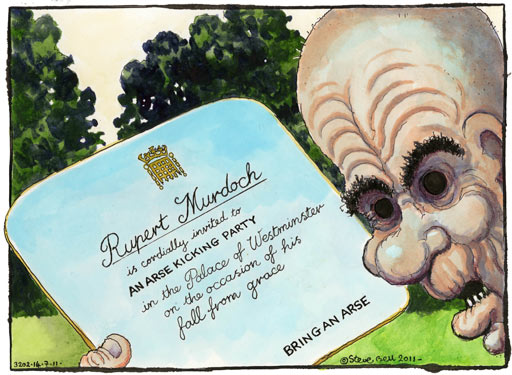
Steve Bell on the BSkyB debate in the House of Commons - cartoon

Steve Bell on the BSkyB debate in the House of Commons - cartoon


Related content...

BSkyB bid on EBay

Wednesday, July 13, 2011

Parole Board dossier on John Hirst/Jailhouselawyer Proforma Summary

Parole Board dossier on John Hirst/Jailhouselawyer Proforma Summary

Parole Board dossier on John Hirst Proforma Summary